Why enterprise IT teams must think like a
B2C brand
Oct 28 · 7 min read

In the consumer world, the customer experience (CX) has achieved a state of near-frictionless perfection. Whether it's ordering a meal, booking a ride, or streaming a movie, the modern consumer expects processes that are instantaneous, transparent, and omnichannel.
However, for the global workforce, the transition from personal digital lives to professional ones is a leap backward in time. When a branch manager or a field engineer faces a technical hurdle, they often encounter the inner-office maze of portals, siloed support tiers, and an endless thread of email tickets.
B2B IT operations require balancing security, compliance, and multilayered infrastructure. While B2C operations are not as complex, there is a growing case for adopting B2C philosophies. To drive true digital transformation, enterprise IT teams need a shift in perspective. IT leadership must look beyond the user and consider the internal customer, applying B2C principles to the delivery of B2B services.
1. The no wrong door philosophy
A primary differentiator in the B2C world is the invisibility of the organizational chart. A consumer rarely knows which department handles a specific query because the brand presents a unified front. Conversely, many B2B environments require employees to navigate a fragmented system where departments operate as separate entities.
A B2C-inspired strategy implements a no wrong door policy. In this model, the employee's point of entry is irrelevant. Whether they reach out via a mobile app, a chatbot, or a walk-up kiosk, the responsibility of routing falls on the service organization. This requires a move away from siloed tools and toward enterprise service management (ESM), where everything falls under a common architecture.
Use case
Let's say a branch manager needs to procure new hardware for their team. An initial request to the IT team splits into three tickets for budget approval, vendor orders, and installation. The IT team redirects them to the finance team, the finance team points them to the procurement team, and the procurement team says the facilities team handles the final setup. The branch manager has now filed four separate requests across four departments and is responsible for tracking each handoff.
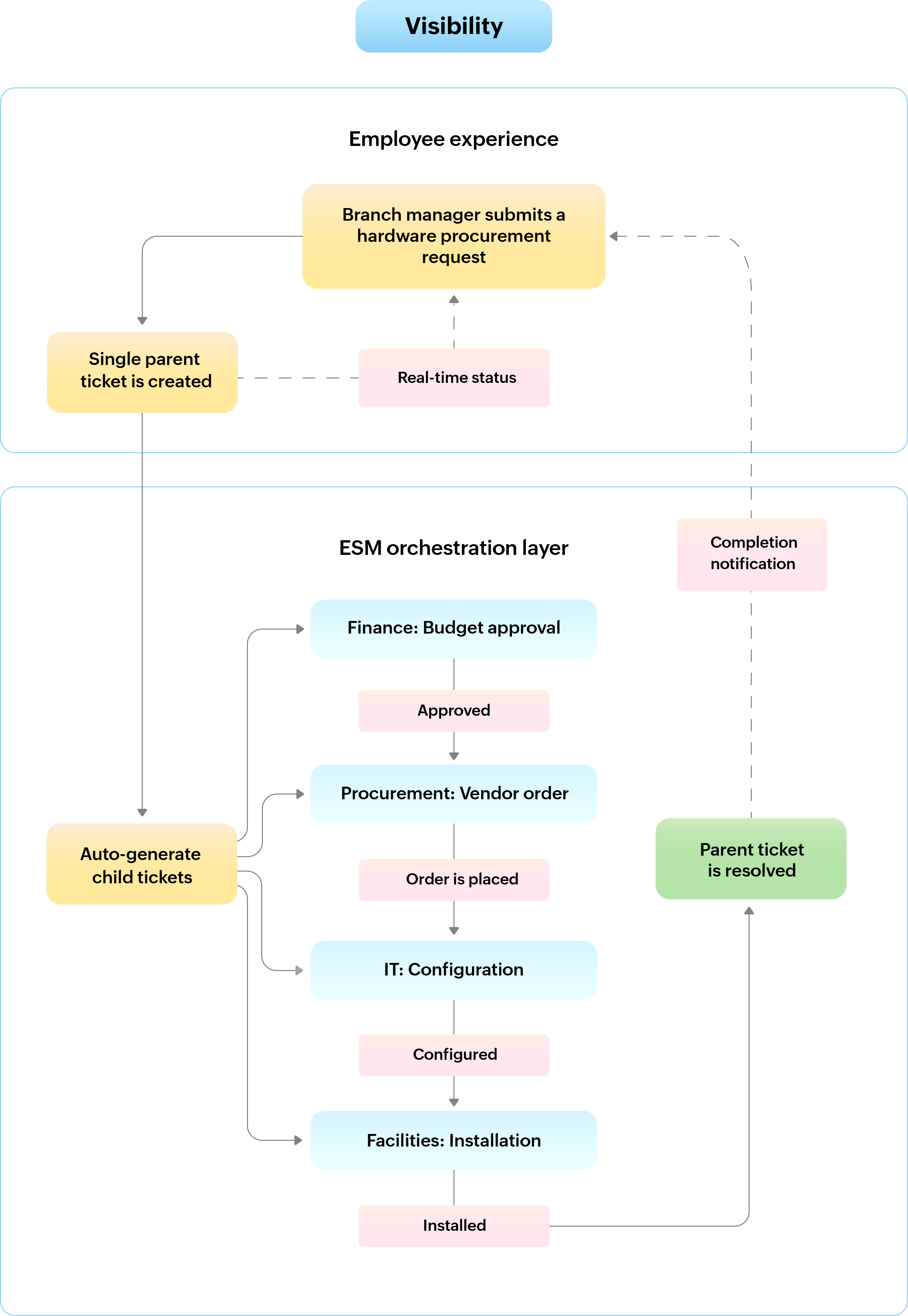
To resolve this issue, the IT help desk team implements an ESM model where the branch manager submits a hardware procurement request through a single portal. The system auto-generates child tickets for the finance (budget approval), procurement (vendor orders), IT (configuration), and facilities (installation) teams, each with the relevant context. The branch manager tracks one parent request. The workflow orchestrates the sequence and dependencies.
When the finance team approves, the procurement team is automatically notified. The branch manager never plays traffic cop, and IT leadership reduces the burden on employees, allowing them to focus on core business objectives.
2. Omnichannel continuity
There is a critical difference between multichannel and omnichannel. Most IT departments are multichannel. They offer several ways to get help, but those channels do not necessarily talk to each other.
B2C philosophy suggests that the context follows the employee. If a branch staff member reports an issue via a mobile app while on the floor, the service desk agent should already have that history visible when the staff member calls in later that afternoon. In a B2B context, this drastically reduces the mean time to resolve issues by eliminating the need for repetitive information gathering.
3. Transparency as a Service
One of the greatest sources of frustration in enterprise IT is the lack of status updates. Think along the lines of Amazon package deliveries. While B2B processes are often more complex and involve longer lead times than consumer transactions, they frequently lack the real-time feedback loops that consumers have come to expect.
Strategic decision-makers must prioritize speed and transparency as core metrics. Adopting a delivery tracker for internal services such as hardware procurement or software access can help IT organizations proactively manage expectations. Transparency reduces the volume of check-in inquiries, freeing up technical resources for high-value tasks while building institutional trust.
4. Designing for the operational edge
B2B IT strategies are often designed for the corporate environment. However, the B2C mindset prioritizes the mobile and frontline experiences. For field employees, the no wrong door experience is a mission-critical requirement. They operate under high-pressure conditions and lack the time to navigate complex, multistep IT systems. Applying frictionless B2C design principles to B2B tools allows technology to act as an accelerator for business.
Use case
A field service engineer at a remote oil rig experiences a critical failure in the pressure monitoring system. They have intermittent connectivity, no access to the corporate network, and are working a 12-hour shift with three other monitoring systems queued for maintenance. The standard self-service portal requires VPN authentication, loads slowly on low bandwidth, times out before submission, and asks them to select from a category tree designed for office IT issues.
They reach out to the help desk, but the L1 technician doesn't understand the operational context and escalates to the wrong team. After four hours, the rig continues to operate without pressure monitoring, which puts ground workers at risk.
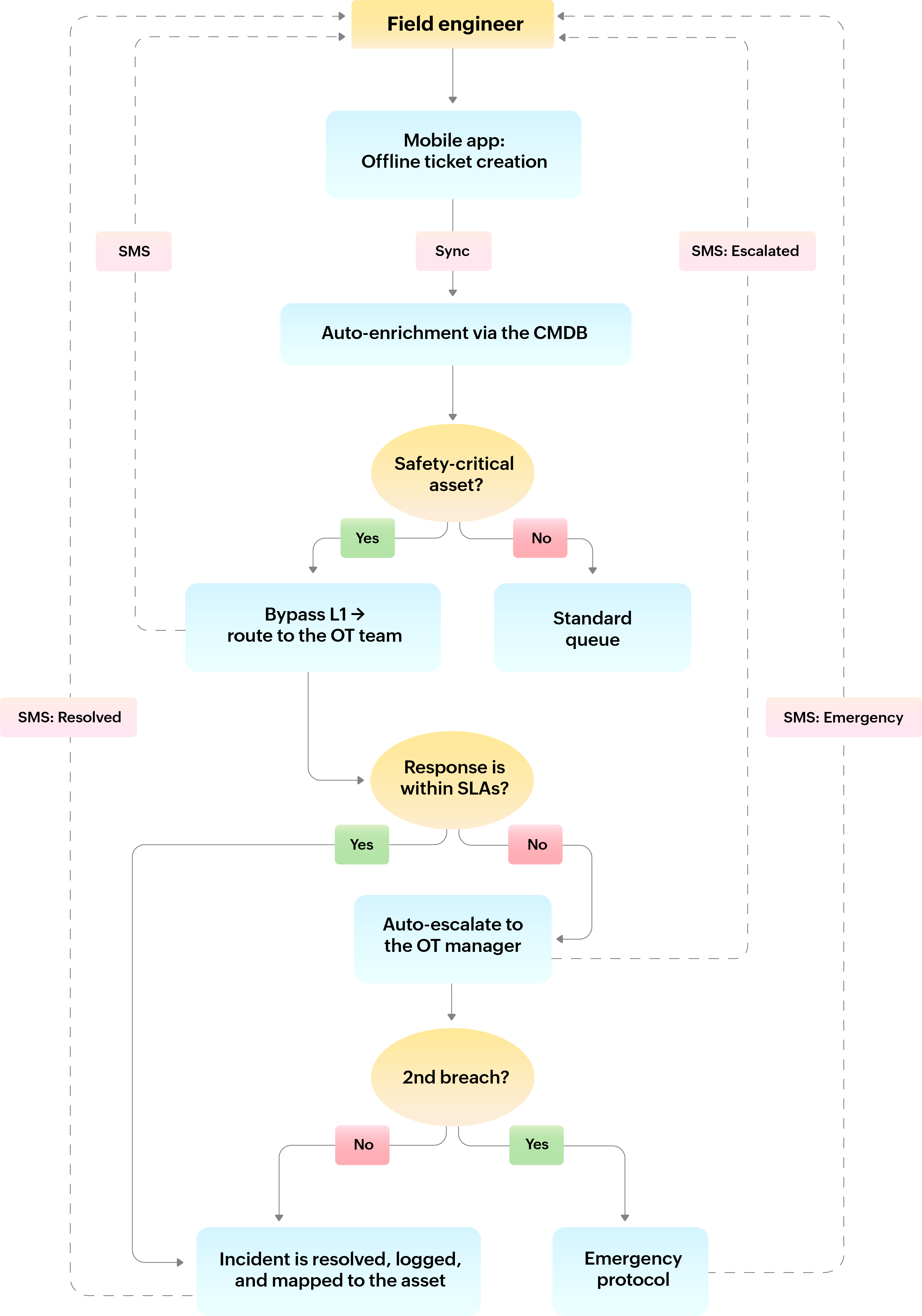
For this scenario, the IT help desk provides a lightweight mobile app optimized for offline-first operations. The engineer opens the app, selects their rig location (auto-detected via the GPS), scans the asset QR code on the pressure monitoring unit, and sends a voice note describing the failure. The app queues the ticket locally and syncs when connectivity resumes.
At the back end, the system auto-updates the ticket with the asset history, recent maintenance logs, and CMDB relationships. Since the asset is tagged as safety-critical, the ticket bypasses L1 triage entirely and routes directly to the OT team with an SLA override. The engineer receives an SMS confirmation, and the team is able to resolve the issue immediately.
The bottom line: The EX is the new CX
When an organization treats the employee experience (EX) with the same diligence as the CX, the benefits are measurable:
- Reduced shadow IT: Employees are less likely to seek unsanctioned work-arounds when official channels are intuitive.
- Enhanced productivity: The time spent playing detective with internal services is reduced.
- Cultural agility: The IT team evolves into a proactive partner in business growth.
Ultimately, the goal is a B2C-ready IT organization that maintains the standards of a B2B company while delivering the seamless accessibility of a world-class consumer brand.
B2C readiness implementation: ManageEngine's cheat sheet for IT leaders
B2C principle |
Audit question |
IT help desk capabilities |
1. The no wrong door philosophy |
When a request falls between departments, who handles the handoff? |
|
2. Omnichannel continuity |
If a user switches from a chat to a call, is the context preserved? |
|
3. Transparency as a Service |
Can an employee track their request status without following up? |
|
4. Designing for the operational edge |
Was this designed for office staff or field users? |
|