Why digital dexterity is the culture shift your workforce needs
May 15 · 9 min read
Employees lose nearly 25% of their workday searching for information. According to McKinsey, employees spend an average of 1.8 hours per day, or more than nine hours each week, just hunting for the files or data they need to do their jobs.
Individually, these inefficiencies seem minor, but together, they create a significant drag on productivity. When workplace tools are better integrated and designed with user needs in mind, work flows more smoothly. Technology only delivers value when it enables people to work seamlessly, and this is precisely where digital dexterity becomes essential.
Digital dexterity vs. digital maturity
Digital dexterity and digital maturity are often confused, yet they represent different dimensions of transformation.
What is digital dexterity? Digital dexterity is about people. It reflects how quickly and effectively employees adapt to new tools, embrace modern ways of working, and apply technology to solve problems. A dexterous workforce does not wait for instructions; it experiments, learns, and finds smarter paths to resolutions that support workforce digital transformation.
In contrast, digital maturity is about an organization. It shows how far a company has advanced in building the right processes, infrastructure, and culture to support digital transformation. Mature organizations have the systems and frameworks in place, but maturity alone is not enough.
A business can invest heavily in modern platforms and still fall short if its workforce lacks the ability or willingness to use them. Real progress happens when maturity and dexterity grow together: one provides the foundation, and the other brings it to life.
The rapid evolution of AI, automation, and cloud-native ecosystems makes it difficult for strategies to keep up with technological change. Digital dexterity gives organizations the muscle memory to pivot, helping teams collaborate across silos, respond to crises without losing momentum, and turn emerging technologies into lasting competitive advantages.
Creating the right environment for digital dexterity
Digital dexterity is not achieved through a single training session or platform rollout. It takes shape over time through consistent use of tools and clear processes, and is upheld by a culture that supports initiative and problem-solving.
1. Patch management across systems
Consider an IT infrastructure team responsible for patching thousands of endpoints across offices and remote setups. Their initial approach relied on bulk weekend rollouts, which often caused failures and delays. With an endpoint management platform, the team redesigned the process. They grouped systems based on location, usage, and risk, then automated staggered deployments. Real-time compliance dashboards gave leadership immediate visibility into patch status.
This approach reduced downtime, improved compliance rates, and strengthened security. More importantly, it changed how the team viewed patch management. It became a continuous process that balanced both protection and productivity.
The payoff of dexterity
This example highlights how digital dexterity turns a routine IT task into a strategic advantage. By combining technology adoption with process redesign, the team built resilience into its operations. That adaptability is what enables organizations to stay ahead in dynamic environments.
Takeaway: Digital dexterity shifts IT work from reactive fixes to proactive, value-driven practices that scale with organizational needs.
2. Asset tracking across platforms
Digital dexterity proves its worth only when it shapes day-to-day IT work. Abstract ideas become real when teams apply them to core tasks, redesigning processes to be faster, smarter, and less error-prone. The following use case shows how this shift plays out in practice.
An IT asset manager wants to know which laptops are running outdated OS versions. The information is scattered across spreadsheets, vendor portals, and endpoint tools that don’t communicate with each other. Hours go into reconciling data before action can even begin. The delay isn’t caused by lack of knowledge, but by disconnected systems that block efficiency.
The payoff of dexterity
Digital dexterity in this case means rethinking asset management with integrated platforms. When data is centralized and accessible, IT teams can act in real time rather than spending hours in reconciliation. The result is stronger compliance, faster remediation, and reduced risk exposure.
Takeaway: Make dexterity measurable. Map every recurring IT task such as asset tracking, patching, or incident response, and identify where automation or integration can remove manual effort. The fewer touchpoints it takes to complete a process, the more dexterous your organization becomes.
3. Incident handoffs between teams
During a service outage, the NOC team identifies abnormal traffic patterns. They log the incident in their monitoring platform, but the service desk team works in a separate tool. Updates have to be copied manually across systems, and by the time everyone is aligned, resolution time has doubled. The friction lies in tool silos, not in team expertise.
The payoff of dexterity
Here, digital dexterity ensures that incident management tools and workflows are connected. With automation and shared platforms, handoffs become seamless, visibility improves, and downtime is significantly reduced. What was once a bottleneck transforms into a coordinated, fast-moving process.
Takeaway: Dexterity is about alignment. When tools, teams, and processes work in sync, business continuity is safeguarded.
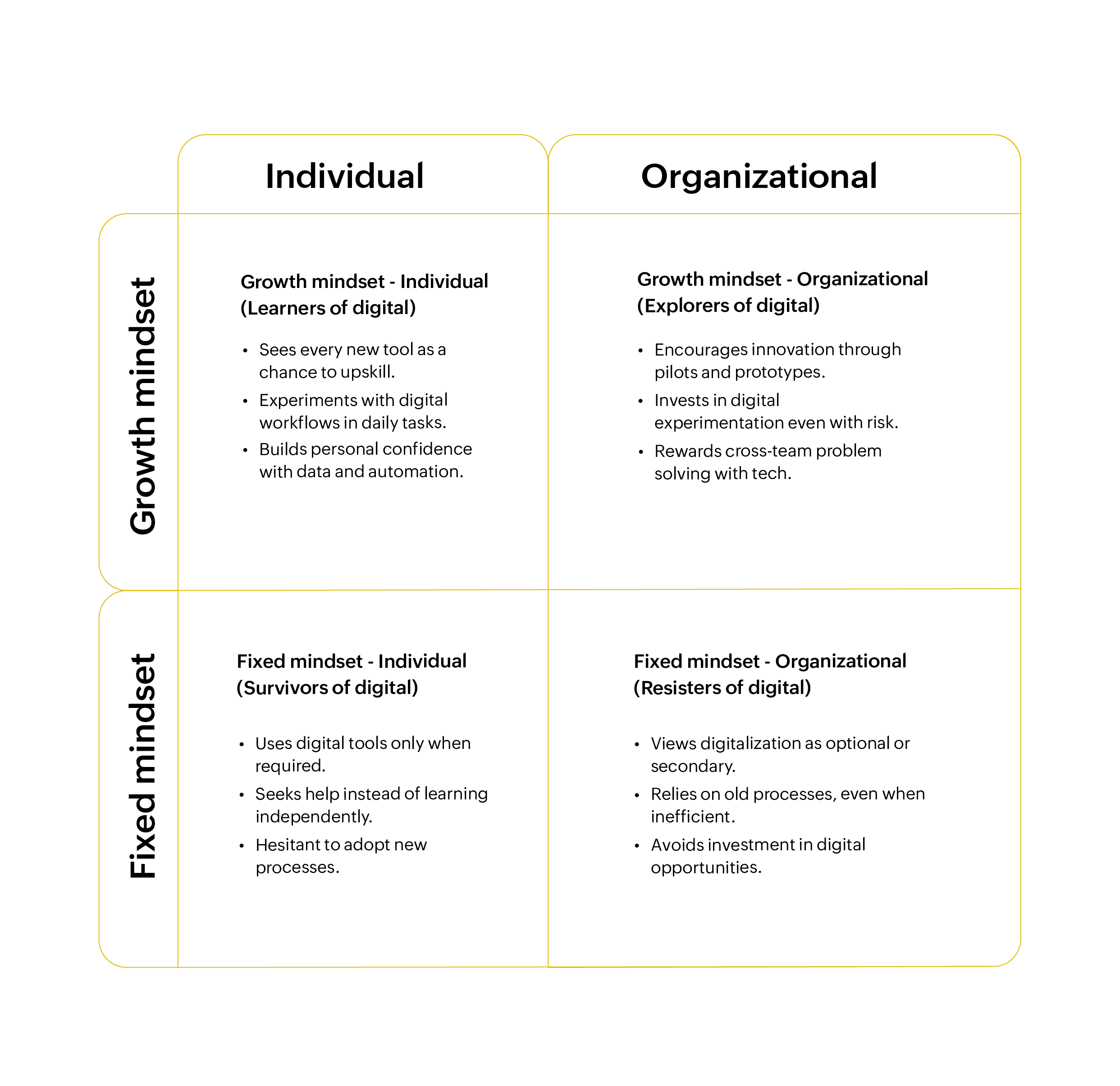
How dexterity takes shape in IT
The above quadrant shows how digital dexterity takes shape within IT. At the individual level, a growth mindset creates learners of digital who proactively masters automation, cloud tools, and new workflows. At the organizational level, the same mindset produces explorers of digitization who pilot emerging platforms, adopt DevOps practices, and push transformation forward. In contrast, survivors only adapt when forced, while resisters keep IT locked in outdated processes. The message is clear: for IT to move from system maintenance to business innovation, both individuals and organizations must cultivate dexterity in equal measure.
Challenges in digital dexterity
Here are six challenges that regularly interfere, and some practical ways to address them.
1. Resistance to digital adoption
Even experienced technical teams can cling to the familiar. Service desk staff may continue tracking tickets in spreadsheets, despite having a capable ITSM platform sitting idle. The hesitation often comes from comfort with existing processes rather than doubts about the new system’s capabilities.
What works: Start with a small, low-risk change. For example, turn on auto-assignment for a single ticket category and track the time saved over a month. Share the numbers with the team and invite feedback before adoption.
2. Gaps in digital literacy
Working in IT does not guarantee readiness for every tool. A network admin who’s spent years with on-premises monitoring might feel out of depth when asked to manage a cloud-native system.
What works: Keep training short, precise, role‐specific, and connected to real tasks. A 30-minute session on creating custom alerts in the new system is far more effective than a full-day generic workshop. Embedding quick tips and walkthroughs directly into the tool itself can make learning part of the workflow.
3. Inconsistent leadership support
Change loses momentum when leaders don’t demonstrate by example. If an IT director pushes for Infrastructure as Code but continues requesting manual changes from the team, it sends a mixed message and the team receives conflicting signals.
What works: Leaders need to be visible users of the same tools and processes they want the team to adopt.
4. Tool fatigue and fragmentation
Many IT teams operate in a tangle of overlapping platforms—one for monitoring, another for alerting, yet another for documentation—with email filling the gaps. Jumping between them depletes focus and slows response times.
What works: Conduct quarterly reviews of all tools in use, asking, What problem does this solve, and could another system address it more effectively? Identify opportunities to integrate or consolidate tools, aiming for fewer platforms that cover more functions.
5. Different comfort levels with technology
Teams are often comprised of digital natives and seasoned experts, and their work styles reflect that. During a patch rollout, some may choose to automate the process with scripts, while others prefer a manual, step-by-step approach. These differences can slow collaboration if not addressed.
What works: Build shared processes that allow for both methods, and ensure documentation covers each approach. Pair team members to cross-train, so all staff can use either method when required.
6. Budget and resource pressures
When budgets are tight, investments in training or process improvement are often reduced or delayed. This can lead to situations where only one or two staff members are trained on a new system, creating bottlenecks and risk.
What works: Prioritize initiatives with measurable operational impact. Roll out changes in stages to spread costs over time and track results to justify further investment. Use vendor-provided training, community forums, and internal recorded sessions to extend learning opportunities without increasing expenses.
The following scorecard provides a sample lens to evaluate progress across process change, tool use, IT involvement, learning culture, and feedback loops.
Indicator |
Low dexterity |
High dexterity |
Process change |
|
|
Tool use |
|
|
IT involvement |
|
|
Learning culture |
|
|
Feedback loops |
|
|
The road ahead
Digital dexterity is a practice organizations implement and a mindset leaders adopt as they continue their digital transformation in the workplace. For IT leaders, supporting it means shaping environments where technology empowers rather than overwhelms.
Start by embedding adaptability into every decision. Choose systems that integrate easily and evolve as business needs change. Build learning ecosystems that make upskilling part of the workflow instead of an afterthought. Create space for experimentation, where teams can test new ideas, automate small wins, and scale what works. And most importantly, measure adoption, not deployment because transformation is proven by how effectively people use tools.