

- Features
- Benefits
- Next step
Features
Build an AI agent governance strategy
Govern AI agents across enterprise AI platforms with the same controls you apply to people.
- Find agents across each platform, assign every agent an owner, and map control policies for complete control.
- Ensure role-appropriate access to your agents with access certifications, monitor their activity, and reassess their permissions throughout the life cycle.
- Give CISOs a unified framework to define, enforce, and audit AI policies across every agent and LLM service in the organization.
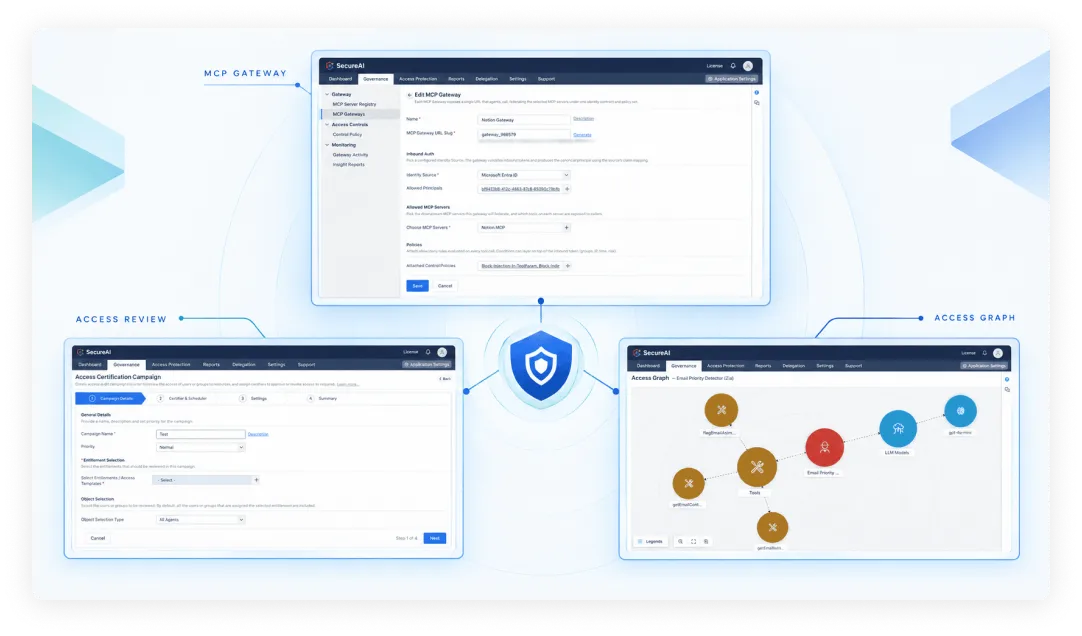
Secure your AI agents from potential attacks
Understand the scope of your AI agents and ensure their configurations keep them secure.
- Combine your agents' roles, owners, permissions, capabilities, model, the files they access, and the tools they use into a single view and evaluate them.
- Produce a consistent cross-platform audit record of your AI agents.
- Retain agent inventory, policy decisions, and gateway logs to comply with data-location and compliance requirements for a secure AI-driven environment.
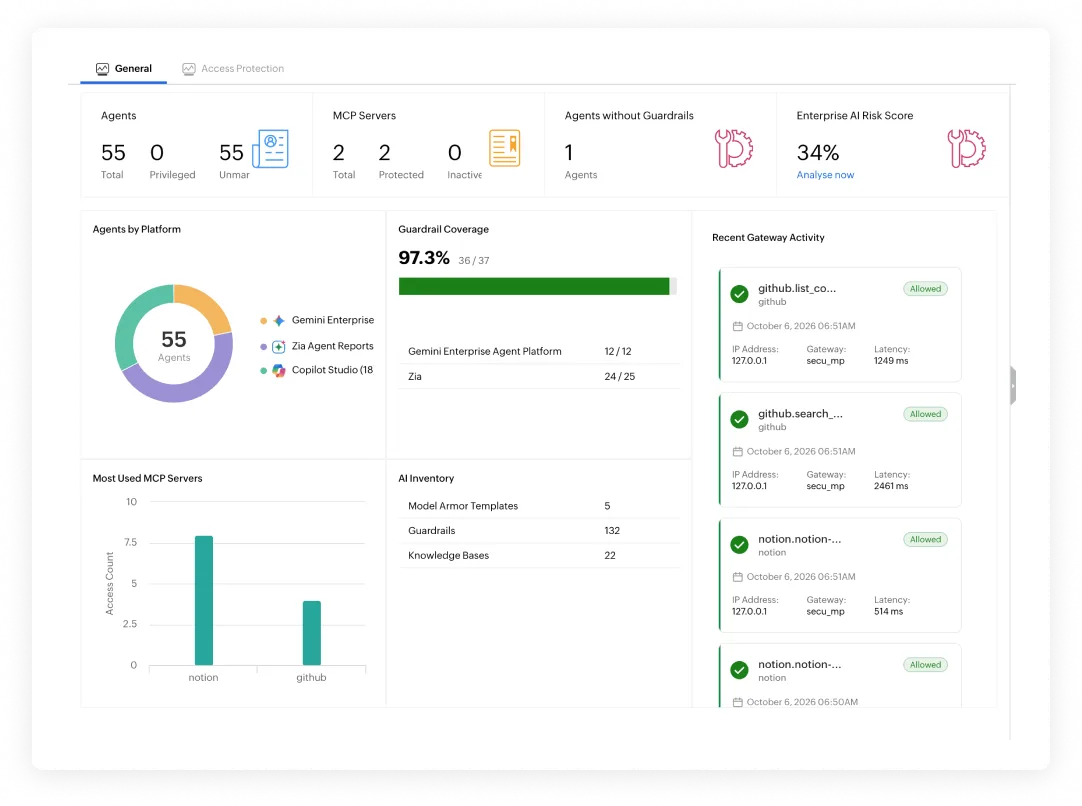
A gateway that sits in front of every MCP server
Adopt MCP servers at the speed your business wants. Govern them at the standard your security team requires.
- Route your AI agents securely through AD360's MCP Gateway, decide who can use which tools, and review every action before they reach your MCP servers.
- Approve, redact, or deny each agent's actions to ensure sensitive data does not exit your environment.
- Get reports on usage, latency, and errors to help platform teams spot slow or failing MCP servers and retire the servers that agents no longer use.
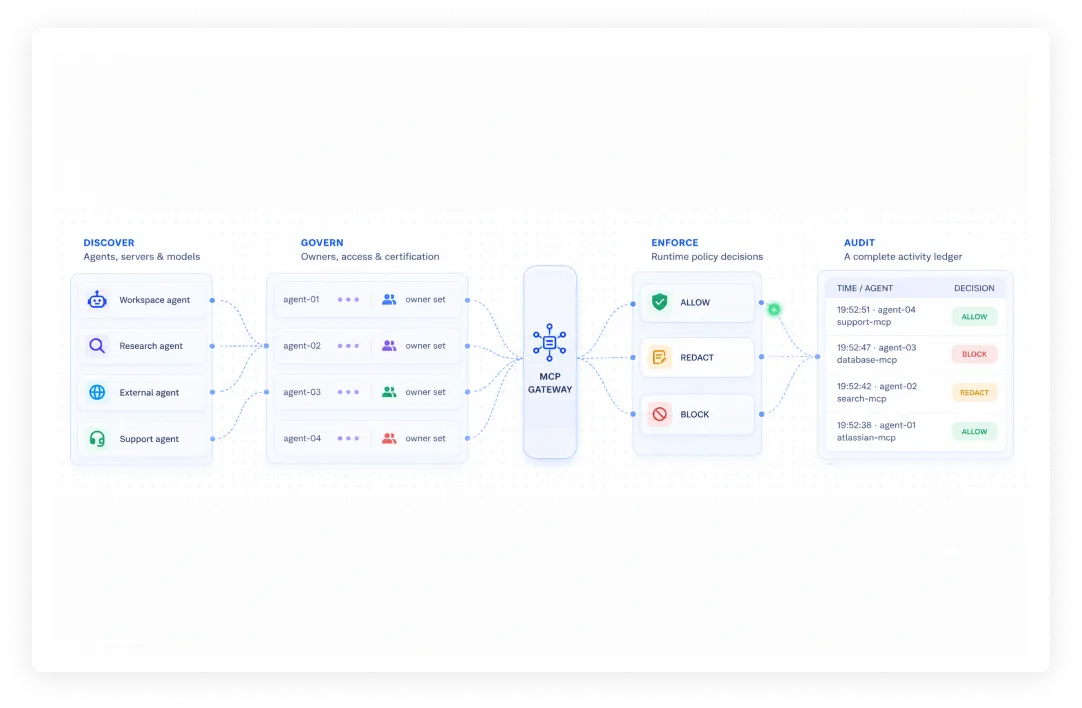
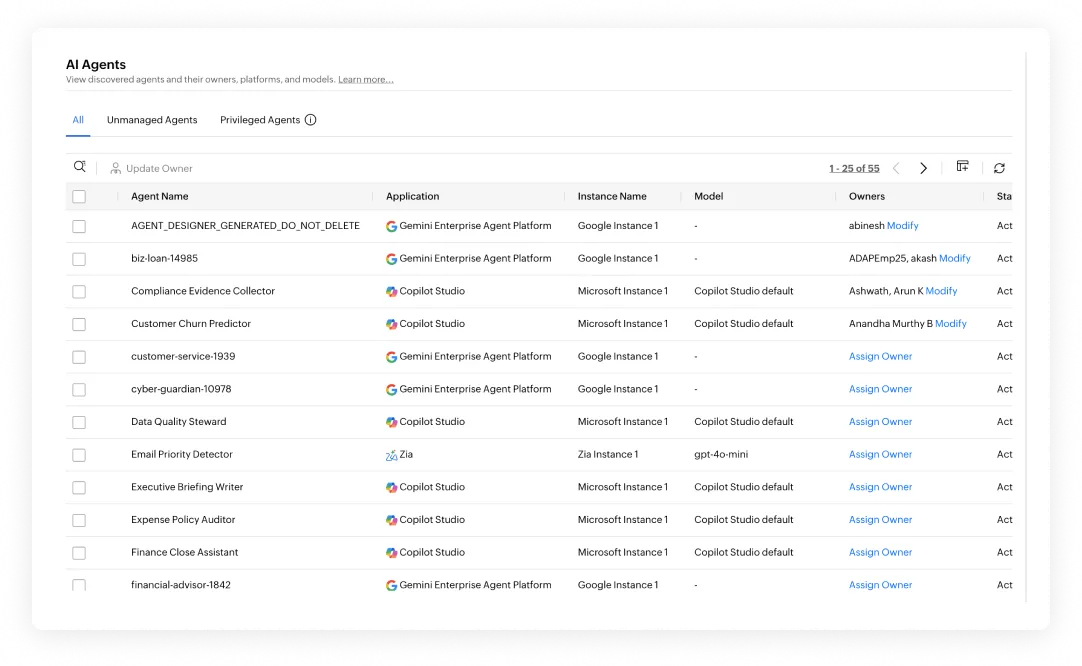
AI agent discovery across your enterprise platforms
Identify every AI agent deployed across enterprise AI platforms.
- Integrate with Google Gemini Enterprise Agent Platform, Microsoft Foundry, and Copilot Studio, and catalog every deployed agent.
- Visualize every agent's identity, access, guardrails, and connections to other agents.
- Identify agents with no owner, excessive access, or unresolved violations, across every platform.
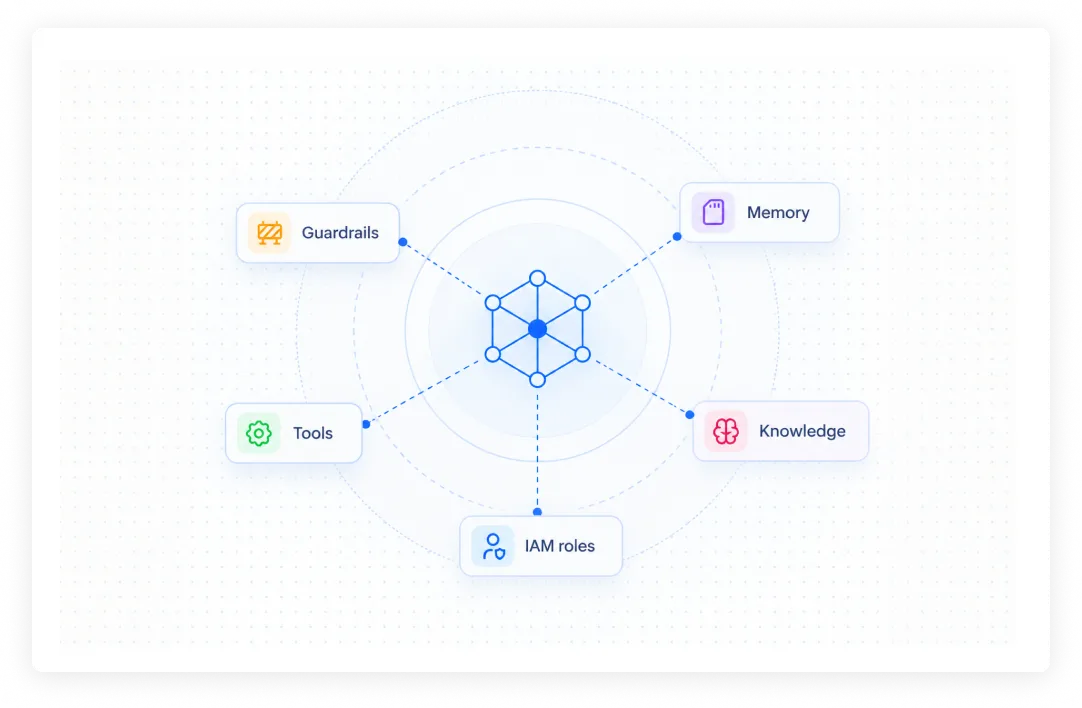
Audit trail for every AI agent
Hold AI agents accountable with human ownership. Let employees oversee agent access, set policies, and enforce controls.
- Every managed agent has a person accountable for its behavior. Assign owners automatically through conditional assignment rules.
- Every tool invocation, authorization event, and data access is captured at the gateway.
- Logs are tamper-proof and exportable, ready for SIEM feeds or compliance
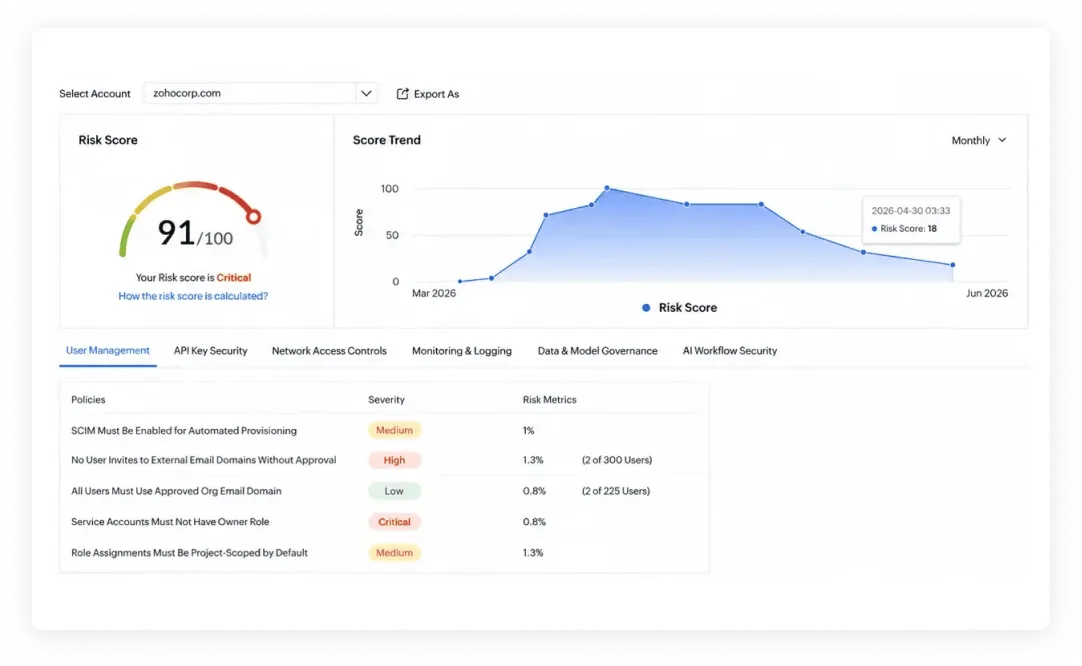
Conduct risk assessments on your enterprise LLMs
Close the visibility gap on LLMs your enterprise depends on using SecureAI:
- Assess LLM configurations across identities, API keys, data governance, and network access to find exposure and fix gaps.
- Measure risk exposure as a deterministic score based on relevant configurations, with compliance mapping across regulatory frameworks.
- Drill down to the specific admin account, user, or app that failed a control, along with identifying details and the reason for failure.
The benefits of AD360 as a dedicated AI governance platform
Deploy AI confidently across your enterprise
Give security teams greater confidence to implement AI tools and agents within defined security boundaries, reducing the friction between innovation and security.
Unified security across multiple platforms
Prevent AI agents from accessing resources or performing actions beyond their intended scope, reducing the potential for disruption and inappropriate data exposure, across Microsoft Foundry, Google Gemini Enterprise Agent Platform, and Microsoft 365 Copilot Studio.
Protect sensitive data from exposure
Ensure AI agents operate within an enforced access scope. AD360 applies constraints at both the input and output stages, so no agent calls an unauthorized tool and no sensitive data passes without DLP review on every request.
Adhere to AI governance guidelines
Align AI agents with regulatory guidelines like NIST AI RMF, ISO/IEC 42001, and OWASP Top 10 for LLM Applications through assigned ownership and complete audit trails, reducing the potential for compliance gaps, failed audits, and unaccountable agent activity.
ManageEngine named a 2023 Gartner Peer Insights Customers’ Choice for Identity Governance and Administration
Next step

- Add to calendar
- Check your inbox (we’ve sent you an email)
- Attend the demo and get all your questions answered
- Apple
- Microsoft 365
- Outlook
- Yahoo