Green ITOps as a business strategy: How to drive sustainability in modern enterprises

Summary
Sustainability in IT is no longer just a checkbox—it’s a core business driver. This article explores how Green IT Operations Management (ITOM) is helping modern enterprises cut costs, improve infrastructure efficiency, and comply with ESG regulations. It highlights quick-win strategies such as optimizing data center energy use, eliminating zombie assets, and using carbon-aware cloud orchestration. With frameworks like the EU’s CSRD and the SEC’s climate disclosures on the rise, IT teams must embed sustainability into daily operations. The article outlines a practical CXO playbook with five key actions: integrating carbon metrics into IT dashboards, automating energy-saving processes, extending hardware lifecycles, and aligning ITOM data with ESG reporting. Green ITOM is not just about environmental compliance—it’s a strategic move to unlock performance, resilience, and long-term value. Forward-thinking CXOs are embracing it as a baseline for innovation and operational maturity.
Not long ago, sustainability in IT was a check box tied to annual ESG goals or boardroom pledges. Now, it’s fast becoming a core business driver.
For forward-looking enterprises, green ITOM is about not just helping reduce carbon footprints but also building smarter, more efficient infrastructures that lower costs, meet compliance goals, and unlock new performance gains.
We can all agree that today’s IT operations (ITOps) are under pressure; demand is rising, workloads are getting heavier, and energy costs are far from stable. Meanwhile, regulatory frameworks like the European Union's CSRD and the United States Securities and Exchange Commission's upcoming climate disclosures are turning carbon visibility into a compliance requirement.
CXOs need more than sustainability rhetoric. They need measurable, manageable, scalable practices that are embedded into ITOps from the inside out.
From a cost center to a value creator: Green ITOM's quick win impact zones
Green ITOM isn’t a monolith; it’s a framework that applies across IT domains. Smart ITOps strategies are now helping enterprises:
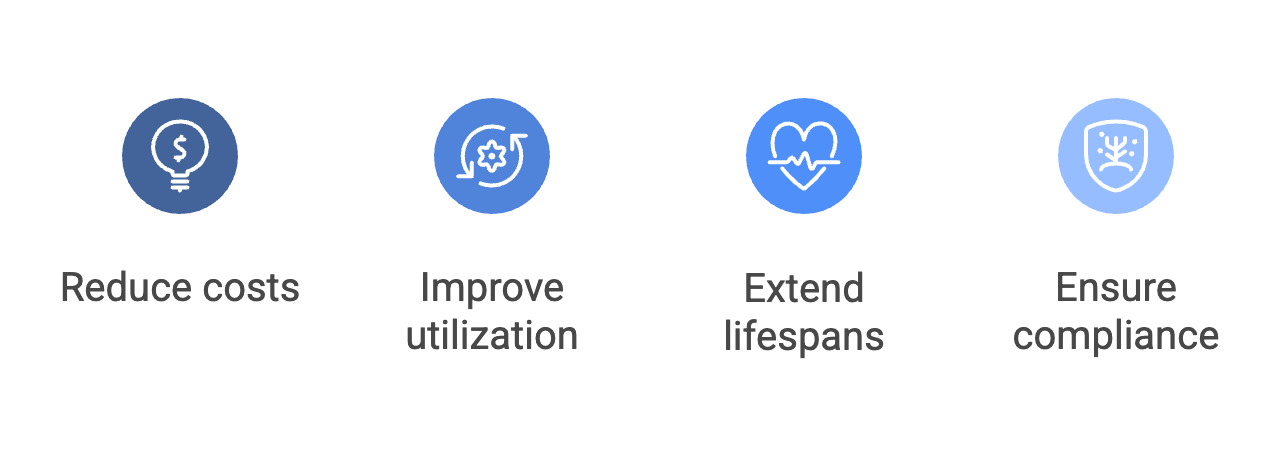
- Cut operational costs through energy-aware scheduling and smarter workload distribution.
- Improve asset utilization with better capacity planning.
- Extend infrastructure lifespans by avoiding unnecessary hardware refresh cycles.
- Comply with ESG mandates and reduce scope 2 emissions.
Here's where enterprises are seeing early traction:
Data center optimization:
AI-assisted tech has long been used to optimize data center power consumption. For instance, back in 2016, Google announced that DeepMind AI's cooling recommendations reduced Google’s energy use for cooling data centers by 40%. Thermal mapping, dynamic airflow controls, and real-time energy analytics are becoming standard for reducing operational costs in hyperscale and edge environments.
Cloud sustainability awareness:
Enterprises are using vendor-provided sustainability dashboards, such as Azure’s Emissions Impact Dashboard, to move workloads based on region-specific carbon intensity.
Zombie asset elimination:
Green ITOM tools detect and decommission comatose resources, reducing power draw and freeing up capacity.
These use cases show that sustainability and performance aren’t mutually exclusive and can be synergistic when powered by smart ITOps.
The CXO playbook: 5 key practices for embedding sustainability into ITOM
To move from isolated efforts to a true green ITOM strategy, CXOs should focus on five core actions that are designed to align technical operations with enterprise sustainability outcomes.
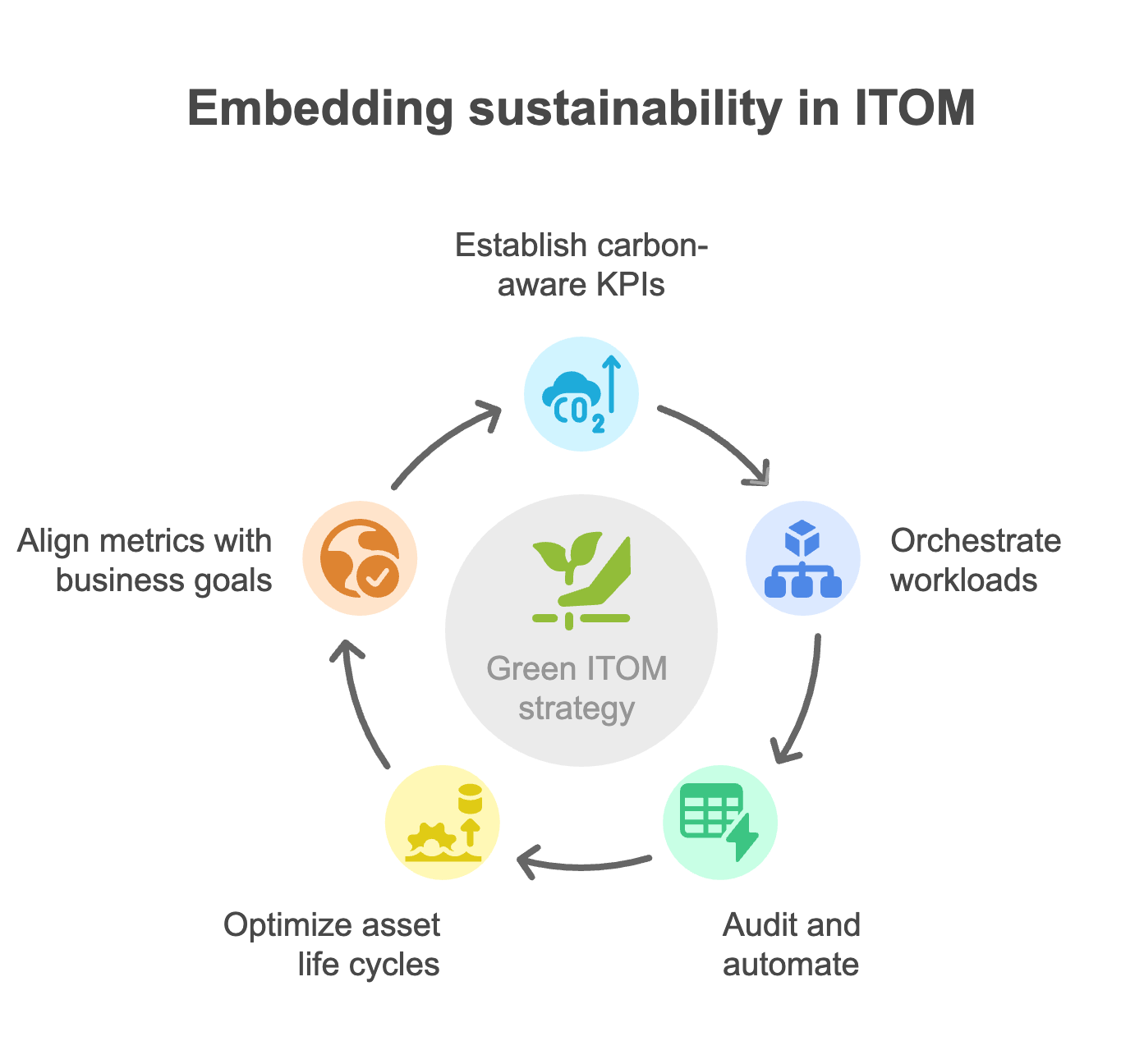
1. Establish carbon-aware IT performance metrics
- Power usage effectiveness (PUE): Use PUE as a baseline metric for your data centers. For instance, for on-premises infrastructure and co-location environments, target a PUE of less than 1.5 for high efficiency.
- Carbon per workload (gCO₂eq/request): Calculate the emissions tied to specific services or systems. Track hardware utilization ratios and set automated flags for underutilized VMs (less than 15%) or physical servers with consistent CPU usage below 30%.
- Hardware utilization rates (%): Low utilization means wasted watts and space. Specifically, setup custom host hardware metrics to track and optimize utilization in virtualized environments.
- Use AIOps or observability platforms that support environmental metrics in real time.
2. Deploy intelligent workload orchestration
- Time-based optimization: Run non-urgent workloads during off-peak or low-carbon energy availability windows. For instance, you can schedule batch jobs during low-carbon hours, such as at night or when renewable availability is the highest.
- Region-aware scheduling: Public clouds provide region-specific emissions data. Use this to route to greener data centers. For instance, organizations can choose to route workloads to AWS regions like Oregon, which has hydro-heavy grids, instead of Ohio, which has coal-heavy grids.
- Edge workload shifting: For distributed environments, dynamically shift tasks to edge nodes with better energy efficiency or renewable power sourcing.
- Orchestration requires integration between your workload manager, such as Kubernetes or hybrid cloud controllers, and sustainability telemetry from your cloud or facility providers.
3. Audit and automate energy-saving actions
- Automatic shutdown policies: Idle VMs, underused containers, and test environments can be shut down after a set idle time.
- Thermal load balancing: Use temperature data from sensors to balance rack heat loads and prevent overcooling.
- AI-powered cooling control: Use ML models to optimize the cooling fan speed, airflow direction, and chiller settings dynamically.
For instance, in cloud-native workloads, implement autoscaling policies that aggressively scale down unused services outside of defined working windows. Integrate these with your ITOM suite and data center infrastructure management platforms.
4. Extend and optimize asset life cycles
- Monitor hardware for actual wear with metrics testing SSD endurance and CPU thermal degradation.
- Redeploy hardware for lower-intensity workloads, such as backup servers or developer sandboxes.
- Create a circular IT program to refurbish or resell viable equipment and reduce e-waste and procurement costs.
- Pair this with regular audits from your CMDB and integrate with procurement tools for decision-making transparency.
5. Align ITOM metrics with ESG reporting and business KPIs
- Use ITOM platforms that support APIs or data connectors to push energy and usage data into ESG platforms. This helps you use ESG dashboards for board and regulatory reporting.
- Correlate IT emissions with financial metrics such as the energy cost per unit revenue or per product. This helps in building finance systems to measure energy spending savings and OpEx.
- CSR initiatives to quantify IT’s role in your organization's climate goals.
This approach of aligning IT, finance, and sustainability yields operational gains and carbon reductions, making green ITOM a business accelerator, not just a compliance check box.
It’s not just green IT—it’s better IT
Green ITOM is no longer about idealism but about operational maturity. The organizations leading in sustainability are also leading in resilience, efficiency, and innovation.
Green ITOps is not an add-on. It’s the new baseline. The smartest CXOs are using it to drive value on multiple fronts, including environmental, financial, and reputational ones.
To stay in the know about more IT trends and best practices for CXOs, stay connected with CXO Focus.