SolarWinds shift to 3-year subscriptions: How will this impact your organization?

Summary
SolarWinds’ move to mandatory 3-year subscriptions in 2025 reflects a familiar private-equity playbook focused on ARR growth, not customer value. The result: higher costs, forced re-licensing, slower innovation, and increased lock-in for customers. The article urges organizations to re-evaluate long-term TCO and explore more transparent, flexible alternatives like ManageEngine that preserve choice and stability.
SolarWinds is defaulting to a 3-year, recurring subscription-by-force model with an official end-of-line for perpetual licenses starting August 1, 2025. Let’s decode the real motive: This is more about Turn/River’s financial strategy than a true drive for modernization.
We've seen this before. The Turn/River Capital's profit-first playbook
In April 2025, SolarWinds was acquired by Turn/River Capital, a private equity (PE) firm known for maximizing operational efficiency and extracting recurring revenue from its portfolio companies.
Notably, Paessler AG, an industry competitor to SolarWinds, followed a similar path after securing investment from Turn/River: Passler shifted to a mandatory 3-year subscription model.
Across Turn/River’s portfolio, the pattern repeats:
| Company | Year | Event/Status | Licensing before | Licensing after | Impact |
|---|---|---|---|---|---|
| Tufin | 2022 | Acquired by Turn/River | Perpetual and subscription models | Subscription model | By Q1 2022, 77% of new license bookings were subscription |
| ActiveState | 2021 | Strategic investment by Turn/River | SaaS | Shift from ownership to rental with a SaaS licensing model shortly after the investment | |
| Redwood | 2021-2024 | Owned by Turn/River | Subscription model | Followed a strategy of increasing annual recurring revenue (ARR) before exit |
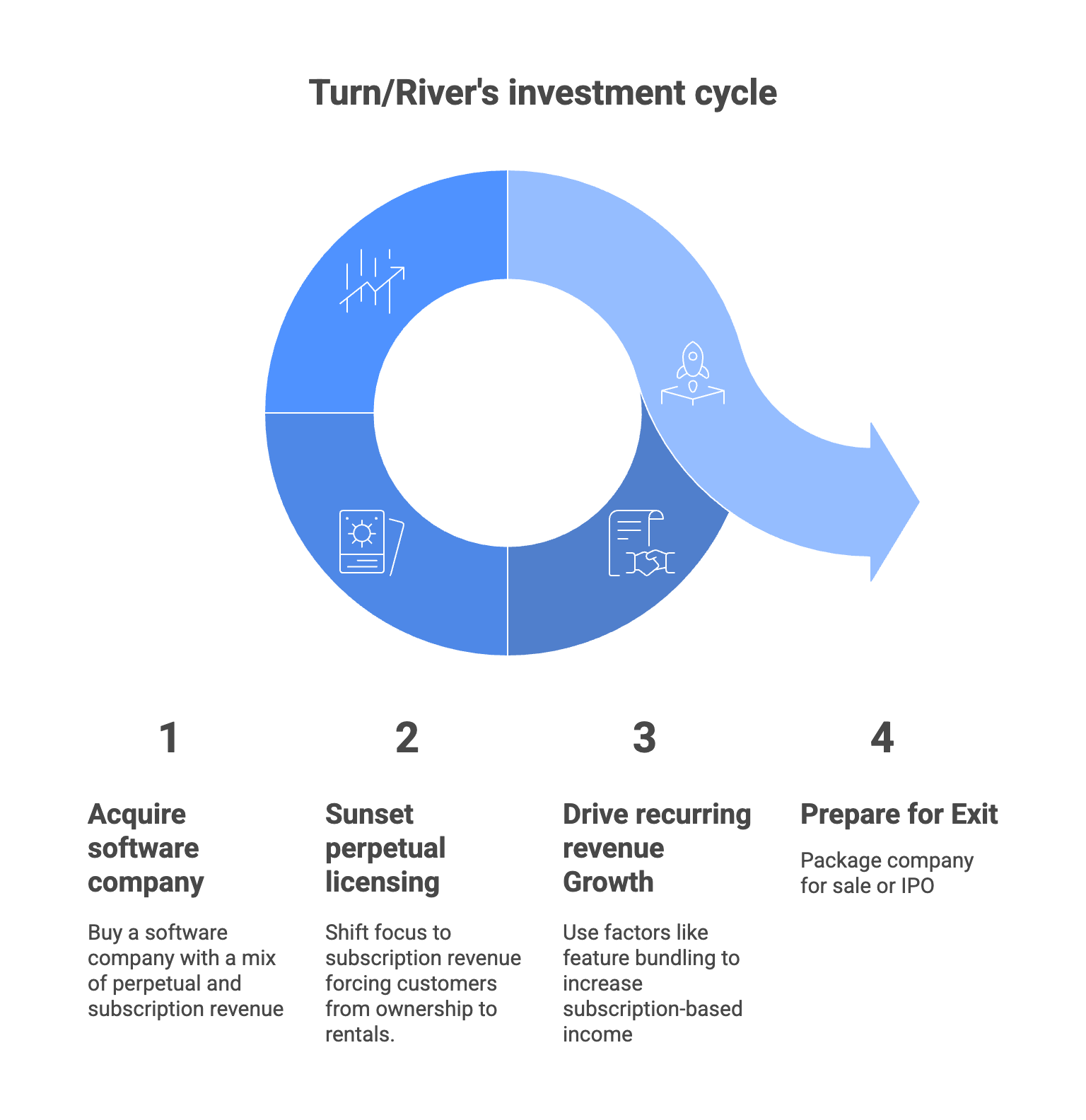
The SolarWinds licensing change fits this mold exactly: a playbook designed to maximize predictable ARR ahead of future exit or valuation events.
But what happens when your vendor prioritizes profit over product?
Private equity-driven software strategies focus on revenue predictability and investor returns. Here’s what that means for SolarWinds customers:
1. Profit over product means increased licensing fees—historically, over 300%.
After Turn/River’s investment, Passler AG raised the cost of its licenses by over 300%, reportedly without prior communication from either the company or account representatives.
Also, SolarWinds has a long-standing pattern of:
Raising renewal prices annually (often 10—20%)
Increasing maintenance fees
Sunsetting older tools or features to force upgrades
With 94% of SolarWinds' revenue tied to ARR, there's even less incentive to hold prices steady and even more incentive to squeeze upgrades and expansions.
Now, with a profit-driven PE investor's involvement, price hikes will become inevitable.
Why this matters: With a similar shift in ownership and licensing-model, SolarWinds customers should expect paying more for the same product experience.
2. Perpetual license holders are being unfairly billed—again.
When existing perpetual license holders are asked to switch to a 3-year subscription just to keep their software updated, it is not innovation but re-monetization of assets that were already paid for.
If you already invested in SolarWinds under a perpetual license, you’re now facing contract changes after the fact, forced repurchases of tools you already own, and critical features hidden behind subscription‑only tiers. Discounts erode with each renewal, and you’re expected to pay higher rates just to keep the same functionality.
3. Reduced innovation: When an exit‑driven owner drives product strategy.
Historical analysis across multiple industries show that large buyout targeted firms often reduce R&D expenditure, treating innovation as a controllable cost. Also, research on PE investment and innovation claims that short‑term financial targets lead to volatile R&D allocation that consistently weakens patent quantity and quality.
This shows that, while Turn/River is known for enforcing ARR-first strategies as seen in Tufin, Redwood, and Paessler, the bigger issue is the structural risk: R&D and innovation lose priority when exit timetables matter more than product roadmaps.
If your vendor is now PE-owned, expect:
Fewer meaningful feature rollouts, with upgrades framed as monetization levers
Slower engineering velocity, as R&D funding trails off
Feature stagnation masked by pricing changes, making renewal feel punitive instead of progressive. In short, your vendor might still operate—but the platform’s future relevance might decline.
4. Rising tiers and hidden costs baked into the HCO model .
SolarWinds is steering customers away from its legacy Orion platform (NPM, NTA, etc.) into the newer Hybrid Cloud Observability (HCO) suite. While it appears like an upgrade, HCO bundles multiple modules and forces you to buy into entire tiers even if you use only a few features.
Want QoE or NetPath? That triggers a higher-tier license.
Need more nodes? You’re nudged into a different pricing slab.
Add cloud connectors? Prepare for usage-based overages.
You’re no longer paying for value. You're now paying for reclassification of your current license model.
3 key questions to ask your team before your next SolarWinds renewal
What’s our projected TCO under this new model and how does it compare to our original investment? Account for inflation clauses, feature bundling, scale-up charges, and usage audit risks.
What happens if we want to downscale, pause, or move to another vendor? Are we tied to SolarWinds’ architecture in ways that make exit infeasible?
Is this vendor still aligned with our IT governance, budgeting strategy, and flexibility needs?
Or, are we being optimized as a line item in someone else’s P&L?
Why ManageEngine is a smarter long-term choice
Unlike SolarWinds, ManageEngine puts flexibility and control back in your hands:
Licensing your way: Perpetual or subscription, no forced lock-ins.
Modular pricing: Pay only for what you use and not forced bundles.
Transparent roadmap: No engineered sunsets or forced upgrades to higher pricing tiers.
Trusted worldwide: By more than 280,000+ organizations including governments, banks, and telecoms.
As an innovation driven, privately held software vendor, ManageEngine puts customer-first to support long-term IT strategy and innovation, not short-term revenue games.
Finally, choose a vendor who lets you choose
Licensing models are more than financial choices. They reflect a vendor’s approach to customer success.
SolarWinds’ forced subscription pivot signals a shift toward revenue protection, not customer flexibility. Before you commit to a 3-year recurring bill, ask: Is this vendor aligned with our long-term IT governance and budgeting strategy?
If the answer is a "no" or even a "maybe," it’s time to switch to a platform that respects customer choice, modularity, and transparency. Welcome to ManageEngine!