Configuring SAML SSO for ManageEngine Vulnerability Manager Plus
The following steps will help you enable single sign-on (SSO) to Vulnerability Manager Plus from ADSelfService Plus.
Prerequisites
- Ensure that the ADSelfService Plus server can be accessed through an HTTPS connection (the Access URL must be configured as HTTPS).
- Log in to ADSelfService Plus as an administrator.
- Navigate to Configuration > Self-Service > Password Sync/Single Sign On > Add Application, and select Vulnerability Manager Plus from the applications displayed.
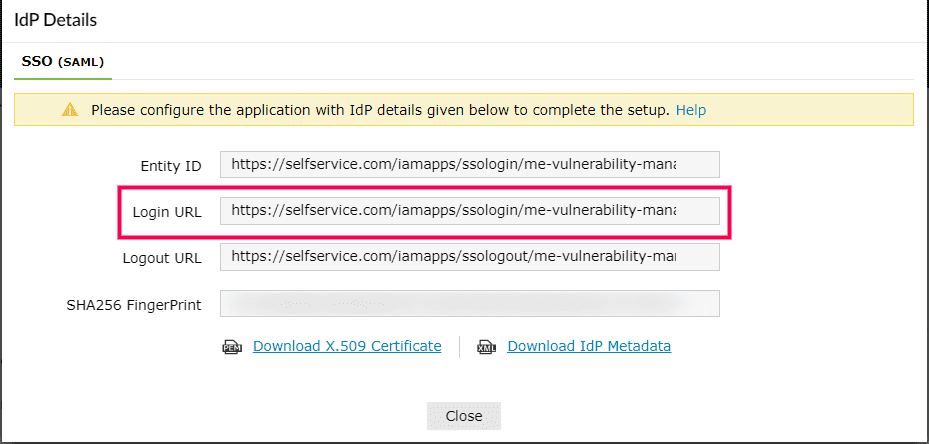
- On the Vulnerability Manager Plus configuration page, click IdP Details in the top-right corner of the screen. A pop-up will appear.
- You can configure the identity provider details by either uploading the metadata file or entering the details manually.
- Uploading the metadata file: Click the Download IdP Metadata link to download the metadata file to be uploaded during the configuration of Vulnerability Manager Plus.
- For manual configuration: Copy the Login URL, which will be used during the configuration of Vulnerability Manager Plus. Download the SSO certificate by clicking the Download X.509 Certificate link.
Note: You can also find Vulnerability Manager Plus from the search bar located in the left pane or the alphabet-wise navigation option in the right pane.
Vulnerability Manager Plus (service provider) configuration steps
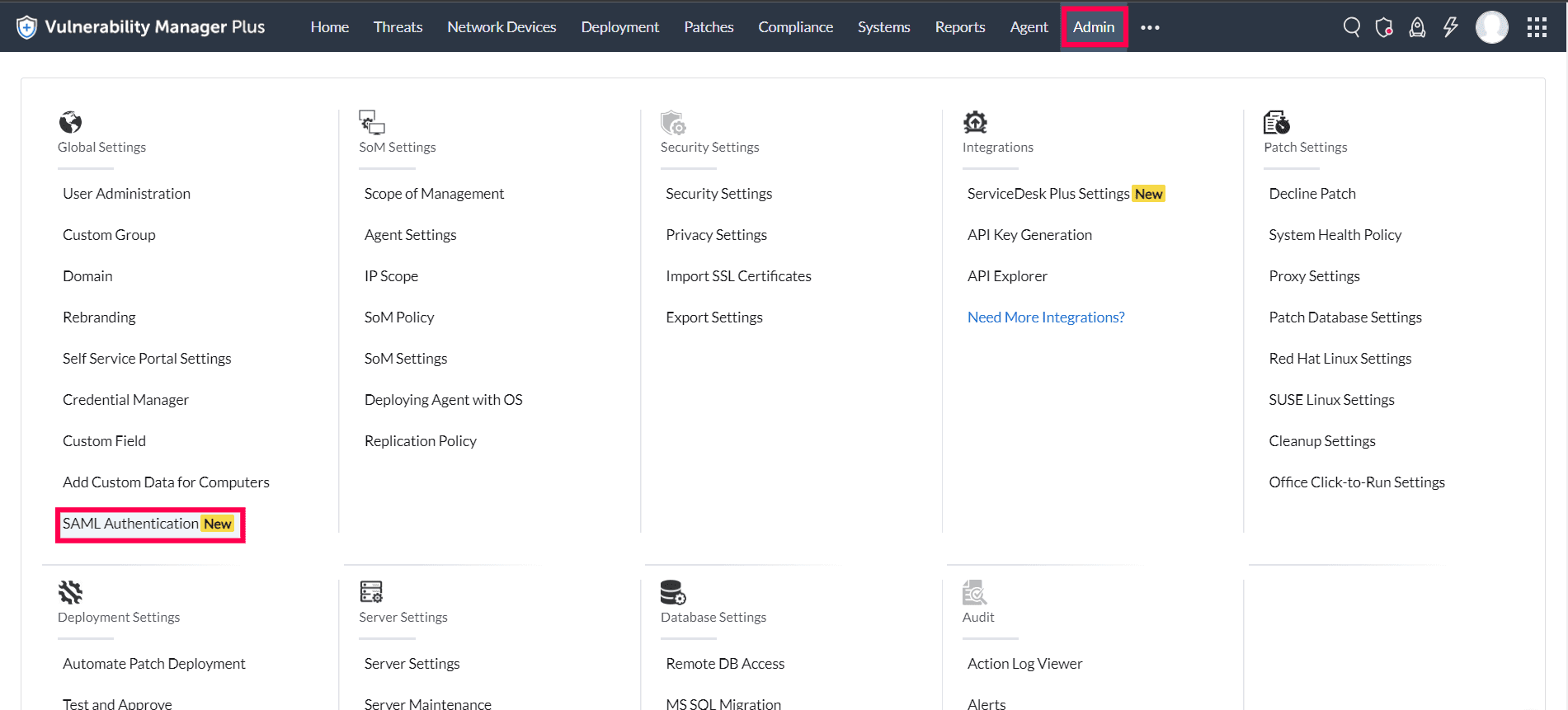
- Log in to Vulnerability Manager Plus with administrator credentials.
- Navigate to Admin > SAML Authentication.
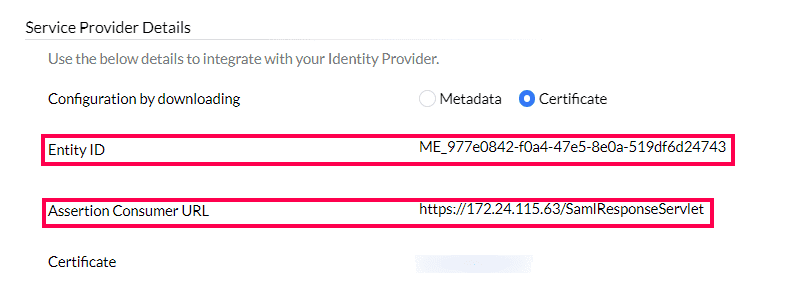
- Copy the values of the Entity Id and the Assertion Consumer URL from the Service Provider Details section; these will be used later.
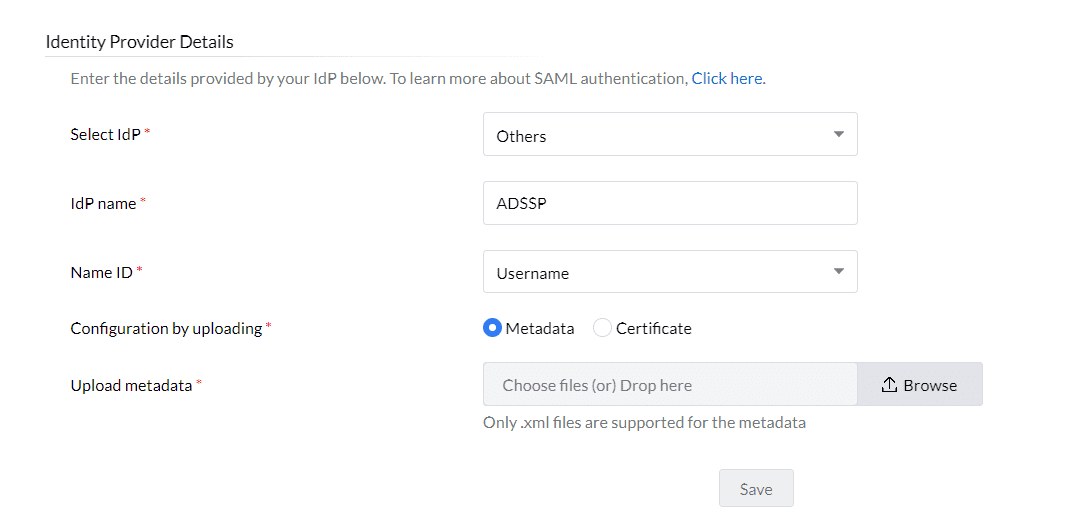
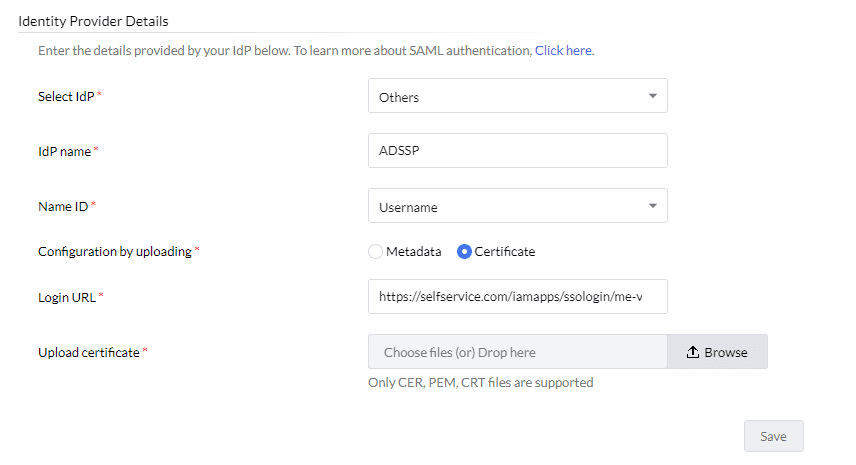
- In the Identity Provider Details section, select Others from the Select IdP drop-down.
- Enter a name for ADSelfService Plus (for example, ADSSP) in the IdP name field.
- Choose a Name ID to map users from ADSelfService Plus with Vulnerability Manager Plus. The username is the default option.
- In the Configuration by uploading field, you can either choose to upload the identity provider Metadata file or configure identity provider information using a Certificate.
- To use the Metadata option, choose Metadata. Click Browse and upload the metadata file downloaded in step 5a of the prerequisites.
- If you choose to configure identity provider information using a certificate, click Choose Certificate and enter the Login URL value copied in step 5b of the prerequisites.
- Click Browse and upload the X.509 certificate file downloaded in step 5b of the prerequisites.
- Click Save.
ADSelfService Plus (identity provider) configuration steps
- Switch to ADSelfService Plus' Vulnerability Manager Plus configuration page.
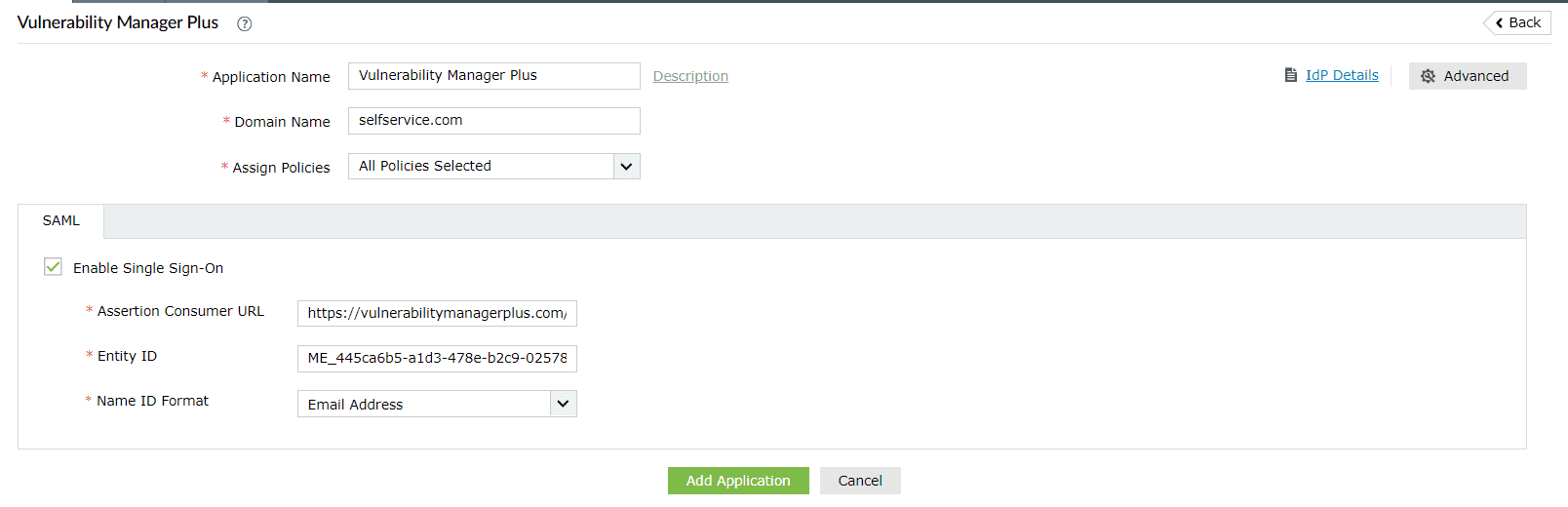
- Enter the Application Name and Description.
- Enter the Domain Name of your Vulnerability Manager Plus account. For example, if you use johndoe@vmp.com to log in to Vulnerability Manager Plus, then vmp.com is the domain name.
- In the Assign Policies field, select the policies for which SSO needs to be enabled.
- Select the SAML tab and check Enable Single Sign-On.
- In the Assertion Consumer URL field, enter the Assertion Consumer URL copied in step 3 of Vulnerability Manager Plus configuration.
- In the Entity ID field, enter the Entity Id value copied in step 3 of Vulnerability Manager Plus configuration.
- In the Name ID Format field, choose the format for the user login attribute value specific to the application.
- Click Add Application.
Note: ADSelfService Plus allows you to create OU- and group-based policies for your AD domains. To create a policy, go to Configuration > Self-Service > Policy Configuration > Add New Policy.
Note: Use Unspecified as the default option if you are unsure about the format of the login attribute value used by the application.
Your users should now be able to sign in to Vulnerability Manager Plus through the ADSelfService Plus portal.
Note: For Vulnerability Manager Plus, both SP-initiated and IdP-initiated flows are supported.