

Last updated on: June 27, 2025
Whether tracking the MTTR or ticket closure rates, traditional reports and dashboards help capture the operational efficiency of IT service desks. However, to truly align ITSM operations with business goals, IT leaders and service desk managers must drive strategic service improvements. To this end, they need in-depth insights into areas that influence service outcomes, including incident trend analysis, SLA compliance, agent productivity, and asset financials. That's why it is essential to embed decision intelligence into your ITSM operations.
In this article, we will explore how the integration between ServiceDesk Plus and Analytics Plus helps organizations harness AI-powered analytics to gain intelligent, actionable insights to drive smarter, faster ITSM decisions.
To understand this better, let's examine the case of a fictional organization, Zylker, and the decision gridlock it faced without advanced analytics.
Zylker's decision paralysis:
The 4 key scenarios

Zylker, a renowned global bank, was on a mission to deliver world-class digital banking experiences. As part of this vision, its IT leaders focused on driving strategic ITSM improvements while managing everyday service operations. A key priority for the team was to strengthen its security incident response strategy while ensuring SLA compliance and avoiding technician burnout.
However, Zylker’s progress was hampered by traditional reporting mechanisms that lacked advanced analytics. The absence of real-time, contextual insights led to a state of decision paralysis, stalling critical actions across the service desk. Here's how:
- Manual compilation of security incident reports from scattered data, delaying responses
- Poor visibility of technician workloads due to complex datasets, creating an imbalance
- SLA complications arising from overlooked dependencies, violating timely targets
- Manual guesswork to identify and overcome bottlenecks, leading to inefficient ITSM operations
Now, let’s walk through how Zylker turned things around by integrating the two solutions to tackle each challenge head-on.
Generating security incident reports and dashboards by conversing with Zia, our native AI-powered virtual assistant

To strengthen its incident response plan, Zylker first had to evaluate its existing processes and uncover critical roadblocks, but this proved challenging. Key data was scattered across multiple systems, requiring IT leaders to compile reports from scratch manually. The process demanded complex queries, often resulting in the selection of inaccurate metrics.
Because these reports remained inaccessible to the relevant stakeholders, they were unable to gather actionable insights quickly, slowing decision-making further. Altogether, this fragmented approach made reporting both time-consuming and error-prone, ultimately inhibiting Zylker’s ability to plan a proactive, effective incident response strategy.
The edge obtained with the integration
To overcome the grind of building complex reports manually, Zylker leveraged the integration between ServiceDesk Plus and Analytics Plus. Instead of Zylker expending disproportionate time and effort, Zia, our AI-powered virtual assistant, used conversational intelligence to help generate visually rich, comprehensive reports and dashboards on the fly. With Ask Zia, the conversational interface of Zia, service desk managers could ask simple questions in natural language to stitch the right context in a single location, eliminating the hassle of complex queries.
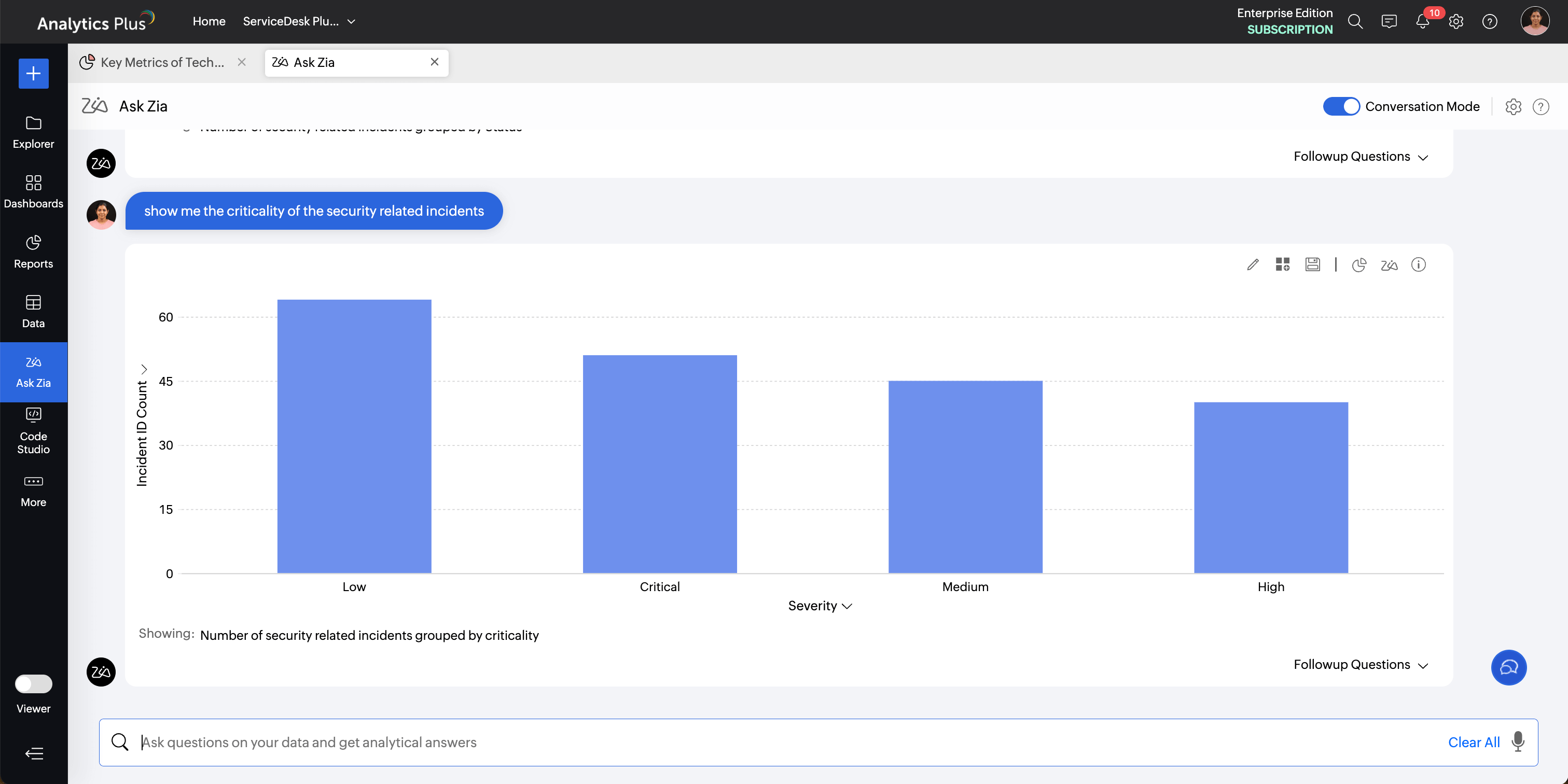
When Zylker’s service desk team needed to plan its incident response strategy, it set out to build a security incident tracker. Starting with a simple prompt like "Show the count of security-related incidents," it followed up with questions about the severity, status, average resolution time, and SLA compliance (Fig. 1). Zia translated each question into widgets with rich visualizations (bar graphs, trend lines, and speedometers), offering clear, visual insights into service health.
By stacking up these widgets into a cohesive dashboard, the team tracked crucial information in a single pane. It further customized the layout and appearance to surface what matters, creating an intuitive, user-friendly interface. Embedding the dashboard generated from Analytics Plus directly within ServiceDesk Plus, the team enhanced collaboration among its peers without juggling multiple windows (Fig. 2).
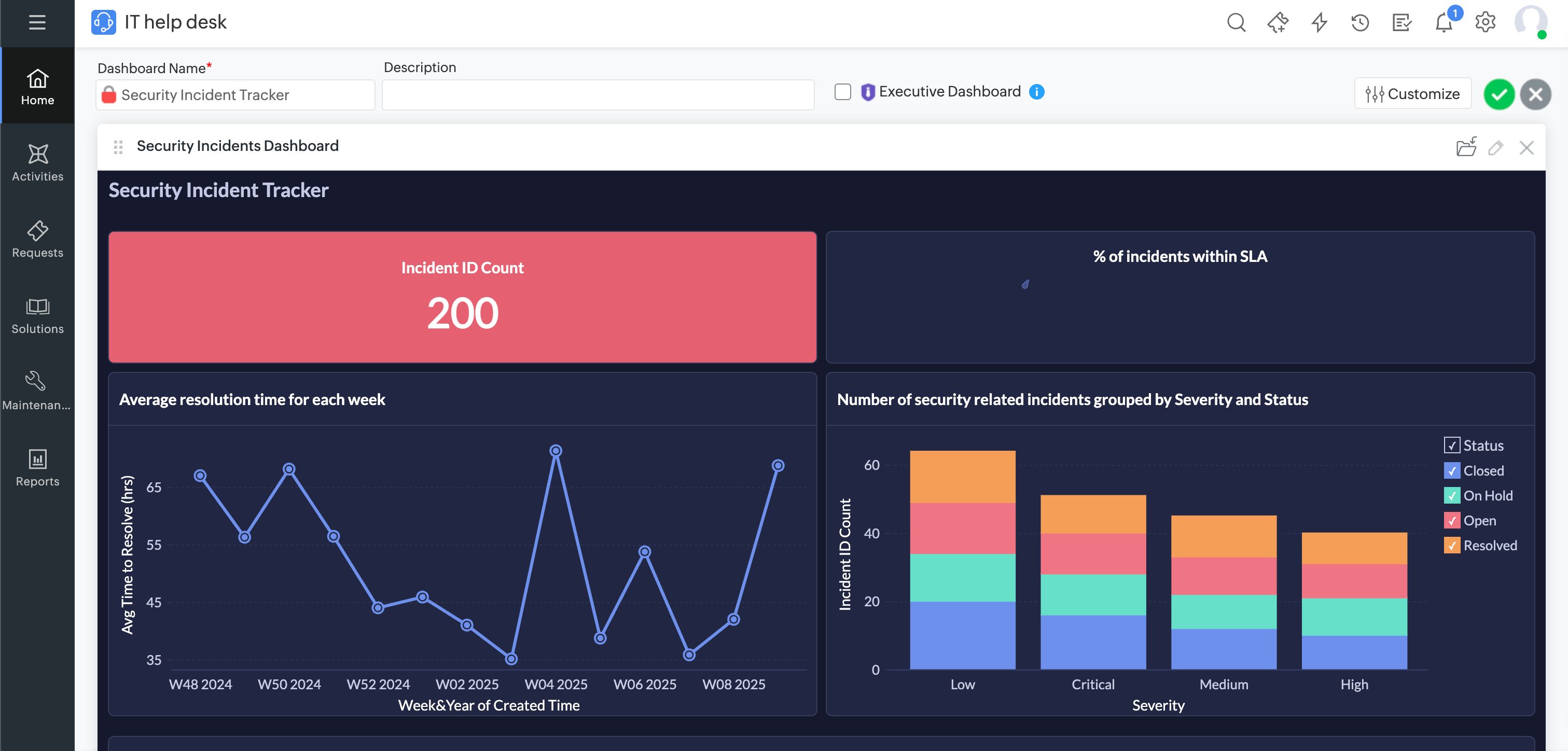
Thus, with just a few conversational prompts, Zylker transformed the way it built reports and dashboards, accelerating decisions and unlocking deeper operational insights.
Optimizing technician workloads by gaining contextual, GenAI-powered insights

At Zylker, IT leaders firmly believed that empowered, well-supported technicians were the backbone of timely service delivery. Yet their metrics told a different—and alarming—story. Technician utilization had soared past 100% as the technicians worked overtime, and ticket backlogs were piling up beyond 50 tickets. Far from being in control, the team was spiraling towards burnout.
Despite having a wealth of data at their fingertips, Zylker’s service desk managers found themselves paralyzed because complex datasets and raw graphs offered little actionable context. Instead, they had to manually review numerous reports at once, including the ticket resolution time report, ticket volume by technician report, and ticket backlog by technician report, hindering the gathering of insights to correlate workload trends. Furthermore, this approach resulted in inconsistent interpretations due to hidden variables, preventing them from addressing the workload management challenge.
The edge obtained with the integration
Rather than manually sifting through cluttered, data-heavy reports, Zylker tapped into Zia Insights, powered by GenAI, to instantly generate concise, contextual descriptions with just a click. This allowed the service desk managers to explore component KPIs, uncover trends, and identify underlying factors—all without complex calculations.
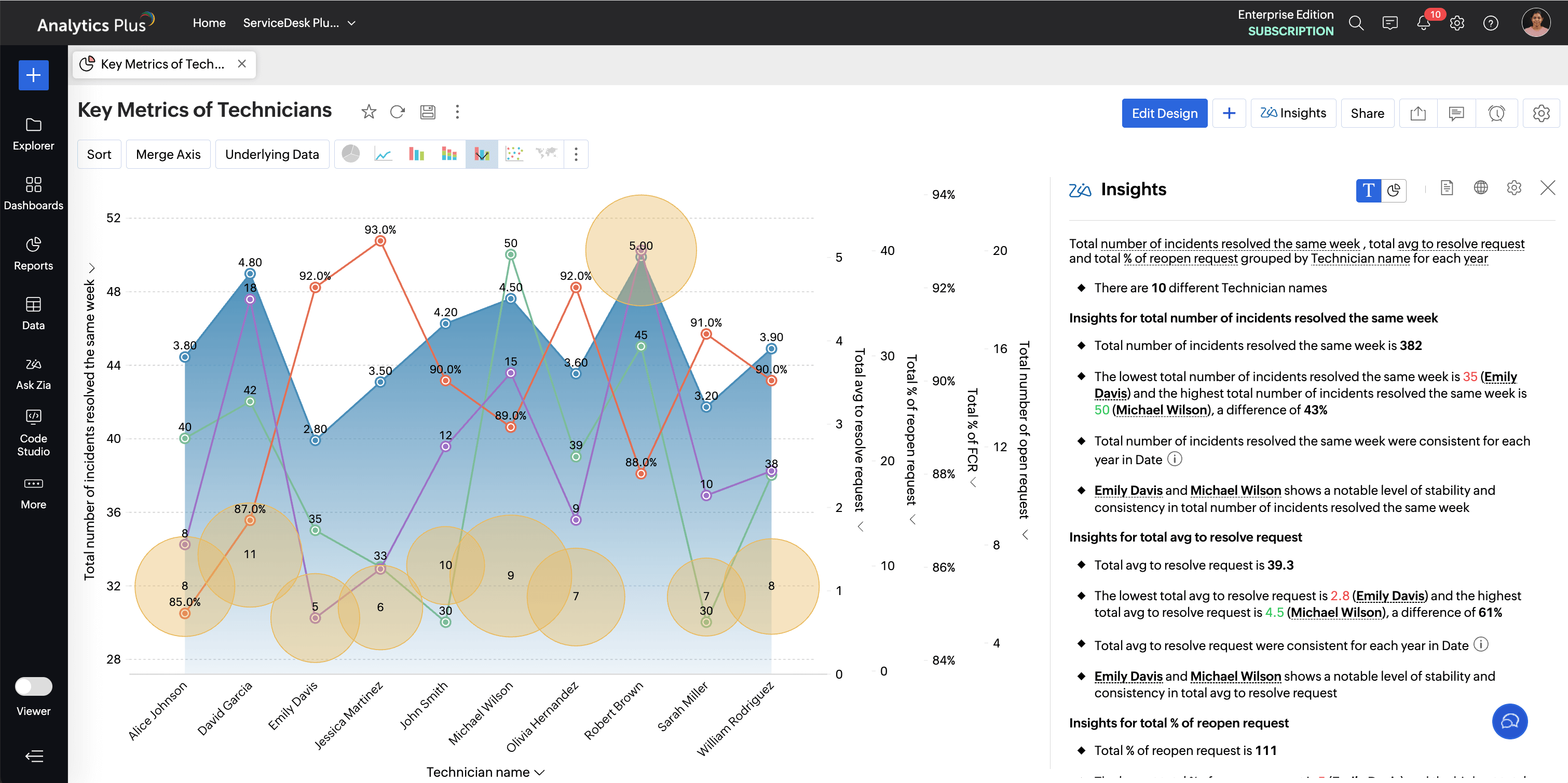
To help optimize technician workloads, Zia Insights presented key trends—the number of incidents resolved, average time taken, and percentage of reopened requests per technician—in both textual and visual formats. By analyzing these metrics, Zia flagged performance deviations, enabling early interventions.
For instance, Zia highlighted the total percentage of reopened requests in the service desk as 111%. Delving further, it analyzed the overall fluctuations in the reopened request rates, including the spikes and drops, while also identifying the contributors to this pattern. Zia showed that Emily Davis had the lowest count of reopened requests (5), while Michael Wilson had the highest (9), indicating a stark difference of 80%—all without manual calculations (Fig. 3). To address this, Zylker planned a timely upskilling program unique to Michael's requirements to boost his performance.
When service trends shifted, like a sudden drop in SLA compliance, Zia’s key driver analysis capability dove deeper, identifying root causes, such as a surge in high-priority requests—again with zero manual effort. Ultimately, Zia transformed raw data into clear, actionable insights, empowering Zylker’s service desk managers to better plan, distribute workloads, and prevent technician burnout.
Achieving SLA compliance with no-code, ML-powered forecasting techniques

Zylker’s IT leaders viewed timely service delivery as essential for smooth banking operations, and they’d set an ambitious goal: maintaining SLA compliance above 95%. However, they found it daunting to hit this target because they overlooked various dependencies.
Zylker’s service desk managers heavily relied on historical data instead of forecasting future demands, blinding them to evolving service dynamics. They often missed the influence of emerging or external factors—like seasonal demand spikes or process shifts—that silently skewed SLA performance. What’s more, ticket management bottlenecks were hidden in plain sight, pushing critical requests closer to breaches without anyone noticing until it was too late. As a result, Zylker’s SLA targets slipped just out of reach.
The edge obtained with the integration
To prevent SLA breaches and stay ahead of the curve, Zylker's service desk managers leveraged Analytics Plus' no-code ML engine to generate actionable forecasts tailored to their unique service environment.
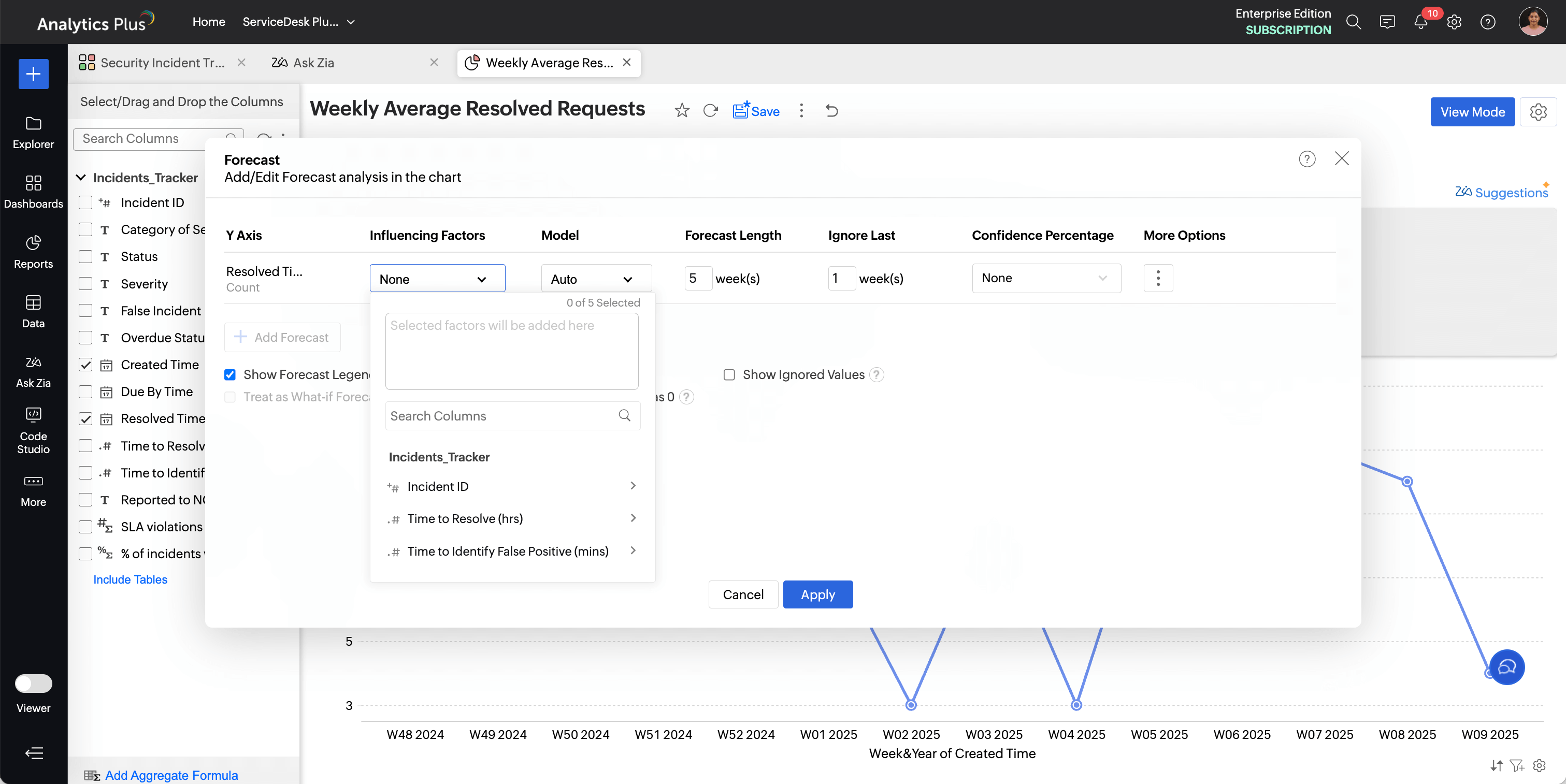
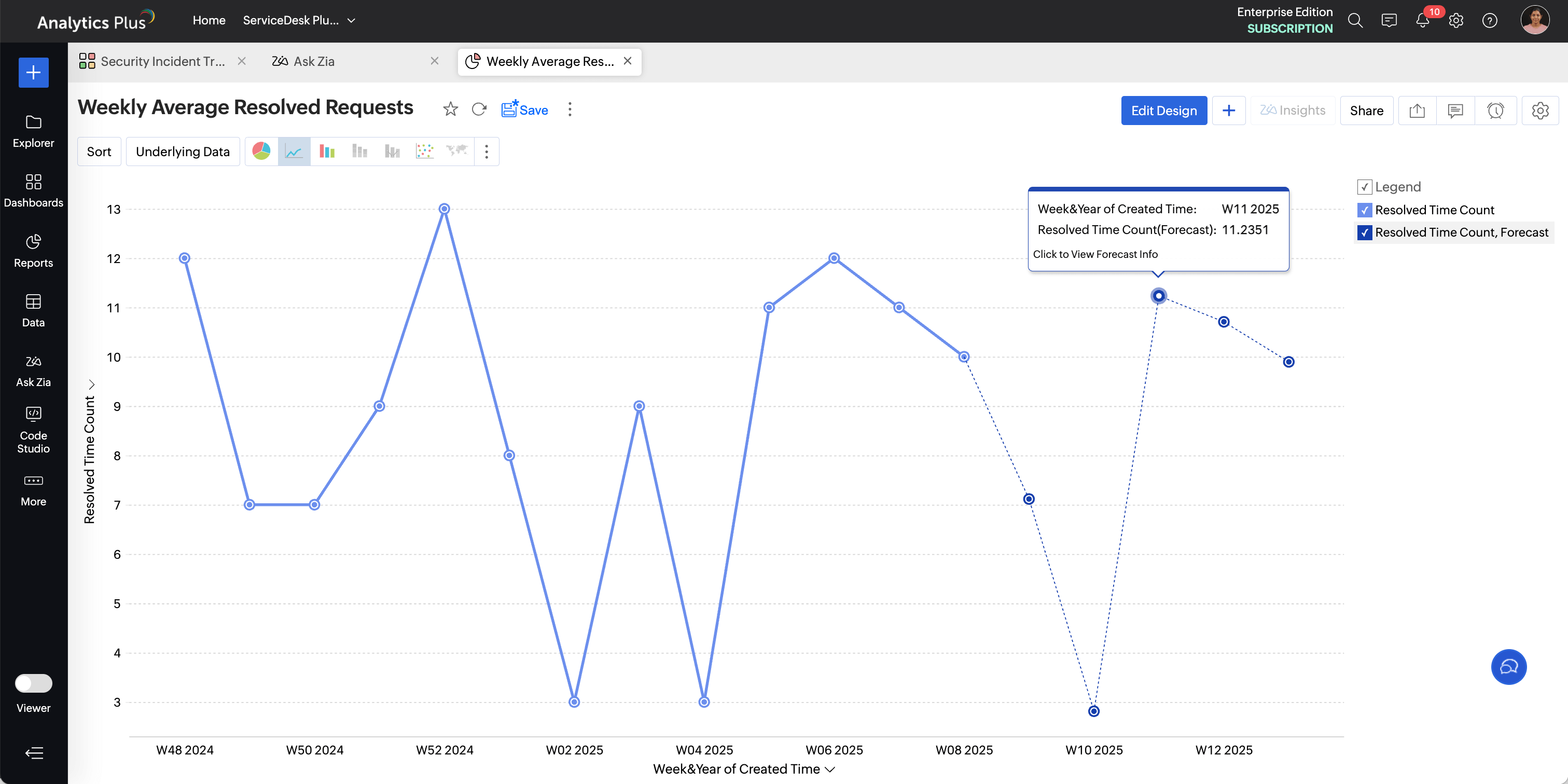
They tracked the weekly average of resolved requests to gain visibility into the technician workload balance, seasonal resolution trends, and backlog efficiency. To improve resource planning for the weeks ahead, they forecasted this weekly average KPI by factoring in key influences, such as the volume of incoming requests and the average resolution time (Fig. 4). Analytics Plus automatically selected the optimal forecasting model (vector autoregression), delivering a five-week outlook (Fig. 5). These predictions revealed upcoming dips or spikes in resolution activity, enabling the team to allocate technicians more strategically and mitigate SLA risks.
Beyond forecasting, the managers also harnessed the AutoML capabilities to build custom, no-code ML models that learn from historical ticket data, uncover patterns, and proactively manage escalation risks. While developing these models, they factored in key attributes (such as the ticket priority and category) and selected appropriate classification algorithms (like decision trees or random forests) to fine-tune the predictions. Once deployed, the models identified open tickets likely to be escalated, empowering the team to take early action, reassign resources, and consistently meet time-based targets.
Enhancing decision intelligence across ITSM modules with Spotlight

To achieve continual service improvement, Zylker set out to analyze its existing ITSM practices and identify areas for enhancement. Yet it quickly ran into a familiar roadblock: information overload.
Despite having access to vast amounts of ITSM data, Zylker struggled to make sense of it, resulting in operational blind spots. This made it difficult to pinpoint what was working, what wasn’t, and where improvements were needed.
Without a clear data strategy, teams resorted to manual guesswork, leading to ineffective operations and stalled progress. To make matters worse, decision fatigue crept in as the teams tried to optimize multiple processes simultaneously—without the insights to guide them. Every improvement initiative became a shot in the dark, with no way to connect the right dots.
The edge obtained with the integration
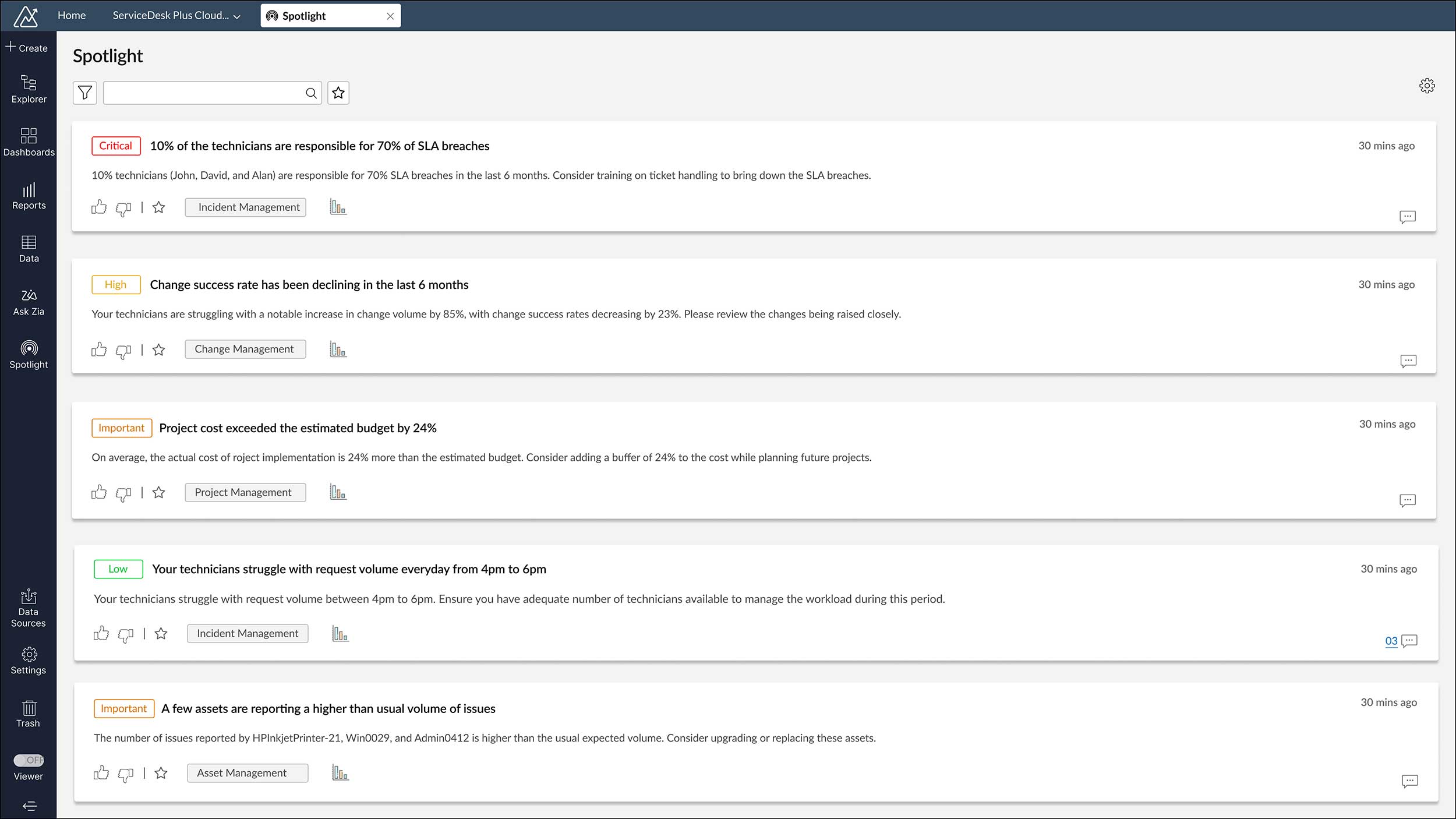
Rather than digging through lengthy reports or sifting through raw data, Zylker's service desk managers leveraged Spotlight, the powerful decision intelligence engine, to gain contextual, intelligent recommendations drawn directly from their ITSM data—across modules like incident, service request, change, and asset management.
Spotlight surfaced hidden bottlenecks while indicating their criticality, highlighted patterns, and offered suggestions for corrective action so teams could act fast and stay ahead (Fig. 6). For example, drawing their attention to a business-critical issue, it identified a spike in the ticket volume between 3 and 4pm and recommended increasing technician availability during that time. In another case, Spotlight flagged three requesters with repeated asset issues and suggested analyzing asset usage patterns to preempt future problems.
In short, Spotlight did the heavy lifting, helping the IT teams make timely, data-driven decisions and driving continual service improvement without the guesswork.
Final thoughts

As organizations advance in their ITSM maturity, the ability to make swift, intelligent decisions will set high-performing teams apart. Advanced analytics for ServiceDesk Plus powered by Analytics Plus transforms raw data into real-time decision intelligence, enabling IT teams to respond proactively, optimize continuously, and stay aligned with evolving business priorities. Looking ahead, decision intelligence will no longer be optional—it will be central to ITSM excellence. With ServiceDesk Plus and Analytics Plus working in tandem, organizations are well-positioned to turn every insight into an impact, shaping an ITSM strategy that not only meets today’s needs but anticipates tomorrow’s.