

On this page
Introduction
The Digital Personal Data Protection Act (DPDPA) is a landmark piece of legislation for India's digital economy, fundamentally changing how Indian enterprises handle personal data. If you're a CISO in a large organization, this means it's time to rethink, retool, and lead the charge in privacy-centric operations. Complying with the DPDPA isn't just a legal requirement; it's a strategic chance to build trust, strengthen governance, and fine- tune your security architecture in an increasingly digital world.
Consider web cookie collection. What was once a technical detail now stands front and center, embodying corporate responsibility and new opportunities. By mastering compliance, championing user-centric consent, and weaving privacy into your company's very brand, you'll do more than just mitigate regulatory risks. You'll also boost trust, cultivate loyalty, and enhance business resilience in a hyper-connected global landscape.
This in-depth guide aims to demystify the DPDPA's impact on cookie collection, reveal crucial implementation nuances that are often overlooked, and equip CISOs with the insights needed to transform compliance into a distinct competitive advantage.
A quick recap of DPDPA principles
The DPDPA is India's most comprehensive privacy law. It overhauls previous frameworks by introducing stricter consent requirements, robust data principal (user) rights, stringent penalties, and special rules for cross-border transfers.
- Consent-first processing: Organizations must secure explicit, informed, granular consent before any data collection or processing, including via cookies.
- Purpose limitation: Data collected for a specific, stated use must not be repurposed or shared outside its original context.
- Data minimization: Only data strictly necessary for the stated business objective may be collected—no more and no less.
- Transparency and user rights: Users have broad rights, such as viewing, correcting, deleting, or transferring their data as well as withdrawing consent at any time.
- Stringent penalties: Noncompliance may result in fines of up to ₹250 crore per contravention, making this one of the world’s toughest privacy laws.
Cookie collection under the DPDPA: What’s changed?
On April 15, 2025, the National e-Governance Division under the Ministry of Electronics and Information Technology released the Business Requirements Document for the Consent Management System (BRDCMS), a pivotal advisory that redefines how Indian businesses must handle cookie consent in alignment with the DPDPA. Though cookies aren’t explicitly defined in the DPDPA, the BRDCMS bridges this gap, outlining actionable standards for consent life cycle management.
Granular consent: Say goodbye to all or nothing
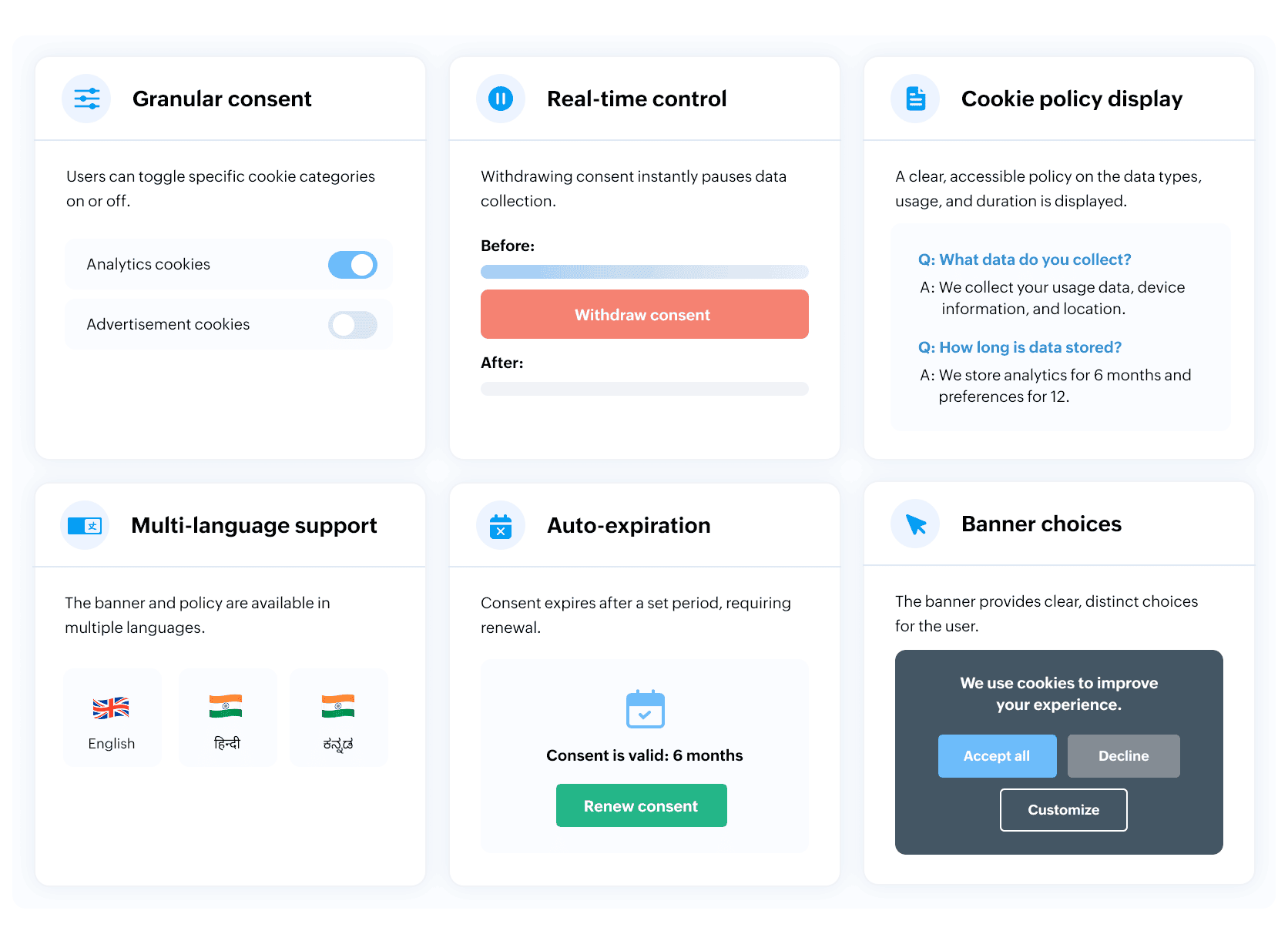
The BRDCMS emphasizes granular consent options—a must for lawful cookie deployment. Users should be empowered to:
- Accept or reject specific cookie categories (e.g., analytics, advertising, and functional cookies).
- Understand exactly what they’re consenting to, in line with Section 6 of the DPDPA on informed, purpose-specific consent.
This nuanced approach enhances transparency while reducing the risk of blanket opt-ins that violate consent standards.
Real-time consent updates: Control back in the users' hands
Under BRDCMS recommendations, cookie preference dashboards must:
- Allow users to modify or revoke consent instantly.
- Be easily accessible via privacy settings or website footers.
- Ensure that revoked consent triggers the immediate cessation of cookie tracking.
Real-time responsiveness is critical to staying compliant with the DPDPA’s principles of ongoing, revocable consent.
Cookie policies: Clear and transparent
To fulfill the DPDPA’s commitment to transparency:
- Cookie policies must explain the what, why, how, and who regarding cookie data.
- Cookie policies should include the duration, purpose, third-party sharing practices, and data retention specifics.
- These policies should be easy to navigate and linked prominently near consent interfaces.
Inclusive by design: Multi-language support is required
In alignment with Section 5(3) of the DPDPA, cookie notices and interfaces must support:
- Multiple Indian languages to ensure accessibility.
- User comprehension across diverse linguistic groups. This inclusion isn’t optional; it’s foundational to lawful notice delivery.
Automated expirations for cookies and preferences
To support data minimization and retention principles, the BRDCMS calls for:
- Auto-expiration mechanisms that deactivate cookies and consent records after predefined periods.
- Alignment with sector-specific retention timelines to avoid over-collection.
Cookie banners: First impressions matter
Your cookie notice banner must deliver:
- Concise, up-front information about cookie usage.
- Actionable choices like Accept all, Reject non-essential cookies, or Customize settings. This interaction sets the tone for informed consent and user trust from the moment users land.
A CISO’s roadmap: Technical and governance imperatives
For CISOs, compliance with the DPDPA is not a check-the-box exercise; it requires systemic changes in people, processes, and technology.
1. Data mapping and discovery
- Conduct comprehensive discovery of all personal data flows, mapping every cookie and tracking technology deployed on company websites, apps, and digital assets.
- Examine and document:
- Data types captured by each cookie.
- Storage locations (on premises, in the cloud, or with third parties).
- How long data is retained and when it is deleted.
- The purpose and legal basis for each processing activity.
2. Privacy by design for cookies
- Redesign your consent management platforms and cookies to embody privacy by design:
- Preemptively limit data collection.
- Integrate user-friendly dashboards for real-time consent changes.
- Localize notices in Indian languages for accessibility, as required by law.
3. Infrastructure and vendor risks
- Audit third-party vendors, such as AdTech, analytics, and MarTech providers, for their cookie collection and compliance posture.
- Insert DPDPA-specific provisions in contracts; require vendors to support consent withdrawal and data access and deletion requests and prohibit the unauthorized reuse of data.
- Monitor for unauthorized third-party cookies via automated tools and periodic manual reviews.
4. Security enhancements
- Augment encryption, access controls, and anonymization for all data harvested through cookies.
- Harden technical boundaries, especially for high-traffic web properties and customer-facing platforms.
- Establish a robust incident response mechanism for potential data breaches, with clear reporting and remediation protocols.
5. Data retention and automated deletion
- Enforce strict retention schedules and the automated deletion of data (and cookies themselves) once retention purposes end.
The living consent paradigm
A unique, not explicitly stated DPDPA imperative for CISOs is the operationalization of living consent in the context of cookies—a concept moving beyond traditional set-and- forget practices.
- Consent evolving with user engagement: When a user changes their cookie preferences (from analytics to only essential cookies, for example), back-end systems must instantaneously halt collection for those categories. There can be no lag in honoring revised consent settings.
- Granular consent records: CISOs must ensure comprehensive logging of each consent action and its scope, maintain historical audit trails, and ensure there is no scope creep over time.
- Multi-channel respect for choices: Consent and preferences expressed on one platform (web, app, or mobile) should be respected and synchronized across all other digital touchpoints of the enterprise—an expectation that goes beyond most global privacy laws and will be scrutinized by Indian authorities as guidance matures.
In a large enterprise, customer journeys are omni-channel. Failing to respect living consent across all user touchpoints is a compliance—and reputational—minefield.
How smarter cookie management wins customers and partners
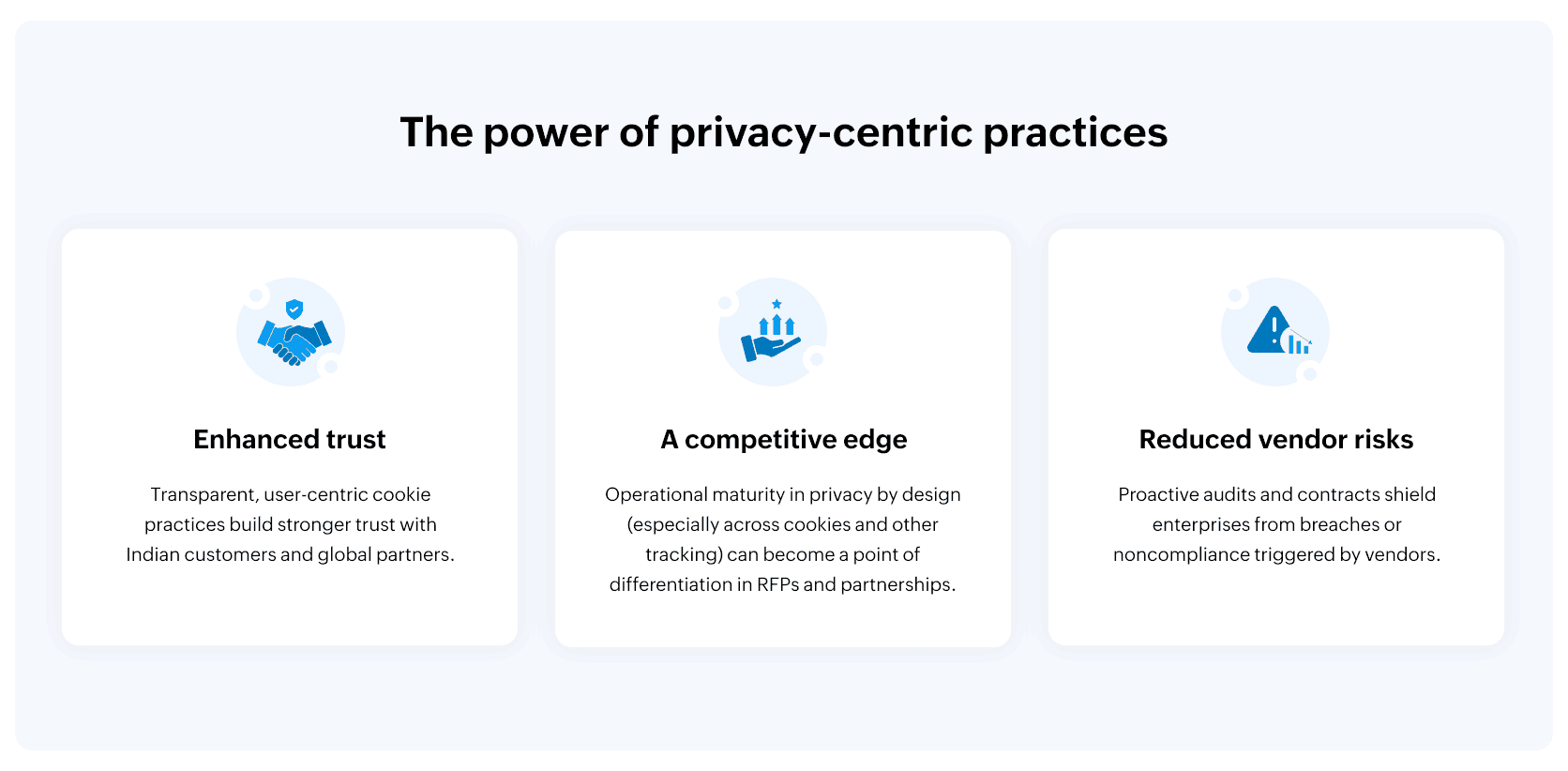
Enhanced trust
Transparent, user-centric cookie practices signal accountability and respect for user data, which are critical differentiators in markets like India where digital literacy and privacy awareness are rising fast.
- For Indian consumers, provide clear disclosures and opt-in controls to enhance their sense of control and safety.
- For global partners, especially those aligned with the GDPR or CPRA, seeing Indian enterprises mirror these practices increases confidence in cross-border data sharing.
- Example: A BFSI firm that shows cookie categories by their purpose—marketing, analytics, or security—and offers granular controls sees lower bounce rates and higher engagement in digital onboarding flows.
A competitive edge
Operational maturity in privacy by design, particularly around cookie governance, can differentiate vendors during high-stakes RFPs.
- Companies that treat privacy as an embedded design principle, not just a legal check box, are more likely to meet evolving requirements from the European Union, DPDPA, or sector-specific guidelines.
- Enterprises showcasing automation in cookie life cycle management (flagging third-party trackers, auto-expiring noncompliant scripts, etc.) demonstrate forward-thinking practices that appeal to audit-heavy sectors like BFSI and healthcare.
- Impact: During RFPs, a vendor’s ability to show cookie risk reduction metrics and real-time dashboards can tilt decisions in its favor.
Reduced vendor risks
Proactive audits and contractual safeguards protect organizations from reputational or financial damage stemming from third-party violations.
- Given how often third-party scripts are embedded via MarTech platforms, a single noncompliant cookie from a vendor can violate user consent rules.
- Conducting cookie risk assessments as part of vendor due diligence helps enterprises quantify and mitigate exposure.
- Contracts should explicitly state cookie responsibilities: who owns consent tracking, what happens in case of a breach, and how often reviews occur.
- Benefit: Strong clauses and audit trails reduce liability during DPDPA enforcement or if a breach draws public scrutiny.
How CISOs must rethink cookies and consent under the DPDPA
As the DPDPA redefines India’s privacy landscape, CISOs must look beyond surface compliance, interpreting the evolving roles of cookies and consent as a strategic imperative. This isn’t just about shielding the organization from penalties; it’s about positioning it with confidence in front of partners and customers as a privacy-forward, trusted digital brand.
Here's what to know about the future of data collection:
Cross-border complexity
Global data flows, especially concerning large enterprises using global MarTech or AdTech, must now be vetted for compliance with DPDPA-sanctioned countries for data transfers. This brings heightened scrutiny to cookies that may send analytics and personalization data to international servers. Organizations may need to rely on region-specific data hosting or isolate Indian data flows.
Technological uncertainty
With the rise of server-side tracking, fingerprinting, and advanced analytics, the definition of a cookie is stretching. Forward-thinking CISOs will treat all user identifiers, regardless of their technical wrapper, as if they are included within the DPDPA’s consent framework, ensuring robust coverage.
Building for Indian diversity
The DPDPA uniquely demands multi-language accessibility for all user notices and choices. Building privacy controls that work seamlessly for India’s linguistic landscape will not only ensure compliance but also broaden true user inclusivity.
Digital brand identities
Most DPDPA guidance stops at compliance. But visionary CISOs can use privacy stewardship as a brand lever:
- Highlight user empowerment in marketing.
- Offer privacy certifications as part of digital onboarding.
- Transform privacy controls (including cookie banners) into interactive, value-driven modules, not obstacles, enhancing the overall digital experience.
This approach will position your enterprise as a proactive guardian of digital rights, not just a reluctant follower of mandates.
Related solutions
ManageEngine AD360 is a unified IAM solution that secures digital identities with adaptive MFA and role-based access control, helping prevent insider threats, even if credentials are compromised.
To learn more,
Sign up for a personalized demoManageEngine Log360 is a unified SIEM platform that combines UEBA, DLP, CASB, and SOAR capabilities to detect threats, protect networks, monitor the dark web, and automate responses, reducing breach impacts and compliance risks.
To learn more,
Sign up for a personalized demoThis content has been reviewed and approved by Ram Vaidyanathan, IT security and technology consultant at ManageEngine.