DDI Central IPAM Tower - Site view
A site represents a physical or geographical location - a data center, branch office, campus, or cloud region, that groups all IP resources tied to that location. In large or distributed networks, IP resources are spread across multiple locations, making it difficult to get a clear picture of what exists where.
The Site View in DDI Central's IPAM Tower solves this by organizing your entire IP inventory around physical locations, giving network administrators a location-first lens to manage, monitor, and troubleshoot IP infrastructure.
With Site View, you can see every cluster, supernet, subnet, and static subnet associated with each site, including both DDI Central managed subnets and unmapped subnets within your private LAN - all from a single interface.
Benefits:
- Quickly isolate network issues of a specific physical location for faster troubleshooting.
- Get a complete picture of IP utilization across all your sites in one place.
- Manage distributed networks from a centralized view without switching between tools.
- Track both DDI-managed and unmapped subnets within each site for full visibility.
- Ensure audit and compliance readiness by knowing exactly which IPs belong to which jurisdiction.
Site View supports three visualization modes - Table, Tree, and Cards, letting you switch between a structured overview, a hierarchical drilldown, and a quick health snapshot depending on what your workflow demands.
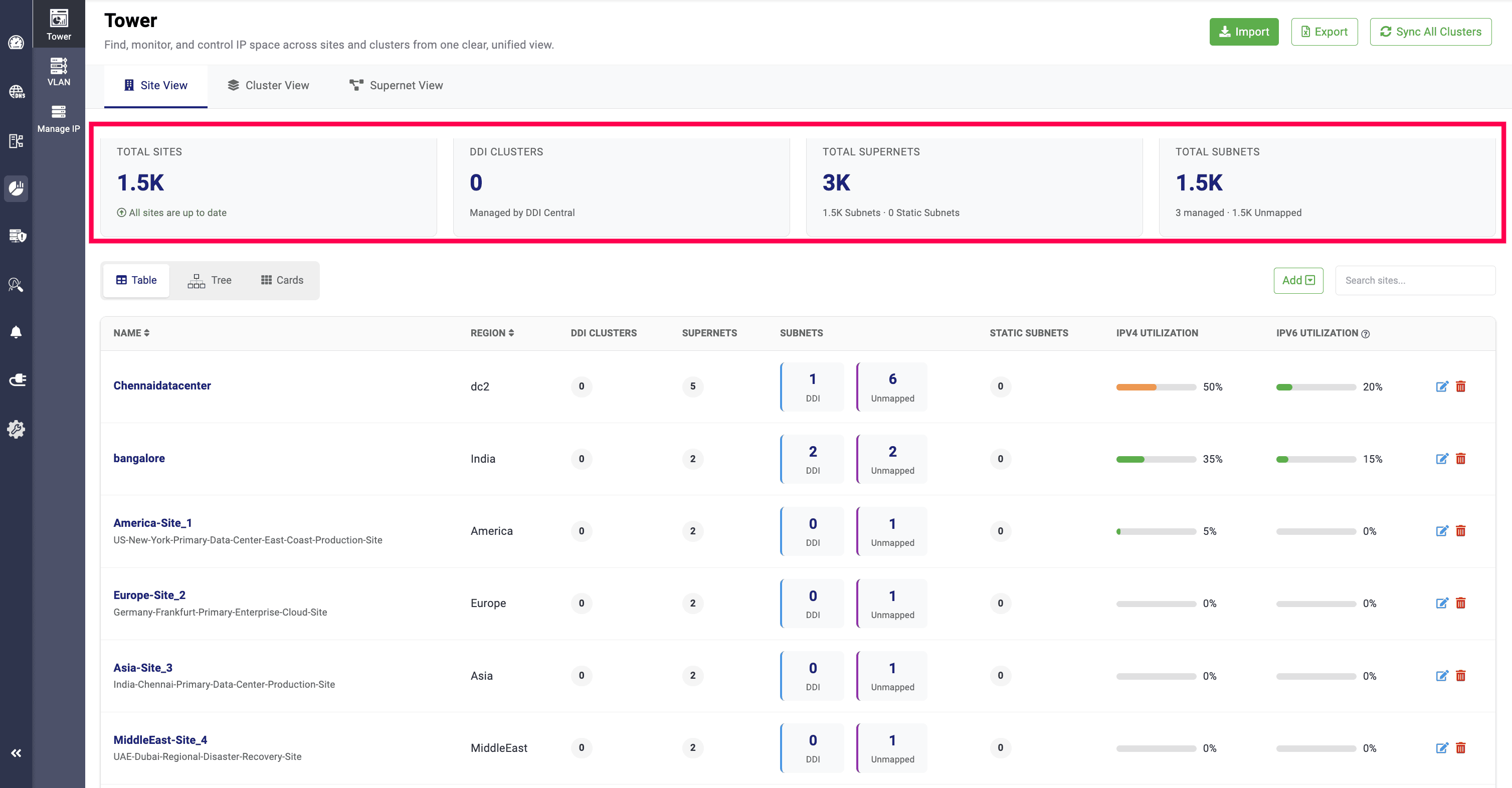
Here, the total number of sites created or imported in real time is displayed in the TOTAL SITES card, along with a timeframe highlighting recent updates and additions. The update timeframe is available for up to one year.
Clusters associated with sites are displayed in the DDI CLUSTERS card, with an indication that they are managed by DDI Central.
The total number of globally defined supernets is shown in the TOTAL SUPERNETS card, along with the total number of subnets and static subnets under those supernets.
Site table view
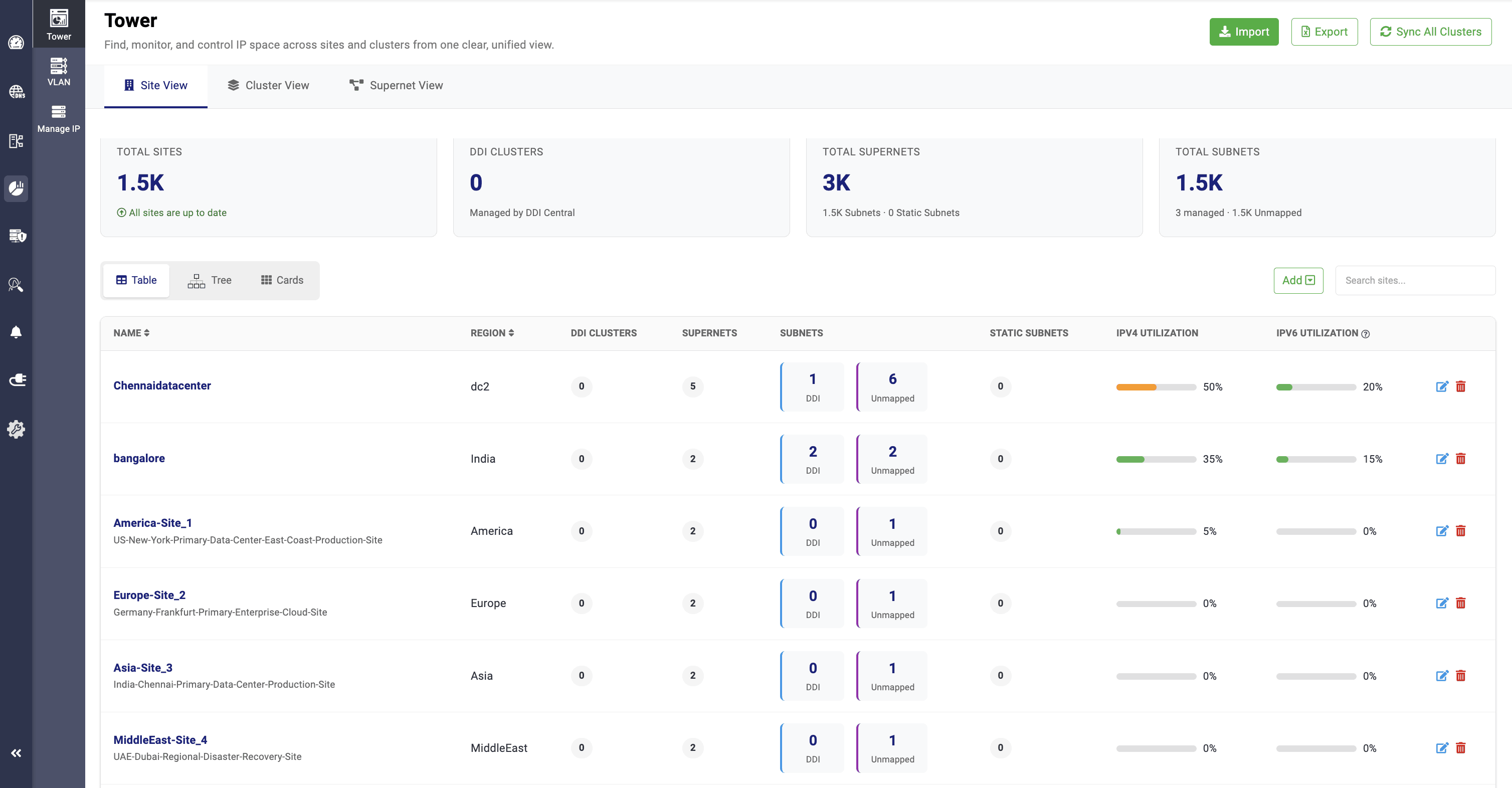
In the Table view, all sites are displayed along with their names, associated regions, total clusters managed by DDI Central, and total supernets. Subnets that are created and associated with sites are displayed as DDI, while subnets that are imported and not associated with any clusters are displayed as Unmapped.
In addition, the total number of static subnets within each site is displayed, and IP utilization is shown as a percentage.
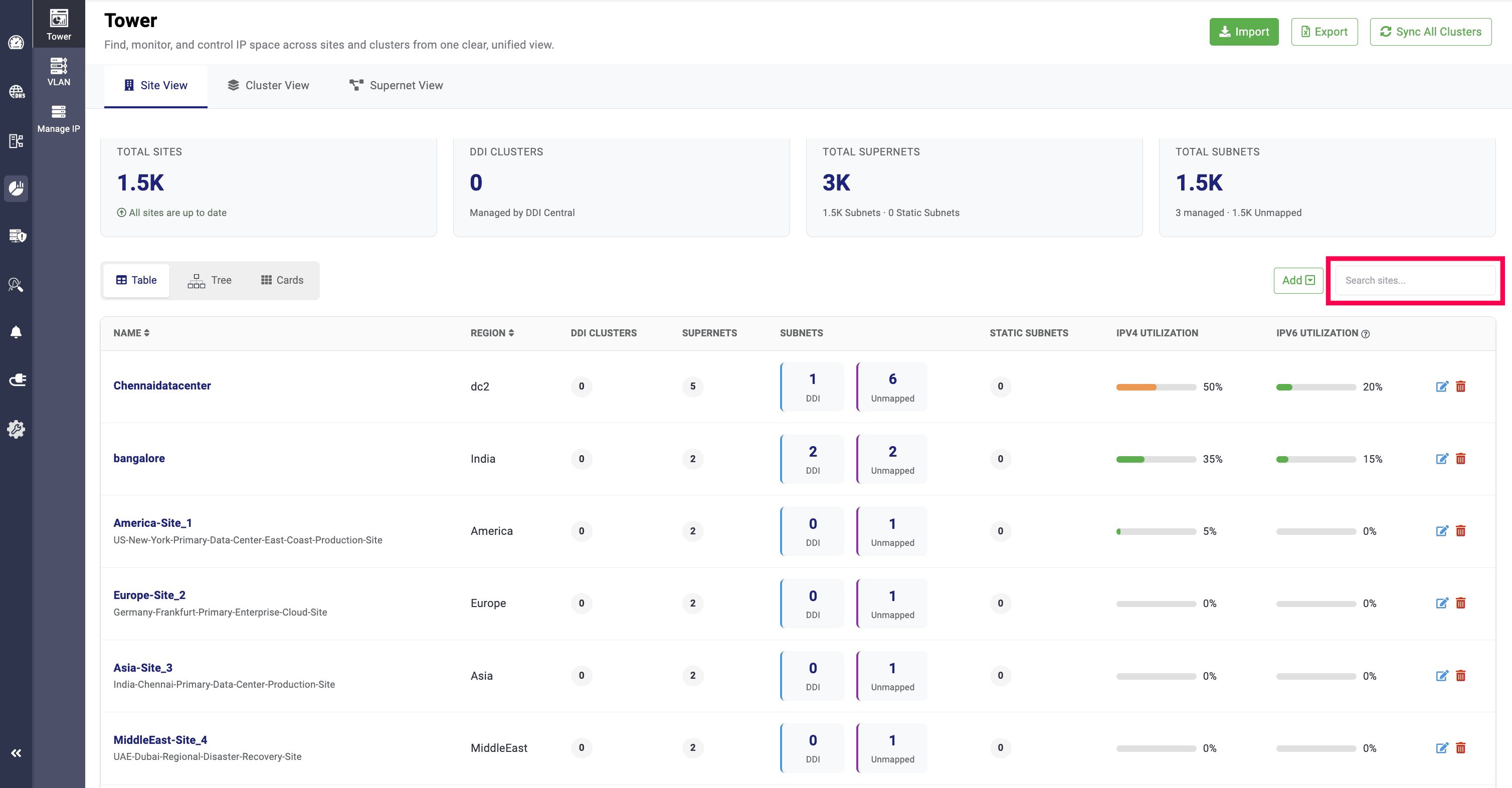
Specific sites can be searched by entering the site name in the Search Site field.
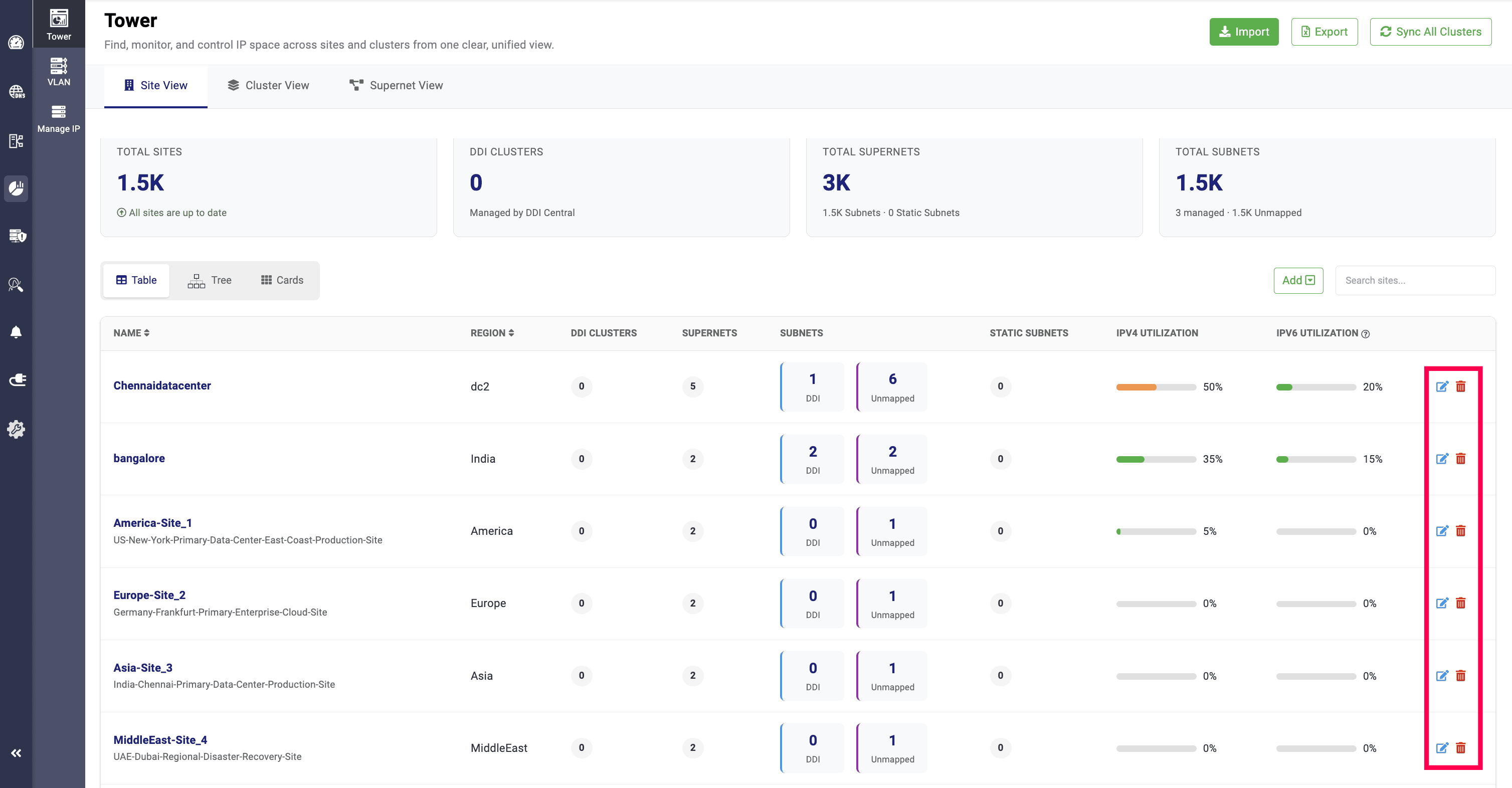
You can modify site configurations or remove created sites using the Edit and Delete options.
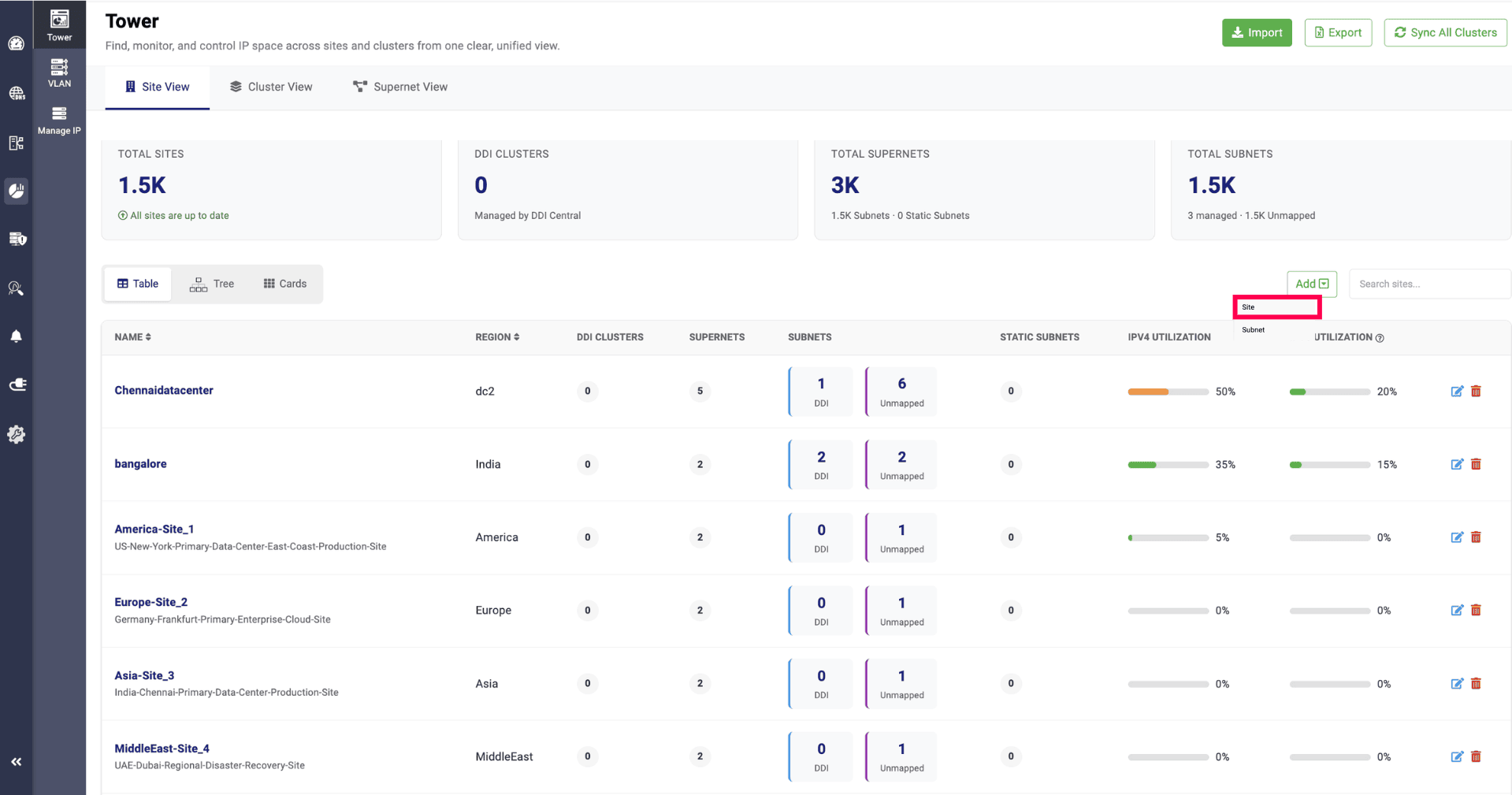
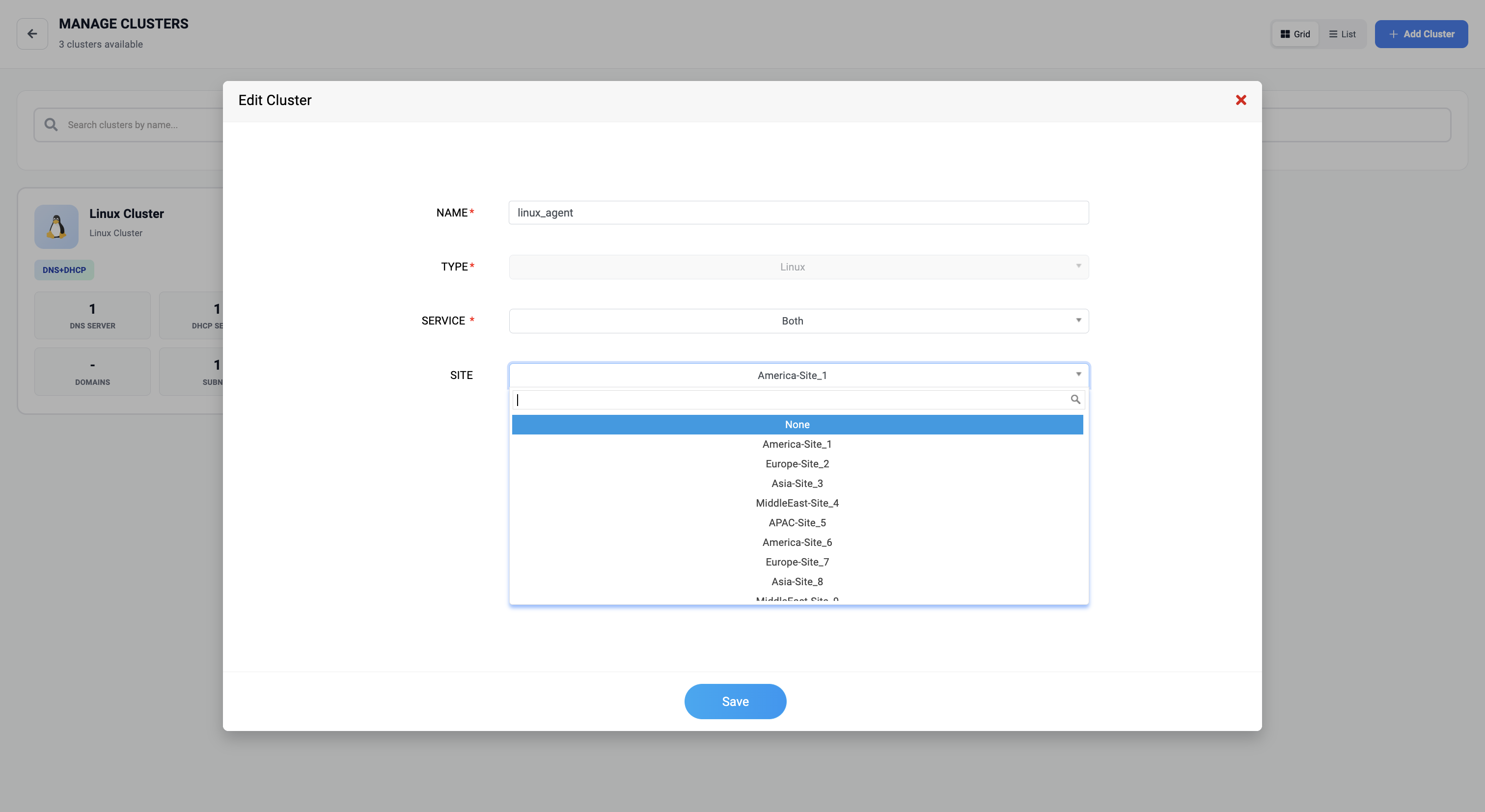
By clicking the Add Site option, you can create multiple sites and associate multiple clusters under a single site. However, a cluster cannot be associated with more than one site.
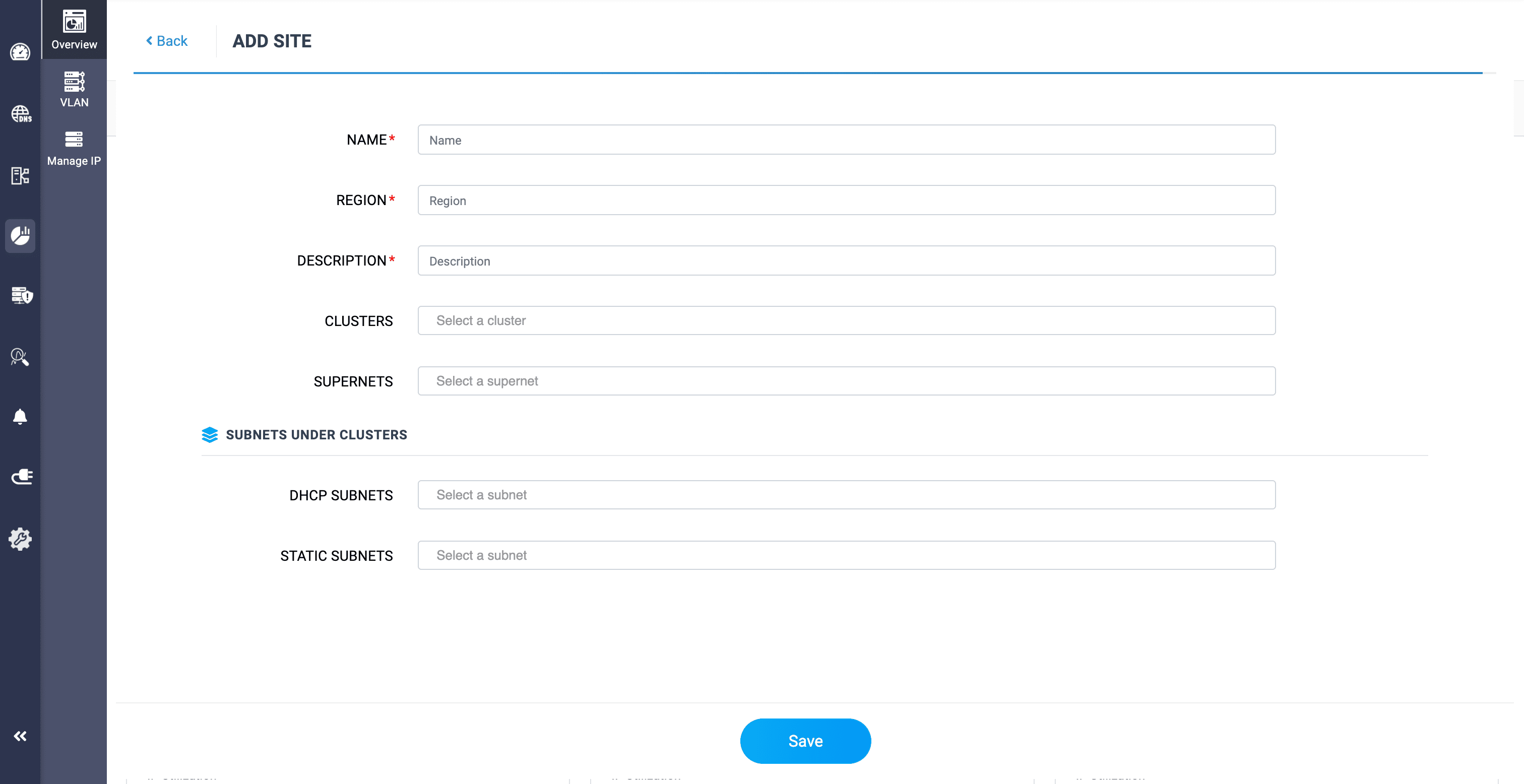
In the Add Site section, you must provide details such as the site name, the region to associate the site with, a description, and the clusters and supernets to be linked.
Multiple clusters can be selected under the CLUSTERS option.
Supernets that are unmapped as well as those within the selected clusters are displayed under the SUPERNETS option.
However, only subnets within the selected cluster(s) will appear under the DHCP SUBNETS option. The same rule applies to the STATIC SUBNETS option.
Multiple subnets across different clusters can be associated with a site.
The Region field is optional, and a site can be created without specifying a region.
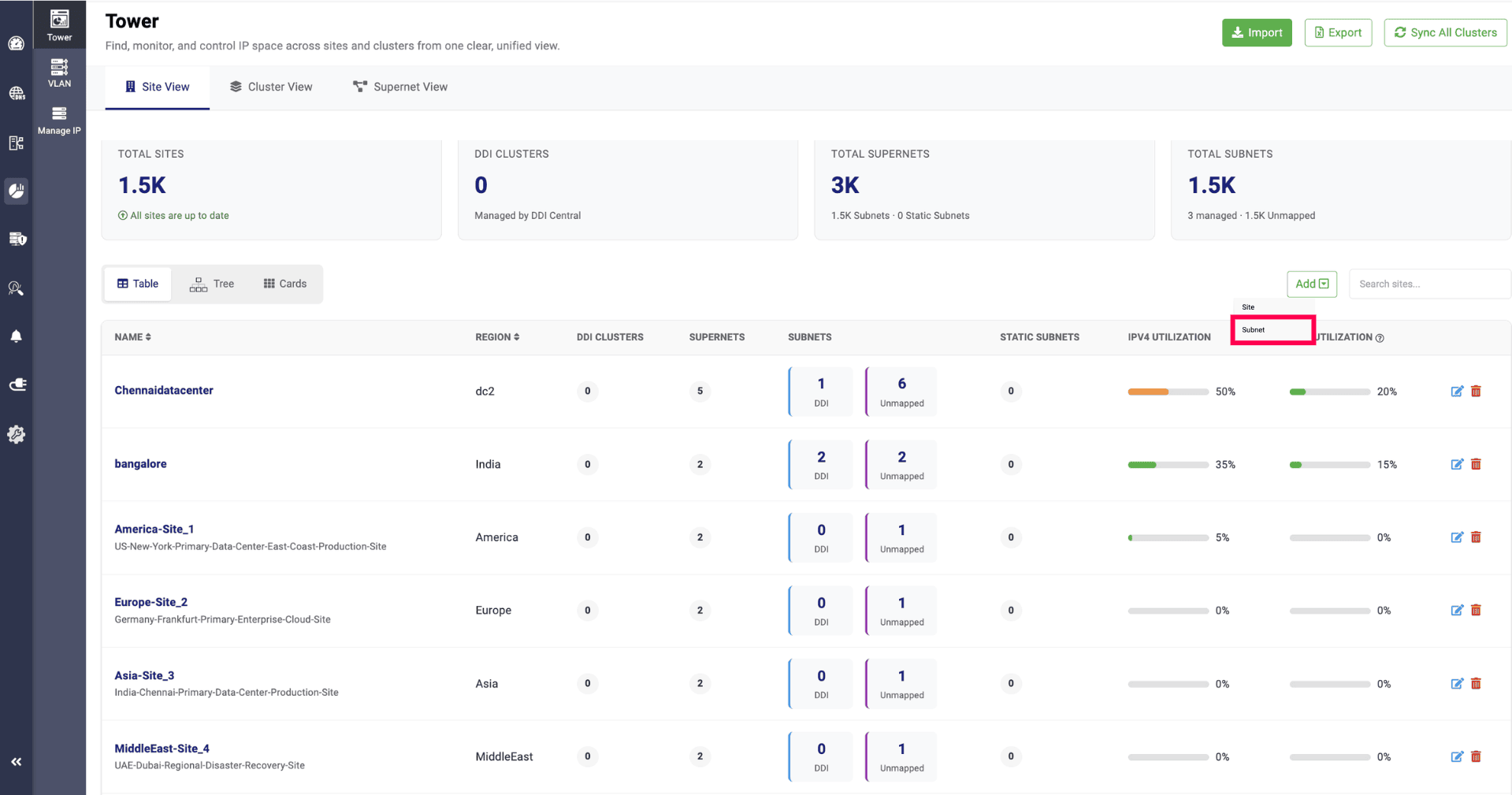
Clicking the Add Subnet option allows network administrators to add specific subnets under the clusters associated with the selected site.
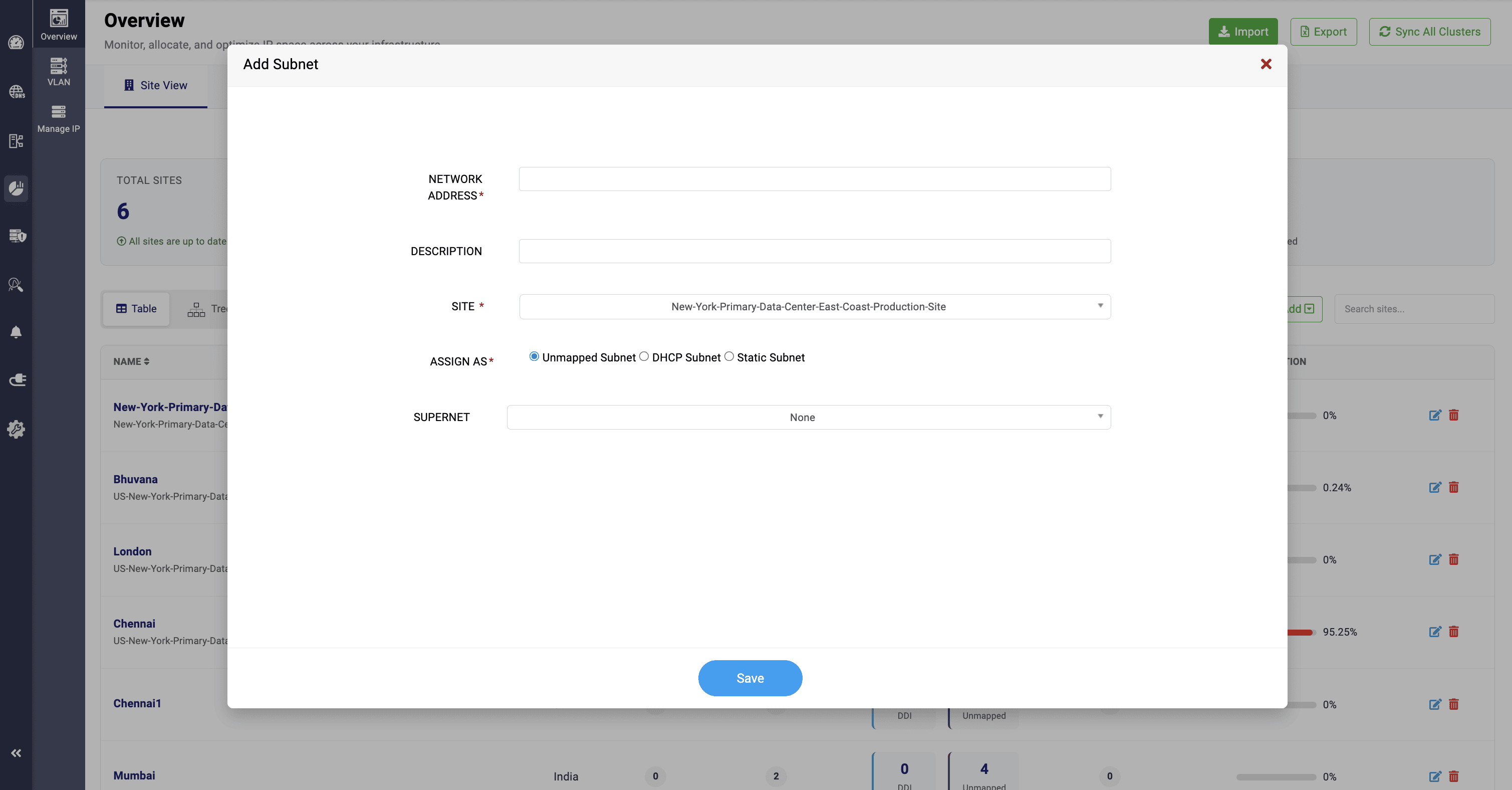
Here, you can provide the subnet’s network address and description, select the site you want to associate it with, assign it as an Unmapped subnet, DHCP-managed subnet, or Static subnet, and allocate a supernet for the subnet.
When a subnet is assigned to a site, it will be configured and added to both the site and the servers within the associated cluster.
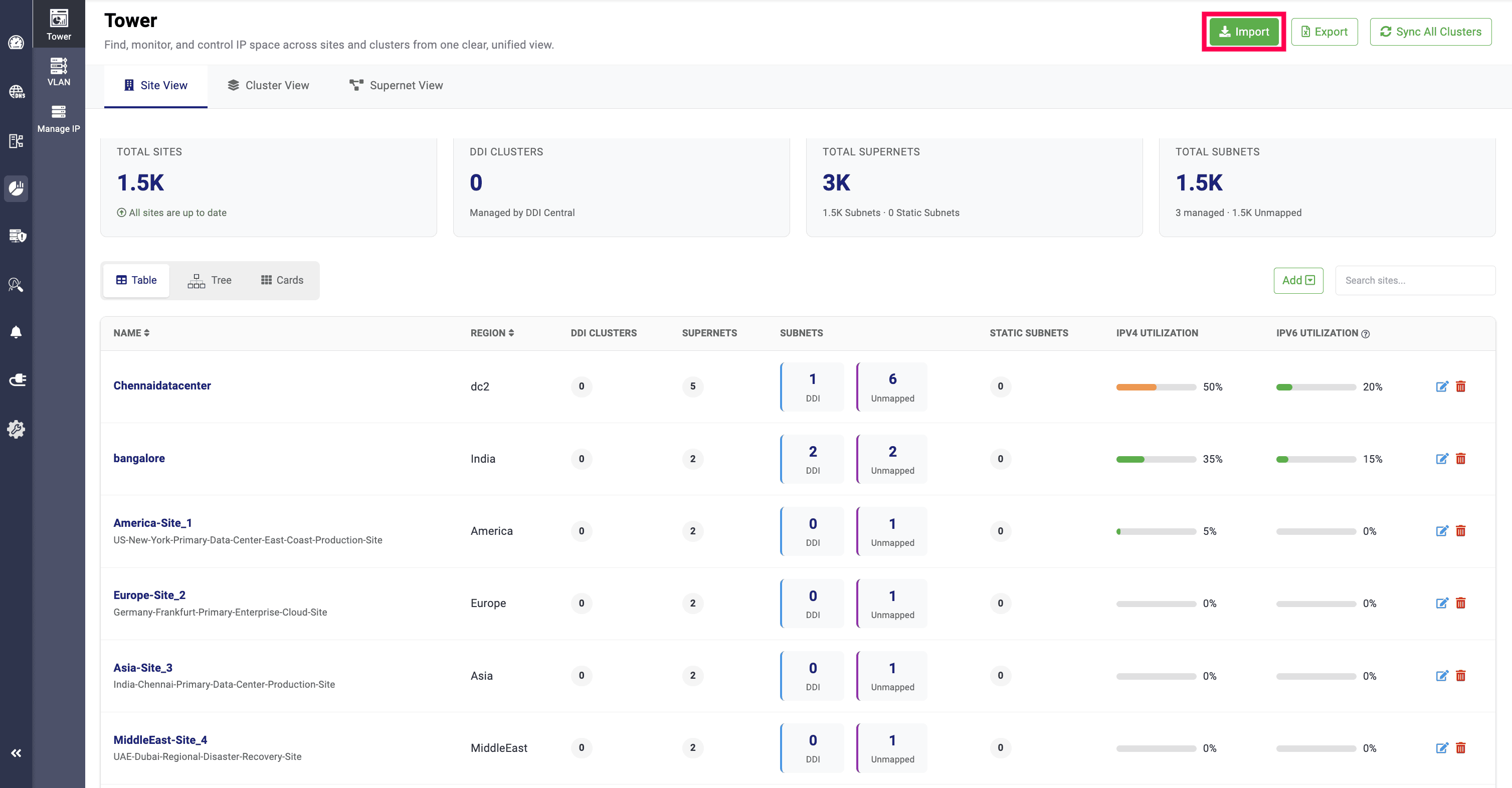
Sites, clusters, supernets, subnets, and static subnets can be imported into the DDI Central application using CSV or XLSX file formats. Both unmapped DHCPv4 and DHCPv6 subnets can be imported through a CSV file. Providing static subnets in the import files is optional.
DDI Central supports XLSX file imports in two formats:
- Single-sheet import — All site, cluster, supernet, subnet, and static subnet details are provided in a single sheet.
- Multiple-sheet import — Separate sheets are created for individual sites, with the associated clusters, supernets, subnets, and static subnets organized in their respective sheets within a single file.
Here are the sample files for each type:
Import files (both CSV and XLSX formats) must include supernet and site data.
Import files should not contain special characters or duplicate entries. If present, they will be ignored during the import process.
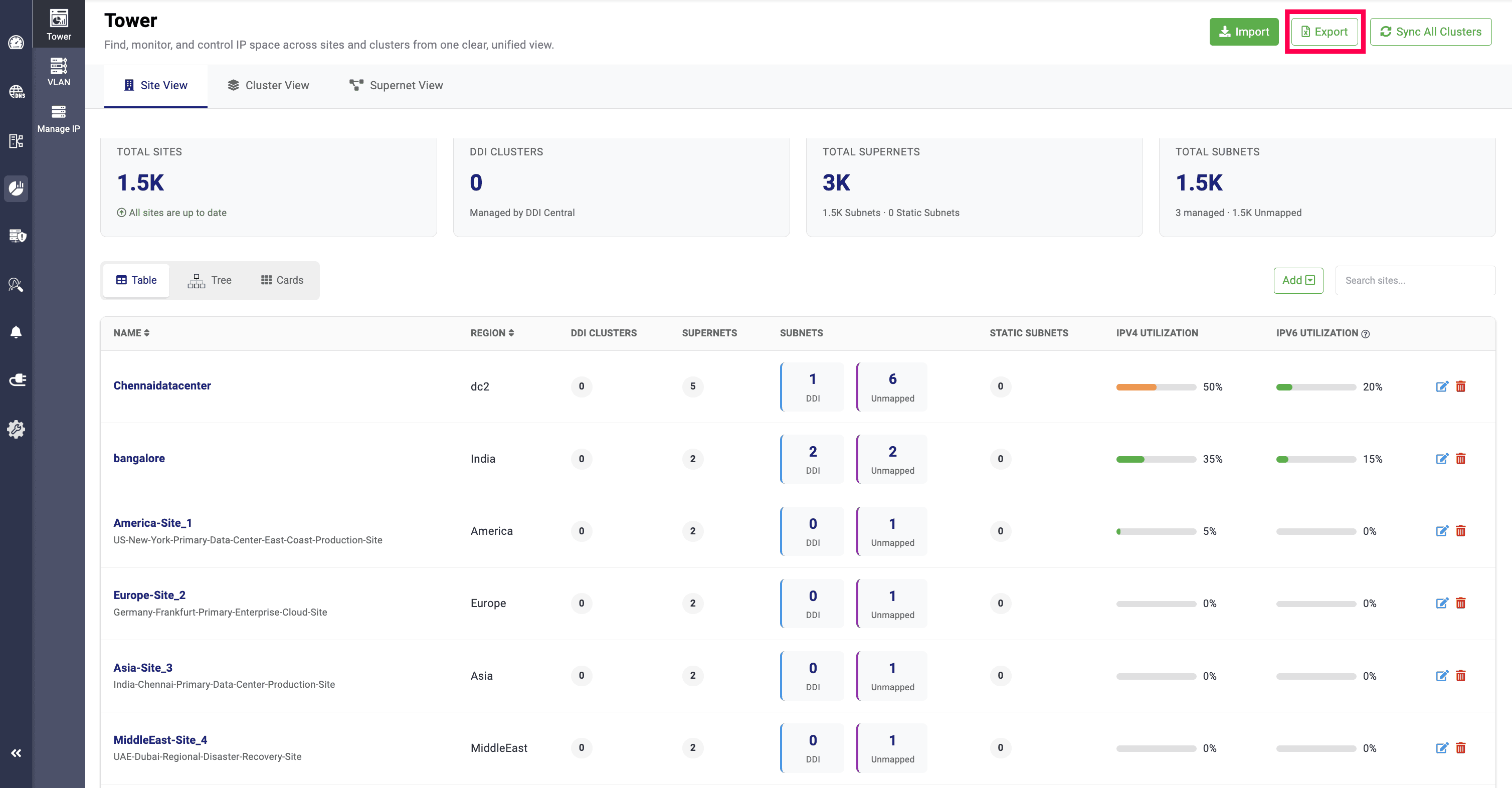
The data show in the site view can also be exported in CSV file format, by clicking on the Export option. The data will be exported in single sheet format.
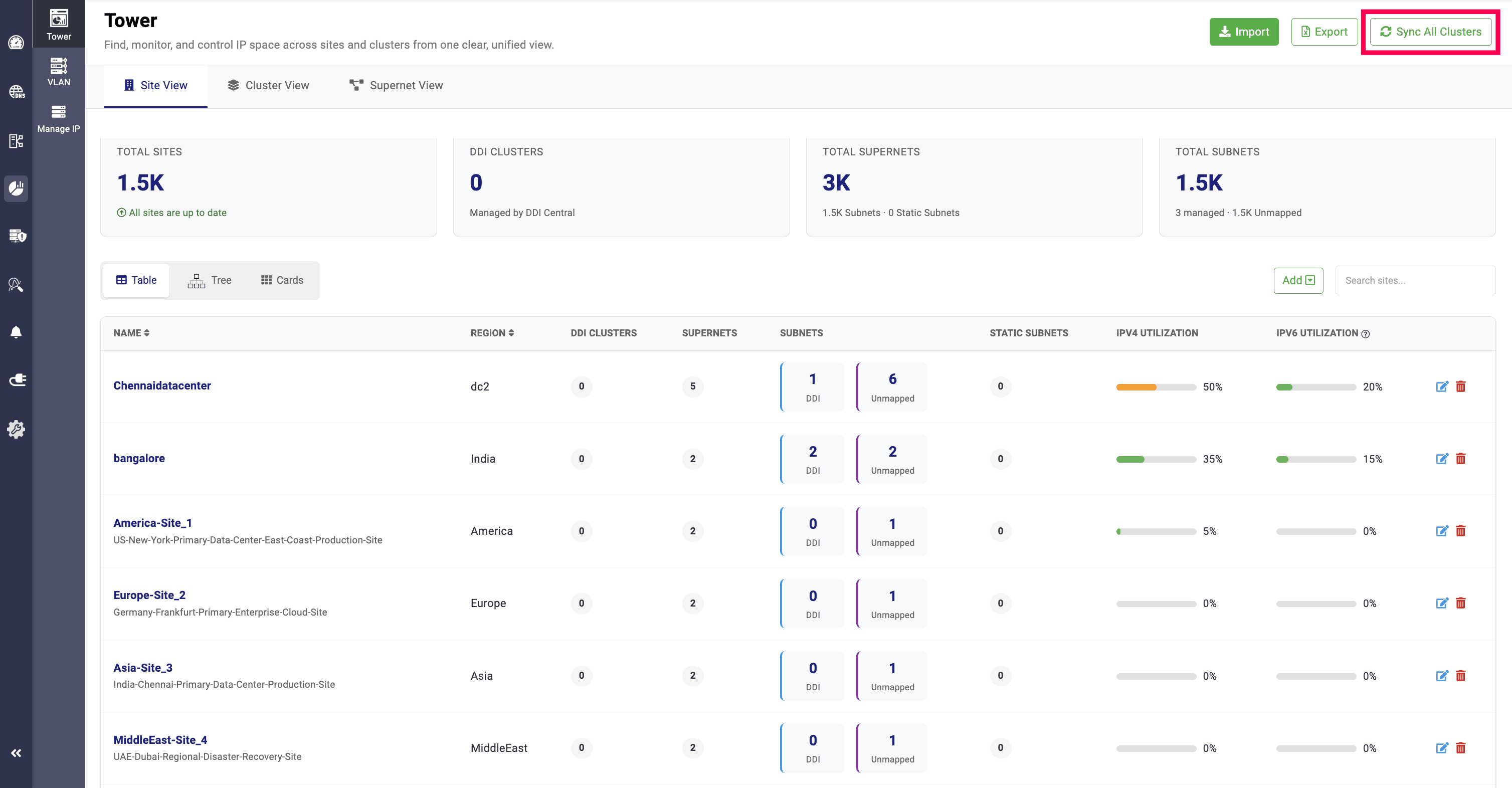
The Sync All Clusters option allows admins to synchronize data and configuration changes across all created clusters.
Sites tree view
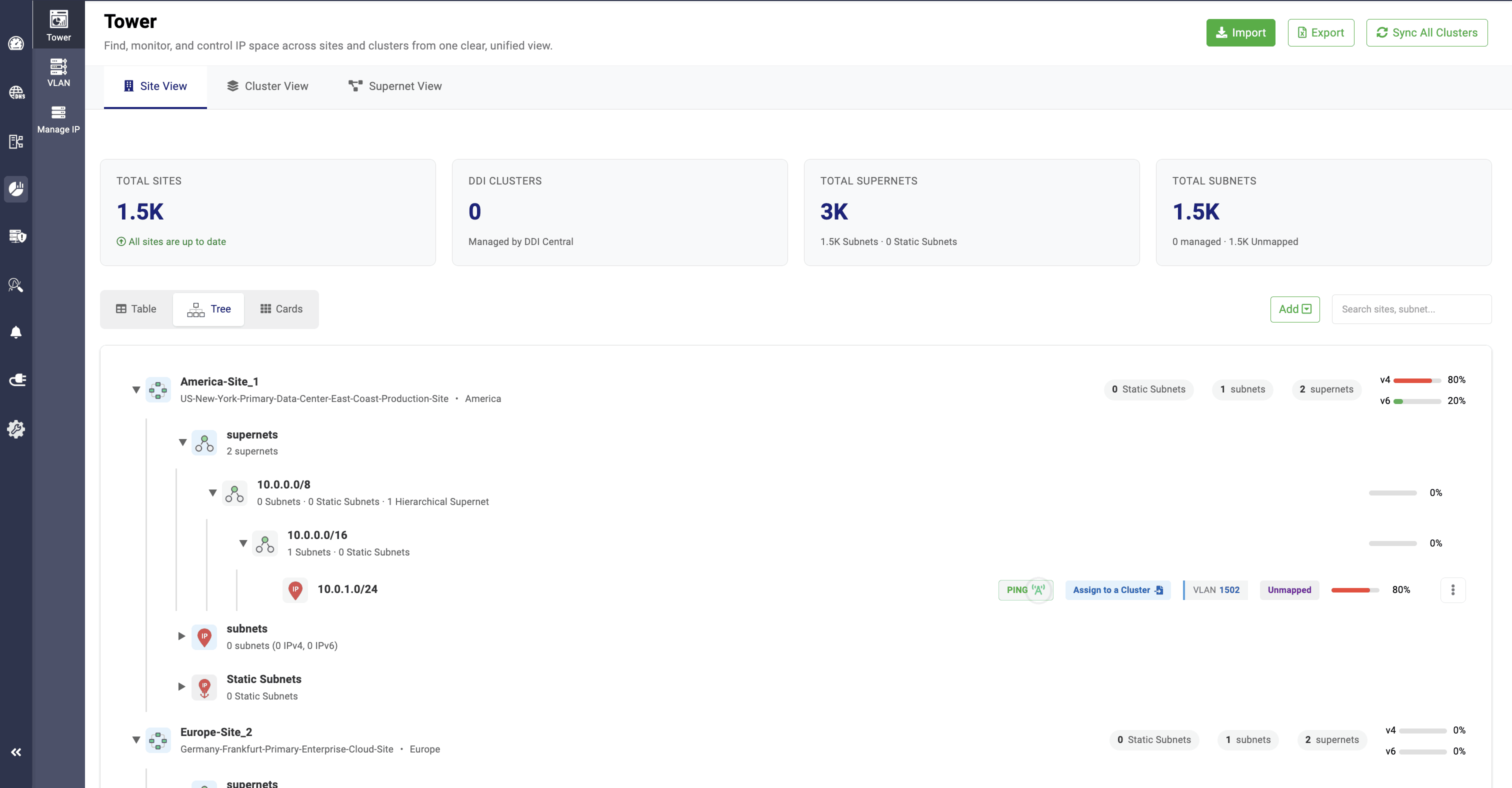
The Tree View provides a hierarchical arrangement of all added sites along with their associated regions, supernets under each site, and the corresponding subnets and static subnets.
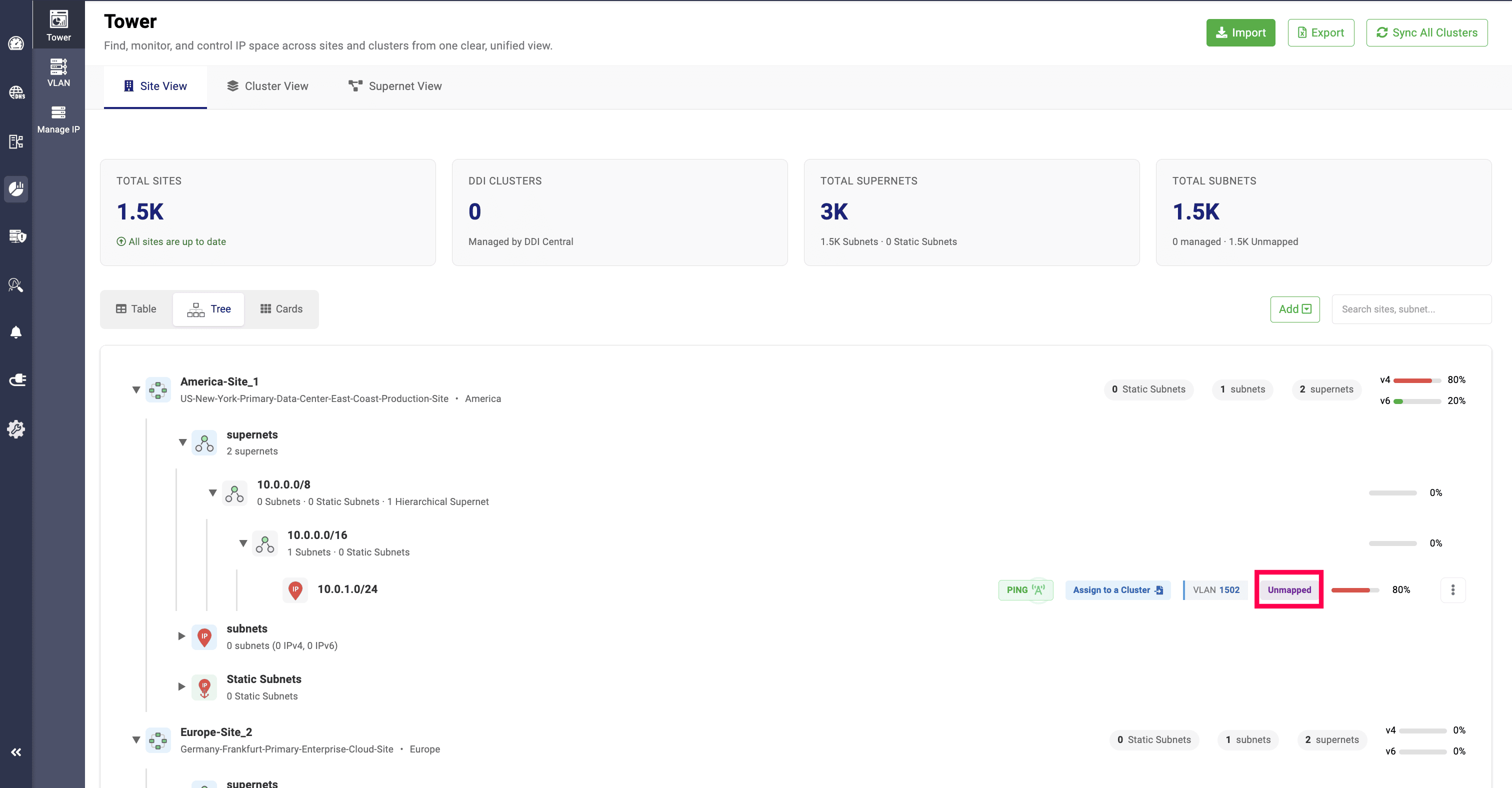
Clicking on the supernets, subnets, and static subnets displays the values configured for each field. Subnets and supernets managed externally are marked as Unmapped, while those managed by DDI Central are marked as DDI.
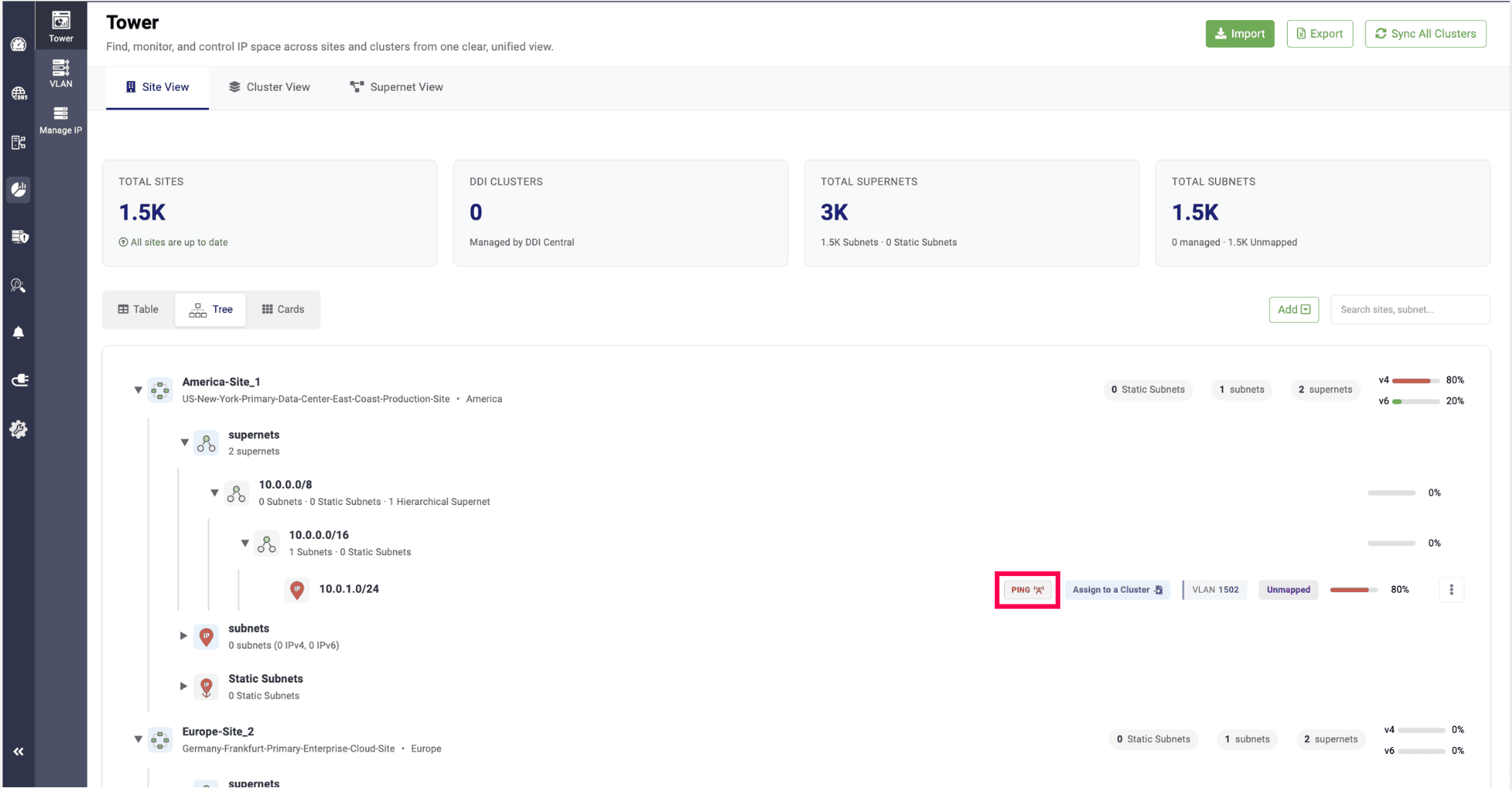
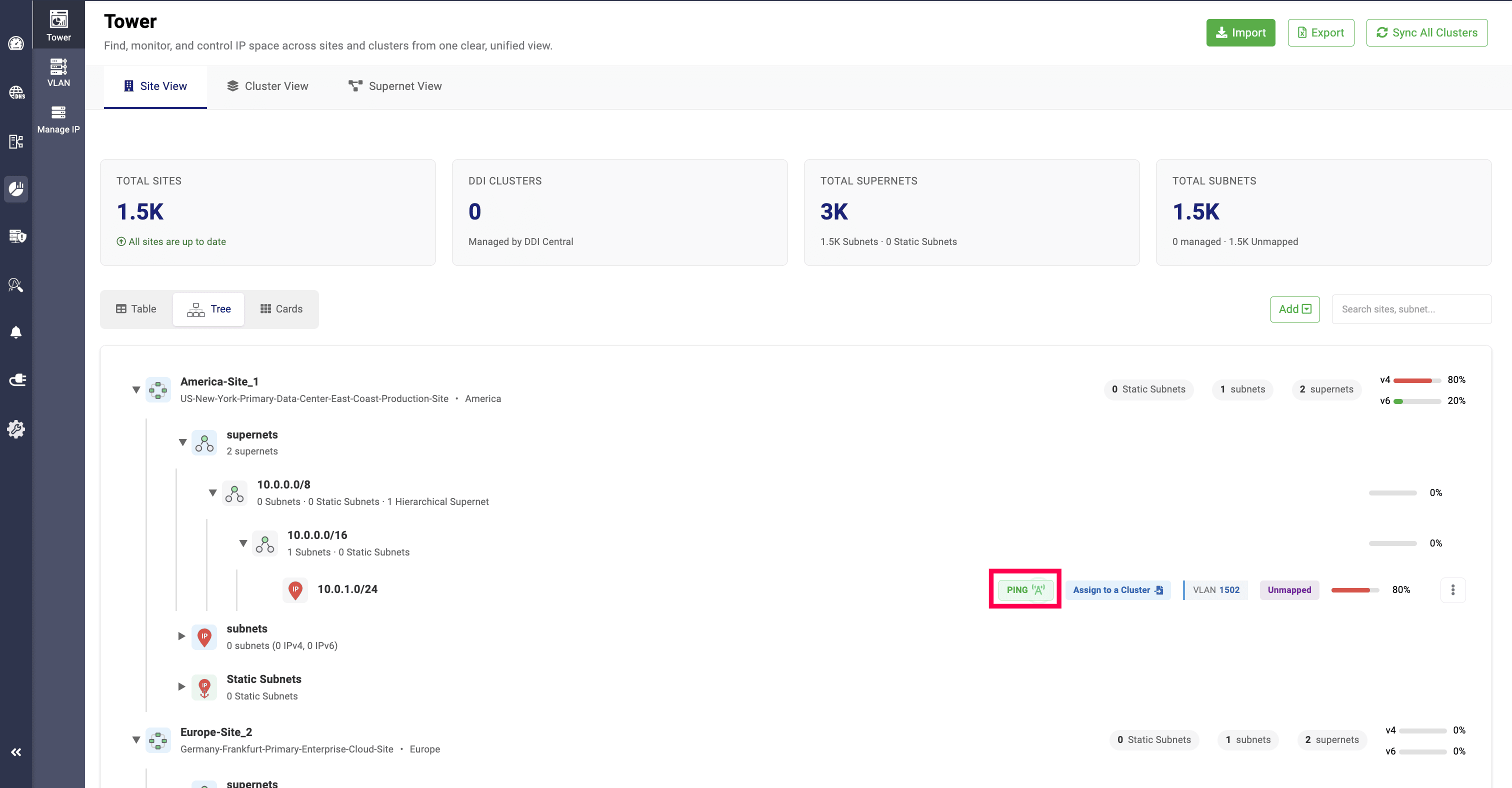
PING option gets enabled automatically for Unmapped subnets, and that can be clicked to deactivate the ping for the subnet. Similarly, clicking it again will activate the ping.
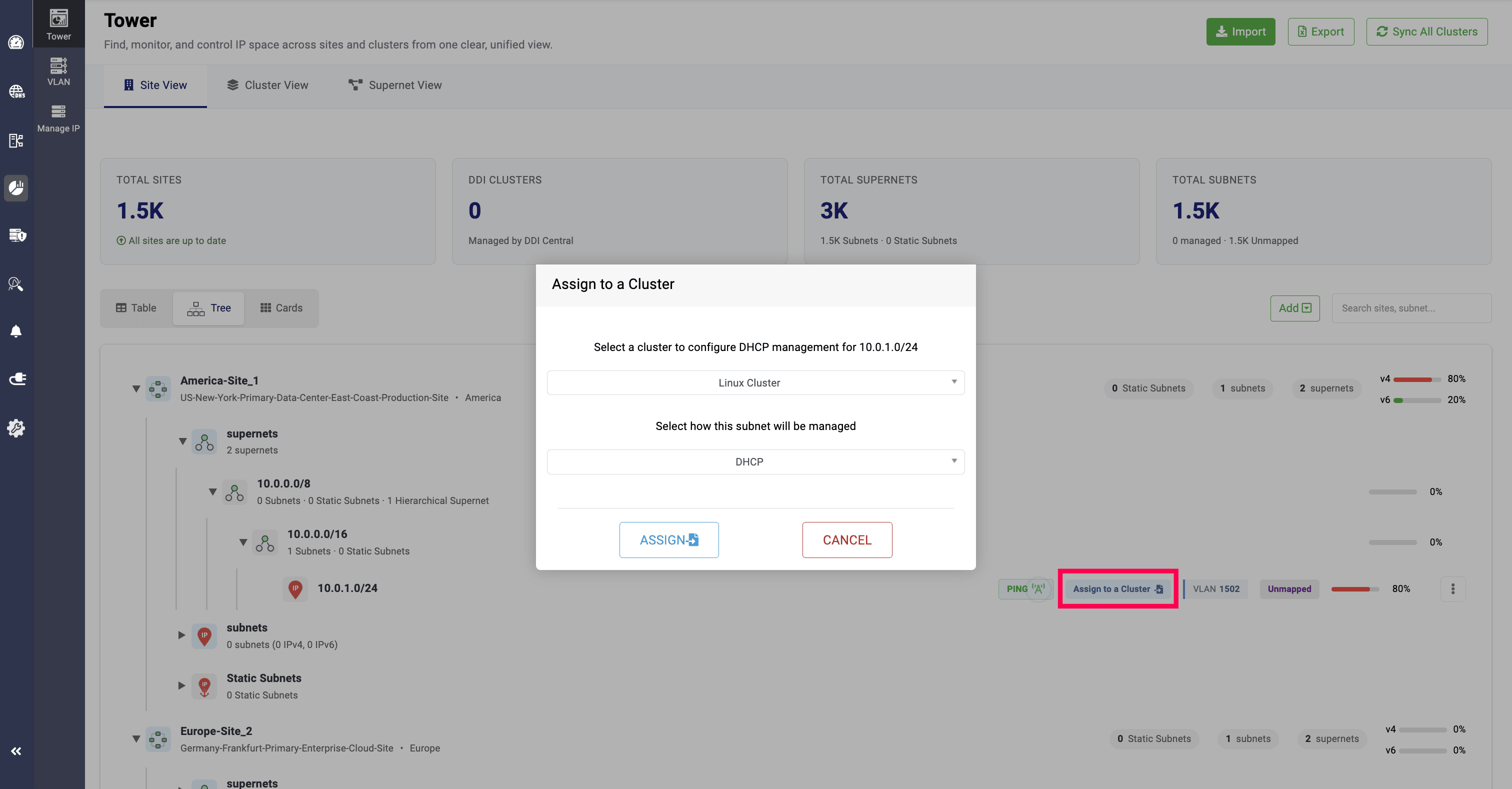
Clicking the Assign to a Cluster option allows you to select a cluster from the dropdown field.
After selecting DHCP and clicking Assign, you will be redirected to the Create Subnet page. If you select Static, you will be redirected to the Create Static Subnet page.
Once assigned, the name of the cluster to which the subnet is assigned will be displayed in the Tree View.
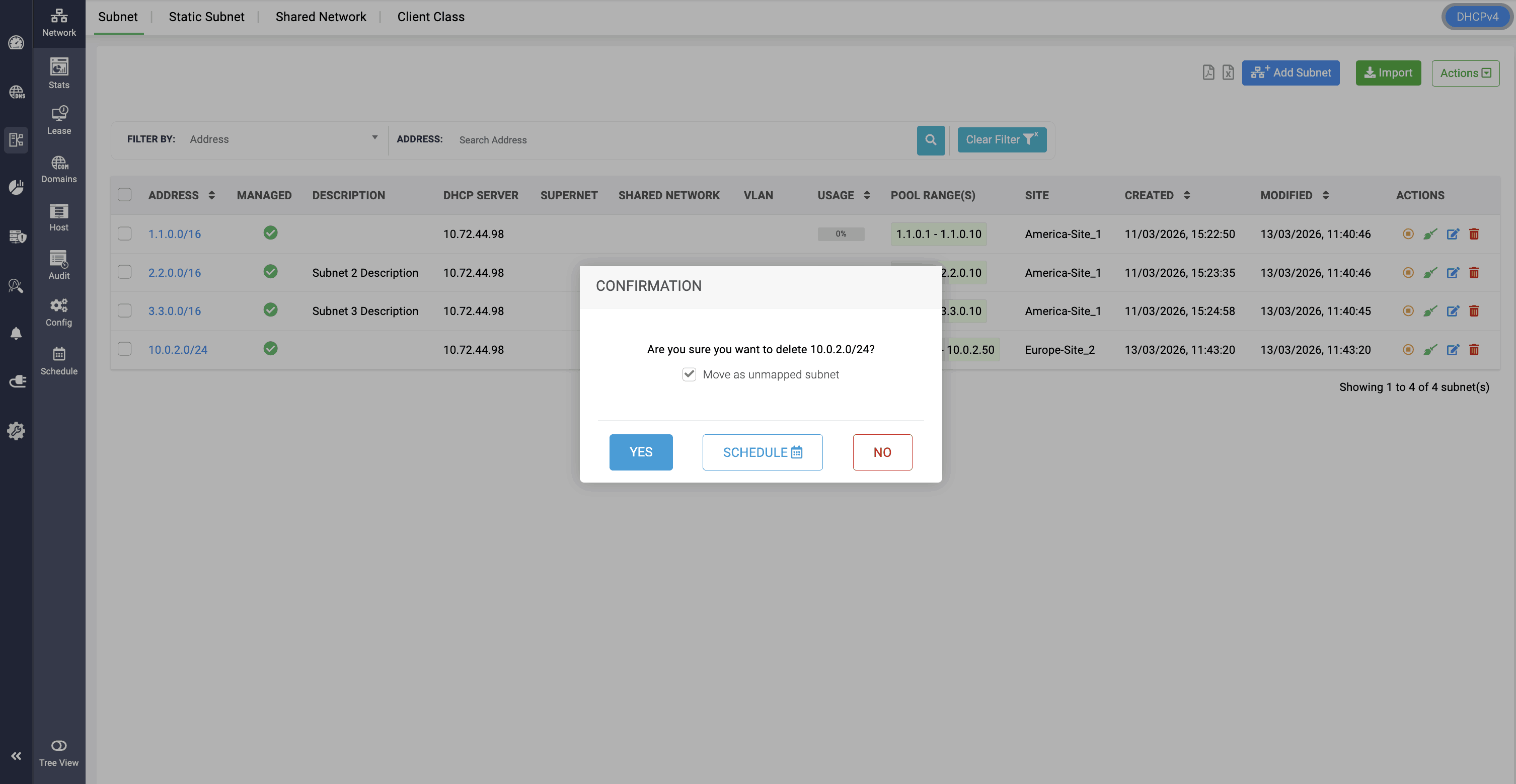
The same subnet can be unmapped from the assigned cluster by navigating to DHCP > Subnets, clicking the Delete icon, and selecting Move as Unmapped Subnet. Alternatively, you can delete the subnet from the network.
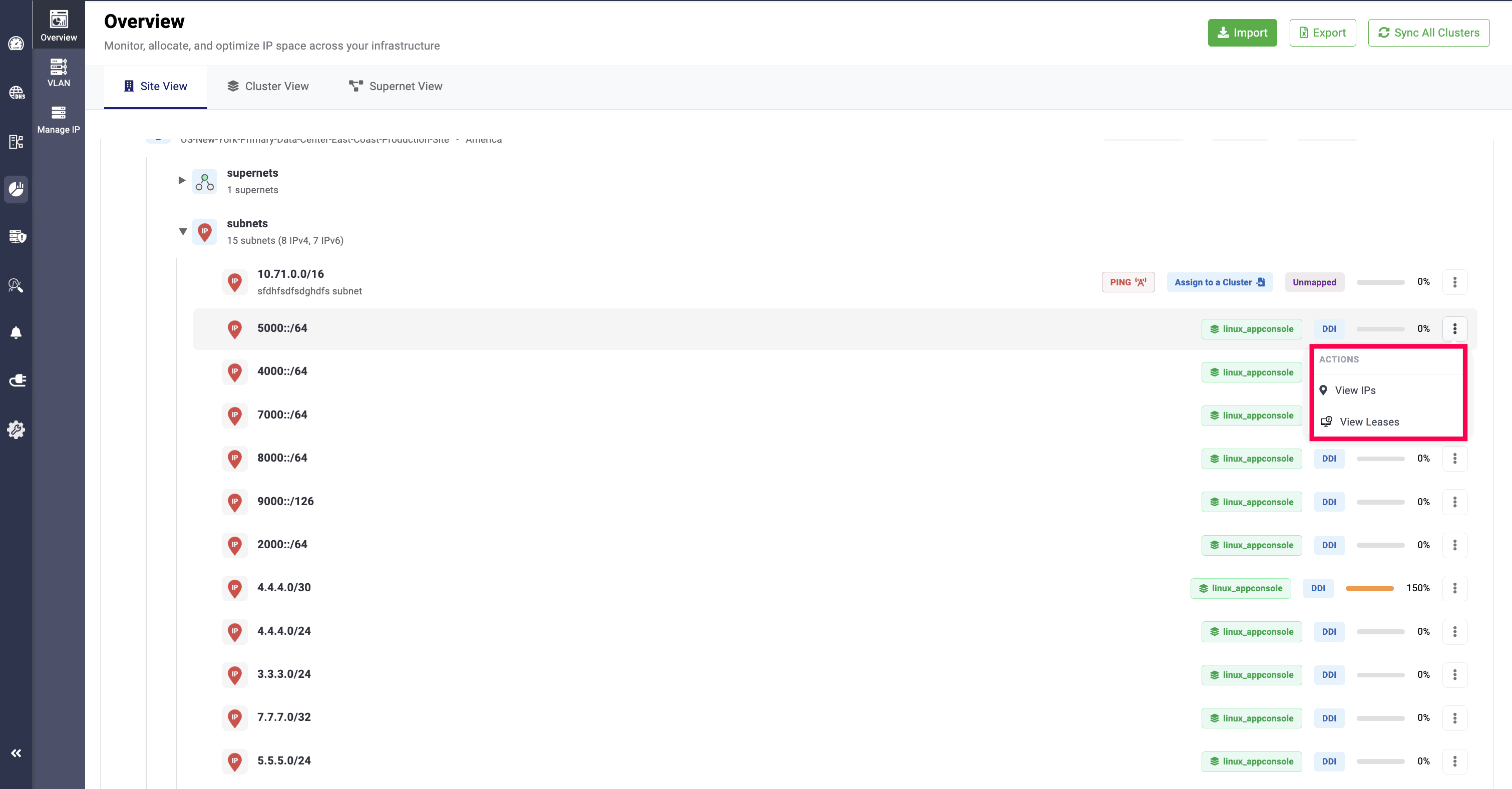
For DDI Managed subnets, you can click on the View IPs option to view all the IP addresses in the subnet, and View Leases option to view the subnet's leases and lease history.
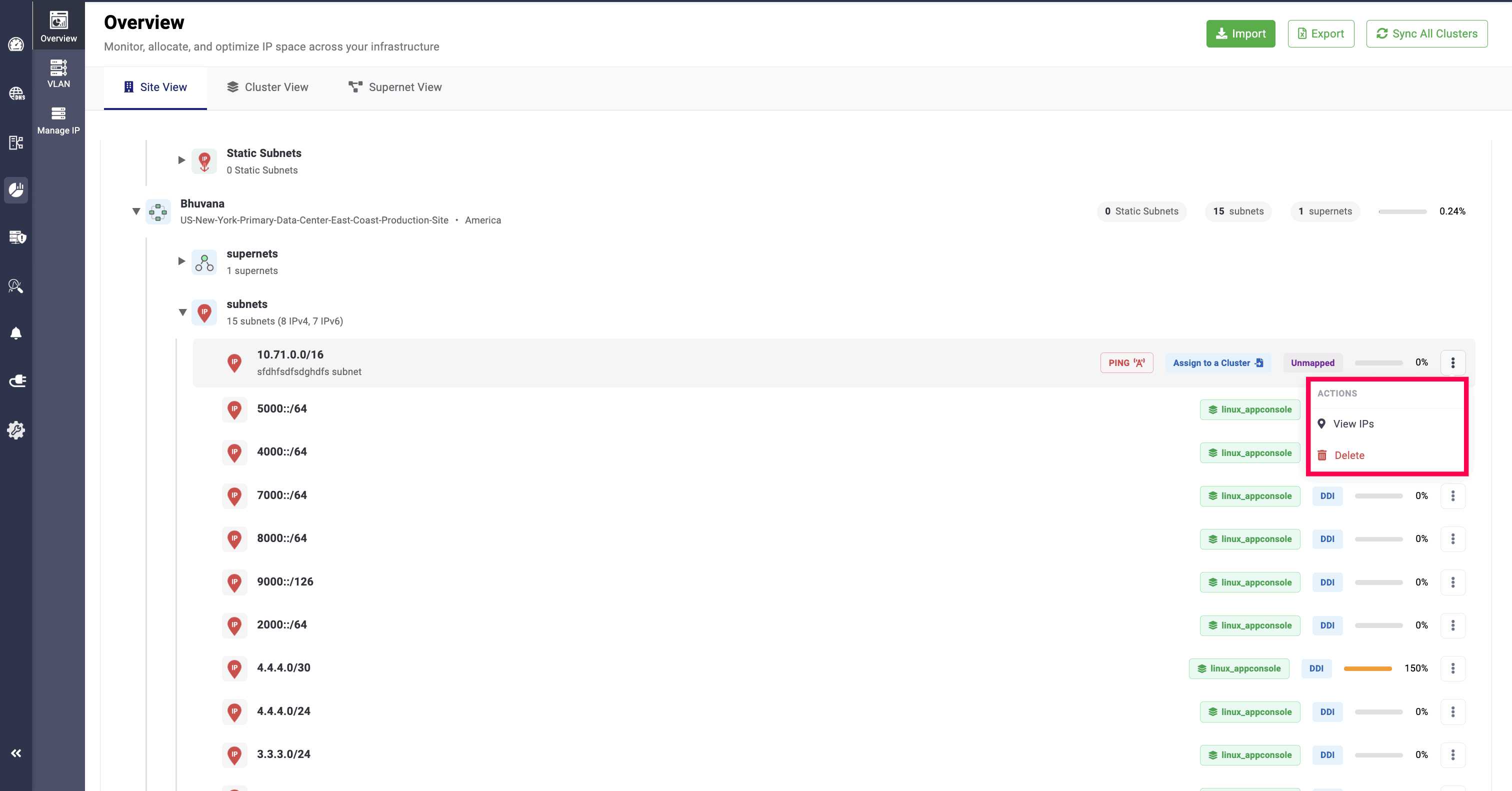
But, for Unmapped subnets, you can only view the IP addresses in the subnet through View IPs option, and you can only delete them through the Delete option.
Sites cards view
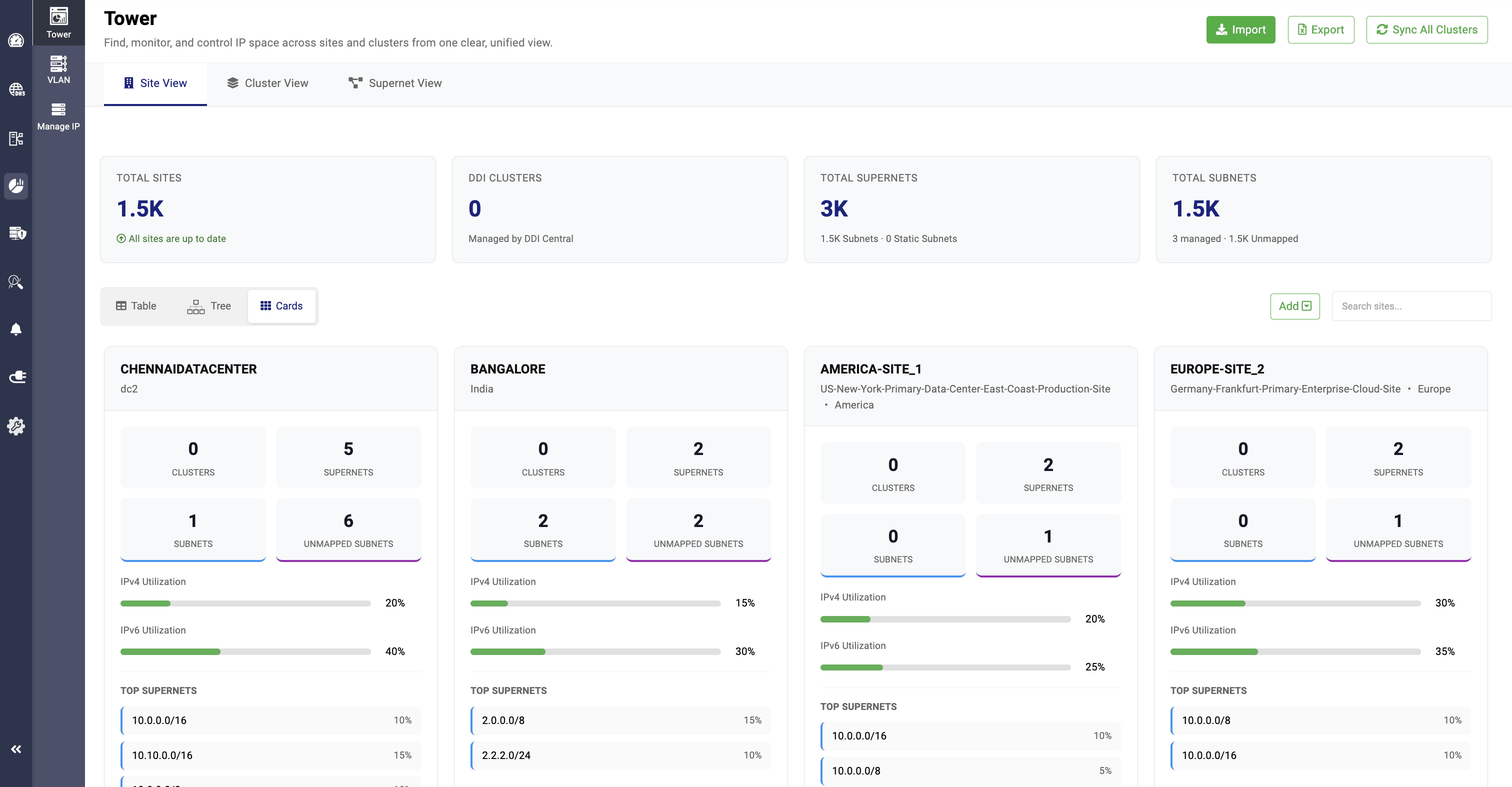
In the Cards View, network admins can see a segmented overview of the total clusters, supernets, subnets, and static subnets, along with their IP utilization and the supernet values with their respective usage.
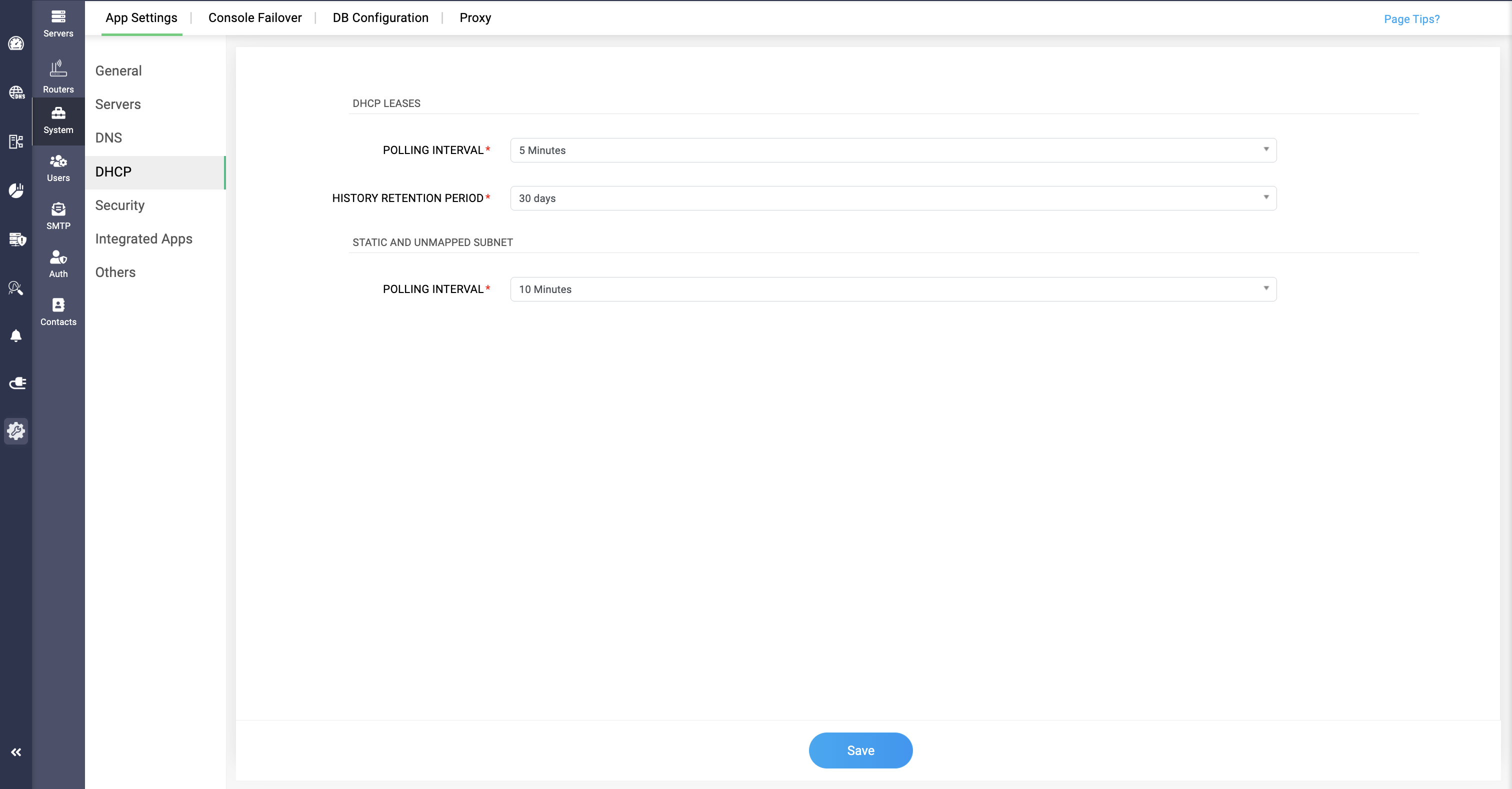
The polling interval for both Static and Unmapped subnet can be configured by going through Settings>System>App Settings>DHCP>STATIC AND UNMAPPED POLLING INTERVAL.