8 future-proof AI implementation strategies for business leaders | CXO Focus

Summary
As AI becomes a cornerstone of modern IT strategy, leaders in IT operations must understand how to harness its capabilities effectively. This article explores how AI is reshaping IT operations management (ITOM), examining the latest advancements and the strategic considerations needed for successful implementation. Aimed at IT and business leaders, it highlights the transformative potential of AI while addressing the operational, ethical, and organizational factors that influence its effectiveness.
AI has shifted from being a technology trend to a business necessity, especially in IT operations management (ITOM). Its ability to automate processes, deliver predictive insights, and enhance decision-making has made it indispensable in navigating today’s complex IT landscapes. According to a report by McKinsey, 52% of large organizations have already established a dedicated team to drive GenAI adoption.
However, adopting AI without a clear plan can lead to costly missteps, from inconsistent performance to loss of trust among stakeholders. To fully harness its potential, business leaders must approach AI implementation with a well-defined strategy, ensuring alignment with business goals and operational realities.
AI advancements so far
AI has rapidly evolved, transforming ITOM by enabling smarter, more proactive, and efficient workflows. Technologies like machine learning (ML), GenAI, and large language models (LLMs) have matured to the point where they’re delivering tangible value across key IT functions such as anomaly detection, incident management, and capacity planning.
Predictive analytics for operational resilience:
ML models now help IT teams detect and address issues before they disrupt services. From forecasting server failures to identifying patterns in network traffic, predictive analytics minimize downtime and keep services stable.
Automation of repetitive tasks:
AI is automating low-value, repetitive IT functions such as ticket categorization, user requests, and root-cause analysis. AI co-pilots have gained popularity for automating tasks such as responding to messages, updating records, and summarizing real-time data. These efficiencies reduce response times and free IT teams to focus on higher-order strategic initiatives.
Real-time visibility and insights:
Observability tools augmented with AI deliver actionable insights faster than traditional methods. Anomaly detection, noise reduction in alerts, and dynamic thresholding help teams manage complex hybrid environments more effectively. AI models can also analyze usage patterns, detect inefficiencies, and make intelligent recommendations for workload right-sizing, instance scheduling, and cost-aware autoscaling.
GenAI and domain-specific LLMs:
GenAI has opened new frontiers in IT operations. From automating configuration scripts and infrastructure templates to assisting in debugging and documentation, GenAI is proving its value across the ITOps life cycle. Domain-specific LLMs, trained on proprietary operational datasets, offer contextualized intelligence—powering smarter knowledge retrieval, incident response, and operational decision-making.
Autonomous decision making with agentic AI:
Agentic AI systems (i.e., AI entities capable of acting autonomously to pursue goals) are emerging as the next evolution in automation. In ITOM, these systems can proactively monitor environments, propose or execute changes, and learn from outcomes. This capability hints at a future where AI doesn't just support IT teams—it augments their decision-making in real time.
AI for sustainability:
In regions and industries where governments and regulatory bodies are tightening environmental regulations or incentivizing green IT, AI is becoming a tool for sustainability. Intelligent workload placement based on carbon intensity, recommendations for energy-efficient resource utilization, and idle resource detection are now part of the AI toolkit. By aligning operations with sustainability goals, enterprises will not only meet compliance requirements but also improve cost efficiency and environmental, social, and governance (ESG) performance.
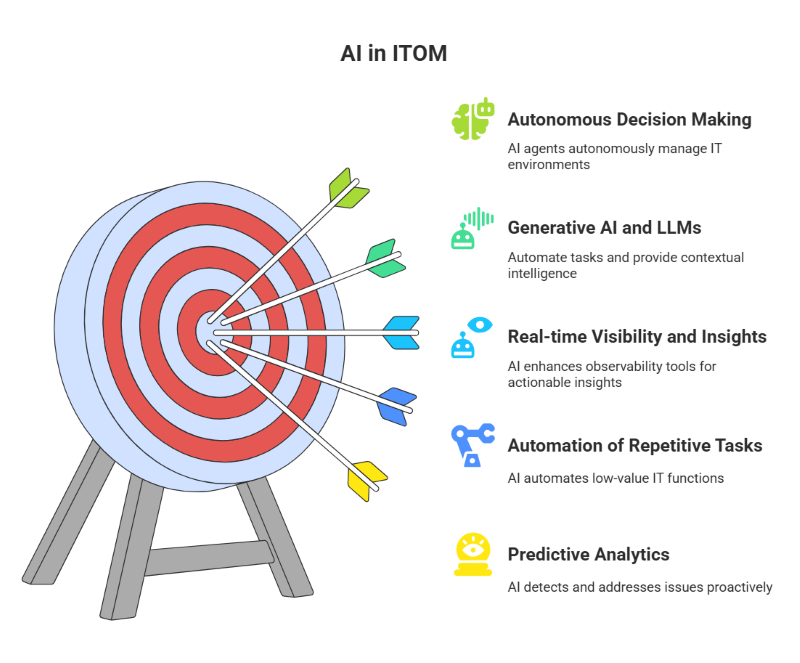
These advancements are setting the stage for a more intelligent, adaptive, and value-driven ITOps landscape.
Challenges faced by organizations
To maximize returns on AI, organizations must adopt a pragmatic, outcome-driven approach. The following strategies provide a structured path forward:
Data quality and fragmentation:
AI’s effectiveness is directly tied to data quality. Many enterprises struggle with siloed, inconsistent, or incomplete datasets—issues that limit the accuracy of AI outputs and complicate model training.
Performance variability:
AI models may behave unpredictably when exposed to new data patterns or operational scenarios. For mission-critical IT systems, this lack of consistency can result in false positives or, worse, missed anomalies.
Ethical and trust considerations:
Opaque algorithms and unexplained outcomes can diminish stakeholder trust. AI decisions—particularly in incident response or capacity planning—must be explainable and free of bias to avoid reputational and operational risks.
Security vulnerabilities:
Integrating AI into ITOps workflows introduces new attack surfaces. Malicious data poisoning, adversarial inputs, or model hijacking are real concerns. Security must be embedded at every stage of the AI life cycle.
Cost and scalability pressures:
Developing and maintaining AI capabilities—especially custom models—can be capital intensive. CXOs must weigh the ROI of in-house AI initiatives versus off-the-shelf solutions and ensure that scaling AI doesn’t create hidden infrastructure or maintenance costs.
Talent and integration gaps:
AI implementation requires cross-functional expertise, from data engineering to DevOps. However, the scarcity of AI-savvy professionals, coupled with legacy system constraints, creates barriers to seamless deployment.
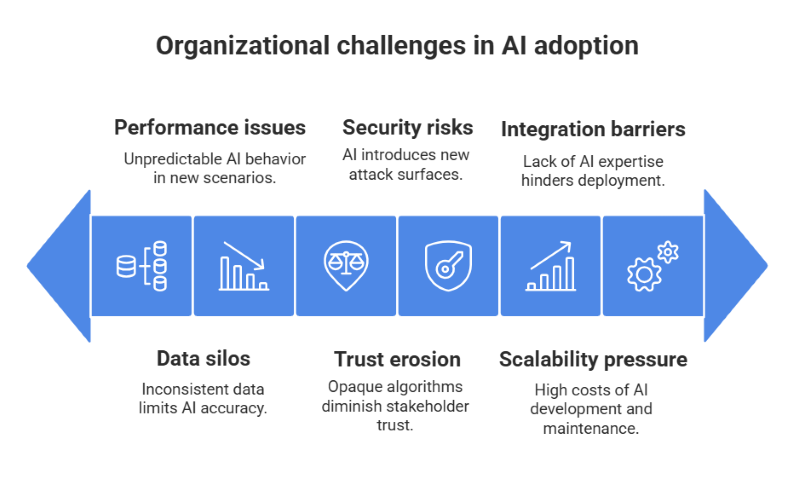
Overcoming these challenges is essential to ensuring that AI initiatives deliver measurable value rather than operational complexity.
Strategies for successful implementation
To maximize returns on AI, organizations must adopt a pragmatic, outcome-driven approach. The following strategies provide a structured path forward:
1. Establish a robust data foundation:
Invest in data governance, integration, and cleansing processes. Use data lakes or centralized observability platforms to break down silos and provide a single source of truth for AI systems to operate on.
2. Build ethical, transparent AI systems:
Ensure AI models are auditable and explainable. Adopt frameworks like model interpretability, fairness testing, and governance controls to foster confidence across technical and non-technical stakeholders.
3. Drive human-AI collaboration:
Position AI as a co-pilot, not a replacement. Human oversight ensures contextual understanding, while AI enhances scale and speed. Encourage workflows where teams make decisions based on AI suggestions, refining trust and model performance simultaneously.
4. Leverage LLMs to simplify complexity:
LLMs can transform how IT teams interact with systems—enabling natural language queries for logs, automating documentation, and guiding incident response. Embedding LLMs into support tools can democratize access to complex information across teams.
5. Explore agentic AI for autonomous operations:
Adopt agentic AI where it makes sense—starting with controlled domains like automated patching, performance tuning, or routine maintenance. These agents can independently identify and execute tasks based on predefined goals, reducing human overhead and accelerating response times.
6. Personalize user experiences with AI:
Beyond internal operations, AI can improve service delivery by personalizing incident handling, knowledge base recommendations, and support workflows. Customizing responses based on user profiles and historical context enhances satisfaction and accelerates resolution.
7. Build a comprehensive change management strategy:
AI adoption alters workflows, expectations, and accountability. A structured change management plan that includes communication, training, and stakeholder alignment is crucial to drive adoption and avoid resistance.
8. Partner strategically:
Collaborate with AI vendors, system integrators, or managed service providers to access specialized expertise and pre-built frameworks. This can accelerate implementation and reduce risk.
These strategies will enable organizations to not only implement AI effectively but also achieve sustainable, long-term value from their initiatives.
Implementing AI in ITOps is not just about leveraging cutting-edge technology, but about doing so thoughtfully and strategically. Business leaders must view AI as a tool to complement human expertise, not replace it. Prioritizing transparency, ethical considerations, and robust data practices is essential to building trust and ensuring sustainable success. The right strategies can help organizations unlock AI’s potential, turning it into a transformative force that drives innovation, efficiency, and resilience in an increasingly digital world.