ManageEngine - Key Manager Plus
ManageEngine Key Manager Plus is a comprehensive certificate and key management solution that helps organizations centrally discover, manage, monitor, and automate the entire lifecycle of certificates and cryptographic keys. With a strong focus on certificate lifecycle management, it enables administrators to maintain a centralized inventory of certificates, track expiration dates, streamline renewals and deployments, and reduce the risk of certificate-related outages, security vulnerabilities, and compliance issues. The solution also provides centralized management of SSH keys, PGP keys, and other digital keys, helping organizations strengthen security and maintain control over their cryptographic assets.
This document covers the following:
1. Why Key Manager Plus?
As organizations use more certificates and keys across servers, applications, cloud platforms, and hybrid infrastructures, tracking them manually becomes complex and difficult to scale. Key Manager Plus brings certificate and key management into one centralized, web-based console, so administrators can see what exists, keep it valid, and stay in control of access.
2. Key Capabilities
- Certificate lifecycle management: Discover, request, deploy, renew, and revoke SSL certificates from a single console, with expiry alerts and flagging of weak, self-signed, or rogue certificates.
- CA integrations: Internal CAs (Microsoft CA, Key Manager Plus Private CA) and external CAs (DigiCert, Sectigo, GlobalSign, Google Trust Services).
- ACME and DNS automation: Automated domain validation with Let’s Encrypt and custom ACME CAs, using DNS providers such as Cloudflare, Azure DNS, and more.
- Cloud integrations: Manage certificates and secrets with Azure Key Vault, Azure Applications, and other supported cloud services.
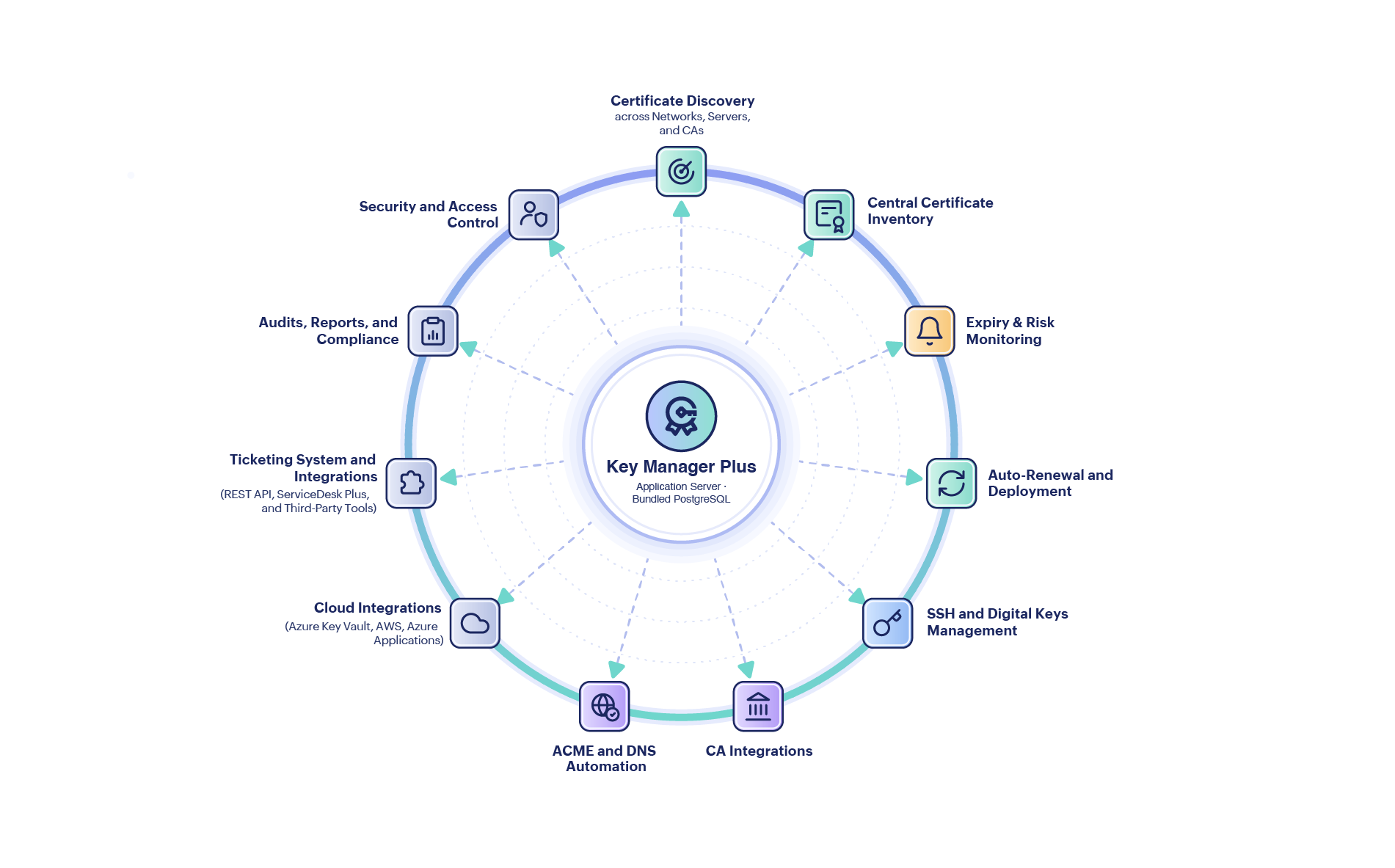
- SSH key management: Discover, generate, deploy, and rotate SSH keys across supported systems.
- Key Vault: Centrally store and manage supported cryptographic keys.
- Discovery and deployment: Agent-based and agentless support for Windows, Linux/Unix, IIS, Apache, NGINX, and load balancers.
- Security and access control: HTTPS access, encrypted storage, role-based access control, and Active Directory/LDAP, RADIUS, and SAML authentication.
- Reports and audits: Audit trails and reports on certificate and key usage, expiry trends, access privileges, and compliance.
- Integrations: REST API, ServiceDesk Plus, and other third-party tools.
- Architecture: A web-based application server with a bundled PostgreSQL database, hosted within your internal network and accessible from anywhere.
3. What Problems Does Key Manager Plus Solve?
Managing certificates and keys across servers, applications, and cloud platforms creates challenges that manual methods struggle to handle. The table below compares the challenges organizations face today with how Key Manager Plus resolves them.
| Current Challenges | Impact | Key Manager Plus Solution |
|---|---|---|
| Lack of visibility across keys and certificates: Certificates and keys are scattered across servers, teams, and environments with no single record. | Unknown assets, unclear ownership, and blind spots that are easy to overlook. | A centralized inventory gives a complete, unified view of all certificates and keys. |
| Missed expirations causing downtime: Expiry dates are tracked in spreadsheets or not tracked at all. | Service outages, broken trust between clients and servers, and lost productivity. | Proactive expiry alerts and automated renewal keep certificates valid before they affect users. |
| Unmonitored SSH keys and excessive privileges: SSH keys are rarely reviewed, rotated, or removed. | Unauthorized access and a growing attack surface. | Key discovery, privilege tracking, and rotation enforcement keep SSH access under control. |
| Weak, self-signed, or rogue certificates: Certificates that do not meet standards or were issued without approval go undetected. | Security vulnerabilities and untrusted connections. | Detection and flagging of these certificates enable timely remediation. |
| Inconsistent compliance and reporting: Evidence of key and certificate usage is gathered manually, if at all. | Failed audits and difficulty demonstrating compliance. | Built-in auditing, reporting, and policy enforcement support consistent compliance. |
| Manual overhead in routine operations: Discovery, renewal, rotation, and monitoring are done by hand across many servers. | Wasted effort, human error, and missed tasks. | Automation of discovery, renewal, rotation, and monitoring reduces effort and errors. |