COMPLIANCE > HIPAA
3
categories of safeguards —
administrative, physical, and technical4
tiers in the HIPAA civil
monetary penalty framework$7.42M
average cost of a healthcare
data breach in 202514 yrs
healthcare has been the
costliest sector for data breaches
The Health Insurance Portability and Accountability Act (HIPAA) is a U.S. federal law that establishes national standards for protecting individuals' health information. Administered by the Department of Health and Human Services (HHS), HIPAA applies to healthcare providers, health plans, healthcare clearinghouses, and business associates that handle Protected Health Information (PHI). HIPAA includes the Privacy Rule, Security Rule, Breach Notification Rule, and Enforcement Rule, which together define how electronic Protected Health Information (ePHI) must be accessed, stored, transmitted, and safeguarded.
Endpoint Central, ManageEngine's unified endpoint management and security solution, helps healthcare organizations operationalize HIPAA requirements at the endpoint layer where ePHI is created, accessed, and most vulnerable to exposure. Through centralized endpoint management, encryption, access control, vulnerability management, device control, audit reporting, and ransomware protection, Endpoint Central enables organizations to strengthen the confidentiality, integrity, and availability of sensitive health data across Windows, macOS, Linux, and mobile devices.
- Why Endpoint Central
- Scope of HIPAA
- HIPAA & HITECH
- Controls mapping
- Penalties
Why Choose Endpoint Central for HIPAA Compliance?
- Continuous Risk Assessment & Remediation
- Endpoint-Level ePHI Protection
- Audit-Ready Visibility
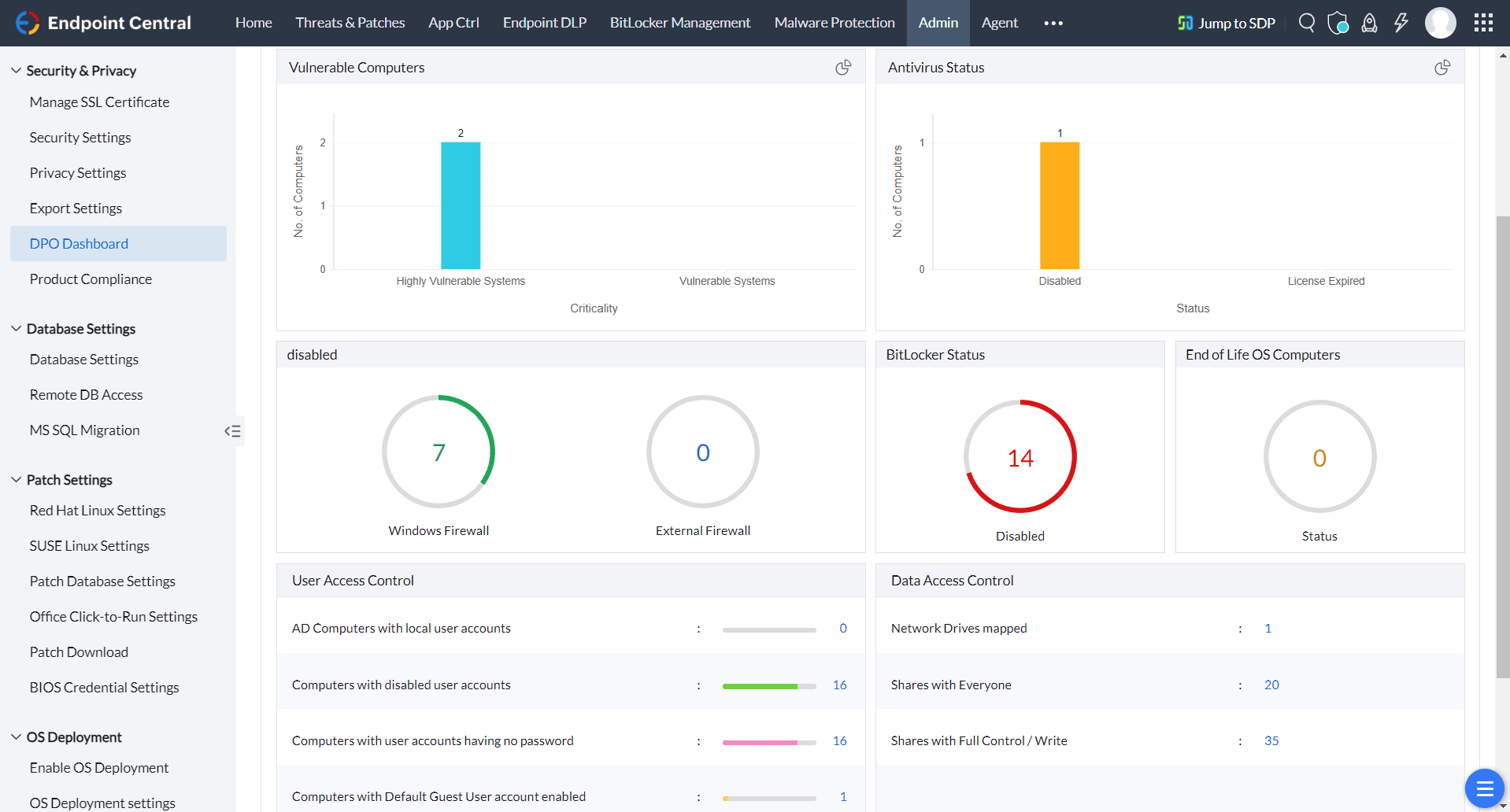
Operationalize the Security Rule's risk analysis requirement (§ 164.308(a)(1)(ii)(A)) with built-in vulnerability assessment, security misconfiguration detection, and integrated remediation. Endpoint Central uses a single-agent architecture to manage and secure Windows, macOS, and Linux endpoints from a unified console. Organizations can identify and remediate missing patches, end-of-life software, weak configurations, and exploitable vulnerabilities without deploying multiple endpoint agents, helping reduce operational complexity, minimize the attack surface, and simplify compliance and audit readiness.
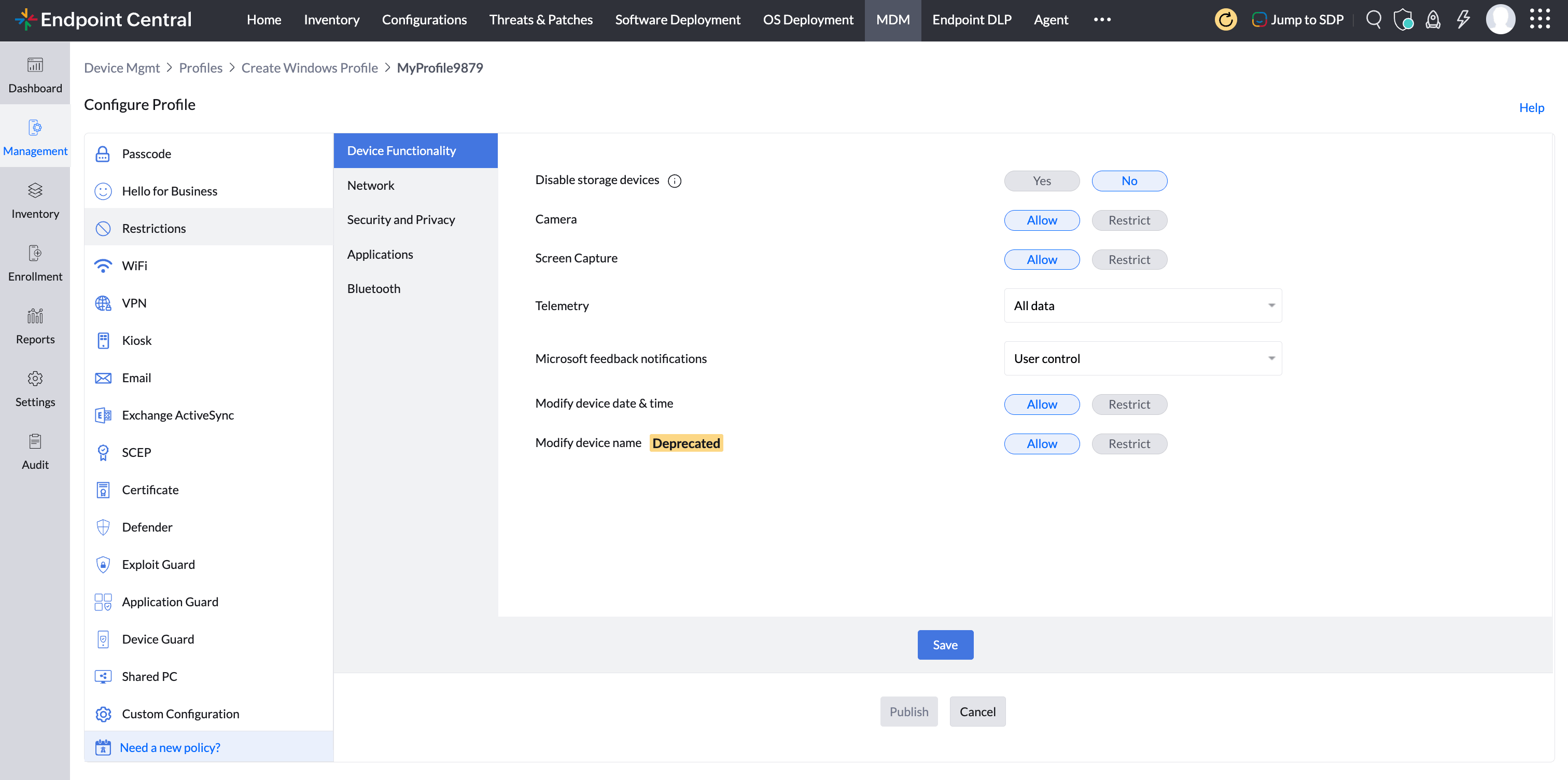
Enforce confidentiality, integrity, and availability of ePHI on every device. Native BitLocker management for Windows and FileVault for macOS provide full-disk encryption; Data Leakage Prevention classifies ePHI and prevents unauthorized transfers via cloud, email, clipboard, or removable media; granular file and folder permissions restrict ePHI access to authorized workforce members.
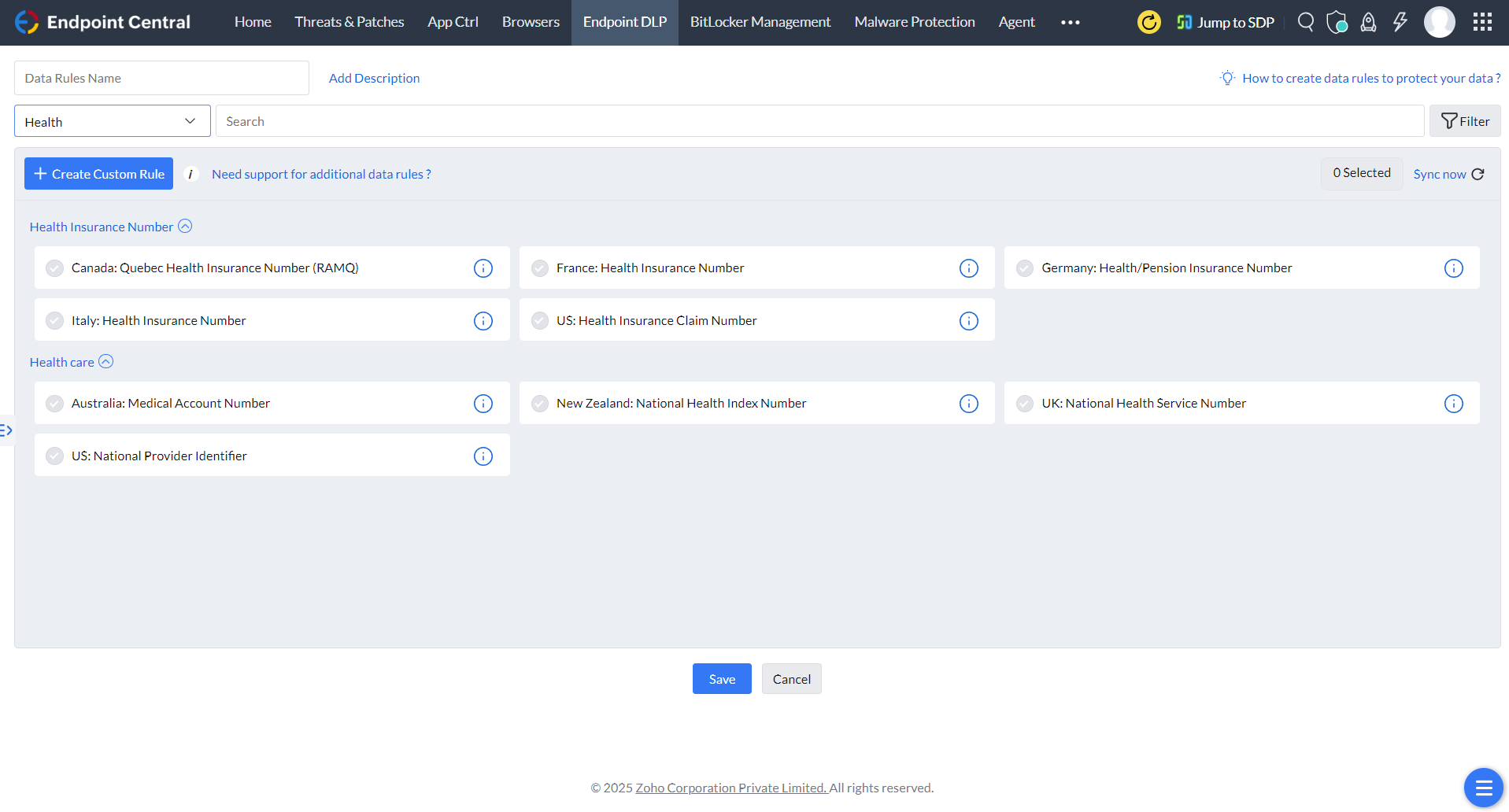
Maintain the audit trail HIPAA auditors expect. Centralized inventory, user logon tracking, software metering, USB activity reports, and a comprehensive reporting engine produce evidence on demand for risk assessments, OCR audits, and internal compliance reviews, covering devices, users, configurations, and security events across the environment.
Scope of HIPAA
HIPAA applies to two broad categories of organizations and to the data they handle:
- Covered entities: Health plans, health care clearing houses, and health care providers that transmit health information in electronic form in connection with HIPAA-standard transactions.
- Business associates: Any person or organization that creates, receives, maintains, or transmits PHI on behalf of a covered entity, including IT service providers, cloud hosts, billing services, and consultants.
PHI and ePHI
Protected Health Information (PHI) is individually identifiable health information related to a person's medical condition, treatment, or healthcare payment. Electronic Protected Health Information (ePHI) refers to PHI stored, processed, or transmitted electronically.
Examples of PHI include patient names, medical record numbers, diagnoses, lab results, prescription history, insurance details, biometric identifiers, and other data that can identify an individual.
HIPAA and HITECH
The Health Information Technology for Economic and Clinical Health (HITECH) Act, passed in 2009, strengthened the privacy and security protections established by HIPAA and promoted the adoption of health information technology.
- Direct application to business associates: HITECH made business associates directly responsible for complying with HIPAA Security Rule requirements and certain Privacy Rule obligations.
- Breach notification: HITECH introduced federal breach notification requirements for incidents involving unsecured PHI, including notifications to affected individuals and regulatory authorities.
- Tiered penalties: HITECH established a four-tier penalty structure based on the severity and nature of non-compliance, increasing potential financial penalties.
- Audit program: HITECH authorized periodic audits of covered entities and business associates to verify HIPAA compliance.
- HIPAA and HITECH compliance: Because HITECH builds upon HIPAA requirements, organizations must establish HIPAA compliance as the foundation for meeting HITECH obligations.
How Endpoint Central helps meet HIPAA safeguard requirements
We have mapped Endpoint Central capabilities to HIPAA safeguard requirements to help healthcare organizations operationalize the protection of electronic Protected Health Information (ePHI). This mapping highlights how Endpoint Central supports access control, encryption, audit readiness, vulnerability management, ransomware protection, and endpoint security compliance.
| Requirement description | How Endpoint Central helps |
|---|---|
Conduct an accurate and thorough assessment of risks and vulnerabilities to the confidentiality, integrity, and availability of ePHI (§ 164.308(a)(1)(ii)(A)) | Built-in vulnerability assessment and security misconfiguration detection provide continuous visibility into risks across Windows, macOS, and Linux endpoints. Reports cover patch status, firewall settings, encryption status, antivirus protection, and high-risk software. |
Implement security measures to reduce risks and vulnerabilities to a reasonable level (§ 164.308(a)(1)(ii)(B)) | Automated Patch Deployment remediates missing patches across operating systems and third-party applications. USB device control, firewall configurations, prohibited software policies, and browser security further reduce the attack surface. |
Regularly review records of information system activity, including audit logs and incident tracking (§ 164.308(a)(1)(ii)(D)) | Reporting on user logon activity, USB usage, software changes, antivirus updates, firewall status, and encryption compliance enables periodic system reviews. SIEM integrations support centralized monitoring and correlation. |
Authorize and supervise workforce members who work with ePHI (§ 164.308(a)(3)(ii)(A)) | Granular file, folder, and registry permission management ensures users access only the ePHI required for their role. User logon tracking supports workforce supervision. |
Implement procedures to determine that the access of a workforce member to ePHI is appropriate (§ 164.308(a)(3)(ii)(B)) | Permissions granted to users and groups are managed centrally and auditable from the console. Periodic review of logon reports surfaces inactive accounts and inappropriate access, supporting workforce clearance procedures. |
Implement policies and procedures for granting access to ePHI through workstations, transactions, programs, processes, or other mechanisms (§ 164.308(a)(4)(ii)(B)) | Group Management enables administrators to add, remove, or modify user policies and groups securing access to ePHI. Drive-mapping permissions, application control, and conditional-access policies tighten access at the resource level. |
Security reminders: Periodic security updates (§ 164.308(a)(5)(ii)(A)) | Automated Patch Deployment, antivirus definition updates, and driver updates keep every managed endpoint current. The DPO/compliance dashboard surfaces drift in real time. |
Procedures for guarding against, detecting, and reporting malicious software (§ 164.308(a)(5)(ii)(B)) | The built-in next-generation antivirus engine detects malware in real time using AI-assisted behaviour analytics and deep learning. Prohibited-software policies and executable blocking close additional vectors. Endpoint quarantine isolates compromised devices pending forensic review. |
Procedures for monitoring log-in attempts and reporting discrepancies (§ 164.308(a)(5)(ii)(C)) | Dedicated reports on user logon/logoff, last logon failed user accounts, currently logged-on users, and currently logged-on computers provide continuous visibility into authentication activity. |
Procedures for creating, changing, and safeguarding passwords (§ 164.308(a)(5)(ii)(D)) | Administrators can enforce password policies, reset user passwords, and on mobile devices configure passcode complexity, length, expiry, and reuse history through MDM profiles. |
Identify and respond to suspected or known security incidents; mitigate harmful effects and document outcomes (§ 164.308(a)(6)(ii)) | Real-time threat alerts, endpoint quarantine, and one-click remediation actions support rapid incident response. Patented anti-ransomware creates non-erasable backups every three hours via Microsoft volume shadow copy service, enabling recovery without paying threat actors. |
Establish and implement a data backup plan to create and maintain retrievable exact copies of ePHI (§ 164.308(a)(7)(ii)(A)) | Endpoint Central supports endpoint recovery through anti-ransomware protection and tamper-protected shadow copies that enable rapid restoration of affected files following ransomware incidents. While these capabilities improve operational resilience and recovery, organizations should maintain dedicated backup and disaster recovery solutions to satisfy broader ePHI backup and retention requirements. |
Device and media controls, accountability and media movement: maintain a record of the movements of hardware and electronic media containing ePHI, and the persons responsible (§ 164.310(d)(1)) | Centralised hardware inventory management provides a continuously updated record of every managed laptop, desktop, server, and mobile device — including assigned user, location, and movement history. Geo-fencing defines virtual boundaries for mobile devices, alerting administrators when a device leaves an authorised location and supporting the accountability requirement for media that carry ePHI. |
Disposal: implement policies and procedures to address the final disposition of ePHI and the hardware or electronic media on which it is stored (§ 164.310(d)(2)(i)) | Remote wipe and selective wipe capabilities remove corporate data from devices being retired, reassigned, or reported lost. Mobile device factory reset is also supported. |
Access control: implement technical policies and procedures that allow only authorized persons or software programs access to ePHI (§ 164.312(a)(1)) | Granular file, folder, and registry permissions, application allowlisting/blocklisting, conditional access policies for mobile devices, and just-in-time access enforce least-privilege access to ePHI. |
Automatic logoff: implement electronic procedures that terminate an electronic session after a predetermined time of inactivity (§ 164.312(a)(2)(iii)) | Power management configurations enforce screen lock and re-authentication after inactivity. Remote lock, sign-off, and shutdown actions are available on demand. |
Encryption and decryption: implement a mechanism to encrypt and decrypt ePHI (§ 164.312(a)(2)(iv)) | BitLocker management for Windows and FileVault for macOS deliver native full-disk encryption with central key escrow and recovery. For mobile devices, Endpoint Central enforces encryption through MDM profiles managed from the same unified console, enabling organizations to apply and monitor encryption policies across Windows, macOS, Android, and iOS devices without relying on separate management tools. |
Audit controls: implement hardware, software, and procedural mechanisms that record and examine activity in information systems that contain or use ePHI (§ 164.312(b)) | Centralised inventory of hardware and software details for mobile devices, desktops, and laptops. Endpoint Central integrates with SIEM platforms for centralised correlation and long-term retention. |
Integrity: implement policies and procedures to protect ePHI from improper alteration or destruction (§ 164.312(c)(1)) | Patented anti-ransomware monitors unusual file movements and supports the creation of non-erasable, three-hourly backups via volume shadow copy. Application allowlisting prevents unauthorised software from altering ePHI; file-integrity reporting flags unexpected changes. |
Person or entity authentication: implement procedures to verify that a person or entity seeking access to ePHI is the one claimed (§ 164.312(d)) | Strong password and passcode policies, mobile passcode profiles with history and complexity rules, and two-factor authentication for console access verify identity. Role-based administration scopes what authenticated technicians can see and do. |
Transmission security: implement technical security measures to guard against unauthorised access to ePHI transmitted over an electronic communications network (§ 164.312(e)(1)) | Agent-to-server communication is hardened with 256-bit AES encryption, and the product can be operated in FIPS 140-2 mode for cryptographic operations. Remote troubleshooting sessions are encrypted end to end. |
Penalties for non-compliance
Organizations handling Protected Health Information (PHI) must comply with HIPAA requirements enforced by the HHS Office for Civil Rights (OCR), with additional enforcement authority granted to state attorneys general under HITECH.
Tiered penalty framework
HIPAA penalties are tiered based on culpability, ranging from no knowledge of the violation to wilful neglect that remains uncorrected.
Per-violation amounts
Per-violation penalties begin in the low figures for Tier 1 violations and exceed $60,000 per violation for Tier 4 violations, with annual caps applied for identical-provision violations.
Beyond financial penalties
Non-compliance can also result in corrective action plans, regulatory investigations, reputational damage, and criminal penalties for intentional misuse of PHI.
Endpoint Central empowers healthcare organizations to translate HIPAA's administrative, physical, and technical safeguards into automated, evidenced controls, reducing the likelihood of a reportable incident and providing the audit trail OCR investigators expect.
Endpoint Central helps in achieving the following compliances
CIS

FERPA
NIST 800-171
UK CYBER ESSENTIALS

NCA
ISO 27001
PCI DSS
NIST 2.0 CSF

HIPAA

DORA

GDPR
NIS2

RBI
Essential 8
Recommended reads
Real Stories, Real Impact: Endpoint Central and Compliance

"Endpoint Central has allowed us to move towards our goal of a centralized application to cover off IT support activities. The deployment was really simple with no real issues. We use it mainly for the integration with ServiceDesk Plus and the reports it provide for our ISO implementation"

Talk to Us About Your Compliance Needs
Feel free to connect with our experts to address your specific queries and discover how Endpoint Central can assist you in meeting HIPAA requirements.