- Help documents
- Collaterals
- E-books & whitepapers
- Blogs
- Video zone
- Awards and recognitions
- Courses
- Getting started
- Security guides
Admin guide
Learn how to install, configure, manage, and maintain AD360, including detailed module settings.
Architecture guide
Understand the architecture of AD360, including its core components, and data flow.
Quick start guide
Learn how to deploy and configure the essential settings of AD360 and its components.
System requirements guide
Understand the hardware, software, and network port requirements needed to deploy and run AD360.
Data protection guide
Understand the security, privacy, and confidentiality measures AD360 applies to identity data.
Securing installation folder
Secure your AD360 installation by tightening directory permissions and running the recommended scripts.
Database migration guide
Learn how to migrate AD360 data from the built-in PostgreSQL database to Microsoft SQL Server.
High availability guide
Learn how to configure high availability for AD360 and its components using automatic failover.
SSL guide
Learn how to secure AD360 and its integrated components by enabling HTTPS and SSL certificates.
- Brochure
- Datasheet
- Use cases
The media industry's costliest identity failure
One phishing email opened the door to one of the entertainment industry's biggest breaches.
The social media trust collapse
A single phone call led to a platform-wide security and reputation crisis.
Hospitality's hidden identity time bomb
Four years of invisible access exposed hundreds of millions of guest records.
The casino attack that cost millions
A help desk deception triggered ransomware, disruption, and crippled casino operations.
The pipeline breach that shocked the United States
One compromised password disrupted fuel supply and sparked a national crisis.
Defending against Active Directory attacks
Understand five common Active Directory attacks, identify security gaps, and apply defensive strategies.
3-step action plan to ensure critical data protection and compliance
Strengthen data protection with this 3 step action plan to ensure critical data protection and compliance
Strengthen your security posture: 10 Critical Windows Event IDs to monitor
Detect hidden threats with a crisp guide to the 10 Windows Event IDs that matter.
Advanced M365 Auditing and Management
Streamline Microsoft 365 management with practical auditing, reporting, and automation.
Harden your MFA against brute-force attacks
Strengthen your MFA against modern brute-force attacks with practical, method-specific defenses.
Steps to Implement MITRE ATT&CK framework for enhanced threat detection
Implement MITRE ATT&CK in five steps and power detection with Log360 - elevating visibility.
A no-code guide to automate JML life cycle management
Automate JML life cycle with a no-code playbook that secures onboarding, role changes, and offboarding.
Essential Eight explained
Navigate the Essential Eight maturity model with clear guidance and MITRE ATT&CK mapping.
The cost of Active Directory mismanagement
Expose the hidden costs of AD mismanagement and fix them with proven practices and stronger governance.
What is PCI DSS compliance? Is your organization compliant?
Understand what PCI DSS compliance is, why it matters, and how AD360 supports audit readiness.
Why should your organization comply with the GDPR?
Understand why GDPR compliance strengthens privacy and improves your security posture.
5 simple steps to HIPAA compliance
Learn the core HIPAA requirements around PHI and five practical steps to strengthen security.
IAM security best practices for PCI DSS compliance
Explore IAM best practices that map to PCI DSS requirements and minimize cardholder data handling.
IAM security best practices for GDPR compliance
Explore IAM best practices that help you meet GDPR principles like data minimization.
NIST password guidelines: Bolstering password security
Explain the latest NIST password recommendations and strengthen password and passphrase policies.
3 ways to protect vulnerable healthcare data from security attacks
Learn three practical ways to secure PHI and strengthen insider-threat detection in healthcare.
Why SIEM is the best defense against cyberthreats
Explain how SIEM strengthens threat detection, insider-risk monitoring, and incident response.
User and entity behavior analytics (UEBA) explained
Understand how UEBA uses baselining and machine learning to detect anomalous behavior.
The secret sauce to detect insider threats
Learn how to identify different types of insider threats and reduce human-error risks.
Insider threats 101: Detect, investigate, and then mitigate
Learn what insider threats look like and detect suspicious behavior early with UEBA and SIEM.
6 essential capabilities of a modern UBA solution
Explore the six must-have capabilities of a modern UBA solution, from risk scoring to visualization.
What are the risks involved in shadow IT
Understand how unsanctioned apps and BYOD create data, malware, and compliance risks.
Maintain confidentiality of critical information by implementing the POLP
Learn how to apply the principle of least privilege across users and roles to cut excess permissions.
The principle of least privilege explained
Understand the principle of least privilege (PoLP) and how to avoid privilege creep.
The rise of adaptive authentication
Explore how adaptive authentication tailors MFA challenges to user risk and reduces friction.
Stay ahead of threats with continuous monitoring
Understand what continuous monitoring is and improve visibility into your IT environment.
3 ways to prevent cyberattacks using real-time alerts
Learn three real-time alerting techniques to detect attacks early and contain them with AD360.
Understanding incident management: processes and importance
Understand what incident management is and follow its key process steps.
What is IAM? Guide to identity and access management
Learn the fundamentals of identity and access management (IAM), its components and use cases.
What is compliance management?
Understand what compliance management is and why it matters for risk reduction and trust.
Hybrid IAM: Securing identities across on-premises and cloud environments
Explore why hybrid IAM is critical for organizations using both on-premises and cloud systems.
Remote workforce enablement: Securing identities and access for work-from-anywhere
Learn how to securely enable a remote workforce using IAM, MFA, SSO, and Zero Trust principles.
Identity lifecycle management for secure IAM
Learn how identity life cycle management automates user provisioning and deprovisioning.
Role-based access control (RBAC) for identity security
Learn how RBAC simplifies permission management and enforces least privilege at scale.
Identity protection with UBA
See how UBA detects compromised accounts, privilege abuse, and insider mistakes.
Identity automation
Learn how identity automation reduces manual IAM effort and cuts provisioning costs.
Identity threat detection and response: Your all-in-one playbook
Learn what identity threat detection and response (ITDR) is and why identity attacks are rising.
Secure your Active Directory: The essential guide to AD risk assessment
Learn what identity risk assessment is for AD and compare major risk methodologies.
SASE: What is secure access service edge
Understand what SASE is and how it converges networking and security in the cloud.
What is PAM? Guide to privileged access management
Learn what privileged access management (PAM) is and why privileged accounts pose unique risks.
Multi-factor authentication (MFA)
Learn how MFA combines passwords with extra factors like OTPs or biometrics to block takeovers.
How to implement Zero Trust and its core components with AD360
Understand Zero Trust security and see why perimeter-based models fall short.
5 pain points you can overcome in AD user account management
Discover five common AD user management challenges, from bulk provisioning to stale accounts.
Smart strategies to provision and de-provision Active Directory accounts
Learn how template-based provisioning streamlines onboarding, transfers, and offboarding.
8 steps to effectively manage groups and users in bulk in Active Directory
Follow eight best practices to bulk-manage AD users and groups using OUs and automation.
Why native Active Directory tools are no longer enough for modern IAM
See why built-in AD tools struggle with today's distributed, security-first environments.
Active Directory clean-up: Should you automate it?
Explore why regular AD clean-up is vital and the risks of stale accounts and groups.
4 AD management mistakes that can weaken your organization's cybersecurity
Learn how admin-account use, poor delegation, and weak password policies invite attackers.
What is user provisioning and de-provisioning in AD360?
Understand how provisioning and de-provisioning create, update, and retire employee accounts.
Benefits of automating user provisioning and de-provisioning with AD360
Discover how automating provisioning with AD360 reduces manual errors and speeds onboarding.
Manual vs. automated identity life cycle management
Compare manual and automated identity life cycle management, and see where workflows help.
Conditional access: The what, why, and how
Learn what conditional access is and how it applies Zero Trust principles like least privilege.
How to empower users and save money with self-service password reset technology
See how self-service password reset lets users securely reset their own passwords.
Enterprise SSO: The antidote to password fatigue
Understand how enterprise SSO reduces password fatigue and strengthens password hygiene.
What are dictionary attacks and how can you prevent them?
Learn how dictionary attacks exploit weak, common passwords using wordlists and personal data.
What is adaptive authentication and how does it work?
Understand how adaptive authentication evaluates location, device, and behavior in real time.
What are YubiKeys and how do they work?
See how YubiKeys use public-key cryptography to deliver phishing-resistant MFA.
What is SAML authentication and how does it work?
Learn how SAML enables single sign-on using signed, standards-based assertions.
Passwords are dying: The increasing need for MFA
See why password-only security keeps failing and how attacks exploit reused credentials.
Manage expired passwords in your organization
Learn how to design balanced password expiration policies aligned with NIST guidance.
Authentication vs. authorization: What's the difference and why it matters
Clarify how authentication proves who a user is and authorization decides what they access.
3 key benefits of continuous vigilance
Discover how continuous vigilance delivers real-time visibility and speeds incident response.
Conditional Access: How It Protects Your Resources
Learn how conditional access evaluates multiple signals to authorize or block access requests.
A Comprehensive Guide to U2F Security Keys
Understand how U2F security keys provide phishing-resistant two-factor authentication.
How SSO Reinforces Password Security
Learn how single sign-on consolidates authentication across multiple applications.
The True Cost of Missing Self-Service Password Reset (SSPR)
Discover how SSPR cuts helpdesk costs and downtime by letting users reset passwords securely.
What is Remote Access VPN?
Understand how remote access VPNs establish secure encrypted connections for remote users.
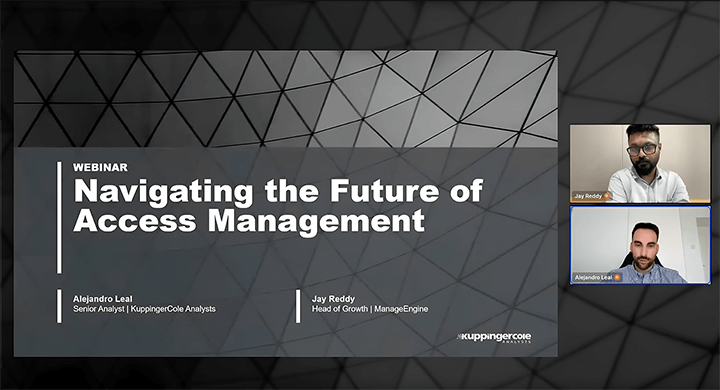
Navigate the future of access management
Watch the discussion between ManageEngine and KuppingerCole for a holistic view of access management.
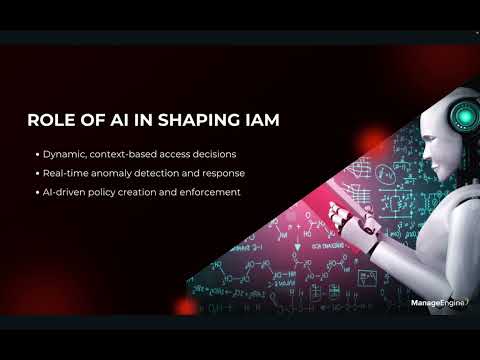
Generative AI and the future of Identity Governance
Explore how generative AI can modernize identity and access management and strengthen zero trust.
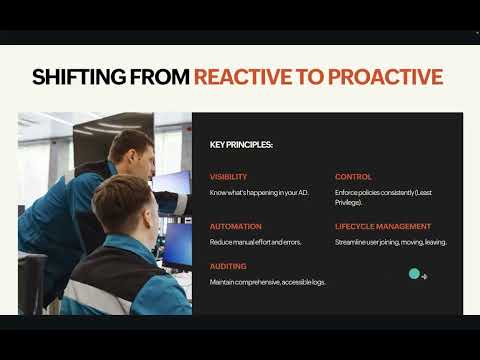
The cost of AD mismanagement: Hidden risks, compliance failures & how to fix them
Explore real-world AD mismanagement scenarios and their security and operational impact.

Zero Trust on a shoestring: Prioritizing high-impact controls for immediate risk reduction
Discover how to apply Zero Trust principles on a tight budget by prioritizing targeted MFA.

Automating Zero Trust: Reducing labor and software costs with policy-driven access controls
Discover how to replace manual identity workflows with policy-driven automation to enforce Zero Trust.

IAM in the Age of AI-Powered Fraud
Explore how to harden identity systems against AI-driven phishing and account takeover.
- Awards
- Analyst recognitions

Honored once again with 2025 TMCnet’s AI in Cybersecurity Innovation Award!
For the second year in a row, AD360 has been recognized at TMCnet's AI in Cybersecurity Awards.

Recognized as the IAM Innovator of the Year at the ITP.NET Security Awards 2025.
These awards honor the cybersecurity leaders, products, and strategies shaping digital security.


A Major Player in the IDC MarketScape: Worldwide Integrated Solutions for Identity Security 2025 Vendor Assessment
This recognition highlights AD360's converged approach to IAM within a unified platform.


ADSelfService Plus Starter Kit
Learn to enable secure self-service password resets, account unlocks, and profile updates.
ADManager Plus Starter Kit
Learn to simplify Active Directory user and group management with best-practice workflows.