How to use predictive AI for enterprise ITOps
Summary
Predictive AI is transforming enterprise ITOps from reactive to proactive by using machine learning to detect issues, forecast incidents, and automate responses. Agentic AI adds autonomy, enabling real-time decision-making and self-healing systems that reduce downtime and improve efficiency. To succeed, organizations must ensure high-quality data, build cross-functional skills, and implement clear governance. For CXOs, predictive AI offers a strategic edge—aligning IT performance with business goals, improving capacity planning, and driving innovation. This shift positions ITOps as a core enabler of resilience, agility, and competitive advantage in increasingly complex digital environments.
As digital infrastructure grows in complexity, the role of ITOps has evolved from reactive firefighting to proactive business enablement. But even the most mature monitoring tools often drown in alerts, making it difficult to see real issues before they escalate.
Predictive AI for ITOps provides a transformative shift to ITOps using ML to foresee incidents, automate responses, and unlock operational agility. For CXOs, it's not just about keeping the lights on but about aligning IT health and performance with business velocity.
Why ITOps needs a predictive AI advantage
Traditionally, ITOps has operated in a reactive loop: an alert is triggered, an engineer investigates, and remediation follows. While real-time monitoring tools have improved visibility, they often fail to provide foresight. Modern IT environments spanning across hybrid cloud, microservices, containers, and edge computing often generate telemetry at a scale that human teams can't effectively parse in real time.
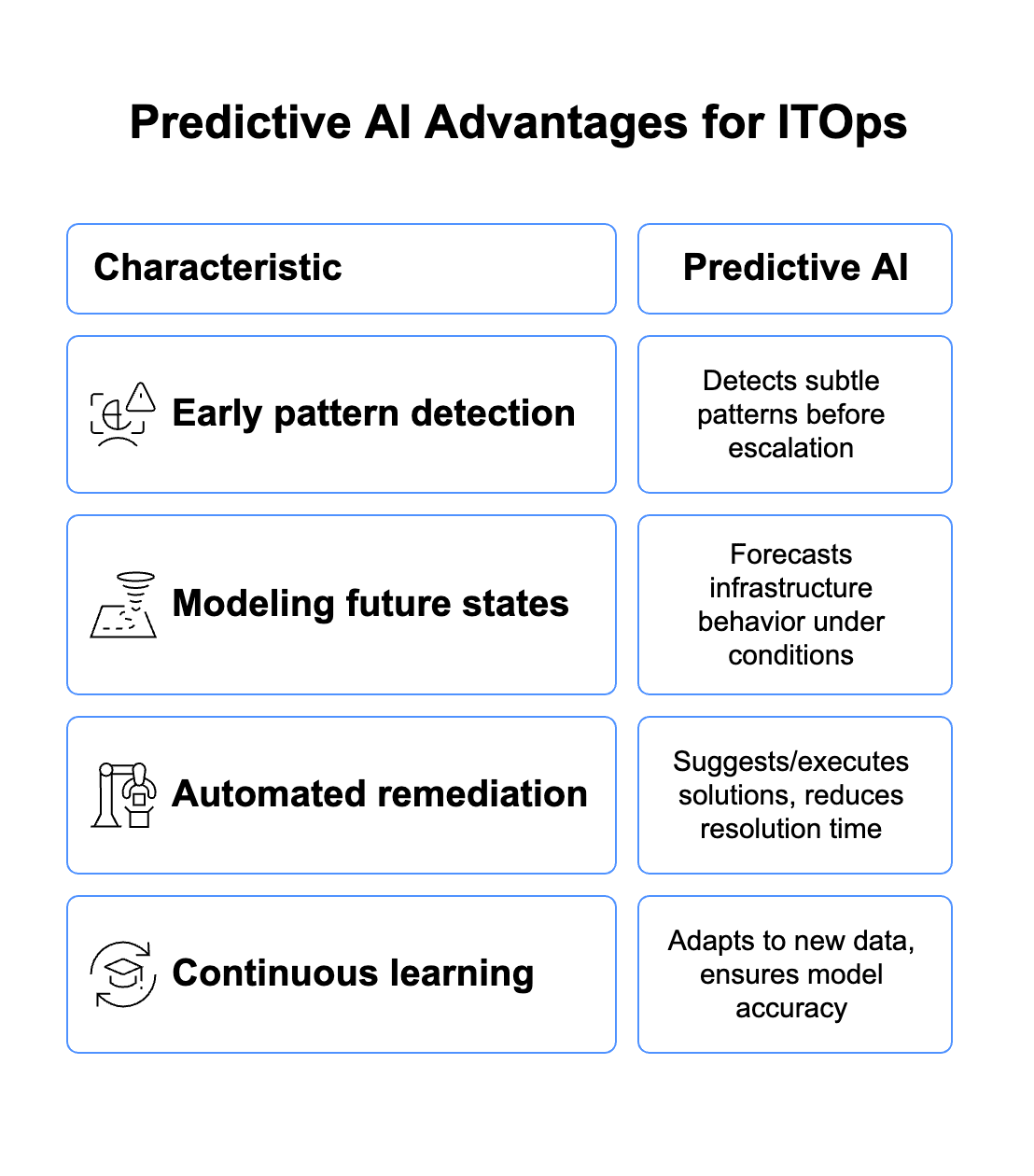
Here’s where predictive AI steps in:
- Early pattern detection: Predictive AI algorithms analyze historical and real-time data to detect subtle, often non-obvious patterns that commonly precede system failures or performance degradations. By identifying these early indicators, AI enables teams to anticipate issues before they escalate.
- Modeling future states: Through sophisticated ML models, AI can simulate and forecast the future state of infrastructure components under varying conditions. This allows ITOps to understand how changes including planned deployments, traffic spikes, or configuration tweaks might impact system stability.
- Automated remediation and recommendations: Predictive AI doesn’t just predict problems; it can also suggest the most effective remediation steps or even execute them autonomously. This reduces mean time to resolution (MTTR), minimizes human error, and frees up engineers to focus on higher-value strategic work.
- Continuous learning and adaptation: The dynamic nature of IT environments means baseline behaviors shift over time. Predictive AI continuously retrains on fresh data, ensuring that its models remain accurate and sensitive to new patterns of normal and abnormal behavior.
The result? IT operations shift from reactive to predictive and even preventive.
Key concepts: Understanding predictive AI in ITOps
Before diving deeper into capabilities and business impact, it's essential to grasp the foundational concepts that define predictive AI in the context of ITOps:
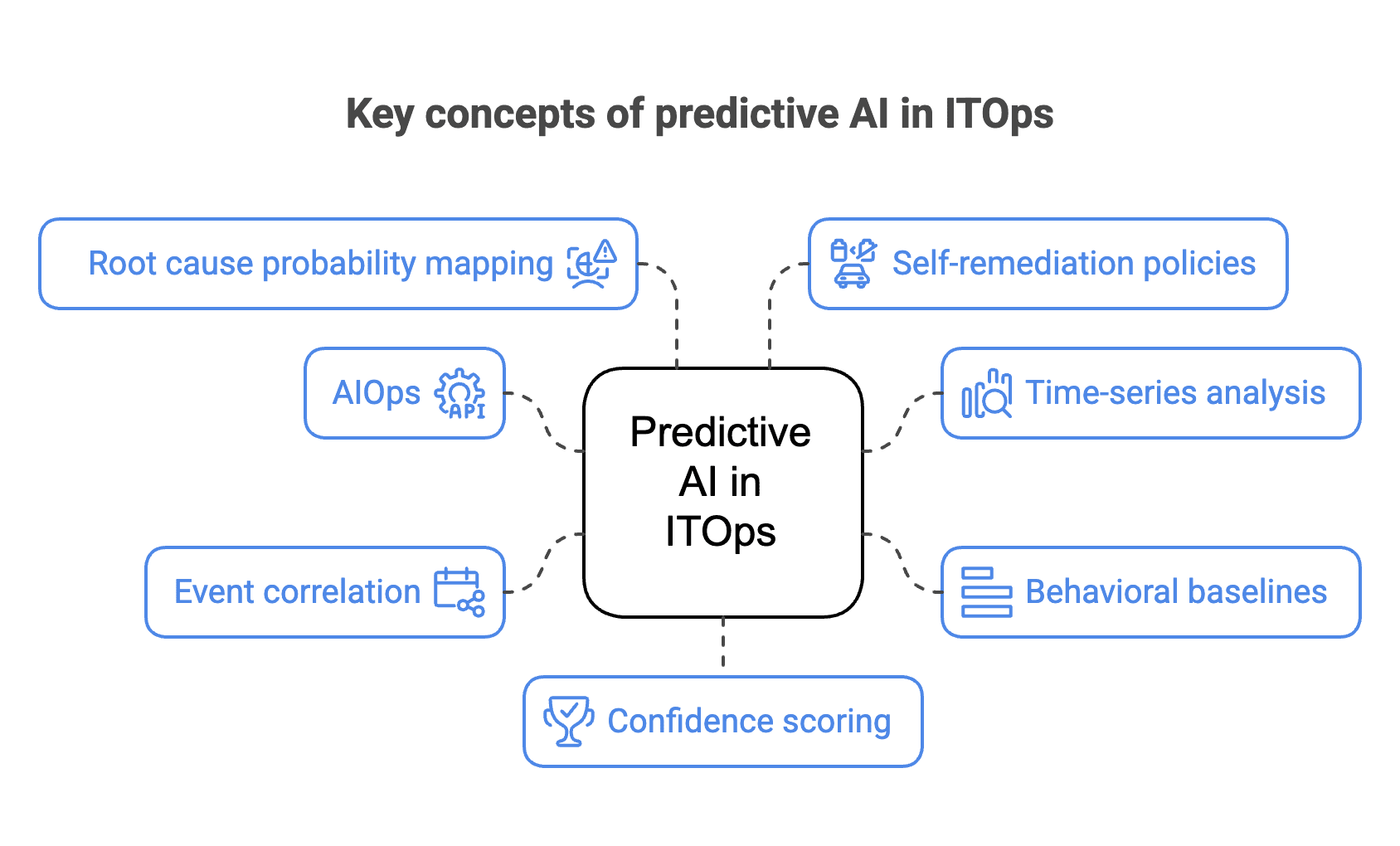
- Artificial intelligence for IT operations (AIOps): AIOps refers to the application of machine learning and data science to IT operations problems. It integrates data from various IT sources, such as metrics, logs, and traces, and applies algorithms to detect patterns, derive insights, and trigger actions. This integration transforms fragmented data into a unified view that supports faster decision-making.
- Time-series analysis: A critical element of predictive AI, time-series analysis involves examining sequences of data points collected over time to identify trends, cyclical patterns, and anomalies. In ITOps, this enables models to forecast key operational metrics such as CPU usage, memory consumption, or network latency by anticipating spikes or drops before they cause issues. Understanding seasonality and trends allows for proactive resource management and capacity planning.
- Behavioral baselines: Rather than relying on static, predefined thresholds for alerts, predictive AI establishes dynamic behavioral baselines that define what "normal" looks like for each system or service. These baselines are derived from historical performance and usage patterns, allowing the system to detect statistically significant deviations. This reduces false positives and ensures that alerts are meaningful and actionable.
- Event correlation: Event correlation is the process of linking related incidents or alerts across different components of the IT environment. For example, AI might connect a spike in database errors with a slowdown in web server response times. By understanding how events relate and cascade, predictive AI can provide context-rich insights that highlight root causes and help prioritize remediation efforts.
- Root cause probability mapping: This is an advanced predictive capability where AI assigns probability scores to multiple potential root causes of an issue. Probabilistic mapping guides engineers toward the most likely sources of problems, significantly accelerating diagnosis and enabling more precise remediation strategies.
- Self-remediation policies: These are predefined automation rules embedded within AI systems that allow for autonomous corrective actions under certain conditions. For instance, if the AI detects a service failure, it might automatically restart the service or switch traffic to a backup system without human intervention. Self-remediation reduces downtime and operational burden while improving system resilience.
- Confidence scoring: To foster trust and adoption of AI-driven automation, many predictive AI tools include confidence scores that quantify how certain the system is about its predictions or recommendations. These scores help human operators gauge when to act on AI insights autonomously versus when to seek further validation.
5 key capabilities of predictive AI in ITOps
To fully leverage predictive AI, it’s important to understand its core capabilities that transform IT operations. These key functions enable smarter, faster, and more efficient management of complex IT environments.
1. Anomaly detection at scale
Predictive AI leverages unsupervised and semi-supervised learning models to detect anomalies that traditional threshold-based monitoring often misses. Unlike fixed-rule systems, these AI models understand the context by recognizing that what’s normal behavior for one service might be unusual for another. This contextual awareness enables more precise detection of subtle issues that could escalate into outages.
CXO insight: By significantly reducing false alarms and alert noise, AI-driven anomaly detection minimizes alert fatigue, ensuring that engineering teams focus their attention on truly meaningful and actionable signals.
2. Incident prediction and risk scoring
Predictive AI analyzes historical logs, telemetry data, and infrastructure topology to forecast incidents before they occur. By identifying deviations from established healthy baselines, the AI assigns risk scores to critical components, effectively prioritizing potential trouble spots in the environment.
Use case: A global e-commerce platform can successfully avert major outages on Black Friday by using predictive AI. This proactive process will flag an unusual memory consumption pattern in its payment API container 12 hours before the peak sales period, enabling engineers to intervene proactively.
3. Automated root cause analysis
When incidents begin to manifest, predictive AI accelerates RCA by correlating events, mapping dependencies, and drawing on historical incident data. This automation narrows down probable causes faster than manual investigation, enabling rapid triage and informed decision-making.
CXO insight: The result is a significant reduction in mean time to resolution (MTTR), which enhances SLA compliance and improves overall customer satisfaction by minimizing downtime.
4. Self-healing infrastructure
Predictive AI can integrate with automation and orchestration tools such as Ansible, Terraform, and ServiceNow to not only predict, but autonomously remediate problems. This might include restarting failing services, scaling resources in response to demand, or rerouting traffic around degraded components.
Example: Telecommunications providers can employ AI-driven automation to resolve edge router degradations without human intervention, freeing NOC staff to focus on higher-value, strategic tasks.
5. Forecasting resource demand
Beyond immediate incident management, predictive AI models forecast future resource consumption such as CPU, storage, and bandwidth by analyzing usage trends and seasonal patterns. This foresight helps teams optimize capacity planning and infrastructure investments.
CXO benefit: Improved resource forecasting aligns IT spending with actual demand, reducing costly over provisioning and cloud waste, and enabling more efficient budget allocation.
Real-world applications: Business-critical scenarios
| Industry | Predictive AI use case |
|---|---|
| Banking | Forecasting potential ATM network outages by analyzing transaction and network data, enabling preemptive switchovers to backup systems and minimizing customer disruption. |
| Healthcare | Predicting latency spikes in electronic medical records (EMR) systems before they impact clinical workflows, ensuring timely access to patient data for healthcare providers. |
| Manufacturing | Detecting abnormal vibration patterns in IoT-connected machinery to identify early signs of equipment failure, reducing unplanned downtime and costly repairs. |
| Retail | Proactively scaling e-commerce infrastructure in anticipation of traffic surges, such as during holiday sales events, ensuring a seamless shopping experience for customers. |
| SaaS | Identifying potential API bottlenecks and performance degradation before they breach SLAs, maintaining application responsiveness and customer satisfaction. |
Implementation considerations for CXOs
While the promise of predictive AI in ITOps is immense, it is important to recognize that it is not a simple plug-and-play solution. Achieving success requires thoughtful strategic alignment across people, processes, and technology platforms:
1. Data quality and integration
Predictive AI’s effectiveness depends heavily on access to clean, comprehensive, and high-fidelity data. This means unifying observability data from diverse sources such as logs, metrics, traces, and topology into a single pane of glass. Fragmented or inconsistent data will undermine AI model accuracy and reliability.
Recommendation: Invest in a full-stack observability platform that either supports AI/ML natively or can seamlessly integrate with specialized AI engines. Prioritize solutions capable of ingesting and normalizing data at scale, enabling predictive models to learn from a complete operational picture.
2. Skill gaps in ITOps
Traditional ITOps teams are often strong in troubleshooting and maintaining systems but might lack proficiency in data science, AI tools, and automation scripting. Closing this skill gap is crucial to fully leveraging predictive AI capabilities.
CXO tip: Form cross-functional squads that blend site reliability engineers (SREs), data scientists, and ITSM experts. Promote continuous learning programs focused on AIOps platforms, coding/scripting skills, and AI-driven automation to build internal expertise and foster collaboration.
3. Explainability and trust
AI-driven insights can face skepticism from users if they feel like they are working with black boxes that don't provide clear and expected outcomes. Teams need clear visibility into how AI arrives at its conclusions, as well as measures of confidence to evaluate reliability.
Best practice: Select AI platforms that emphasize explainability by providing visual tracebacks, confidence scores, and clear rationale behind predictions and recommendations. This transparency builds user trust, encourages adoption, and supports faster, confident decision-making.
4. Governance and guardrails
While autonomous remediation is a powerful capability, it must be carefully governed to avoid unintended consequences. Clear policies are essential to define the boundaries for AI-driven actions, specifying when AI can act independently and when it should escalate or recommend human intervention.
Action point: Implement policy-as-code frameworks to codify change control rules, audit trails, and rollback mechanisms. This ensures that AI automation operates safely within approved parameters, reducing operational risk and maintaining compliance.
Looking ahead: Predictive AI as a competitive lever
As AI continues to mature and embed itself into the fabric of IT operations, its role is set to transcend traditional operational support and become a critical strategic enabler for the business. Predictive AI will not only enhance efficiency but also drive innovation, agility, and competitive differentiation. In the near future, key trends to watch include:
- Predictive capacity-as-a-Service: AI-driven capacity planning will become a standard service, dynamically aligning IT provisioning with evolving business growth trajectories. By forecasting resource needs well in advance, organizations can optimize infrastructure investments, reduce waste, and ensure seamless scaling that supports business objectives without disruption.
- CIO cockpits: Executive-level dashboards powered by predictive analytics will provide CIOs and leadership teams with real-time visibility into infrastructure health, risk factors, and operational performance linked directly to critical business KPIs. This integration will facilitate data-driven decision-making at the highest levels and enable IT to speak the language of business impact clearly and persuasively.
- Cross-domain AI integration: The future will see AI systems breaking down silos by correlating IT operations data with signals from security, compliance, and user experience domains. This holistic view will empower organizations to optimize performance, reduce risk, and enhance customer satisfaction in a unified, intelligent manner.
In a landscape where uptime is currency and latency is cost, predictive AI transforms ITOps into a business advantage. For CIOs, CTOs, and COOs, the mandate is clear: don’t just detect problems. Predict and prevent them before your stakeholders feel the impact.
The journey to predictive operations is not only a technological upgrade, but a mindset shift. One that moves ITOps from the basement to the boardroom.