


You've spent the last couple of years getting comfortable with AI that talks. It drafts your emails, summarizes your reports, and suggests your next line of code, and it's been an easy thing to trust, because all it ever did was hand you words and leave the doing to you. But the version showing up now is different in a way that matters: it doesn't just talk, it acts. And that single change is about to transform how you think about security. While you're sitting in a meeting, an AI agent can send emails, pull records from multiple systems, and close tickets; and it does all of it with real credentials, real permissions, and real access to your systems.
Gartner establishes agentic AI oversight as the biggest cybersecurity issue in its Top Trends for 2026 report, ahead of regulatory upheaval and post-quantum encryption, warning that agents are spreading through no-code tools faster than security teams can see them. The World Economic Forum's Global Cybersecurity Outlook 2026, drawn from over 800 leaders across 92 countries, agrees: adoption is racing well ahead of the governance meant to contain it.
What's the difference between an AI agent and an AI assistant ?
The difference between an AI assistant and an agent comes down to what each can do once you stop typing. A regular assistant, like the copilot in your inbox or code editor, generates text and hands the doing back to you.
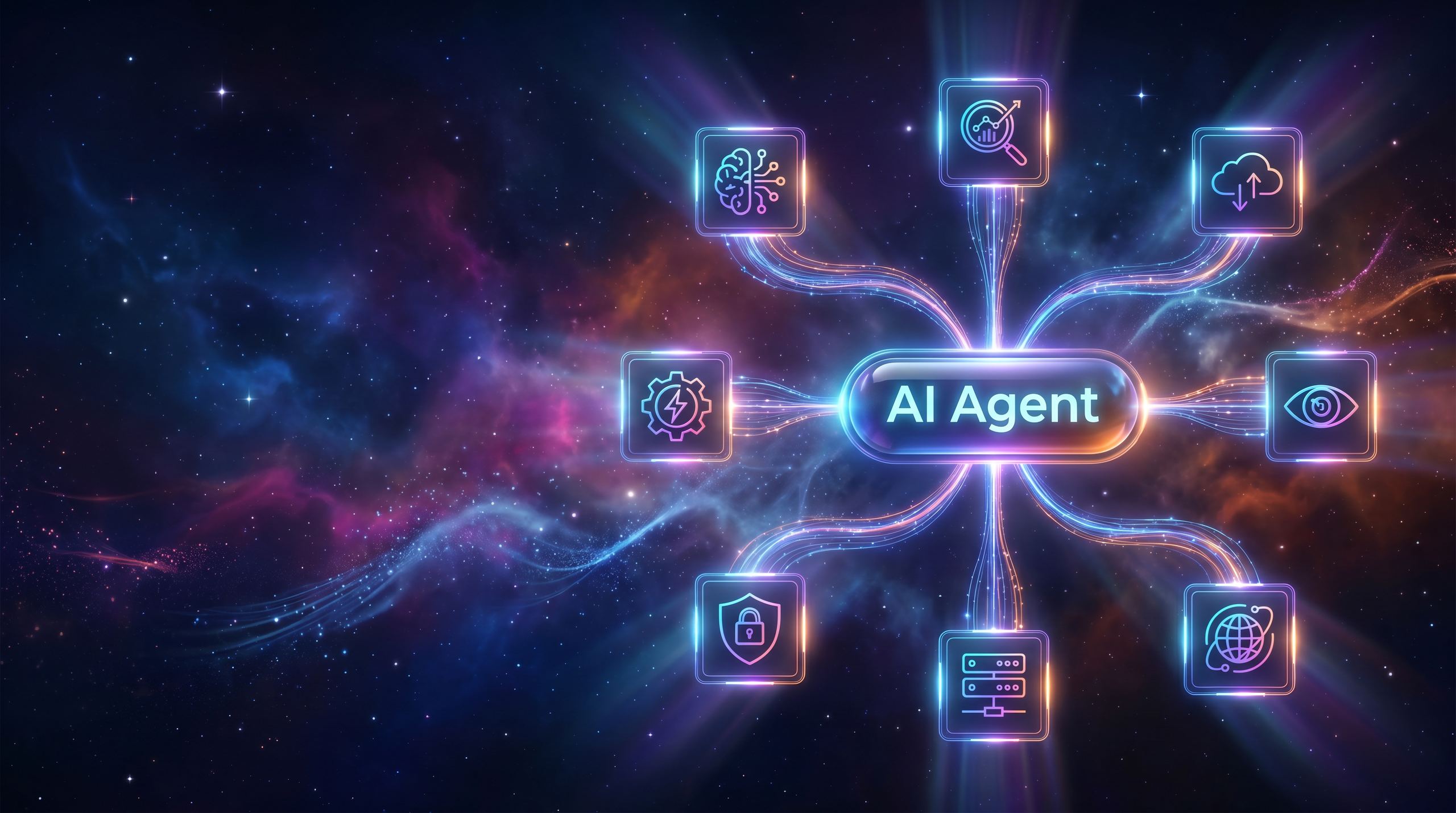
An agent runs on the same LLMs, but it's wired to act. Give it a goal and it plans the steps, reaches for the tools it needs, pulls in data through methods like retrieval-augmented generation (RAG), moves across your applications and APIs, and decides as it goes.
If you'd like to go deeper, we have a library of content that unpacks these concepts:
- AI Agents: What they are, their impact, and the future ahead
- AI agents vs. APIs: The future of enterprise integration
- Agentic AI vs AI agents: Differences that enterprises should know
- How does an agentic AI work and why your enterprise needs it
Why AI agents are a security risk
An agent brings together four things your security team usually keeps separate: an identity, a set of permissions, access to sensitive data, and the ability to act on those previous three faster than any person could. Someone with too much access is a risk you would probably spot in an audit. An agent is harder to spot, because it makes thousands of decisions an hour and will do whatever a cleverly worded message tells it to.
Every system you connect it to becomes another place it can act, and because the agent chooses its own next step, one small mistake early on can turn into a whole string of actions nobody signed off on.
And those are just the mistakes that could happen without malicious intent. Gartner predicts that by 2028, 25% of all enterprise breaches will trace back to AI agent abuse, from both outside attackers and insiders who turn agents against their own organization.
How to secure AI agents: The controls CIOs and CISOs should put in place
The good part is that none of this asks you to start over. You already know how to do most of it. It's the same security thinking you rely on every day, just pointed at a new kind of worker.
The first piece of that thinking is least-privilege access, which just means deciding what each agent is allowed to touch. The difference with agents is that they need a second limit too, one on how far they can act on their own before they check back with you.
That second limit has a name—least agency—drawn from OWASP's Top 10 for Agentic Applications, the current reference for agent risk. It's the one idea I'd most want you to take away: autonomy is something an agent should earn from you, not something you leave switched on by default.
So start where you always would, and give each agent access to exactly what its task needs and nothing spare. Give agents access only to specific tasks and set a time limit. Do not give them permanent permissions. Broad, "just in case" access leads to privilege creep, where agents end up with more power than they actually need to do their jobs. Entro's 2025 research found that in AWS environments, 62% of machine identities had sat unused for 90 days but still held on to their access.
Give every agent its own identity, too, and I'd really push you not to skip this one. In most enterprises, machine identities now far outnumber human ones. And GitGuardian's 2026 report found nearly 29 million credentials exposed in public code on GitHub in 2025, with roughly 70% of those leaked back in 2022 still working years later. The moment your agents share credentials, you lose the thing you'll want most after an incident, which is the ability to say which agent did what. So keep each identity separate, and keep its credentials short-lived.
For anything that really matters, make the agent stop and ask you first. Let it read a calendar on its own, but moving money or emailing a customer should wait for a human to sign off. Back that up with tool allowlists, so an agent only reaches the systems its job calls for, and sandboxed execution, so anything it does stays contained and can't spill into the rest of your environment.
Then keep watching, because permissions drift and even valid identities start to act up over time. Just remember that your logs will show you each action on its own, while the real trouble hides in the sequence, so train your attention on the pattern, not the single click.
The AI agent security checklist
If you only save one part of this article, save this. Run every agent through these six checks before it goes live, and keep checking on a regular schedule after that.
- Identity and access: Give every agent its own identity, never a shared or borrowed human one, and grant least-privilege access from day one. If you can't tell which agent took an action, you can't investigate it.
- Permissions and privilege: Review each agent's access on a set schedule and pull back anything it hasn't used. Standing permissions that outlive the task are the most common way agents gather risk over time.
- Data protection: Limit each agent to the data its task actually needs, and fence off sensitive stores so they're off-limits by default. Treat any data an agent can reach as data that could leak.
- Tools and workflows: Put tool access on an allowlist, keep the agent's execution contained and separate from production, and route high-stakes actions like moving money, deleting records, or emailing customers through human approval. Anything not explicitly allowed should be blocked.
- Monitoring and logging: Log every action, set a baseline for what normal looks like, and alert on the anomalies. Watch the pattern across actions, not just each click on its own.
- Governance and ownership: Give every agent a named human owner, a risk rating, and a line in a central inventory. You can't secure, audit, or retire what nobody owns and nobody has counted.
An agent that clears all six is one you can actually trust with the keys.
The part worth remembering
Autonomous agents aren't something to fear or a fad to wait out. They're a useful new kind of colleague, and like any colleague you'd trust with system access, they deserve an identity, a defined role, sensible limits, and someone watching the work. The winning organizations will be the ones who governed their agents on the way in, not the ones scrambling to catch up afterward.
Frequently asked questions
What is AI agent security? The controls, identities, and governance that stop autonomous AI agents from being misused, hijacked, or over-permissioned.
How is securing AI agents different from securing traditional software? Traditional software follows fixed instructions, while an agent decides for itself how to reach its goal, so you need to bind autonomous behavior rather than lock down known behavior.
What are the biggest agentic AI security risks? Identity abuse from stolen credentials, excessive permissions, prompt injection, and data leakage, mostly from agents having more access than they need and less monitoring than they deserve.
What is prompt injection, and why is it dangerous for AI agents? An attacker hides malicious instructions inside content the agent reads, and the agent acts on them as if they were legitimate prompt instructions.
Should every AI agent have its own identity? Yes, because a dedicated identity lets you enforce least-privilege access, trace any action to a specific agent, and revoke access cleanly.
How do you apply least privilege to AI agents? Give each agent access only to what its task needs and keep trimming it, using allowlists for tools and human approval for high-stakes actions.
What is AI agent governance? The framework for deploying agents responsibly: ownership, a full inventory, risk classification, and policies for how agents get approved, monitored, and retired.
How do you monitor AI agents in production? Log every action, set a baseline for normal behavior, and alert on anomalies like activity spikes or out-of-scope access requests.
What is shadow AI, and why is it a security risk? Unsanctioned AI tools employees use without approval. Shadow AI is risky because these unsanctioned AI move company data through systems your team can't see; IBM linked it to one in five breaches.