Cloud migration cost savings: Strategies to balance transformation and efficiency in 2025

Summary
As cloud adoption reaches new levels of maturity in 2025, enterprises are moving beyond basic lift-and-shift strategies to optimize their cloud environments for both performance and cost-efficiency. This article explores the evolving state of cloud migration, highlighting the increasing financial complexity IT operations teams face—from hidden usage charges to long-term vendor lock-in.
It outlines the tangible benefits of cloud adoption while mapping them against their associated cost risks. By detailing the various types of cloud-related expenses and providing practical strategies—including FinOps, governance practices, and elastic maintenance—this piece equips business and IT leaders with actionable insights to achieve sustainable cloud cost savings without compromising agility or innovation.
As digital transformation continues to accelerate, cloud migration remains a top priority for businesses seeking scalability, flexibility, and innovation. In 2025, the conversation is no longer about whether organizations should move to the cloud but how they can do so strategically—without compromising financial sustainability.
The state of cloud migration in 2025
Cloud adoption has moved beyond experimentation into a phase of strategic scaling. But with this maturity comes a pressing challenge: cost management. According to a 2025 Flexera report, 84% of organizations now cite controlling cloud spend as their top concern. Distributed environments bring added complexity—data sprawl, overlapping services, fragmented billing, and underutilized resources all contribute to rising costs.
While the cloud promises agility and scalability, these benefits can be offset by unchecked spending and unpredictable operational overhead. To realize the value of their investments truly, organizations must now evolve from simply adopting the cloud to mastering its economics.
Benefits of cloud migration vs. cost
Cloud migration offers undeniable advantages, like accelerating time-to-market and simplifying access to advanced capabilities like AI, ML, and real-time analytics that would otherwise require significant on-premises investments. However, these benefits often come with nuanced cost implications. Understanding both the value and the potential pitfalls is key to achieving the desired ROI from cloud investments.
Different types of cloud-related costs include:
- Operational costs: This includes ongoing spend on compute, storage, and networking resources, often driven by variable workloads.
- Hidden costs: Charges for data egress, API calls, managed services, and idle resources aren’t always visible in upfront estimates.
- Migration costs: One-time expenses associated with re-architecting applications, refactoring databases, and training personnel can add up.
- Governance and security costs: These costs include ensuring compliance, securing environments, and setting up monitoring add to overhead.
- Hybrid connectivity costs: Maintaining seamless integration between on-premises systems and cloud platforms via VPNs, dedicated interconnects, or an SD-WAN can result in substantial ongoing network and infrastructure expenses.
- Disaster recovery and backup costs: While the cloud enables automated backups and faster disaster recovery, storing large volumes of backup data and replicating workloads across regions can significantly increase storage and data transfer bills.
- Long-term costs: Lock-in with a single cloud provider or use of premium services can lead to higher total cost of ownership (TCO).
Despite these challenges, a well-executed cloud strategy can significantly improve performance, resilience, and agility. Here’s a breakdown of key benefits and the associated cost risks:
| Cloud benefit | Associated cost risk |
|---|---|
| Scalable infrastructure | Unused or underutilized resources can silently inflate monthly bills. |
| Pay-as-you-go pricing | Lack of spend visibility leads to budget overruns and forecasting challenges. |
| Faster deployment and innovation cycles | Increased reliance on managed services can create complex cost structures. |
| Automated backups and disaster recovery | Without storage life cycle policies, backup costs can balloon unexpectedly. |
| Reduced hardware and maintenance expenses | Upfront migration, retooling, and staff training can offset initial savings. |
| Access to AI, ML, and advanced analytics tools | Premium services and high compute demands can significantly raise TCO. |
| Geo-redundancy and global availability | Running multi-region architectures can result in high data transfer charges. |
Organizations must adopt a proactive approach to architecture, usage, and governance to ensure these costs don’t outweigh the benefits. To realize cloud migration cost savings, business leaders must go beyond lift-and-shift strategies and focus on optimizing architectures, usage, and governance.
Strategies for business leaders to control cloud spend
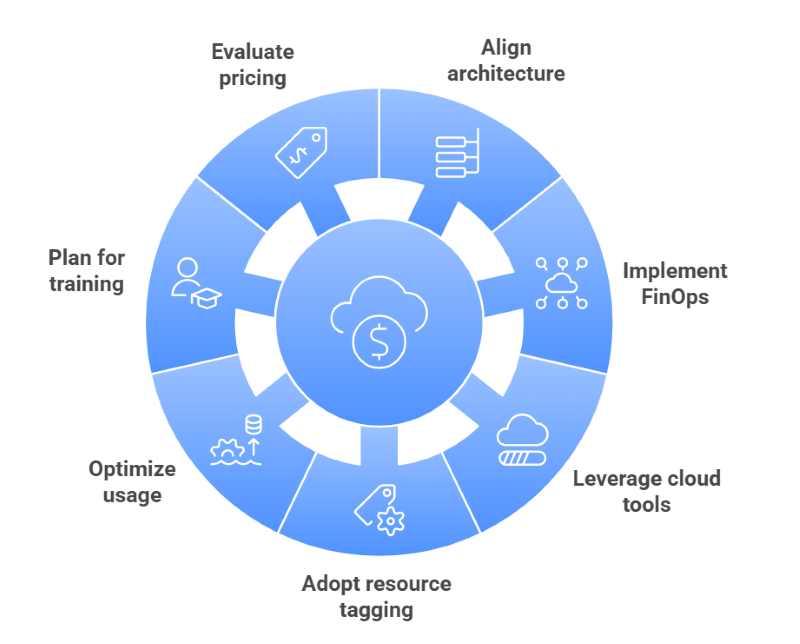
- 1. Align cloud architecture with business outcomes
Cloud cost optimization begins with clarity. Ensure your cloud adoption strategy is aligned with business goals—whether it’s scalability, performance, or innovation. This helps avoid overengineering environments and ensures spending directly supports growth. - 2. Implement FinOps practices early
FinOps, or financial operations, brings together finance, engineering, and operations teams to monitor and manage cloud costs collaboratively. Establishing real-time visibility, usage accountability, and forecast modeling can reduce waste and improve ROI. - 3. Leverage cloud-native cost controls
Most major cloud providers offer tools such as AWS Cost Explorer, Azure Cost Management, and Google’s Billing Reports. Use them to set budgets, automate alerts, and monitor underutilized resources. Strategies like rightsizing recommendations or scheduling unused instances can lead to significant savings. - 4. Adopt cloud resource tagging and governance
Proper tagging helps allocate costs to the right departments, projects, or applications. Governance frameworks ensure unused resources are decommissioned promptly and that spending is traceable to business value. - 5. Optimize storage and compute usage
Move from generic storage classes to tiered options based on usage patterns. Consider serverless computing, containerized workloads, or reserved instances when appropriate. Reducing idle capacity can directly reduce costs. - 6. Plan for training and change management
Unexpected costs often stem from knowledge gaps. Empower teams with the skills to provision resources responsibly and understand the financial implications of technical decisions. A strong cloud competency center can drive sustainable usage practices. - 7. Evaluate vendor-specific pricing models and discounts
Enterprise agreements, sustained use discounts, and hybrid use benefits (like Azure Hybrid Benefit) can dramatically lower recurring costs. Cloud marketplaces also offer third-party solutions that optimize performance without escalating expenses.
In 2025, cloud success is defined not just by migration but by how intelligently organizations manage cost and complexity at scale. For business and IT leaders, the path forward lies in building a cloud-smart strategy—one that unites architecture, operations, and financial accountability. By adopting a continuous optimization mindset, enterprises can unlock the full value of the cloud while keeping spend predictable, sustainable, and tied to real outcomes.