Composable applications: A smarter approach to agile, scalable digital systems

Summary
As enterprises prioritize agility and scalability, composable applications are emerging as a strategic approach to modern software development. This article explores what composable applications are, their growing market potential, the technologies that enable them, and the benefits they offer. It also outlines practical strategies for IT and business leaders to build a composable strategy while addressing the common challenges that can hinder successful implementation.
In today's fast-paced digital economy, businesses must respond to change with speed and precision. Traditional monolithic applications, once considered robust and dependable, often struggle to keep up with modern demands. Enter composable applications, a modular approach to application development that allows organizations to build, scale, and adapt digital systems more flexibly.
What are composable applications?
Composable applications are software that is built using modular, interchangeable components. They're known as packaged business capabilities, and can be quickly assembled, reused, and replaced to meet changing business requirements. These applications leverage APIs, microservices, headless architecture, and containerized services to support a highly dynamic and scalable IT environment.
This architectural shift supports the concept of composable business, where IT systems are no longer rigid stacks but flexible, LEGO-like pieces that can be configured to support new workflows, products, and customer experiences on demand.
Composable applications vs. monolithic applications
Monolithic applications typically combine multiple business functions into a tightly coupled codebase, meaning changes to one part of the application can affect other components. Composable applications take a modular approach, separating functionality into independently managed components that can be changed or scaled without rebuilding the entire application.
This distinction can give enterprises greater agility, but composability also introduces additional requirements for integration, governance, observability, security, and service management.
| Aspect | Monolithic applications | Composable applications |
|---|---|---|
| Architecture | Tightly coupled | Modular and loosely coupled |
| Deployment | Typically deployed as a unit | Components can be deployed independently |
| Scalability | Scale the broader application | Scale individual components |
| Change management | Changes can affect multiple functions | Components can be changed independently |
| Integration | Often more centralized | API- and event-driven |
| Complexity | Lower distributed-system complexity | Higher integration and orchestration complexity |
Why composable applications matter for modern enterprises
Composable applications matter because enterprises increasingly need to change digital services without rebuilding entire application stacks. Modular architectures allow organizations to introduce new capabilities, scale specific workloads, and adapt customer experiences while reducing dependence on tightly coupled systems.
The Business Research Company predicts that the composable applications market size will grow to more than $17 billion in 2029, reflecting a growing enterprise demand for modular, agile digital architectures.
As digital transformation continues to accelerate, organizations need to experiment, innovate, and pivot quickly. Composable applications offer a solution by:
- Reducing the time to market for new features and services.
- Improving development agility through reusable components.
- Enhancing system resilience through isolating failures to individual services.
- Supporting personalization through flexible front-end and back-end decoupling.
5 benefits of composable applications
Composable applications deliver both technical and business value, helping organizations transition from siloed operations to more agile and responsive infrastructures. Here’s a snapshot of the key benefits and the business impacts they offer:
| Benefit | Business impact |
|---|---|
| A modular design | Faster innovation and lower development overhead |
| API-driven integration | Easier interoperability with third-party systemsh |
| Scalability and performance tuning | Scaling individual components without overhauling the full stack |
| Business and IT alignment | Empowering non-technical teams to configure or compose features |
| Resilience and uptime | Isolating failures and reducing their impact on broader system operations |
Key technologies powering composable applications
The shift toward composable architectures is supported by a powerful stack of technologies that prioritize modularity, scalability, and interoperability:
Microservices architecture
Applications are decomposed into independently deployable services, enabling better isolation, faster updates, and easier scaling.
APIs and event-driven architecture
APIs serve as the glue between components, while event-driven models support real-time responsiveness and decoupled services.
Headless CMS and commerce platforms
These separate the back end from the front end, allowing teams to build and update digital experiences independently.
Containers and Kubernetes
Containerization ensures consistent environments, and orchestration with Kubernetes allows teams to deploy, manage, and scale services efficiently.
Low-code and no-code platforms
These tools allow business users to compose or customize applications without writing extensive code, speeding up the time to market and reducing reliance on developers.
CI/CD pipelines and DevSecOps
CI/CD processes ensure faster, safer delivery of updates while embedding security early in development.
These technologies form the building blocks that enable teams to create flexible, future-proof application ecosystems with confidence.
Challenges and considerations with composable applications
Despite their advantages, composable applications introduce new layers of complexity that organizations must manage effectively:
Governance and orchestration
Managing multiple microservices and APIs across environments requires robust governance policies and clear orchestration strategies to avoid service sprawl and technical debt.
Security
Each modular component and exposed API is a potential entry point for attackers. Implementing Zero Trust architecture, API security, and real-time threat detection is essential.
Skill requirements
Teams must be equipped with skills in cloud-native development, container orchestration, and DevOps practices—skills that are often in short supply.
Integration with legacy systems
While composable apps enable agility, integrating them with monolithic or outdated legacy systems can be complex and resource-intensive.
Tooling fragmentation
Without proper oversight, organizations risk using too many disconnected tools, which can reduce visibility and increase management overhead.
QA and data management hurdles
Ensuring consistent data quality across distributed components and environments is difficult. QA processes must evolve to validate interactions across services, often requiring synthetic test data and end-to-end test automation frameworks.
Cultural alignment
Moving to a composable model often requires a cultural shift where both IT and business stakeholders collaborate more closely and embrace continuous change.
Observability and operational complexity
Distributed components make it harder to understand application performance end to end. A failure in one service can affect multiple downstream processes, while the underlying infrastructure, APIs, containers, and applications may be managed by different teams. Organizations adopting composable architectures therefore need unified observability, distributed tracing, event correlation, and dependency mapping to maintain visibility across the application stack.
By proactively addressing these challenges, organizations can create a resilient composable architecture that performs, scales, and adapts seamlessly.
Getting started: Building a composable strategy
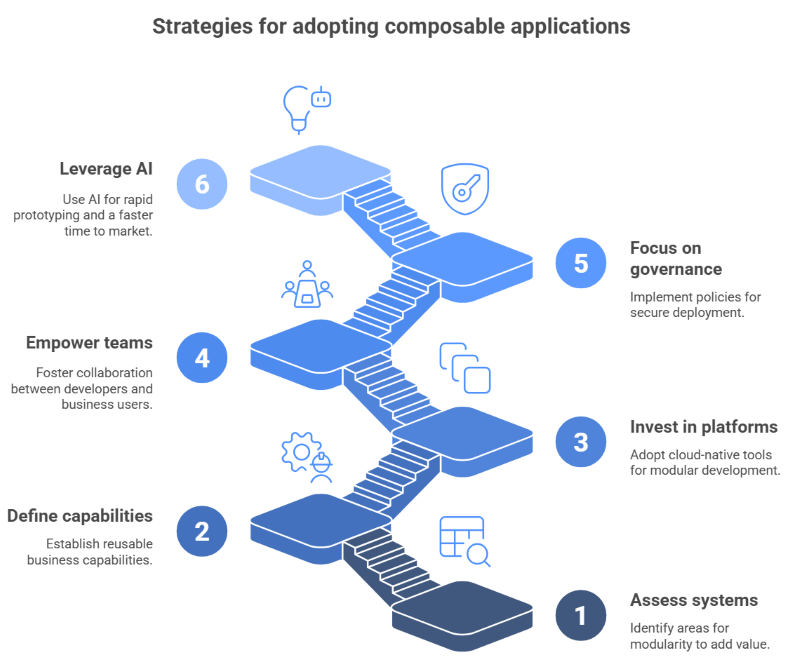
To adopt composable applications successfully, IT and business leaders should:
- Assess current systems: Identify areas where modularity would bring the most value.
- Define reusable business capabilities: Start with high-impact areas like customer onboarding, billing, or product catalog management.
- Invest in modern platforms: Leverage cloud-native tools and platforms that support modular development.
- Empower cross-functional teams: Encourage collaboration between developers, architects, and business users.
- Focus on governance and security: Set policies and automations for secure, consistent deployment and life cycle management.
- Leverage generative AI for rapid prototyping: Use generative AI to accelerate the design and generation of modular components, helping teams experiment with new business capabilities faster and reduce the time to market.
What the future looks like
Composable applications represent a foundational shift in how organizations approach technology. As AI, edge computing, and data-driven experiences become more mainstream, composability will be essential for delivering the responsiveness and flexibility these technologies demand. Organizations that embrace composable thinking today will be better positioned to innovate, scale, and differentiate in a competitive digital landscape.
FAQ
What are composable applications?
Composable applications are software systems built from modular, reusable, and interchangeable components. These components can be independently developed, deployed, scaled, and replaced, allowing organizations to adapt applications to changing business requirements.