

Digital experience monitoring: How it works and why organizations should care

Summary
In today’s experience-first digital economy, user satisfaction hinges on seamless application performance. This article explores digital experience monitoring (DEM) as a critical discipline that goes beyond traditional backend monitoring to deliver real-time insights into how users interact with digital services. It delves into the two core components—Synthetic Transaction Monitoring (STM) and Real User Monitoring (RUM)—and explains how they work together to provide end-to-end visibility. The article also outlines implementation challenges and offers guidance for CXOs on how to align DEM with broader business objectives to drive long-term value.
In an era where users expect seamless digital interactions, monitoring back-end metrics alone is no longer enough. Performance issues, even if transient, can affect thousands of users across devices, locations, or platforms—often before IT teams even know about them. This is where digital experience monitoring plays a pivotal role.
What is digital experience monitoring?
Digital experience monitoring (DEM) is a modern approach to observing and optimizing the complete journey users take when interacting with digital services. Unlike traditional monitoring, which focuses on individual IT components (like servers or databases), DEM provides a holistic, user-centric view of performance. It aims to understand how actual users, whether customers or employees, perceive the speed, availability, and functionality of websites, web applications, and mobile applications, ensuring a seamless and productive digital interaction.
How digital experience monitoring works
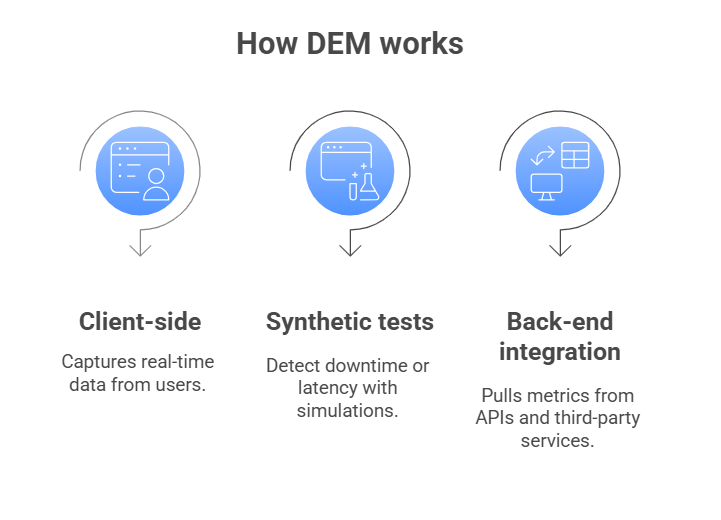
DEM works by continuously collecting, analyzing, and correlating performance data across user touchpoints to evaluate the quality of digital interactions. Here's how it works:
- Client-side instrumentation: (via JavaScript agents or SDKs) captures real-time data such as page load times, JavaScript errors, and interaction delays from actual users.
- Synthetic tests: run scripted transactions from multiple global locations to simulate user journeys and proactively detect downtime or latency spikes.
- Back-end integration: pulls in metrics from APIs, DNSs, CDNs, and third-party services to identify bottlenecks across the service chain.
This multi-dimensional data is then correlated and analyzed through monitoring platforms that offer real-time dashboards, anomaly detection, and historical trend analysis. The result is deep, actionable visibility into how infrastructure, application performance, and external dependencies affect the end-user experience.
Why digital experience monitoring matters
Traditional infrastructure monitoring tools provide visibility into CPU, memory, or network metrics but lack context about how those issues affect real users. DEM addresses this by combining simulated and real-user interactions to provide an outside-in view of system health.
With DEM, IT teams can:
- Detect performance degradation before it impacts users: By leveraging real-time insights from both synthetic and real user monitoring, DEM allows IT teams to proactively identify issues such as slow page loads, failed transactions, or service unavailability. Early detection helps resolve potential disruptions before they impact user satisfaction or business operations.
- Correlate user issues with back-end systems or third-party services: DEM integrates front-end experience data with back-end infrastructure metrics, enabling teams to trace user problems, like timeouts or errors, back to specific system components, APIs, microservices, or even third-party integrations. This correlation accelerates root cause analysis and facilitates faster incident resolution.
- Meet SLAs tied to user experience KPIs: As user experience becomes a core component of business performance, organizations are increasingly adopting service-level agreements (SLAs) that go beyond uptime to include user-centric metrics. DEM provides the visibility needed to track these KPIs continuously and ensure digital services consistently meet performance expectations outlined in internal or customer-facing SLAs.
Core components of digital experience monitoring
At its core, DEM relies on two complementary approaches: synthetic transaction monitoring (STM) and real user monitoring (RUM). Each brings unique strengths, and when used together, they offer a comprehensive view of digital performance.
STM
STM, also known as synthetic monitoring, involves using scripted sequences to simulate user interactions with a website or application. These scripts emulate the paths a typical user would take, such as logging in, searching for a product, adding items to a cart, or submitting a form.
For example, e-commerce platforms may rely on STM during events like a Black Friday sale to ensure their most critical customer journeys remain operational under heavy load. A retailer might simulate the full checkout process across global regions every few minutes. If synthetic tests detect latency spikes or checkout failures, alerts are triggered instantly, enabling IT teams to investigate before the issue impacts actual customers. This proactive visibility is crucial for maintaining revenue and brand trust during high-stakes traffic surges.
How it works:
- Global monitoring network: STM fundamentally operates through a global network of monitoring nodes (or agents). These nodes are strategically deployed across various geographical locations and different ISPs, simulating diverse user access points. For on-premises applications, these nodes might be deployed within an organization's internal network to monitor internal-facing applications. For cloud-based applications, nodes are typically located in various cloud regions to test global availability and performance from an external perspective.
- Proactive testing: STM actively executes preconfigured scripts at scheduled intervals (e.g., every five minutes), regardless of real user traffic. This proactive approach allows organizations to detect availability and performance issues before real users are impacted, ensuring continuous uptime and consistent service delivery.
- Controlled and consistent environment: By running identical scripts repeatedly, STM provides highly consistent performance data in a controlled environment. This consistency is crucial for establishing accurate performance baselines and for quickly identifying regressions after code deployments or infrastructure changes. If a synthetic test degrades or fails, it provides clear, quantifiable evidence of a problem.
- Accurate root cause analysis (RCA): STM tools provide detailed, actionable metrics when a synthetic test fails or degrades that help drill down to the root cause. These include waterfall charts visualizing individual element load times to identify slow resources or third-party dependencies, along with specific timings for DNS lookup, connection times, and first byte time to pinpoint network or server-side issues. Additionally, error codes help pinpoint specific HTTP or script failures, enabling engineers to quickly identify the exact component or transaction phase causing a performance bottleneck.
RUM
RUM is a passive monitoring technique that captures and analyzes every interaction of actual users with a website, web application, or mobile application in real time.
RUM is typically used to track how different users across regions, devices, and networks experience a web or mobile application. For example, it can reveal that users on older browsers or slower networks face longer load times or higher error rates. This insight allows teams to prioritize optimizations and fix performance issues that affect specific segments of their user base in real-world conditions.
How it works:
- Real-time visibility: RUM uses a small JavaScript tag (web) or SDK (mobile) embedded in the application to non-invasively collect data directly from the end-user's browser or device. This provides an authentic perspective, accounting for real-world variables like network conditions, device types, and locations.
- Granular performance metrics: RUM tracks a wide array of user-centric metrics, including perceived page load times (FCP, LCP), individual resource timing, AJAX/HTTP request times, JavaScript errors, and network latency from the user's perspective.
- User behavior analysis: Beyond performance, RUM captures user navigation paths, clickstreams, form submission rates, and time spent on pages. This data helps with understanding user behavior, identifying usability issues, and pinpointing conversion blockers.
- Session replay: A powerful feature, Session Replay reconstructs a user's entire journey (mouse movements, clicks, keystrokes) exactly as they experienced it, providing visual insights into user struggles and bugs.
- Apdex scoring: Many RUM solutions quantify user satisfaction using the Apdex score, translating raw performance data into a measurable metric of user contentment.
Here is a comparison of the key characteristics of STM and RUM:
| Aspect | STM | RUM |
|---|---|---|
| Working | Simulates user interactions with an application or website using pre-scripted transactions | Collects performance data from real users as they interact with the application in real time |
| Use case | Best suited for proactively identifying issues, testing performance before release, and benchmarking SLAs | Ideal for understanding the actual user experience across different devices, browsers, geographies, and networks |
| Data captured | Measures load times, availability, and step completion for predefined user journeys | Captures metrics such as page load time, user interactions, navigation paths, and client-side errors |
| Visibility scope | Limited to synthetic paths and does not reflect variations in real-world user behavior | Provides rich contextual data on actual user sessions, including performance variation and user behavior |
| Troubleshooting capability | Useful for controlled testing and identifying performance issues before users are affected | Helps diagnose issues experienced by specific users under specific conditions (device, browser, location) |
| Implementation | Requires scripted test scenarios and scheduled runs; low overhead | Requires JavaScript agents or SDKs embedded in the application; higher data volume but more realistic |
| Strengths | Great for proactive alerting, SLA validation, and geographic performance comparison | Excels at user-centric performance analysis, long-term trend monitoring, and real-time issue identification |
| Limitations | Doesn’t capture unexpected user behaviors or edge cases | Relies on real traffic, so it can’t detect issues on unused features or in low-traffic areas |
Challenges with deploying digital experience monitoring
DEM, while offering immense benefits, presents several challenges for organizations during implementation and ongoing management. These can range from technical complexities to organizational hurdles:
- Complexity of digital ecosystems: Modern digital landscapes are incredibly intricate, involving numerous applications, microservices, cloud environments, third-party APIs, and diverse user devices and networks. Monitoring this entire ecosystem comprehensively requires versatile DEM tools capable of synthesizing data across all these elements, which can be a significant challenge. Achieving end-to-end visibility across such a complex web can be daunting.
- Disparate technologies and vendor lock-in: The DEM market offers a variety of solutions, each employing different underlying technologies and approaches (e.g., specific RUM agents, APM frameworks). Choosing a solution that effectively integrates these disparate technologies to provide a cohesive view can be challenging. Furthermore, committing to a single vendor's ecosystem might lead to lock-in, limiting flexibility in the future.
- Cost and ROI justification: Enterprise-grade DEM solutions can be expensive, involving licensing fees, infrastructure costs, and personnel investments. Justifying the return on investment (ROI) can be challenging, as the benefits (e.g., reduced customer churn, increased productivity, faster MTTR) are often indirect and require careful measurement and correlation with business outcomes.
- Privacy and compliance: With increasing data privacy regulations globally (like the GDPR, the CCPA, and similar regulations in India), organizations face the delicate balance of collecting meaningful user data while ensuring strict compliance. DEM solutions must be configured carefully to anonymize sensitive data, adhere to data residency requirements, and respect user consent, which adds complexity to deployment and operation.
DEM is essential for ensuring that performance metrics align with user satisfaction. By leveraging the strengths of both synthetic and real user monitoring, teams can shift from reactive to proactive performance management.
How CXOs should approach digital experience monitoring
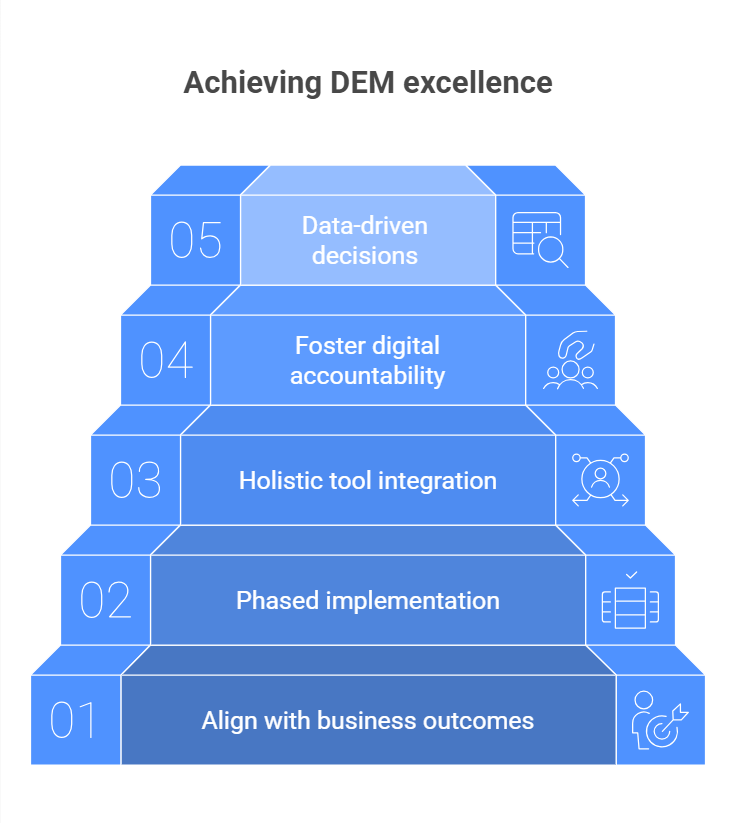
For CXOs and C-level executives, embracing DEM is a strategic imperative, directly impacting business level objectives (BLOs) like revenue, operational efficiency, and brand reputation.
To maximize these benefits, organizations should strategically approach DEM by:
- Aligning with core business outcomes: CXOs must link DEM objectives directly to BLOs. For example, improved customer satisfaction via faster page loads boosts conversion rates. This ensures DEM investments demonstrate clear ROI by impacting customer churn, sales, or employee efficiency.
- Phased implementation for demonstrable ROI: CXOs should advocate a phased DEM rollout, starting with critical applications. This allows for rapid demonstration of ROI through early wins, like reduced cart abandonment or faster employee login, building a strong case for broader adoption.
- Holistic tool selection and integration: C-level executives must ensure DEM tool selection prioritizes comprehensive integration across the IT landscape. Seamless integration with existing APM, network, and ITSM systems is crucial for end-to-end visibility, accelerating problem resolution and minimizing downtime costs.
- Fostering a culture of digital accountability: DEM's success requires breaking down organizational silos. CXOs must champion a culture where development, operations, product, and marketing teams share accountability for the digital experience, ensuring collaborative, proactive problem-solving that impacts BLOs.
- Data-driven decision making and optimization: CXOs should empower teams to use DEM insights for strategic decisions. This continuous feedback loop ensures every optimization directly contributes to enhancing customer satisfaction, boosting productivity, and driving sustained business growth.
As digital ecosystems become more complex, continuous optimization will be key. By embedding DEM into daily operations and decision-making, organizations can ensure seamless digital performance, improve customer satisfaction, and stay competitive in an experience-first era.