

The secret to building a digital modernization strategy that works: Case studies from top organizations

Summary
This page is a CXO playbook on digital modernization, outlining its core meaning, five strategic pillars, and real-world case studies from leaders like Microsoft, Unilever, and Starbucks. It provides step-by-step guidance on vision, technology, culture, and governance to help organizations thrive in the digital economy. Read the full page for detailed strategies and actionable insights.
As a CXO, you already know the difference between surviving and thriving lies in how well you adapt. However, transformation isn’t enough anymore. What you need is digital modernization: a strategic, holistic redesign of your systems, culture, and business model that positions your organization for agility, resilience, and growth.
In this playbook, you’ll see how to build and execute a robust digital modernization strategy. You’ll discover the pillars that matter, the governance and investment choices you must make, and the cultural shifts you’ll need to drive. Along the way, you’ll learn from real-world case studies of leaders, like Microsoft, Unilever, Starbucks, Petrobras, and Analog Devices, that have modernized with lasting impacts.
What a digital modernization strategy really means
At its core, a digital modernization strategy is an executive-led agenda to:
- Replace obsolete legacy systems with cloud-native or modular architectures.
- Reorient processes and products around digital-first experiences.
- Embed data and AI into business-IT processes to drive personalization, efficiency, and insight.
- Foster a culture of innovation with continuous delivery and agile ways of working.
- Ensure that governance, security, and ROI measurement guide the journey.
You’re not implementing one tool or a platform; you’re reshaping how your entire enterprise operates in a digital economy.
The 5 strategic pillars of digital modernization you must have
Your modernization strategy should stand on five foundational pillars:
| Pillar | Why it matters |
|---|---|
| 1. Vision and leadership | You must clearly articulate a bold ambition, rally executive sponsors, and align the C-suite. |
| 2. A customer-centric design | You need insight-driven, personalized solutions that evolve with customer expectations. |
| 3. Technology and architecture | The cloud, APIs, modular platforms, AI, and automation provide the backbone. |
| 4. Talent and culture | Your teams need skills transformation, agile working models, and cross-functional collaboration. |
| 5. Governance and metrics | You must implement transparent roadmaps, KPIs, and guardrails to track your ROI and minimize risks. |
Case studies: How leaders modernized their digital initiatives
| Organization | Strategy | Digital modernization plan | Takeaways |
|---|---|---|---|
| Analog Devices | Customer-centered modernization with generative AI | Analog Devices modernized by starting with its customers. After surveying nearly 5,000 customers and internal field teams, the company redesigned its customer journey. It leveraged generative AI to create natural language searches, automated content, and personalized digital interactions. | Anchor your modernization strategy in customer feedback, then scale AI and digital initiatives to meet those needs. |
| Unilever | A faster time to market through data | Unilever digitized loyalty data and third-party inputs into a database of 900 million anonymized consumer records. By putting digitalization at the core, Unilever launched products 50% faster and delivered targeted ads in India at one-fifth of the usual cost. | Build your modernization strategy around data as an enterprise asset. Use it to shorten cycles, personalize at scale, and drive efficiency. |
| Microsoft | Reinventing business models with the cloud in the mix | Microsoft’s shift in business models is a clear example of modernization. The pivot from traditional software licensing to a cloud-first licensing model, along with acquiring LinkedIn and GitHub to improve cross-product capabilities, tripled the company’s market capitalization. | Sometimes, modernization requires you to reinvent your entire business model, not just your technology. |
| Starbucks | Mobile-first loyalty and platform thinking | Starbucks didn’t just build an app; it created a loyalty-driven platform with mobile ordering, mobile payments, and AI-driven recommendations. This generated an “unparalleled frequency” of repeat customers. | Think platforms, not features. Design ecosystems that deepen customer engagement and revenue. |
| Petrobras | Scaling modernization with low-code development | Petrobras faced over 2,000 legacy applications and chose to scale modernization with OutSystems' low-code platform. Within eight months, it built 48 new apps, improved productivity, and cut the development time for new apps by up to 60%. | When legacy tool sprawl overwhelms you, low-code development can accelerate modernization without overwhelming your developers' capacity. |
| Nike and LEGO | Digital communities to build loyalty and retention | Nike and LEGO created digital communities, AR experiences, and co-creation apps that boosted loyalty and sales. | Digital modernization helps you expand your brand presence to a new-age audience. |
Your modernization playbook: A step-by-step guide to getting it right
Here’s how to structure your digital modernization strategy:
1. Establish a bold vision
- Define clear, measurable goals: Aim high but stay specific. For example, target 50% digital revenue within three years or a 60% reduction in technical debt.
- Align with business outcomes: Ensure your vision ties directly to broader business objectives such as customer growth, operational efficiency, or innovation leadership.
- Communicate with and rally stakeholders: Make your vision inspiring and clear to all stakeholders, including executives, employees, and partners.
2. Perform organizational assessments
- Map current systems and processes: Take stock of legacy infrastructure, integrations, and workflows. Use system audits and architecture diagrams.
- Identify bottlenecks and pain points: Look for operational inefficiencies and technical debt that slow you down.
- Understand customer journeys: Use large-scale surveys, customer interviews, and journey mapping to identify friction points.
- Benchmark your organization against industry leaders: Adopt best practices from companies like Analog Devices that leverage data-driven insights to guide transformation.
3. Design a balanced roadmap
- Mix quick wins with long-term bets: Balance delivering immediate value through low-code apps or API wrappers with strategic projects like migrating to cloud ERP or building AI pipelines.
- Prioritize initiatives by their impact and effort: Use frameworks like impact, confidence, and ease (ICE) scoring to prioritize projects.
- Build in flexibility: Allow your roadmap to evolve based on feedback and market changes.
4. Build your tech backbone
- Adopt modular, API-first architectures: Enable seamless integrations and agility.
- Invest in cloud ERP and data platforms: Shift from monolithic systems to scalable, flexible cloud environments.
- Leverage AI and analytics: Build AI pipelines to unlock insights and automate decisions.
- Ensure security and compliance: Modern systems must be secure by design.
5. Develop your talent and culture
- Upskill your workforce: Launch digital literacy and advanced training programs.
- Create cross-functional squads: Break down silos by forming agile teams combining business and tech skills.
- Foster a startup mindset: Encourage experimentation, risk-taking, and continuous learning.
- Celebrate success and learn from failures: Keep motivation high and build resilience.
6. Govern with metrics
- Establish a steering committee: Include stakeholders across business units for oversight and alignment.
- Track meaningful KPIs: Examples include the speed to market, cost savings, customer satisfaction (NPS), and employee engagement.
- Learn from industry benchmarks: Starbucks tracks repeat customer engagement, and Unilever monitors the product launch speed for agility insights.
- Perform regular reviews and adjustments: Use metrics to pivot and prioritize resources effectively.
7. Sustain the momentum
- View modernization as ongoing: It’s a journey, not a project.
- Reinvest continuously: Allocate a budget and resources for ongoing innovation and upgrades.
- Maintain the cultural commitment: Keep leadership and teams motivated through transparent communication and recognition programs.
- Adapt to future trends: Stay ahead by monitoring emerging technologies and market shifts.
Why modernization matters to you
When you modernize effectively, you unlock:
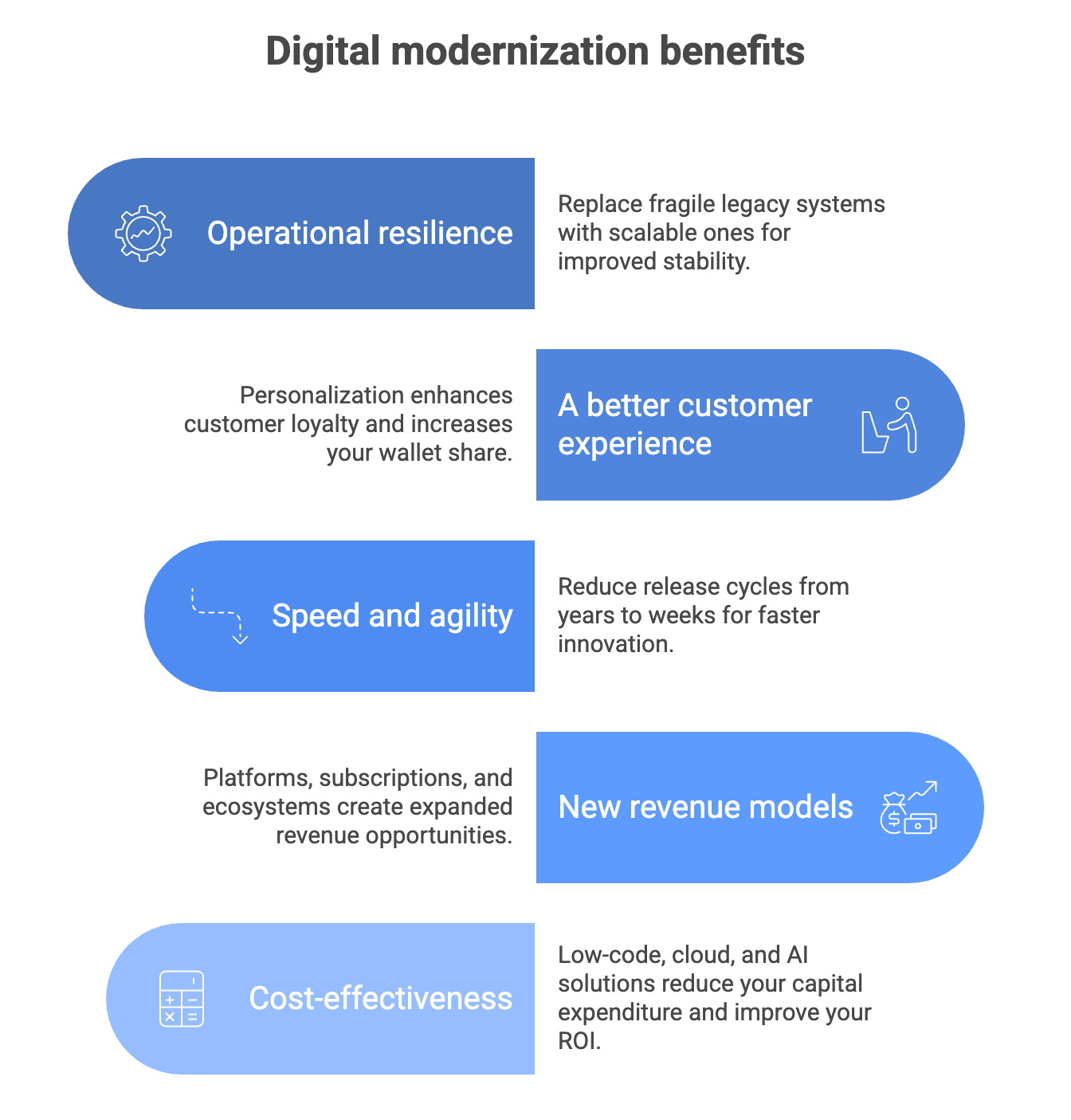
As a CXO, you hold the mandate to lead your organization's digital modernization strategy. This isn’t the IT team’s job but a boardroom-level responsibility. You must:
- Commit to long-term capability building, not quick fixes.
- Start with customers, not technologies.
- Balance speed with governance to protect enterprise integrity.
- Link every digital investment directly to strategic outcomes.
If you act with conviction and clarity, your modernization strategy won’t just refresh your systems; it will reshape your enterprise for the digital future.