Digital transformation strategies: How business leaders can future-proof operations

Summary
In today’s fast-evolving business landscape, digital transformation isn’t just a competitive advantage—it’s a necessity. Organizations are under increasing pressure to innovate, become more agile, and deliver seamless customer experiences, all while keeping costs and risks in check.
This article dives into what it really takes to lead a successful digital transformation. From adopting AIOps and observability tools to embracing agile practices and agentic AI, you'll discover the technologies and strategies that help businesses stay ahead.
Digital transformation is no longer optional, it’s essential for businesses to remain competitive in the current landscape. It’s not just about adopting technology; it’s about embedding digital tools into the core of business strategy to drive growth, improve agility, and deliver value.
Why business leaders should care about digital transformation strategies
Digital transformation is a gateway to operational efficiency, enhanced customer experiences, and sustainable growth. Yet, despite its promise, a Gartner report reveals that only 48% of digital initiatives across enterprises meet or exceed their business outcome targets. This underscores the importance of not just adopting digital strategies, but executing them effectively to gain a competitive edge through real-time insights and automation. Without a well-executed digital transformation, organizations risk falling behind as competitors innovate and customer expectations continue to rise.
Leadership plays a critical role in aligning these initiatives with long-term business goals. Beyond immediate operational benefits, digital transformation has significant financial implications. Digitally mature companies are better positioned to reduce costs, optimize resource utilization, and create scalable revenue models. Investments in modern technologies not only drive current efficiencies but also ensure sustainable growth, helping organizations stay competitive in a rapidly evolving market.
The role of technology: Catalysts for digital transformation
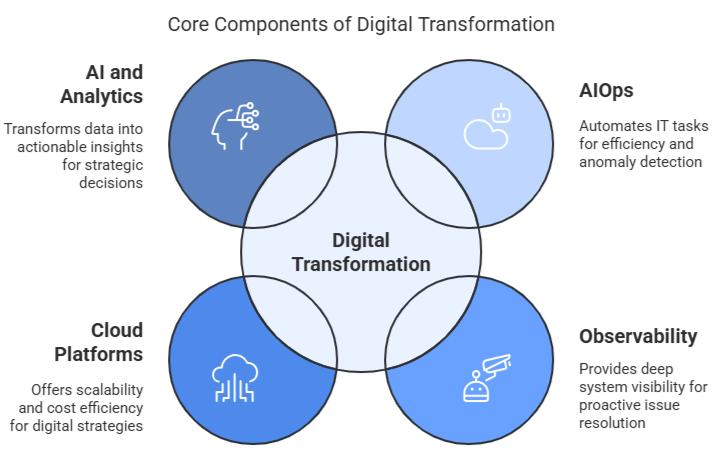
- AIOps for streamlined IT operations: Artificial intelligence for IT operations (AIOps) leverages machine learning and advanced analytics to automate repetitive IT tasks. It enables faster anomaly detection, predictive maintenance, and proactive issue resolution, reducing downtime and improving operational efficiency. By freeing up IT teams to focus on strategic initiatives, AIOps becomes a vital enabler of scalable and efficient IT operations.
- Observability for proactive monitoring: Observability tools provide deep visibility into system performance, helping organizations detect and resolve issues before they impact end users. This is particularly critical for maintaining high availability in complex, distributed IT environments. For ITOps teams, observability enhances service reliability and supports data-driven decision-making.
- The cloud as the foundation: Cloud platforms offer the scalability, flexibility, and cost efficiency needed for digital transformation. Hybrid and multi-cloud strategies allow organizations to optimize workloads, enhance agility, and reduce the burden of managing on-premises infrastructure. Global capability centers (GCCs) often serve as hubs for driving cloud adoption, enabling organizations to centralize expertise and innovation for their cloud strategies.
- AI and analytics for data-driven decisions: AI-powered analytics transform vast amounts of data into actionable insights. From forecasting customer behavior to optimizing supply chain operations, these tools empower business leaders to make informed, strategic decisions. Personalization powered by AI enhances customer experiences, fostering loyalty and driving revenue.
Strategies for successful digital transformation
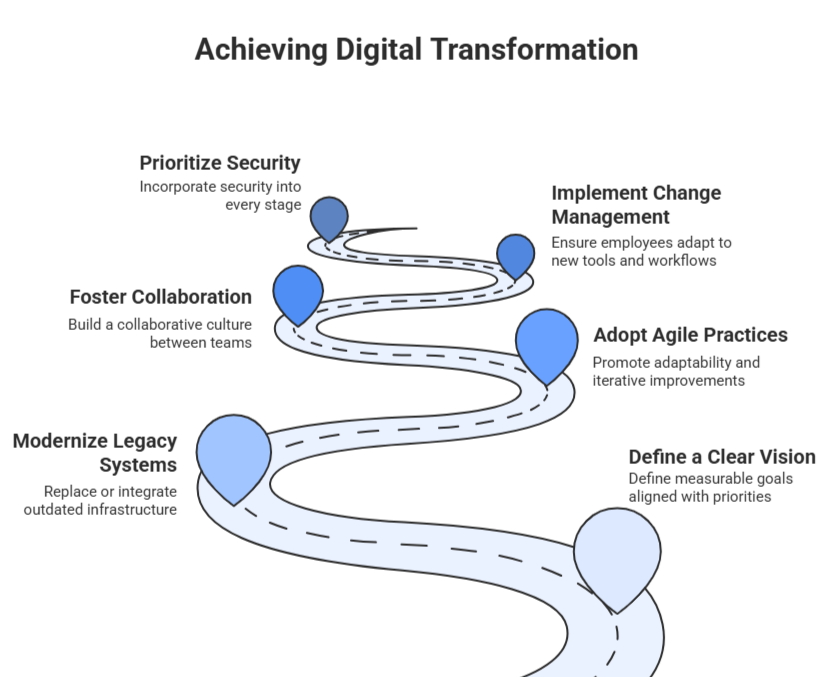
- Start with a clear vision: Defining measurable goals aligned with organizational priorities is essential. A clear vision provides a roadmap for digital transformation efforts, ensuring that initiatives stay focused and deliver meaningful outcomes.
- Modernize legacy systems: Legacy systems often hinder the adoption of modern technologies. Replacing or integrating outdated infrastructure enables businesses to take advantage of new tools without being held back by inefficiencies. This step is critical for organizations aiming to improve agility and performance.
- Adopt agile practices: Agile methodologies promote adaptability, ensuring that digital transformation projects align with evolving business needs. Regular feedback loops, iterative improvements, and cross-functional collaboration make agile practices indispensable for successful transformation.
- Foster collaboration across teams: Successful digital transformation requires buy-in from all levels of the organization. Building a collaborative culture between IT and business teams ensures smoother implementation, reducing resistance and aligning efforts with company goals.
- Implement a robust change management strategy: Transformation inevitably brings change, which can be met with resistance if not managed properly. A strong change management strategy includes clear communication, training programs, and phased roll outs to ensure employees adapt to new tools and workflows effectively.
- Prioritize security
Incorporating security into every stage of the transformation process is non-negotiable. From adopting zero-trust frameworks to implementing automated compliance monitoring, businesses must address security risks proactively to protect their operations and reputation.
What the future looks like: Embracing the next wave of transformation
- Agentic AI as a strategic enabler: Agentic AI refers to AI systems capable of autonomous decision-making and goal-directed behavior, and represents the next frontier in digital transformation. These systems can proactively identify opportunities, execute tasks across systems, and adapt to changing conditions without constant human oversight. From automating incident response in IT operations to dynamically reallocating resources for optimal efficiency, agentic AI introduces a new level of operational intelligence. Organizations that integrate agentic AI into their strategy can accelerate innovation cycles and achieve greater agility.
- Sustainability as a strategic priority: With growing environmental concerns, businesses are prioritizing sustainable IT practices. From adopting energy-efficient cloud services to reducing e-waste, sustainability is becoming integral to digital transformation strategies. Organizations that embrace green IT not only meet regulatory requirements but also improve their brand image and reduce operational costs.
- Cybersecurity in a connected world: As digital ecosystems expand, cybersecurity risks grow exponentially. Securing APIs, adopting zero-trust architectures, and implementing advanced threat detection systems will be critical. Cybersecurity strategies must evolve alongside digital transformation to safeguard sensitive data and maintain customer trust.
Digital transformation is a continuous evolution, not a one-time initiative. Its success hinges on visionary leadership, strategic investment in the right technologies, and an organizational culture that embraces agility and innovation. As new technologies like agentic AI emerge and cybersecurity threats become more sophisticated, businesses must remain adaptable and forward-thinking. Those that align their digital transformation strategies with long-term business goals—and execute them with precision—will not only withstand disruption but also set the pace for the future.