Is your IT ready for these 5 digital workplace trends?

Summary
As digital transformation continues to reshape the workplace, businesses must adopt a strategic approach to build a successful digital workplace. This involves more than just implementing tools; it requires integrating technology, processes, and organizational culture. The role of IT operations (ITOps) teams is crucial in ensuring the smooth functioning of digital environments, from managing cloud infrastructure to maintaining security.
Key trends to watch include AI-powered collaboration tools, hybrid workspaces, employee experience platforms, digital twins for workforce management, and unified communication systems. These trends are revolutionizing how teams collaborate and enhancing productivity in a rapidly evolving work landscape.
For a deeper understanding of how these trends can impact your organization and drive digital transformation, read the full article.
As enterprises continue to adopt a digital first strategy, enabling digital workplaces is helping create an agile, efficient, and scalable work environment. Gartner suggests that, Infrastructure and IT operations (I&O) leaders need to strike a balance between optimizing costs and enhancing skill sets to advance digital workplace capabilities. This means that building a digital workplace is more than just deploying a collection of tools. It requires a comprehensive strategy that integrates technology, processes, and organization culture. This empowers employees to work from anywhere, collaborate seamlessly, and make data-driven decisions.
So what is a digital workplace, and how does digital transformation shape its evolution? More importantly, what key digital workplace trends trends should C-suite leaders consider as they steer their enterprises through this transformation that is reshaping the future of work? Let's explore.
What is a digital workplace, and how does digital transformation fuel it?
As digital transformation accelerates, enterprises are increasingly turning to digital workplace trends to build agile, scalable, and employee-centric work environments. According to Gartner, Infrastructure and IT Operations (I&O) leaders must balance cost optimization with upskilling to stay competitive in this evolving landscape.
But building a digital workplace isn't just about adding tools—it’s about crafting a cohesive strategy that connects technology, processes, and culture. The result? Empowered employees who can collaborate seamlessly, work from anywhere, and make smarter, data-driven decisions.
So what exactly is a digital workplace? How is it being reshaped by digital transformation—and what key digital workplace trends should IT and business leaders focus on to future-proof their organizations? Let’s dive in.
- Cloud computing: Migrating business-critical applications to the cloud allows employees to access resources on demand, enabling flexible work environments.
- Automation and AI: By leveraging AI and automation tools, organizations can optimize workflows, reduce operational bottlenecks, and ensure consistency across tasks. For instance, AI can automate repetitive tasks like network health monitoring or IT service requests, freeing up employees for more strategic work.
- Collaboration tools: Modern digital workplaces leverage different platforms for real-time communication, document sharing, and virtual meetings, bridging the gap between geographically dispersed teams.
What part does your IT operations team play in enabling the digital workplace?
IT operations (ITOps) teams are the backbone of digital workplaces, ensuring that all the moving parts work together smoothly. As organizations adopt cloud platforms, collaboration tools, and advanced cybersecurity measures, ITOps teams must maintain a robust infrastructure while also supporting the rapid pace of digital transformation. They ensure infrastructure reliability, security, and scalability, making them central to successful transformation.
Key areas where ITOps teams enable a digital workplace include:
Infrastructure as Code (IaC): With employees working from multiple locations, scaling infrastructure to meet growing demands is essential. With IaC tools, IT teams can automate the provisioning and management of cloud infrastructure, ensuring consistent and scalable environments for digital workplace applications.
For instance, a financial institution deploying its employee intranet on AWS can use Terraform to automatically spin up the necessary servers, storage, and networking components based on preconfigured templates, ensuring rapid scalability and high availability.
- AI-driven IT operations: By leveraging AIOps solutions like ManageEngine OpManager Nexus, ITOps teams can automatically detect, analyze, and resolve IT issues before they impact end users. This proactive approach minimizes downtime in digital workplaces and ensures a seamless employee experience.
- Security and identity management: With the rise of remote work, ensuring secure access to enterprise resources is critical. ITOps teams implement Zero Trust security frameworks to ensure that only authorized users can access sensitive data, regardless of their location.
Top 5 digital workplace trends to look out for
For C-suite executives, staying ahead of emerging digital workplace trends is critical to ensuring a competitive edge.
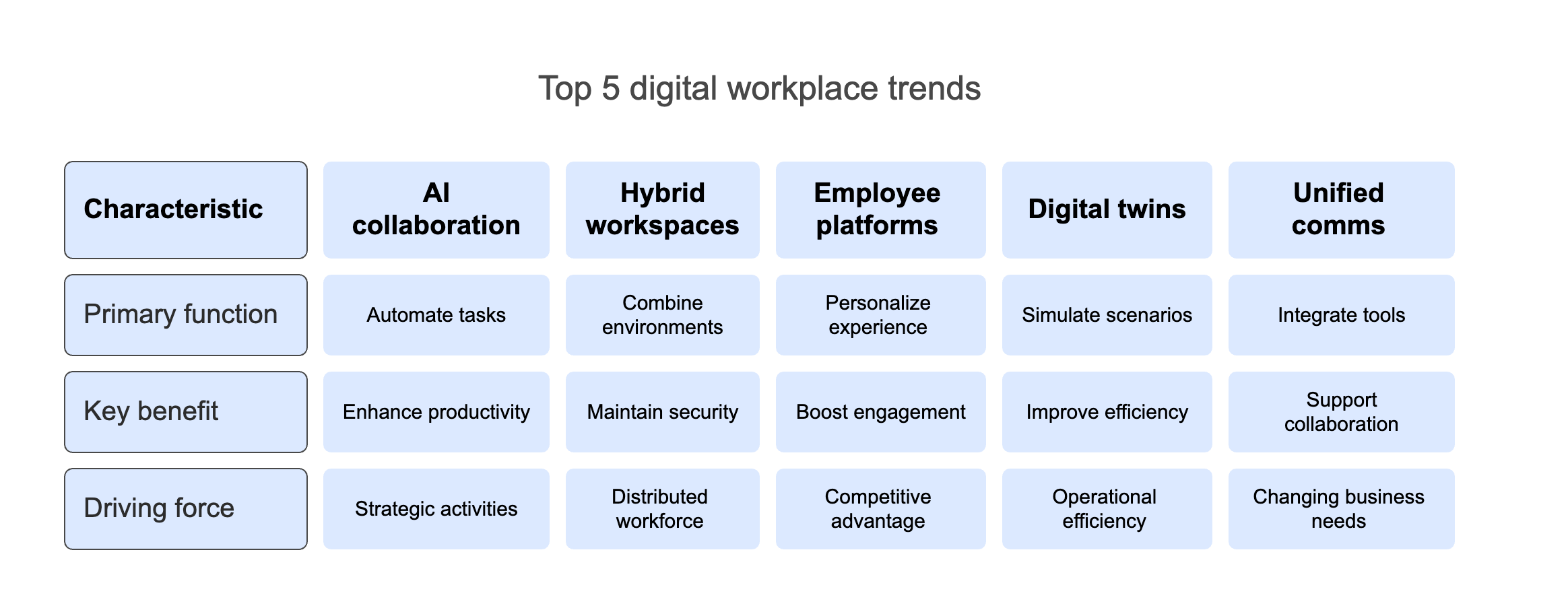
- AI-powered collaboration tools are revolutionizing teamwork by automating repetitive tasks like scheduling and note-taking, allowing teams to focus on strategic activities. They enhance productivity by integrating AI into everyday workflows, driving smarter project management and real-time decision-making.
- Hybrid workspaces combine remote work with in-office collaboration, becoming essential in today’s distributed workforce. CIOs and CTOs are key to optimizing technology, such as cloud computing and VPNs, to maintain security and productivity while balancing virtual and physical environments.
- Employee experience platforms focus on delivering personalized, seamless experiences for employees. These platforms use analytics to understand needs, boost engagement, and drive productivity, making employee satisfaction a competitive advantage in talent retention.
- Digital twins for workforce management enable companies to simulate and optimize workplace scenarios. By creating virtual models of the workforce, decision-makers can improve office layouts and team structures, enhancing operational efficiency.
- Unified Communications as a Service integrates communication tools like video, messaging, and VoIP into a single platform, supporting seamless collaboration for remote and hybrid teams. Its flexibility and scalability make it essential for adapting to changing business needs.
From AI-powered collaboration to hybrid workspaces and employee experience platforms, these digital workplace trends are transforming how enterprises operate and innovate. For IT leaders, staying ahead of these shifts means aligning closely with HR, security, and business teams to build a digital workplace strategy that’s secure, flexible, and future-ready.
The pace of change isn't slowing down. To stay competitive, enterprises must embrace these emerging digital workplace trends—not as optional upgrades, but as essential building blocks of modern business.
The future is digital. The time to adapt is now.