Threat Detection
What is signature-based malware detection?
Signature-based detection can only stop malware it has already seen. Modern attacks are built to stay unseen.

Most malware protection tools were built for threats that leave identifiable traces behind. Modern attacks increasingly do not. This article explores how signature-based malware detection works, why it still matters, where it struggles against modern threats, and how behavioral and multilayered detection help fill those gaps.
What is signature-based malware detection?
A simple way to think about it is like a fingerprint database. If a file matches a known malicious pattern, it is flagged immediately. To build these signatures, security researchers analyze malware samples and extract identifiable patterns such as hashes, byte sequences, and code fragments, which are then added to a signature database.
Signature-based antivirus uses this database to scan files during downloads, execution, or write to disk events. If a match is found, the file is blocked or quarantined. This approach is fast, efficient, and highly reliable against known threats. However, it cannot detect malware it has never seen before.
What is a malware signature?
A malware signature is a unique pattern extracted from malicious code that helps security tools identify known threats during scanning. These signatures generally fall into three primary categories, and most modern antivirus engines use a combination of all three.
Hash based signatures use a fixed length string generated through algorithms such as MD5, SHA-1, or SHA-256. Every file produces a unique hash value. If a file's hash matches a known malicious hash, it is flagged immediately. Hash matching is extremely fast and accurate for exact matches. However, even a small change to the file creates a completely different hash, which is why attackers frequently modify malware to evade detection.
Modern enterprise malware detection platforms often combine signature matching with file reputation services. In addition to checking a file's hash, they verify whether the file has been previously identified as malicious, originates from a trusted publisher, or has been associated with known threats. Reputation data helps prioritize suspicious files before further behavioral or runtime analysis.
Byte sequence signatures focus on specific code patterns within malware rather than the entire file. Security researchers identify byte sequences that consistently appear across malware variants, allowing antivirus engines to detect modified versions that still share common code structures.
YARA rules extend traditional malware signatures by matching combinations of strings, byte patterns, and conditions instead of relying on a single file hash. Security researchers commonly use YARA for malware classification, threat hunting, and identifying malware families that share similar characteristics, making it a valuable complement to signature-based detection.
Heuristic signatures identify suspicious characteristics instead of relying on exact matches. They flag files that resemble known malware behavior or structural patterns, even if the file has never been seen before. This gives antivirus engines a limited ability to detect new or evolving threats by recognizing familiar signs of malicious activity.
How signature-based detection works
Signature-based detection runs continuously in the background with minimal impact on the user. When a file is created, downloaded, executed, or written to disk, the security agent intercepts it and begins analysis. The file's hash is generated and checked against a database of known malicious hashes. If a match is found, the file is immediately blocked or quarantined.
At the center of this process is the antivirus signature database, a continuously updated repository of known malware fingerprints built from previously analyzed threats. It contains malicious hashes, byte sequences, and heuristic rules collected by security researchers. If no hash match is found, the engine looks for known byte-sequence patterns and then uses heuristic analysis to identify suspicious characteristics such as packed executables, encrypted payloads, or abnormal file structures.
This entire process happens within milliseconds, making signature-based detection fast and highly effective against known threats. However, its accuracy depends heavily on how broad and up to date the signature database is. If a threat has never been seen before, signature-based detection alone may not recognize it.
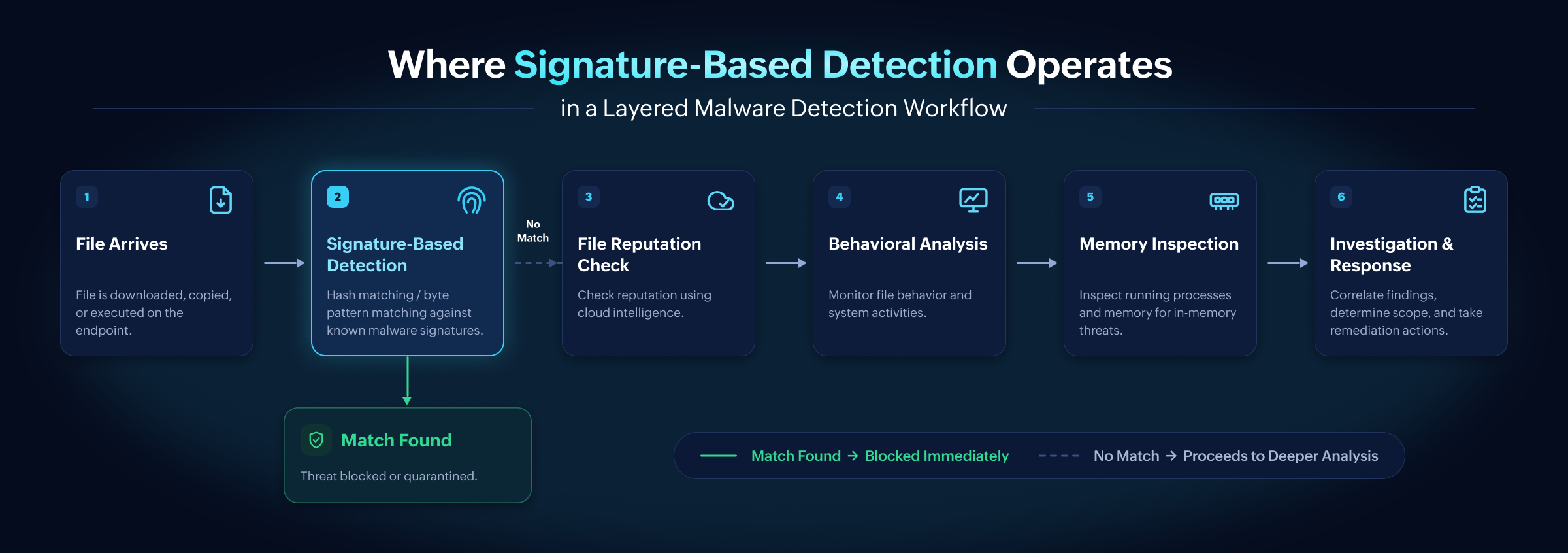
Where signature-based detection fits in the detection pipeline
Signature-based detection is the first layer of inspection in most malware detection workflows. Every file is checked against known malware signatures before deeper analysis begins. If no signature matches, additional layers such as file reputation, behavioral analysis, or memory inspection evaluate the file for unknown or emerging threats. This layered approach helps stop known malware quickly while improving detection of new attack techniques.
How signature-based detection has evolved
Signature-based detection has evolved significantly from the early days of traditional antivirus. What once relied on simple malware identification has grown into a more adaptive detection approach designed to handle modern malware attacks and rapidly evolving cyber threats.
As attackers began creating more evasive malware variants, security vendors expanded beyond basic pattern matching to improve detection accuracy. Faster update cycles, cloud-connected threat intelligence, and shared telemetry helped reduce the gap between malware discovery and protection.
The rise of AI in malware detection and AI in threat detection further transformed how modern security platforms operate. Today's detection engines combine signatures with heuristic analysis, behavioral monitoring, and AI-driven analysis to identify suspicious activity, unknown threats, and attack techniques that traditional antivirus solutions often miss.
Cloud intelligence also changed how protections are delivered. Modern platforms can analyze malware activity globally and distribute new detections across connected endpoints in near real time, improving response speed against emerging threats.
Today, signature-based detection remains an important layer of endpoint protection for identifying known threats quickly and efficiently. However, modern endpoint security increasingly relies on multilayered detection approaches that combine signatures, AI-assisted analysis, behavioral monitoring, and threat intelligence to defend against advanced malware attacks more effectively.
Why signature-based detection still matters
Despite its limitations, signature-based detection remains highly effective against a large volume of real-world threats. Most malware today is not entirely new. It is often reused, repackaged, or slightly modified from existing malware families that security vendors have already analyzed and documented. This approach continues to offer several important advantages. It is fast, lightweight, and generates very few false positives for known malicious files. It also provides strong coverage against commodity malware, making it a reliable first layer of defense in most environments.
Signature-based detection is especially valuable during incident response. Once a malicious file is identified, security teams can quickly scan every endpoint across the environment to determine the scope of compromise and contain the spread faster. At scale, this speed, consistency, and operational simplicity make signature-based detection a foundational part of endpoint security, even as modern security platforms add more advanced behavioral and AI-driven detection layers on top of it.
Where signature-based detection falls short
Signature-based detection is built to recognize known threats, which also becomes its biggest limitation when facing new or unseen attacks.
Before a new threat can be detected, security researchers must first discover it, analyze it, create a signature, and distribute that update to endpoints. During this entire process, systems remain exposed. This gap is known as the detection window, and modern attackers are designed to exploit it.
Polymorphic malware changes its code with every infection, creating new variants that bypass signature matching. Fileless malware operates entirely in memory using legitimate system tools, leaving no file on disk for traditional scanners to inspect. Living off the land attacks abuse trusted binaries such as PowerShell and WMI, which appear legitimate because the tools themselves are not malicious. Zero-day exploits target previously unknown vulnerabilities, meaning no signature or patch exists at the time of attack.
As a result, signature-based detection remains highly effective against known malware, but it struggles against unknown, fileless, and rapidly evolving threats.
Signature-based detection vs Next-Generation Antivirus (NGAV)
Traditional antivirus and
Most next-generation antivirus (NGAV) are built on very different approaches to threat detection. Signature-based antivirus focuses on identifying known malware patterns, while NGAV is designed to detect suspicious behavior, unknown threats, and modern attack techniques in real time.
| Attribute | Signature-based Detection | Next-Generation Antivirus (NGAV) |
|---|---|---|
| Detection approach | Matches files against known malware signatures and hashes | Uses behavioral analysis, machine learning, and heuristics to identify suspicious activity |
| Unknown threat detection | Limited to previously identified malware | Designed to detect unknown and zero-day threats |
| Fileless attack detection | Ineffective because there is no file to scan | Monitors process behavior and memory activity to identify fileless attacks |
| Polymorphic malware detection | Limited because malware code changes frequently | Detects suspicious behavior even when malware variants change their code |
| Response capabilities | Primarily detects and quarantines malicious files | Supports automated containment, process termination, rollback, and investigation |
| False positives | Low for known threats | Moderate without proper tuning |
| Threat intelligence | Relies on regular signature updates | Integrates real-time threat intelligence and cloud-based analysis |
In practice, modern endpoint protection platforms use both approaches together. Signature-based detection provides fast and reliable coverage for known threats, while NGAV strengthens protection against unknown, evasive, and advanced attacks.
How advanced malware evades signature detection
Modern attackers actively test malware against security tools before deployment to ensure their payloads bypass signature-based detection before reaching a target environment.
One of the most common techniques is code obfuscation, where malware code is modified using encryption, packing, or junk instructions to change its appearance without affecting how it functions. Polymorphic malware takes this further by generating a new variant with every infection, making each sample look different while maintaining the same malicious behavior. Metamorphic malware is even more advanced, rewriting its entire code structure while preserving its logic, leaving no consistent byte pattern for signature engines to detect.
Another major challenge is sandbox evasion. Malware can detect virtual analysis environments and intentionally delay or avoid malicious activity until it runs on a real production system. This creates a gap between what security tools observe and what the malware actually does after execution. Fileless malware removes the problem entirely by running directly in memory using legitimate system tools, leaving no file on disk for traditional signature engines to scan.
Together, these techniques ensure that traditional detection methods are bypassed before execution begins.
Signature-based vs Behavioral vs Heuristic detection
Modern endpoint protection relies on multiple detection approaches because no single method can identify every type of attack. Signature-based, behavioral, and heuristic detection each focus on different aspects of malicious activity and are most effective when used together.
| Attribute | Signature-based detection | Behavioral detection | Heuristic detection |
|---|---|---|---|
| What it monitors | Files and known code patterns | Process activity and runtime behavior | Code structure and suspicious logic patterns |
| How it detects threats | Matches known malware signatures | Identifies suspicious actions and anomalies | Analyzes files for malware-like characteristics |
| Detection of known threats | Very strong | Moderate | Moderate to strong |
| Detection of unknown threats | Limited | Strong | Moderate |
| Detection of fileless attacks | Ineffective | Strong | Limited to moderate |
| Detection of polymorphic malware | Limited | Strong | Moderate |
| Protection against zero-days | Limited | Strong | Moderate |
| False positives | Low for known threats | Moderate without proper tuning | Moderate to high |
| System resource usage | Low | Moderate to high | Low to moderate |
| Detection speed | Near instant | Continuous real-time monitoring | Static and pre-execution analysis |
| Requires prior malware sample | Yes | No | Not always |
Signature-based detection remains highly effective for identifying known malware quickly and with minimal system impact. Behavioral detection focuses on how processes behave during execution, making it more effective against unknown, fileless, and evasive threats. Heuristic detection sits between the two, identifying suspicious characteristics that resemble malware even when no exact signature exists.
Modern malware protection platforms combine all three detection approaches to strengthen coverage across known, unknown, and emerging threats while reducing the blind spots associated with relying on a single detection method.
How to reduce false positives in signature detection
False positives happen when legitimate software is incorrectly identified as malicious. This can waste security team time, disrupt users, and sometimes interrupt important business operations.
One of the most effective ways to reduce false positives is by maintaining updated allowlists of trusted applications and files. This prevents known good software from being unnecessarily flagged during scans. Modern security platforms also use layered analysis before taking action. Instead of immediately quarantining a suspicious file, the file can first go through behavioral inspection to determine whether it is actually acting maliciously. This additional validation step helps reduce unnecessary alerts and automated responses.
Detection rules should also be tuned based on the environment. Systems used for software development, scripting, or security research often run tools that may appear suspicious to security engines. Adjusting detection sensitivity for these endpoints helps reduce noise without weakening protection. Maintaining an accurate software inventory across all endpoints is equally important. When security teams know which applications are authorized in the environment, it becomes much easier to determine whether a flagged file is legitimate or genuinely suspicious.
How modern endpoint security extends beyond signatures
Signature-based detection remains an important foundation of endpoint security, but modern threats increasingly use techniques that leave little or no identifiable signature behind. As a result, endpoint security has evolved beyond relying only on known malware patterns.
Modern detection approaches combine multiple analysis methods to identify suspicious activity that traditional signature matching may miss. Behavioral analysis monitors processes in real time for indicators such as abnormal registry changes, unusual API calls, suspicious script execution, privilege escalation attempts, and irregular file access behavior. AI and ML-assisted models further improve detection by identifying behavioral and code characteristics commonly associated with malicious activity, even when no prior signature exists. Memory analysis adds another layer of visibility by inspecting active process memory for shellcode injections, reflective DLL loading, and in-memory payloads that never touch disk. This is particularly important for detecting fileless malware and attacks that operate entirely through legitimate system tools.
Modern endpoint security platforms also incorporate response and forensic capabilities alongside detection. Endpoint isolation can help contain lateral movement after a compromise is identified, while remediation mechanisms assist in stopping malicious activity and restoring affected systems. Root cause analysis mapped to MITRE ATT&CK techniques provides visibility into how an attack entered the environment, how it progressed, and which techniques were used during execution. This layered approach helps address many of the limitations of signature-based detection. Polymorphic malware that continuously changes its code may still expose recognizable behavioral patterns. Fileless attacks that avoid disk-based scanning can still be identified in memory. Living-off-the-land techniques that abuse trusted administrative tools can still appear suspicious through abnormal execution chains and process behavior.
Antivirus vs IDS: understanding the difference
Antivirus and intrusion detection systems (IDS) are both important security controls, but they operate in different ways. Traditional antivirus focuses on protecting individual endpoints by scanning files and processes for known malicious signatures, while IDS monitors network traffic and system activity to identify suspicious behavior and intrusion attempts across the environment.
| Attribute | Antivirus | IDS (Intrusion Detection System) |
|---|---|---|
| Where it operates | Endpoint or host level | Network traffic and host event monitoring |
| Primary detection method | Signature matching on files, processes, and executables | Signature-based and anomaly-based traffic analysis |
| Fileless attack visibility | Limited because there may be no file to scan | Moderate through suspicious network behavior indicators |
| Scope of coverage | Individual endpoints and devices | Network-wide visibility including lateral movement |
| Response capability | Can quarantine, block, or remove malicious files | Typically alert-only in IDS mode; IPS can actively block traffic |
| Best used for | Detecting known malware on endpoints | Detecting network intrusions, command-and-control traffic, and suspicious communication patterns |
In practice, modern security environments rely on both endpoint and network-level visibility. Antivirus helps stop known malware directly on devices, while IDS provides broader insight into suspicious communication patterns and attack movement across the network. Together, they form complementary layers of defense, although both increasingly require behavioral and anomaly-based analysis to detect modern threats effectively.


