- What is RMM?
- 8 Key Benefits of an RMM (Remote Monitoring & Management)
Share:




Technology never really slows down, and neither do businesses. Every few years, something new changes the way we work. Right now, it’s the rise of multi-cloud setups, AI-driven operations, and a growing reliance on IoT. These shifts aren’t small; they’re changing how organizations function and compete.
And right at the center of it all are IT service providers, helping businesses keep up, stay secure, and stay efficient. To do that well, they too need to evolve with stronger tools, smarter systems, and platforms that can keep pace with whatever comes next. Because today, IT tools aren’t just support systems anymore; they’re the engines that drive business growth.
What is RMM?
Remote monitoring and management (RMM) acts as the operational backbone for MSPs and IT teams, helping them monitor, manage, and maintain client systems remotely from a single console. It simplifies everyday IT operations, automates repetitive tasks, and ensures that systems stay secure and updated; all without disrupting end users.
Simply put, RMM is the launchpad that helps MSPs embrace and enable every new phase of digital advancement. Now, let’s look at how it transforms IT service delivery in measurable ways.
8 Key Benefits of an RMM (Remote Monitoring & Management)
Service quality and customer experience
- Proactive issue detection: Continuous monitoring helps identify problems before they affect end users, ensuring uninterrupted client operations.
- Improved SLA performance: Automated alerting and real-time visibility reduce response and resolution times, improving customer satisfaction.
- Unified visibility: Centralized dashboards consolidate device, network, and application data, helping teams make faster and more informed decisions.
- Remote remediation: Technicians can resolve incidents instantly—without requiring physical presence—leading to faster, more reliable support delivery.
Security and compliance
- Automated patching: RMM tools streamline patch management, ensuring all endpoints are consistently updated and protected against vulnerabilities.
- Multi-layered protection: Integrated threat detection, ransomware prevention, and endpoint monitoring keep IT environments secure.
- Regulatory alignment: Automated reports and audit-ready data help businesses stay compliant with industry frameworks like GDPR, HIPAA, and ISO standards.
- Access control and encryption: Role-based privileges and secure remote access reduce exposure to insider and external threats.
Workforce flexibility
- Remote operations: Cloud-based RMM solutions empower IT teams to monitor and manage client networks from anywhere, promoting distributed workforce models.
- Reduced manual effort: Automation scripts and scheduled workflows minimize repetitive tasks, allowing technicians to focus on strategic work.
- Collaborative management: Multi-user access and tenant-aware dashboards simplify coordination across regions, clients, and time zones.
- 24/7 coverage: Always-on monitoring ensures that even small teams can deliver round-the-clock support efficiently.
Scalability and growth
- Effortless client onboarding: RMM platforms are designed to support multiple clients without requiring separate setups or tool duplication.
- Support for hybrid environments: Whether managing cloud, on-premises, or IoT endpoints, RMM scales as infrastructure evolves.
- Automation at scale: Script-based configurations and policy templates enable managing thousands of endpoints with minimal intervention.
- Elastic infrastructure: As device counts grow, resource allocation and monitoring capacity can expand seamlessly.
Integration and ecosystem compatibility
- Unified ecosystem: RMM tools integrate with service desk, PSA, and monitoring platforms, enabling end-to-end service delivery.
- Data flow continuity: Information moves contextually between systems, reducing errors and improving cross-team visibility.
- Custom integrations: Open APIs and scripting support enable alignment with existing business tools and automation frameworks.
- Centralized control: One console for multiple functions simplifies administration and reduces the learning curve for new technicians.
Operational efficiency
- Reduced downtime: Predictive alerts and automated remediation lower incident rates and service interruptions.
- Simplified workflows: Task automation eliminates redundant steps, improving overall productivity.
- Unified dashboards: A single view of performance metrics allows quicker decision-making and faster troubleshooting.
- Streamlined tool stack: Consolidating IT operations into one platform eliminates tool sprawl and maintenance overhead.
Data and decision intelligence
- Advanced analytics: RMM solutions collect granular data on device performance, application uptime, and network behavior for deeper insights.
- Predictive trend analysis: Historical data helps forecast capacity needs and detect recurring issues before they escalate.
- Performance benchmarking: MSPs and IT teams can measure SLA adherence, technician efficiency, and resource utilization with precision.
- Strategic planning: Insight-driven dashboards support long-term decisions on client expansion and resource allocation.
Financial and resource optimization
- Lower operational costs: Automation and centralized management reduce the need for additional headcount or manual intervention.
- Higher revenue margins: Improved uptime and faster response translate into stronger customer retention and higher contract values.
- Reduced overhead: Fewer tools mean fewer licenses, integrations, and maintenance expenses.
- Improved asset utilization: Monitoring helps identify underused resources, optimizing budgets and infrastructure spend.
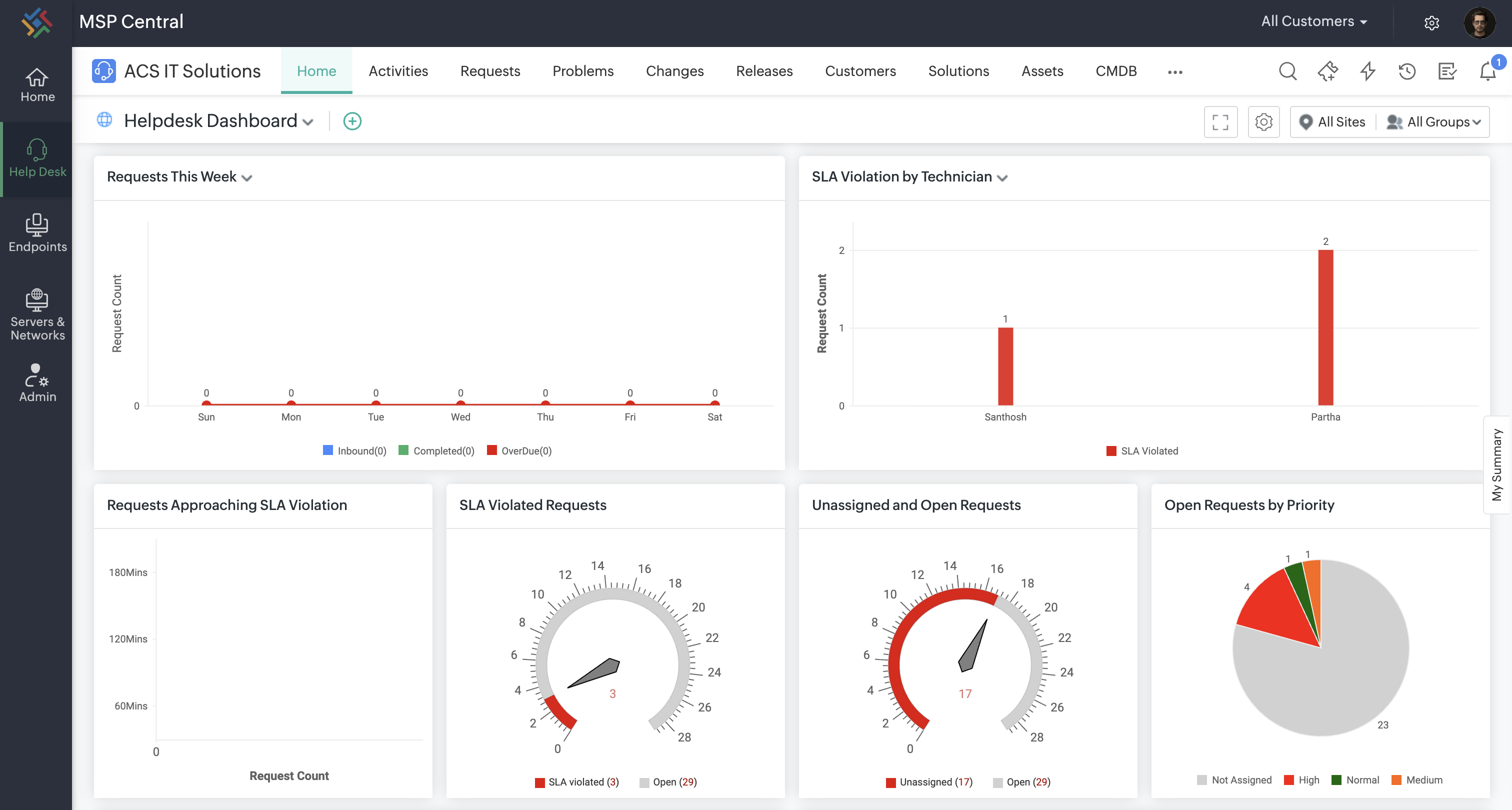
Every benefit discussed from automation and security to scalability and decision intelligence; finds its complete expression within MSP Central. It’s built as a unified platform where RMM isn’t just another module but a connected component of a larger IT management ecosystem.
By centralizing monitoring, service delivery, and security under one roof, MSP Central helps MSPs and IT teams convert operational insights into action. It bridges the traditional gaps between people, tools, and processes, allowing teams to deliver reliable, scalable, and data-driven IT services that align with evolving client expectations.