What Is a DEX Score?
The Digital Employee Experience (DEX) Score is a measure of how efficiently employees can complete tasks within their IT environment. By combining endpoint metrics and application performance data, the score quantifies overall user satisfaction across applications, systems, services, and devices. Ranging from 0 to 100, a higher score indicates minimal IT disruptions, ensuring a seamless digital experience that enhances productivity.
How is the DEX Score calculated?
The DEX Score is computed by evaluating five core pillars of user experience:
| Pillar | Description | Example Metrics |
|---|---|---|
| Endpoint Performance | Measures how efficiently a device runs system and application workloads. | CPU usage, Memory consumption, Disk space |
| Endpoint Reliability | Assesses the stability of a device and its likelihood of failing during use. | System crashes, Battery health, Device age |
| Endpoint Responsiveness | Captures how quickly the device reacts to user input and completes key actions. | Logon time, Boot time, Max input delay |
| Application Reliability | Measures how stable and reliable applications are. | Application crashes |
| User Sentiment | Measure user sentiment regarding their experience with the provided technology. | Capture user responses through Engage |
In addition to the existing score categories, you can define custom category in experience score. Custom scores can include metrics from sensor fields for score calculation.
The detailed process is as follows:
Metrics are gathered at different intervals depending on the type of data. For example, CPU usage is collected every 10 minutes to monitor system performance, while crash events are recorded immediately when they occur.
At a scheduled time each day, the system calculates a score for each metric on a scale of 0 to 100. Each score reflects the metricâs performance against its defined threshold over the past 24 hours. A deviceâs overall DEX Score is calculated as the average of all individual metric scores. The organizationâs overall DEX Score is then calculated as the average score across all devices.
For example, the system monitors CPU usage over a 24-hour period. If the threshold for high CPU usage is set at 70%, and CPU usage remains below 70%, the CPU score remains at 100. However, each time CPU usage exceeds 70%, the score is reduced by 10 points.
Configuring Metrics properties and Baseline scoring
A baseline score is a manually configured metric that represents the desired health or compliance standard for your organization. This score serves as a benchmark to evaluate individual devices or the overall organization against predefined expectations.
Default score is 75 which can be changed under Settings.
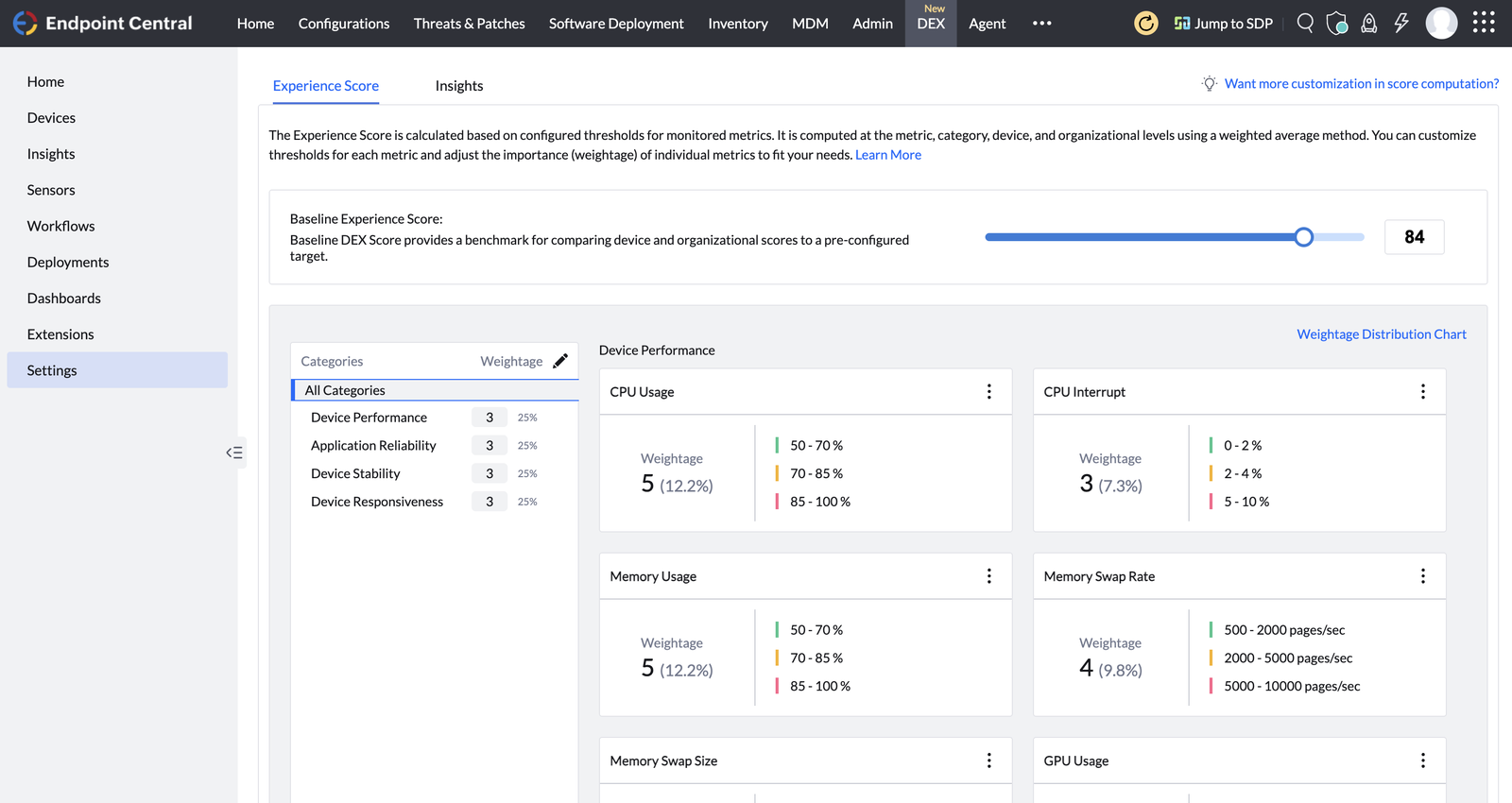
Metrics details
Metrics | Metrics Explanation |
Free Disk Space | Available storage will be monitored over 24 hours, and when a specified condition is met, the score will be reduced. A lower score may result in device slowness, impacting user productivity. |
CPU Usage | CPU usage will be measured, and events will be recorded when specific conditions are met. A higher number of events indicates greater CPU load, potentially impacting system performance and responsiveness. |
CPU Interrupt | Temporary CPU halt requests sent to the CPU will be recorded as events. A higher number of events can lead to reduced system efficiency. |
Memory Usage | Memory usage will be monitored over 24 hours, and events will be recorded when specific conditions are met. A higher number of events indicates less available physical memory, which can affect user performance. |
Memory Swap Rate | The rate of data swapping between RAM and swap space will be recorded over a period. When the configured threshold is reached, it will be marked as an event. A low score indicates device slowness. |
Memory Swap Size | The usage of allocated space for virtual memory will be recorded over a period. When the configured threshold is reached, it will be marked as an event. A high number of events indicates performance degradation. |
Max Input Delay | The time taken for the device to respond to a user click is measured. When the threshold is reached, it is marked as an event. A high number of events can lead to lag or unresponsiveness, negatively impacting the user experience. |
Boot Time | The time taken for the device to become ready for use will be recorded over time. When the threshold is reached, it will be marked as an event. More events can negatively affect user productivity. |
Battery Health | The overall condition and capacity of a battery are measured compared to its original state. A lower score indicates reduced battery lifespan, leading to shorter usage time between charge |
Warranty | The warranty period defines the time during which a manufacturer or vendor guarantees repair or replacement of a product in case of defects or failures. A shorter remaining warranty period means less coverage for potential issues. |
Device Age | The age of the device represents the time elapsed since it was manufactured or first activated. An older device may experience reduced performance, hardware wear, and limited software support. |
Application Crash | Software crashes are counted over 24 hours, with each crash marked as an event. More events can lead to user frustration. |
System Crash | System failures are counted over 30 days, with each crash recorded as an event. More events lead to increased work delays. |
Hard Reset | Forcing a device to restart to fix errors will be recorded as events. More events cause inconvenience to the user. |
WiFi Signal Strength | Reflects the quality of the wireless network connection, which affects connectivity and application responsiveness. |
WiFi Receive Rate | Measures the rate at which data is received over Wi-Fi, indicating download performance. |
WiFi Transmit Rate | Measures the rate at which data is sent over Wi-Fi, indicating upload performance. |
Network Output Queue Length | Indicates the number of network packets queued for transmission, helping to identify network congestion or delays. |
User Sentiment | Represent user feeling about company offered technology |
In addition to above metrics, Sensor can be included in existing categories and new categories.
Accessing Score
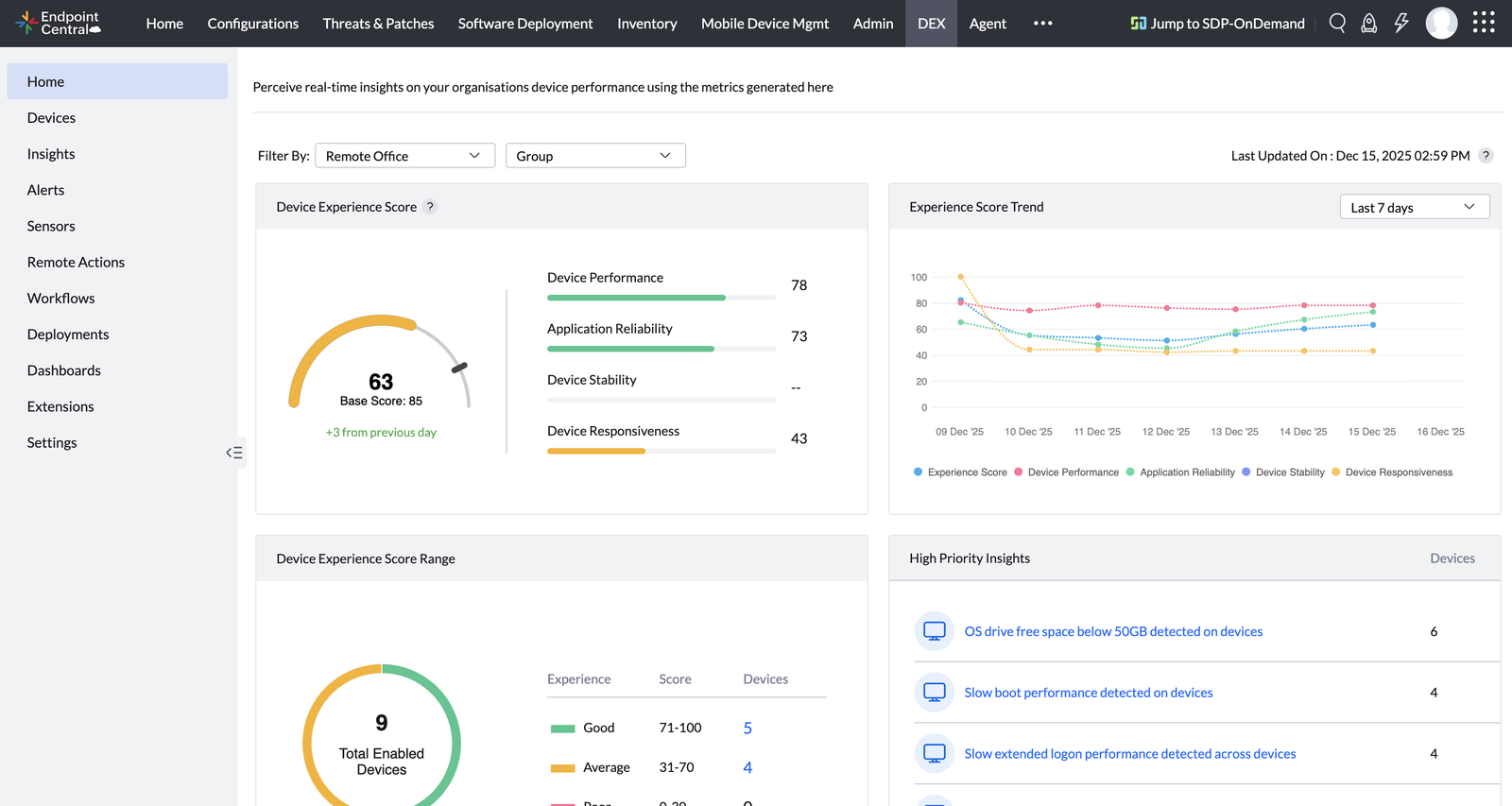
On clicking DEX > Home, an over all score of org will be displayed which is the average score of all devices in the organization. If the score falls below 50, the device will be marked as Critical.
Experience Score over time will be used to compare how Org score deviates from Base score over time.
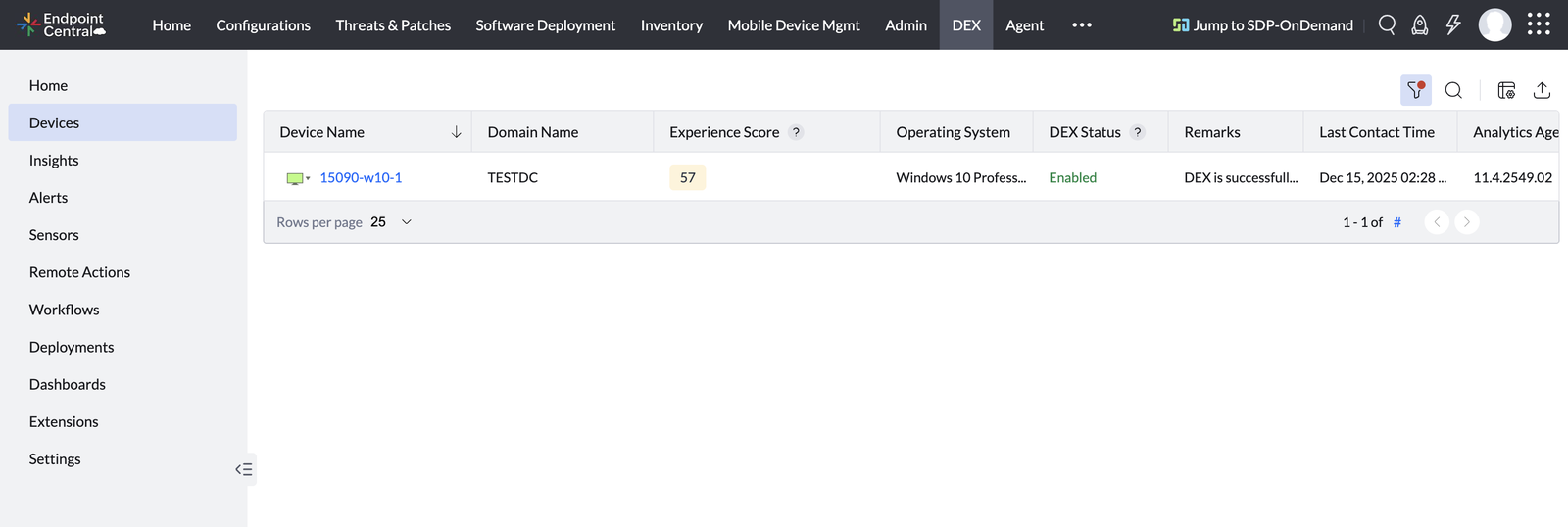
Device Score:
To view the individual device score, navigate to DEX > Devices . The score displayed is the average of all metrics for that device.
User Sentiment Score
User sentiment helps validate and enhance qualitative experience analysis. While technical metrics may indicate good device performance, user perception may differ during actual usage. Incorporating sentiment scores enables deeper insight into user-reported issues and helps improve overall digital experience.
User sentiment can be included directly in the overall experience score alongside technical and operational metrics. Sentiment is treated as a configurable input and can be enabled, adjusted, or excluded based on organizational requirements.
User sentiment responses collected through Engage can be included as part of experience score calculations.
A workflow with multiple Engage stages must be created and deployed to all devices on a recurring schedule to collect continuous feedback.
Refer to the workflow configuration for detailed steps.
Steps to configure user sentiment score
- Create a new category with User Sentiment as the category name. Enable Sentiment Score Category for the category.
- Add new metrics under this category post save of category.
- Select Engage. Only Engage stages from deployed workflows are listed.
- Select Lookup as the score function.
- Assign scores for each user response under Configure Score Thresholds.
- Click Add Score Metric to save.
You can view user sentiment score details in Dashboards, Device View, and Reports.