High GPU Utilization Insight
The High GPU Utilization insight identifies devices where graphics processing usage exceeds the configured threshold. Sustained high GPU usage can cause slow rendering, lag during video calls, delayed UI animations, and degraded performance in any application that relies on the graphics processor.
This insight helps administrators:
- Identify how many devices are affected and whether the issue is widespread or isolated
- Pinpoint the application or process responsible for the GPU pressure
- Determine whether the issue is software-driven or a hardware capacity problem
- Prioritize and execute remediation before users are significantly impacted
Trigger Conditions
The High GPU Utilization insight is generated when:
- GPU usage on a device exceeds the configured threshold.
- Default threshold: GPU usage greater than 75%.
- Threshold values can be customized based on organizational workload requirements.
Accessing the Insight
- In Endpoint Central, click DEX in the top navigation bar.
- Select Insights from the left sidebar.
- Locate the insight: Devices experiencing slow app and graphics rendering due to high GPU usage.
- Click the insight name to open the detail view.
Interpreting the Insight Metrics
The insight details page provides information that helps determine whether the issue is isolated to a few devices, driven by a specific application, or concentrated within a particular hardware group.
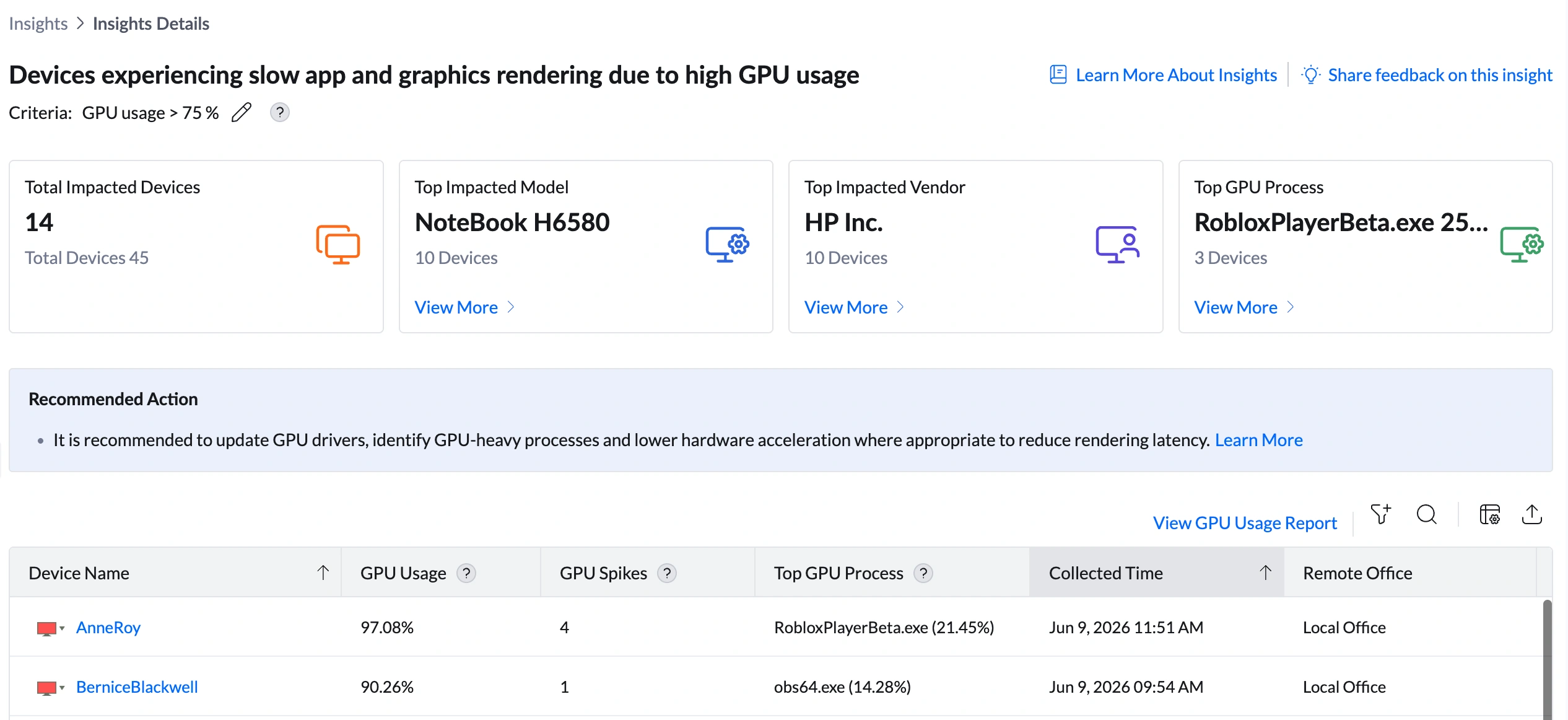
| Metric | What it shows | How to use it |
|---|---|---|
| Total Impacted Devices | Number of devices currently exceeding the GPU threshold (e.g., 14 out of 45 total) | Assess the scale of the issue. A sudden increase — especially if many devices are affected simultaneously — suggests a recent software change, update, or new application deployment may be the trigger. If the count is growing gradually, it may indicate hardware aging. |
| Top Impacted Model | The device model most commonly found among impacted devices (e.g., NoteBook H6580) | Identifies whether the issue is hardware model-specific. Click View More to open the Impacted Models Summary, which shows: Model Name, Total Devices in Model, Affected Devices, % of Devices Affected, and Insight Contribution %. |
| Top Impacted Vendor | The hardware manufacturer most frequently associated with impacted devices (e.g., HP Inc.) | Identifies whether a specific vendor's hardware is disproportionately affected. Click View More to see vendor-level device counts and Insight Contribution %. If one vendor accounts for 70%+ of the insight contribution, check for vendor-released GPU driver updates or firmware advisories for that brand. |
| Top GPU Process | The application consuming the most GPU across impacted devices, shown with its usage percentage (e.g., RobloxPlayerBeta.exe 25.64%) | This is your primary investigation starting point. A single process appearing across multiple devices is the fastest path to root cause. Click View More to see a per-process breakdown of affected devices and contribution percentage. The percentage shown is that process's share of GPU on the device where it is the top consumer — not its average across all devices. |
Analyzing Affected Devices
Below the summary cards, a device table lists every machine currently exceeding the GPU threshold. This is where you move from insight to investigation.
Understanding the columns
| Column | What to look for | What it means for remediation |
|---|---|---|
| GPU Usage % | Devices above 90% are critically impacted (e.g., AnneRoy at 97.08%, LauraStone at 98.54%) | Prioritize these immediately — the user is very likely experiencing visible rendering lag or application freezes. |
| GPU Spikes | A high count (7—10) indicates a persistent, recurring problem — not a temporary burst (e.g., KurtStrickland: 8 spikes, MaryDority: 10 spikes) | A low spike count with high GPU % may be a one-time event. A high spike count confirms the device is consistently overloaded and requires active remediation. |
| Top GPU Process | The specific application driving GPU on that device — this may differ between devices (e.g., vlc.exe on some, RobloxPlayerBeta.exe on others) | Treat each device's top process individually. Different users may have different GPU-heavy applications running. |
| Collected Time | The timestamp when the data was recorded | Use this to identify time-of-day patterns — for example, if all spikes occur at noon, it may coincide with a scheduled video call or backup task. |
| Remote Office / Domain | The office location and domain of the device | Helps determine if the issue is localized to a specific office or site — useful if a local GPU-intensive workload or policy is the cause. |
| Operating System | The Windows version running on the device | Older OS versions may have GPU driver compatibility issues. If a specific OS version correlates with high GPU, check for driver or OS update requirements. |
Sorting and filtering the table
- Click the GPU Usage % column header to sort descending and surface the most critically impacted devices first.
- Use the search icon above the table to find a specific device by name.
- Use the filter icon to scope the table by device group, OS version, or branch office.
Root Cause Investigation
Step 1 — Identify the process
Review the Top GPU Process summary card and the Top GPU Process column in the device table. Ask:
- Is the same process appearing across most impacted devices? If yes, this is an application-level issue that can be addressed at scale.
- Are different devices showing different top processes? If yes, the issue is workload-specific — investigate device by device.
- Is the process unfamiliar? Before taking any action, validate the executable path and publisher. An unrecognized process consuming high GPU could indicate unauthorized software or a security concern.
Common GPU-intensive processes and their usual causes:
| Process | Likely Cause | First Action |
|---|---|---|
| chrome.exe / msedge.exe | Browser hardware acceleration enabled — the browser uses the GPU for rendering web content, video, and animations | Disable hardware acceleration in browser settings, or deploy a policy restricting it. Navigate to: Configurations > Browser Settings. |
| ms-teams.exe | Video conferencing with background effects, video on, or screen sharing active | Advise users to turn off virtual backgrounds and video when not presenting. Check for a Teams update. |
| vlc.exe | High-resolution video playback or transcoding | If expected for the user's role, assess whether the device GPU spec is adequate. If not expected, check whether the user has an unauthorized media workload running. |
| obs64.exe | Screen recording or live streaming software running in the background | This is typically unauthorized on standard business devices. Verify with the user and remove if not required for their role. |
| RobloxPlayerBeta.exe | Gaming application running on a business device | This is almost always unauthorized on managed business endpoints. Use Software Deployment to uninstall or block the application. |
Step 2 — Check model and vendor drill-downs
Click View More under Top Impacted Model to open the Impacted Models Summary. This shows Model Name, Total Devices in Model, Affected Devices, % of Devices Affected, and Insight Contribution %. Click View More under Top Impacted Vendor to confirm whether the issue is vendor-specific. If one vendor accounts for the majority of contribution, check for GPU driver updates or firmware advisories published by that vendor.
Step 3 — Validate with the GPU Usage Report
For historical context, click View GPU Usage Report at the top right of the device table. This report provides:
- Logged On User — correlates GPU spikes with the specific user's activity or workflow
- Collected Time — enables identification of time-of-day patterns
- Full device metrics — GPU Usage %, GPU Spikes, Top GPU Process, OS, Remote Office, Domain
Remediation
Use the table below to match what you observe to the right remediation path. Always verify the issue has resolved using the GPU Usage Report after taking action.
| If you see this... | Do this |
|---|---|
| chrome.exe or msedge.exe is the Top GPU Process across multiple devices | Browser hardware acceleration is likely causing the GPU load. Disable it via a Configurations policy or advise users to turn it off manually (Browser Settings > System > Use hardware acceleration when available). Monitor whether GPU usage drops within 24 hours. |
| ms-teams.exe is the Top GPU Process and GPU Spikes are high | Video conferencing is the likely cause. Advise users to disable virtual backgrounds, reduce video quality, and close Teams completely when not in use. Check for a pending Teams update via Software Deployment. |
| vlc.exe or obs64.exe appears as Top GPU Process | Verify with the affected user whether this application is required for their role. If not authorized, remove it using Software Deployment > Uninstall. If authorized, assess whether the device's GPU spec is adequate for the workload. |
| RobloxPlayerBeta.exe or other gaming/personal applications appear | This is an unauthorized application on a managed device. Use Application Control or Software Deployment to uninstall it. Review device usage policy with the user. |
| Top Impacted Model shows 100% devices affected for a specific model | The GPU in that hardware model is likely under-spec for the current workloads. Compare the GPU spec against the applications running on those devices. Escalate to hardware refresh planning for devices that cannot be upgraded. |
| GPU Spikes are consistently high (7—10) with the same Collected Time across multiple devices | A scheduled task, automated backup, or recurring video call may coincide with the spike. Cross-reference the timestamp in the GPU Usage Report with Software Deployment history and scheduled task logs. |
| An unfamiliar process appears as Top GPU Process | Do not block it immediately. First validate: right-click the device name > Remote Actions > Open Command Prompt, then run: wmic process where name='<process>' get executablepath,description. Verify publisher and path before taking action. |
| A single device has persistently high GPU while similar devices do not | Check whether the user has installed GPU-intensive software not covered by standard policy. Use Remote Actions > Remote Desktop to connect and observe active processes. Review whether the device's GPU driver is current. |
Post-Remediation Monitoring
- Return to DEX > Insights. The device count on the High GPU Utilization insight should have decreased. If it has not, the root cause has not been fully addressed.
- Open DEX > Reports > GPU Usage Report and filter by the previously impacted devices. Confirm GPU usage % has returned to expected levels.
- If a specific process was identified as the cause, verify it no longer appears as the Top GPU Process on those devices.
- Set up an Alert (DEX > Alerts) targeting the affected devices with a GPU threshold notification so you are informed immediately if the issue recurs.
Frequently Asked Questions
Why is the Top GPU Process the most important metric to check first?
Because it identifies whether a common application is responsible for GPU load across multiple devices — which is the fastest path to a scalable fix. If the same process appears on 10 devices, one remediation action (policy, update, or user guidance) can resolve all 10 at once. Start here before investigating hardware.
Does temporary GPU activity trigger the insight?
Temporary spikes during normal workloads are expected and may not reflect a real problem. The insight is designed to surface sustained GPU pressure. Use the GPU Spikes column to differentiate: a device with 1—2 spikes may have had a brief burst, while a device with 8—10 spikes is consistently overloaded.
Can hardware limitations cause this insight to fire?
Yes. Devices with integrated or low-spec GPUs may consistently exceed the threshold when running modern applications — especially those using hardware acceleration. To identify this, check the Top Impacted Model drill-down. If one model shows 100% devices affected and the Top GPU Process is a standard business application, the hardware is the bottleneck. Escalate these devices to your hardware refresh queue.
Which applications most commonly cause high GPU usage?
Video conferencing tools (Teams, Zoom), browsers with hardware acceleration enabled (Chrome, Edge), video playback apps (VLC), screen recording software (OBS), and graphics applications are the most common contributors. On managed business devices, gaming applications (Roblox, Steam) also appear and typically indicate unauthorized software.
Should I review this insight alongside other insights?
Yes. High GPU utilization often co-occurs with High CPU Utilization and slow application rendering issues. If the same devices appear in both GPU and CPU insights, the device hardware overall may be under-spec for the assigned workloads — not just the GPU. Review both insights together before deciding on remediation.