Bridging the gap between alerts and action in modern IT operations
Modern IT teams are not short on visibility.
With advanced monitoring and observability tools, detecting issues is faster and more accurate than ever. Alerts fire in seconds. Dashboards update in real time. Anomalies are surfaced automatically.
And yet, when incidents occur, resolution still takes longer than expected. That's because the problem isn’t detection. It’s what happens next.
The growing gap between alerts and action
In theory, the flow is simple:
Issue → Alert → Response → Resolution
In reality, the flow often looks disparate:
Alerts are triggered across multiple systems.
Notifications reach multiple teams at once.
Ownership is unclear.
Context is scattered.
Escalations are delayed.
Response becomes reactive instead of structured.
This gap between alerts and meaningful action is where reliability begins to break down.
The operational reality: Coordination is the bottleneck
Most delays in incident resolution don’t happen because issues go undetected.
They happen because:
The right person wasn’t notified in time.
Teams had to coordinate response manually.
Escalation paths weren’t clearly defined.
Information had to be gathered across tools.
In other words, the bottleneck is not visibility—it’s coordination.
From alerts to structured response
High-performing IT teams treat alerting as the starting point, not the system itself.
They build structured workflows around it:
Alerts are automatically routed to the right on-call engineer.
Ownership is predefined through schedules.
Escalations are triggered if no action is taken.
Incidents are tracked with full context.
Teams collaborate within a unified workflow.
This reduces ambiguity and shortens the path from detection to resolution.
Bridging the gap with integrated workflows
This is where integrating monitoring with incident response platforms becomes essential.
By combining ManageEngine FSO with ilert, teams can create a connected workflow:
ManageEngine FSO detects issues and generates alerts.
ilert routes alerts intelligently based on on-call schedules.
Escalations are automated to prevent delays.
Incidents are tracked and managed in a structured way.
Instead of relying on manual coordination, the system ensures that every alert leads to a clear, timely response.
Why this matters now
Modern IT environments span cloud and hybrid infrastructure, rely on a web of interconnected services and integrations, and are expected to consistently deliver uninterrupted digital experiences—raising the bar for resilience, coordination, and real-time visibility.
In this context, even small delays in response can have a significant impact—on users, revenue, and brand trust.
Reliability today is not just about detecting issues quickly. It’s about responding to them effectively.
Turning alerts into action
Closing the gap between alerts and action requires more than better monitoring. It requires a coordinated approach to incident response.
If your team is experiencing alert fatigue, delayed escalations, unclear ownership during incidents, or longer-than-expected resolution times, it may be time to rethink how alerts are handled after they’re triggered.
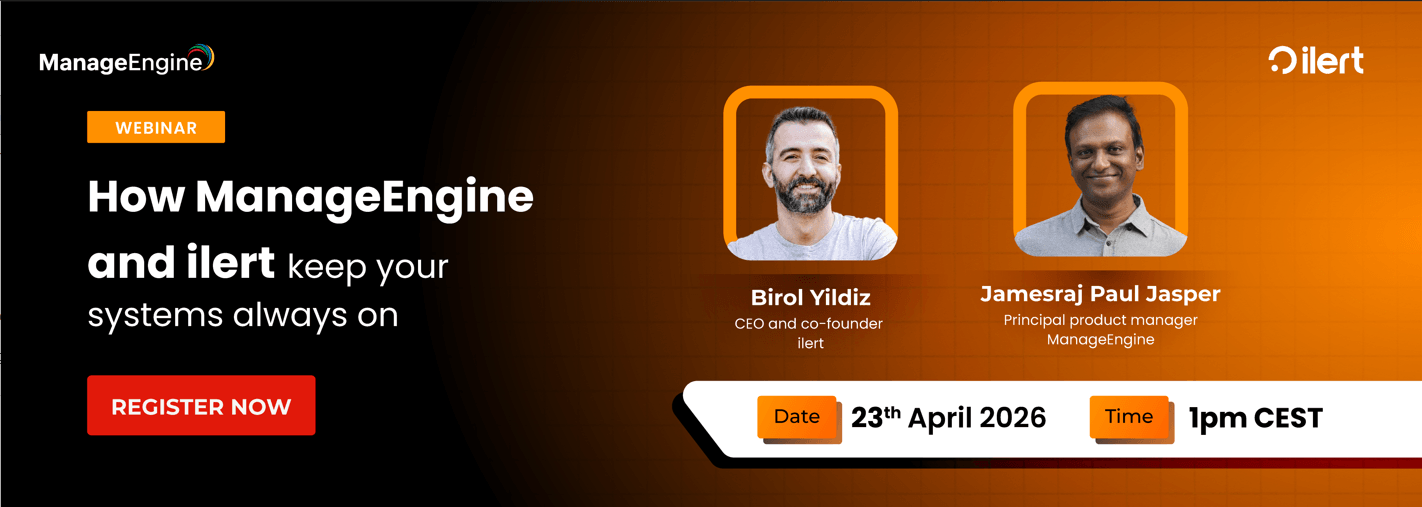
Join the webinar: From alerts to action in practice
We’re hosting a live session on how to bridge the gap between monitoring and incident response using ManageEngine FSO and ilert.
In this webinar, you’ll learn how to:
Turn alerts into actionable incidents automatically.
Route notifications to the right responders without delay.
Set up escalation policies that prevent incidents from stalling.
Reduce alert fatigue while improving response efficiency.
Build a more resilient IT operations workflow.
Date and time: Apr. 23 2026 | 1pm CEST
Featuring:
Birol Yildiz, CEO and co-founder, ilert
Jamesraj Paul Jasper, Principal product manager, ManageEngine FSO
Reserve your spot and see how integrated workflows can improve incident response.