Build, predict, and transform with ML that increases operational efficiency
From creation to deployment, operationalize ML with speed, simplicity, and scale. Build adaptive, precise models that continuously learn from your IT data—no data science expertise required.
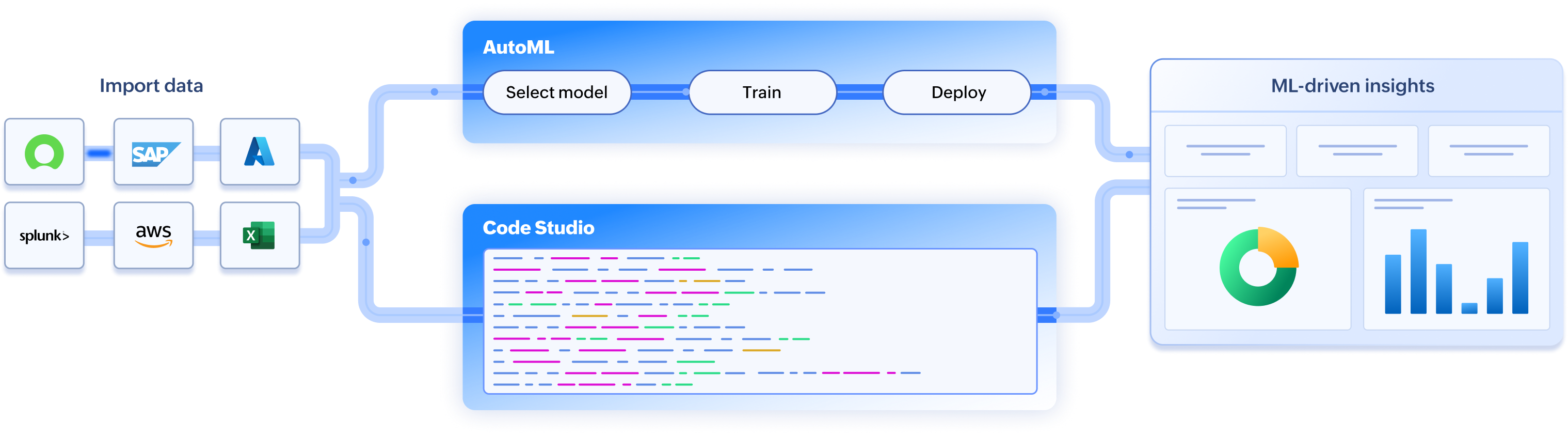
Two ways to build—one powerful outcome
No-code machine learning with AutoML
Rapid modelling
Eliminate complexity with an intuitive, guided interface to create, train, and deploy deep-reasoning models without writing a single line of code.
Algorithm evaluation
Automatically identify, test, and evaluate multiple algorithms to pick the best-performing model based on built-in accuracy metrics and underlying training logic.
Instant deployment
Put your no-code ML model to work immediately by deploying it on your operational data to generate actionable insights that drive fast, proactive decisions.
Continuous learning
Your model doesn’t just predict—it evolves. AutoML adapts in real time, learning from new operational data to stay aligned with changing IT patterns.
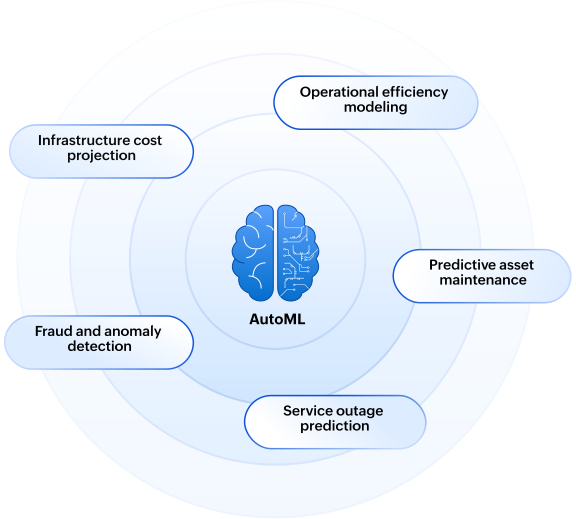
Write custom ML with Code Studio
Custom scripting
Build from scratch or import third-party Python code tailored to your unique IT needs—ideal for complex analysis that requires deep learning with fine-grained controls over machine learning models.
Powerful libraries
Leverage a wide range of industry-tested libraries to accelerate insights, enrich raw data, and calculate custom KPIs, all within a secure, dedicated studio environment.
Complete control
Define model outcomes without being limited by existing datasets or rigid data structures, giving you full control over the insights you generate.
Zia assistance
Accelerate script writing with real-time code suggestions from Zia, your AI assistant, streamlining development and minimizing errors.
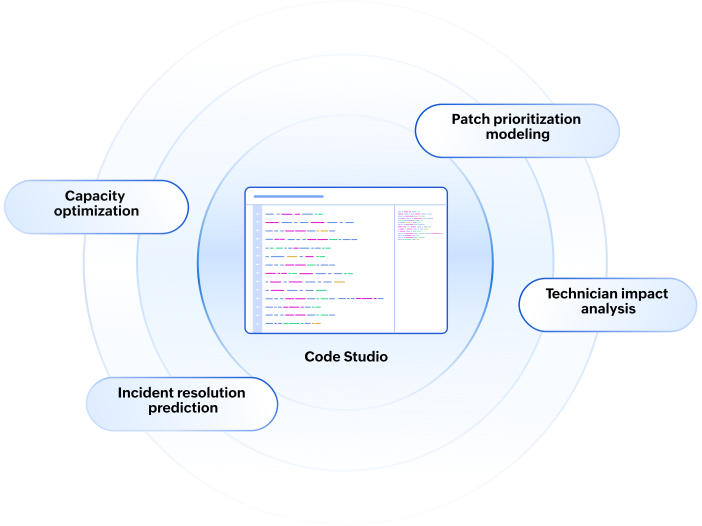
Put your no-code ML models to work across your IT landscape
IT asset replacement assessment
Create models that can predict the lifespan of assets by assessing the frequency of failures, asset age, cost of repairs, and cost of replacement to suggest the right replacement window to optimize costs and usage.
User churn analysis
Analyze ticket history, frequency, and feedback data to model dissatisfaction patterns. Identify ticket handling practices such as frequent reassignments that create a sub-par user experience.
Risk assessment
Automatically score and flag high-risk projects or infrastructure components. Build models that assess system risks based on past performance, change history, and compliance metrics. Focus mitigation efforts where the potential impact is highest.
Forecasting at scale
Forecast future ticket volumes, bandwidth needs, or server utilization using no-code machine learning models that incorporate multi-variable inputs to predict ticket surges, capacity demands, or service loads more accurately.
Downtime prediction
Combine historical incident, configuration, and maintenance data to model and predict the probability of downtime for key systems—enabling proactive maintenance and ensuring service continuity.
Root cause prediction
Use machine learning to analyze historical incidents and asset dependencies to automatically identify likely root causes, guiding technicians to faster resolution and reduced MTTR.
Fraud or anomaly detection
Train models to recognize irregularities in login activity, access patterns, or endpoint behavior, pinpointing risks such as credential misuse, unauthorized access, or unusual software installations.
License optimization
Model software usage patterns to predict under- or overutilized licenses across teams. Guide redistribution or renewal strategies to reduce costs and ensure compliance.