7 reasons why intelligent network automation should be on every CXO's agenda

Summary
Discover how intelligent network automation is transforming IT operations by combining AI, machine learning, and policy-based orchestration to deliver agility, reliability, and security at scale. This article explores its strategic value for CXOs, real-world benefits, and practical considerations for seamless adoption, illustrated with an example of automated network reconfiguration during peak demand.
Network infrastructure forms the backbone of every successful enterprise today. But managing increasingly complex and distributed networks using traditional methods is getting unsustainable.
That's where intelligent network automation comes in, offering a paradigm shift in how ITOps professionals and business leaders can optimize their infrastructure, enhance agility, and drive business value. In fact, Gartner® predicts that by 2026, 30% of enterprises will automate more than half of their network activities, further highlighting the urgency for organizations to embrace automation at scale.
What is intelligent network automation?
Intelligent network automation goes beyond basic scripting and rule-based systems. It leverages artificial intelligence (AI) and machine learning (ML) to autonomously manage, configure, optimize, and even heal network environments. By analyzing vast amounts of network data, these intelligent systems can understand patterns, predict potential issues, and make informed decisions in real time, significantly reducing the need for manual intervention. This translates to a more proactive, efficient, and resilient network infrastructure.
How does intelligent network automation work?
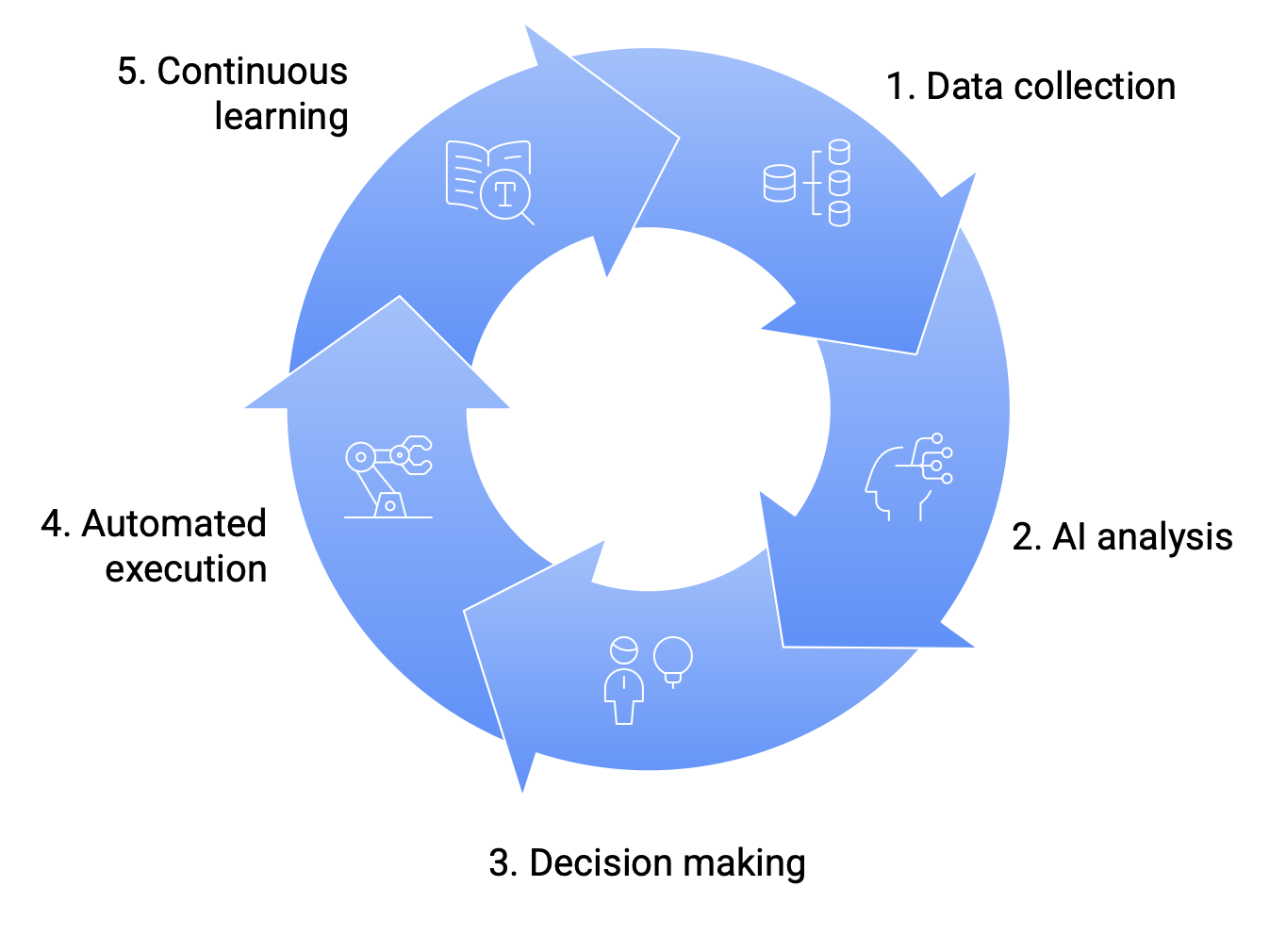
At its core, intelligent network automation operates through a sophisticated cycle of data acquisition, analysis, decision-making, and action. Here’s a breakdown of the key processes:
- Data collection and aggregation: The system gathers comprehensive data from all network devices, including performance metrics, logs, configurations, and traffic flows.
- AI- and ML-powered analysis: Advanced algorithms analyze this data to identify anomalies, predict trends (like capacity bottlenecks), and understand the root cause of issues.
- Intelligent decision-making: Based on the analysis, the system makes intelligent decisions, such as automatically reconfiguring devices, optimizing traffic paths, or triggering remediation workflows.
- Automated execution: The system then executes these decisions automatically, updating configurations, deploying patches, or initiating self-healing processes without manual intervention.
- Continuous learning and optimization: The AI and ML models continuously learn from the network's behavior and the outcomes of its actions, further refining its decision-making capabilities over time.
This closed-loop approach allows the network to become more self-aware, self-optimizing, and ultimately, more aligned with business objectives—a crucial advantage for ITOps leaders focused on delivering strategic value.
Key use cases for intelligent network automation
Intelligent network automation delivers measurable value across multiple ITOps functions, directly impacting performance, security, and operational efficiency.
- Predictive maintenance and anomaly detection: By continuously monitoring telemetry data, AI models can detect early warning signs of hardware failure, link instability, or abnormal traffic patterns. Predictive insights allow IT teams to replace components or adjust configurations before issues cause outages. This proactive approach not only safeguards business continuity but also reduces unplanned downtime costs. For example, an e-commerce company could identify a switch showing early signs of packet loss days before a major sales event, preventing a potential service disruption.
- Automated provisioning and configuration: Automating device onboarding and service rollout eliminates time-consuming manual steps. Configuration templates and policy-based provisioning ensure consistency across vendors and environments, whether deploying 100 new branch routers or rolling out a cloud-based WAN service. For instance, Terraform can be used to define and provision the network topology, firewalls, and cloud network resources in a consistent, repeatable way. Once the infrastructure is in place, tools like Ansible can then automatically configure the devices with the correct settings and policies, ensuring consistency across vendors and environments.
- Network optimization and traffic engineering: The system dynamically reallocates bandwidth, reroutes traffic, or modifies QoS parameters based on real-time usage and business priorities. For instance, during a global video conference involving multiple regions, the network can temporarily prioritize video traffic, ensuring smooth communication without manual intervention. These optimizations improve the user experience while ensuring efficient use of infrastructure.
- Automated troubleshooting and remediation: When performance thresholds are breached or anomalies detected, intelligent automation can initiate diagnostics, apply fixes, or execute predefined playbooks without human input. An intelligent platform might leverage an Ansible playbook to restart a failed service or re-establish a dropped BGP session, shortening mean time to repair and freeing skilled engineers to focus on strategic initiatives.
- Security policy enforcement: Automation ensures that security configurations are consistently applied across the entire network, regardless of device type or vendor. Integrated compliance checks against standards like ISO 27001, the NIST Cybersecurity Framework, the PCI DSS, or HIPAA can automatically remediate deviations, reducing risk exposure and ensuring audit readiness. By embedding these checks into ongoing operations, security posture remains consistent without introducing manual bottlenecks.
- Intent-based networking (IBN): With IBN, leaders define high-level business intents, such as ensuring uninterrupted connectivity for critical healthcare systems or prioritizing ERP traffic during month-end closing. The automation platform translates these intents into specific device configurations and policies, applying them across the network. This approach simplifies complex management tasks and ensures that IT operations directly align with business goals.
For CXO and business leaders, these use cases translate to significant improvements in operational efficiency, reduced risks, and faster time-to-market for new services
Benefits for CXOs: Driving business value with intelligent network automation
For CXOs, adopting intelligent network automation translates into significant strategic and operational advantages:
- Enhanced operational efficiency: Automating routine network management tasks such as device provisioning, patch deployment, and policy enforcement significantly reduces manual workload. This allows highly skilled IT staff to redirect their time toward innovation, digital transformation projects, and initiatives that drive customer and shareholder value. Over time, reduced dependency on manual intervention also minimizes human error, improving overall service quality.
- Improved network agility and responsiveness: In dynamic business environments, the ability to provision services on demand, adapt to seasonal or unexpected traffic spikes, and implement changes in minutes rather than days is a critical differentiator. Intelligent network automation enables ITOM teams to rapidly respond to market shifts, mergers and acquisitions, or new product launches without service degradation, directly supporting business growth and customer experience goals.
- Reduced downtime and increased reliability: Proactive monitoring and predictive analytics allow the system to detect and address issues before they escalate into outages. Automated remediation workflows ensure that incidents are resolved quickly—often before end users notice an impact. This translates into fewer disruptions to critical operations, stronger customer trust, and improved SLA compliance.
- Strengthened security posture: By continuously validating configurations against security baselines and compliance requirements, intelligent network automation helps maintain a consistent security posture. Real-time threat detection paired with automated policy enforcement reduces vulnerabilities, limits attack surfaces, and accelerates incident containment—a key advantage in industries where regulatory compliance and data protection are paramount.
- Data-driven decision-making: The analytics capabilities embedded in intelligent network automation provide CXOs with actionable insights for capacity planning, technology investments, and resource allocation. Trends in bandwidth utilization, application performance, and security events can inform long-term strategies, helping organizations make confident, evidence-based decisions.
- Cost optimization: Lower operational expenses are achieved through automation-driven efficiency, fewer outages, and optimized use of existing resources. By eliminating unnecessary overprovisioning and extending the life cycle of network assets through proactive maintenance, organizations can realize substantial cost savings without compromising performance.
- Alignment with business objectives: Through IBN, network operations are directly aligned with high-level business goals. This ensures that infrastructure changes and resource allocations support strategic priorities, whether that means prioritizing mission-critical applications, enabling remote workforce expansion, or improving customer-facing digital services.
Strategic considerations for implementing intelligent network automation
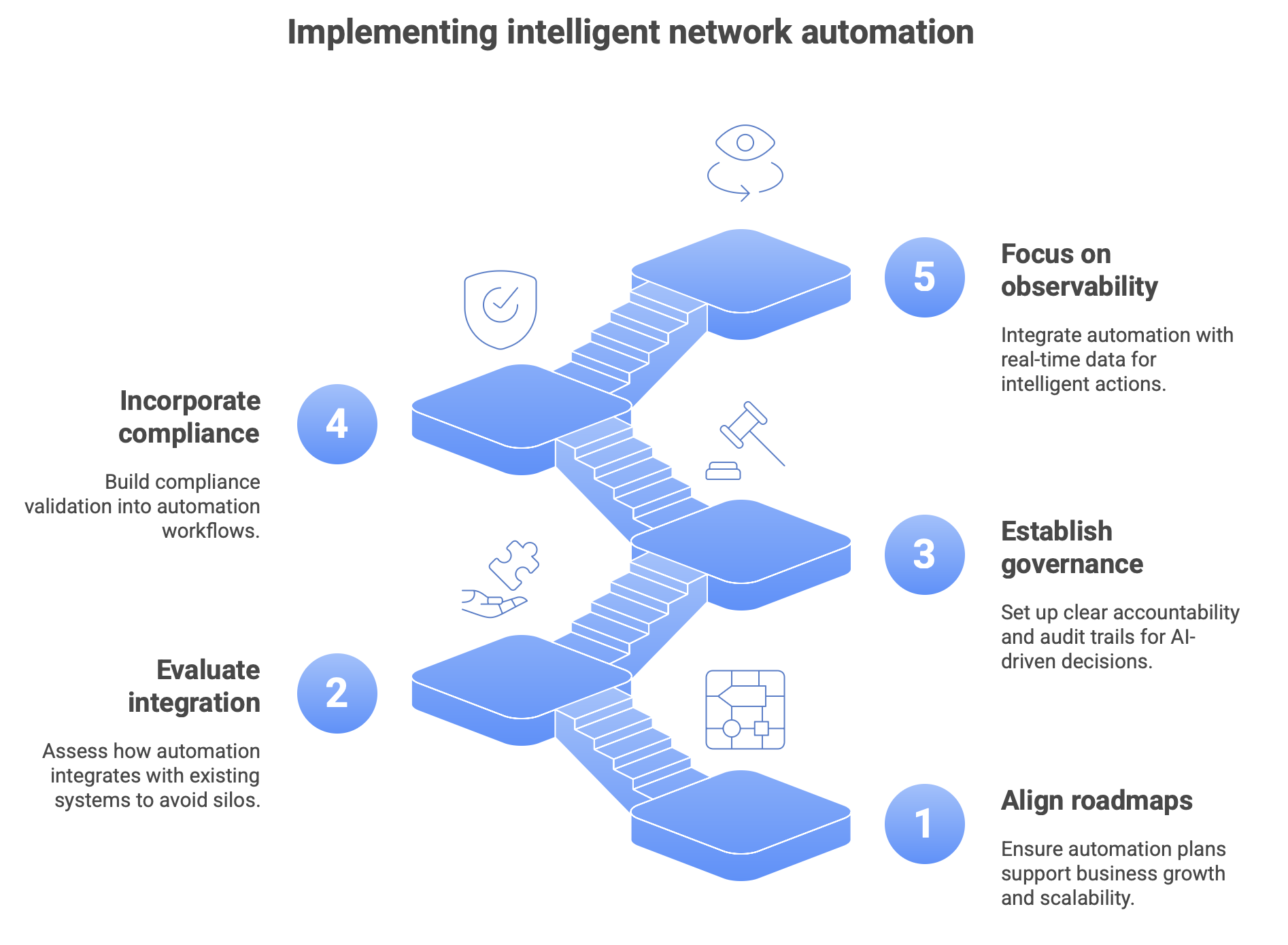
For CXOs, deploying intelligent network automation is less about adopting a new toolset and more about orchestrating a strategic shift in how IT operations support and accelerate business objectives. Key considerations include:
- Align automation roadmaps with business growth plans: Automation should not be deployed in isolation. The roadmap must anticipate future acquisitions, market expansions, and service rollouts so that the automation framework can scale and adapt without major redesigns. For example, if global expansion is on the horizon, ensure your automation platform supports multi-vendor, multi-region orchestration from day one.
- Evaluate integration depth with existing ecosystems: Intelligent automation must seamlessly work with orchestration tools like Ansible or Terraform, existing ITSM platforms, and monitoring systems. A fragmented setup can create new silos, negating the efficiency gains. CXOs should push for proof-of-concept integrations before full-scale deployment to validate interoperability.
- Establish governance for AI-driven decisions: As automation systems begin executing policy changes or self-healing actions without human intervention, governance becomes critical. Clear accountability structures, audit trails, and human approval thresholds for high-impact changes ensure that automation remains aligned with compliance and risk management frameworks.
- Incorporate compliance as a continuous process: For industries bound by standards like ISO 27001, the PCI DSS, or HIPAA, automation should have compliance validation built into workflows—not as an afterthought. This allows security policy enforcement and configuration changes to be automatically validated against regulatory requirements in real time.
- Focus on observability-driven automation: Automation is only as good as the data that powers it. Ensure the automation platform is tightly integrated with your observability stack so that real-time telemetry, anomaly detection, and business KPIs drive automated decisions. This elevates automation from scripted responses to truly intelligent, context-aware actions.
What this means for CXOs
Intelligent network automation is no longer a futuristic concept reserved for technology leaders with vast resources. It has become a practical, high-impact approach for organizations seeking to modernize IT operations, improve service delivery, and strengthen resilience in an increasingly digital economy.
For CXOs, the value lies in enabling the business to scale faster, adapt to change with confidence, and protect critical services from both performance and security risks. Organizations that embrace intelligent network automation today position themselves not just to keep pace with technological change but to lead in a marketplace where agility, reliability, and the customer experience define long-term success.