
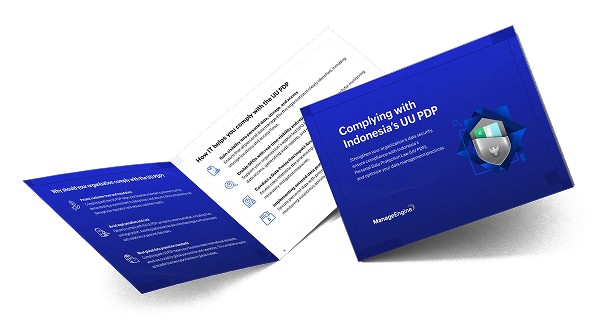
Strengthen your organization’s data security, ensure compliance with Indonesia’s Personal Data Protection Law (UU PDP), and optimize your data management practices.


The UU PDP is a regulation designed to protect the personal data of individuals in Indonesia. This law governs how organizations manage and process personal data securely, ensuring privacy, security, and transparency in data handling.
By complying with the UU PDP, businesses can enhance customer trust, reduce the risk of data breaches, and avoid legal penalties. The UU PDP helps maintain the integrity of personal data, improves security procedures, and aligns with global data protection standards such as the GDPR.
 Protect customer trust and reputation
Complying with the UU PDP helps your business maintain customer trust by demonstrating a commitment to data privacy and security. Non-compliance can damage your reputation and reduce customer loyalty.
 Avoid legal penalties and cost
Failure to comply with the UU PDP can lead to severe penalties, including fines and legal action. Avoiding data breaches also minimizes legal costs associated with violations or personal data leaks.
 Meet global data protection standards
Complying with UU PDP means your business meets international standards, which are crucial for global partnerships and operations. This compliance opens up broader business opportunities in global markets.

Ensure that all personal data managed by the organization is clearly identified, including storage locations and access flows.

Support your organization’s appointed DPO by providing the right IT tools for monitoring data access, generating audit reports, and ensuring continuous compliance.

Assess risks related to the processing of personal data to identify potential impacts and necessary mitigation measures.

Secure personal data with protection measures such as encryption, access control, and monitoring suspicious activity.

Help establish clear personal data management policies and ensure that internal standards are always in line with applicable regulations.

Conduct regular training to raise employee awareness and ensure everybody understands their role in protecting personal data.

Track how personal data is accessed and used, identify breaches, and ensure security controls are effective through continuous auditing and reporting.

Quickly identify and respond to security incidents. Notify affected individuals and relevant authorities in accordance with the UU PDP.
Classify personal data into general personal data and specific personal data.
Locate and maintain a detailed inventory of sensitive content such as PII and ePHI across multiple data repositories. Scan for passport numbers, SSNs, credit card numbers, and over 100 other types of personal data.
Prevent personal data leakage across all endpoint devices.
Establish principles in personal data processing, such as protection, legal certainty, public interest, accountability, and confidentiality.
Ensure the confidentiality of personal data by monitoring and analyzing logs to detect unauthorized access or tampering. Provide detailed reports on these activities to verify if any personal data has been altered.
Analyze logs to detect activities that do not comply with these principles.
Prevent data leakage through endpoint devices and controls unauthorized data transfers.
Anonymize personal data and ensure secure, lawful data processing in compliance with legal requirements.
Monitor who accesses personal data, including when and where it is used, and remove stale, duplicate, and orphaned files to ensure data minimization.
Enforce key data protection principles by ensuring secure, accountable, and compliant identity and access management, backed by detailed audit trails and access controls
Regulates types of personal data processing, including collection, storage, and destruction.
Monitor activities related to data processing and maintain its integrity.
Protect data from unauthorized access and ensure data destruction according to regulations.
Enforce strict access controls, accountability, and governance over personal data.
Secure endpoints where personal data is stored and processed. Apply security measures like encryption, access controls, and secure configurations, supporting the secure processing of data on employee devices.
Maintain the security of systems where personal data is processed by keeping operating systems and applications up to date with the latest patches.
Defines the obligations of data controllers and processors in personal data processing.
Detect unauthorized access or activities that violate processing policies and provide detailed reports to ensure personal data is processed in compliance with regulations.
Establishes the obligation for electronic system operators to implement personal data protection against unauthorized access, alteration, disclosure, or destruction.
Monitor and analyze logs to detect data security breaches.
Block leakage of files containing sensitive data (PII/ePHI) across USB devices, email clients, Wi-Fi, etc. Regulate USB drive usage and enforce granular access control measures by restricting read, write, or even just execute access. Enforce the use of sanctioned devices using blocklists.
Secure browser usage with control policies that restrict unauthorized downloads and access.
Ensure proper access control for high-privileged accounts and record sessions for more secure access monitoring of personal data.
Manage and securely store credentials, ensuring proper access control for personal data stored within systems.
Keep personal data secure by monitoring logs for unauthorized access and providing detailed reports to spot potential breaches. User and entity behavior analytics (UEBA) analyzes user behavior to detect unusual activity, helping to prevent unauthorized access and protect data.
Protect personal data on endpoints by enforcing security policies and monitoring for vulnerabilities or non-compliant actions.
Protect personal data with MFA, conditional access policies, auditing, and periodic access reviews.
Introduces the obligation to conduct a data protection impact assessment for high-risk personal data processing.
Get visibility into user activities and compliance gaps. Monitor, detect, and report unauthorized access to personal data managed by the data processor.
Get UEBA and real-time incident detection to identify and respond to unauthorized access attempts and anomalous behavior quickly and effectively.
Establishes the obligation to protect and ensure the security of personal data during the processing process.
Provide monitoring and reporting of incidents related to personal data security.
Prevent data leakage using customizable DLP policies to track and control the movement of business-critical information across IT assets, like USB devices, email clients, cloud apps, Wi-Fi, and printers. Monitor file integrity, identify high-risk users and data hoarders, and stop ransomware attacks, insider threats, and more.
Ensure ongoing protection of systems involved in personal data processing by automating patch deployment across OS and third-party apps. Get audit-ready reports on patch status, supporting compliance with UU PDP security obligations for data processing.
Ensure personal data security throughout the processing life cycle by enforcing access controls, monitoring user activities, and generating real-time alerts to prevent unauthorized access or data breaches.
Requires data controllers to maintain the confidentiality of personal data being processed.
Protect the confidentiality of data with strict access controls.
Safely store and manage passwords to maintain the confidentiality of personal data.
Ensure that personal data on endpoints remains confidential. Enforce policies for device encryption, manage access control, and ensure that sensitive data is stored securely.
Apply anonymization techniques to protect sensitive information in compliance with UU PDP confidentiality requirements.
Implement granular access controls, enable real-time monitoring, and conduct comprehensive auditing to help data controllers meet confidentiality requirements.
Regulate the obligation to notify data subjects and relevant authorities in case of a personal data breach.
Get real-time reports and notifications about personal data breaches.
Detect and report data breaches for compliance.
Leverage real-time alerts, a detailed risk assessment report, and audit logs to ensure timely detection and notification of personal data breaches.
Defines the obligations of data processors in processing data according to the controller's instructions.
Monitors user access in Active Directory, detects and reports unauthorized access to data managed by the data processor
Regulates the obligation of the controller and processor to appoint a DPO whose role is to monitor and ensure compliance with the UU PDP.
Manage privileged access for users with high-level access rights, including audited access sessions to ensure compliance by the DPO.
Regulate the duties of the DPO to monitor compliance with the UU PDP, provide advice, and act as a liaison between the organization and relevant authorities.
Monitor and analyze personal data activity logs to ensure compliance.
Analyze logs to detect activities that do not comply with these principles.
Assists with Articles 5, 19, 32, 34, 46, and 54.
Download this guide to take a closer look at how ManageEngine can help you comply with the UU PDP.
Implementing UU PDP compliance requires a combination of processes, policies, and technology. The solutions mentioned above can help with compliance, but organizations must assess how these solutions align with their specific needs. This information is for general guidance and should not be considered legal advice. ManageEngine makes no warranties about the accuracy or completeness of this material. For legal advice on UU PDP compliance, please consult your legal advisor.