


Reimagining enterprise connectivity: The CXO’s guide to software-defined networking

Summary
This article explores how Software-Defined Networks (SDN) are revolutionizing enterprise IT operations by decoupling network control from hardware, enabling centralized management, automation, and scalability. It explains the core components of SDN, contrasts it with traditional networking, and highlights key business advantages such as improved agility, cost efficiency, and enhanced security
In a world where agility and control define competitive advantage, software-defined networking or SDN has emerged as a cornerstone of modern IT infrastructure. SDN separates the network’s control plane (decision-making) from the data plane (traffic forwarding), enabling centralized programmability, automation, and policy-driven management.
What is software-defined networking?
Software-Defined Networking, or SDN is an architectural approach that makes enterprise networks programmable, agile, and centrally managed by separating the network’s control logic from the physical devices that forward traffic. Instead of relying on static, hardware-driven configurations, SDN uses a centralized software controller to dynamically shape how data moves across the network, based on business policies, application needs, and real-time traffic conditions.
Instead of configuring individual switches and routers manually, SDN allows IT teams to define policies and network behavior centrally via a controller, which communicates with the underlying devices using open protocols such as OpenFlow. This approach gives enterprises the ability to dynamically manage traffic, enforce security policies, and optimize performance across multi-cloud or hybrid environments.
How software-defined networking works:
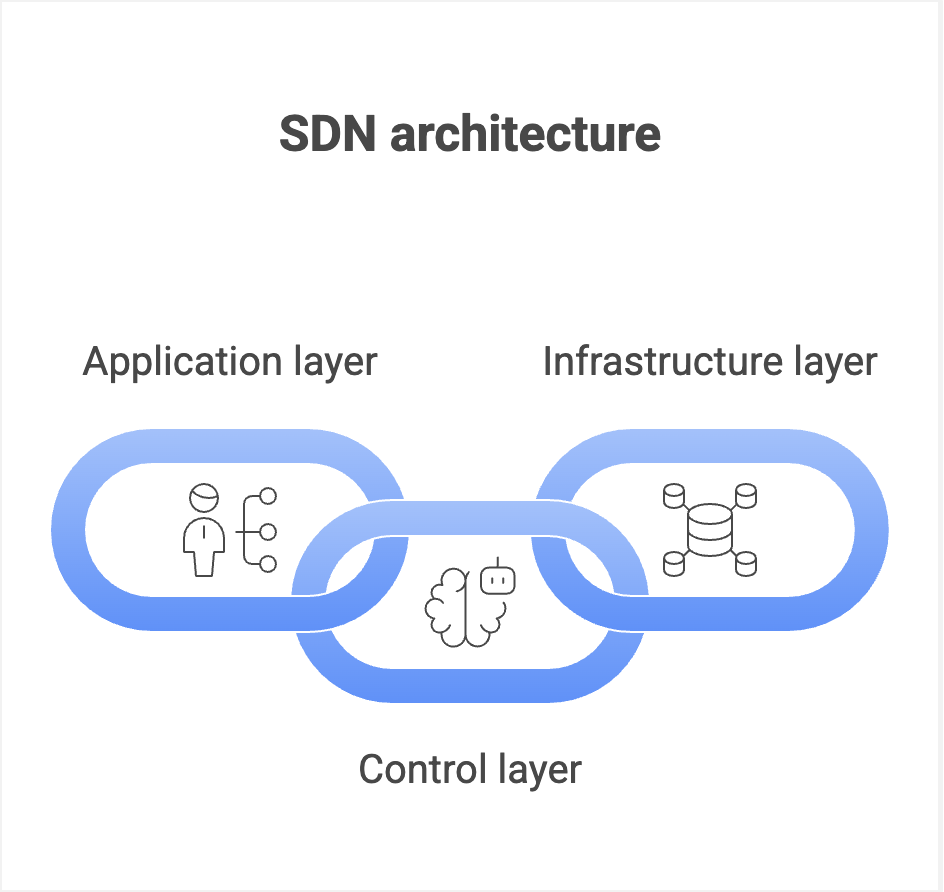
At its core, SDN functions as a powerful, intelligent operating system for your enterprise network. This system is designed to translate high-level business goals directly into network actions, unifying disparate hardware under a single administrative umbrella. The magic lies in a layered architecture that ensures dynamic, programmable behavior across the entire infrastructure.
An SDN architecture typically consists of three primary layers: application, control, and infrastructure. They work together to deliver dynamic, programmable network behavior:
- Application layer: This is where business intent is translated into high-level network policies. For example, an organization may define policies that prioritize video conferencing traffic or restrict data transfer to specific geographic zones for compliance reasons. The application layer communicates these requirements to the control layer through open APIs, ensuring that business priorities directly influence network behavior.
- Control layer: Often referred to as the “brain” of SDN, this layer houses the SDN controller, which maintains a global view of the entire network. The controller interprets the business and application policies received from the application layer and converts them into precise configurations for network devices. For instance, if a new branch office is added, the controller can automatically push the required routing and security configurations across the infrastructure, eliminating the need for manual device-by-device changes. This centralized control enables agility, consistency, and real-time adaptability.
- Infrastructure layer: This is the physical or virtual foundation of the network: the switches, routers, and firewalls responsible for forwarding traffic. In an SDN environment, these devices no longer make independent routing decisions; instead, they follow the instructions issued by the controller. This simplifies device management and ensures network-wide consistency. Moreover, infrastructure can be composed of both commodity hardware and virtual network functions, significantly reducing dependency on expensive proprietary appliances.
Models of SDN
To achieve the programmability and centralized control that define SDN, various deployment models have emerged, each suited to different enterprise needs and architectures:
- OpenFlow-based SDN: This is the original, foundational model. It relies on the OpenFlow protocol to communicate directly between the central controller and the forwarding plane (switches/routers). It provides the highest degree of network control and hardware abstraction. This model is best suited for greenfield data centers or environments that require maximal vendor independence and granular control.
- API-based (overlay) SDN: Also known as SDN Overlays, this model uses a software layer (often implemented via protocols like VXLAN) running over the existing physical network infrastructure. The intelligence is virtualized on top, allowing the existing hardware to remain largely untouched. It's ideal for hybrid cloud deployments and rapid implementations where leveraging existing hardware is key (such as SD-WAN and Network Function Virtualization - NFV).
- Hybrid SDN: This model allows traditional networking protocols (like OSPF or BGP) and SDN protocols (like OpenFlow) to coexist. Only a subset of network traffic or specific services are managed by the SDN controller, which enables a phased transition. It's the most practical choice for large, established enterprises with complex brownfield environments who need to migrate gradually.
- Policy-based (intent-based) SDN: This represents the evolution of SDN. Administrators define the desired business intent (e.g., "all high-priority application traffic must be segmented") rather than low-level configurations. The system then automatically translates this intent into network policies. This model is focused on achieving maximum automation, compliance, and end-to-end service assurance.
Traditional networks vs. SDN: A comparative view
Before diving into implementation, it’s essential to understand how software-defined networks differ from traditional, hardware-centric architectures. Traditional networks rely on manual configuration and tightly coupled control and data planes, making them rigid and slow to adapt. In contrast, SDN introduces programmability, automation, and centralized control, enabling IT teams to respond instantly to changing business and operational demands. The comparison below highlights the key distinctions between traditional networking and SDN.
| Aspect | Traditional network | Software-defined network |
|---|---|---|
| Architecture | Hardware-defined; each device configured manually | Software-defined; centralized controller manages all devices |
| Scalability | Limited by physical infrastructure | Easily scalable through software configuration |
| Agility | Static and slow to adapt | Dynamic and responsive to application demands |
| Visibility | Fragmented, device-specific monitoring | End-to-end network visibility via a unified dashboard |
| Security | Dependent on hardware firewalls and VLANs | Granular, policy-driven microsegmentation |
| Cost efficiency | High CapEx for specialized hardware | Lower TCO via automation and hardware abstraction |
For CXOs, this transition translates directly to faster time-to-market, lower operational overhead, and improved risk control, all while aligning the network with broader digital transformation goals.
Business advantages of SDN
For CXOs, the real advantage of SDN lies in how it transforms networks from rigid, hardware-bound systems into intelligent, programmable assets that drive agility, security, and efficiency. By separating the control plane from the data plane, SDN gives organizations centralized control and end-to-end visibility—key capabilities for thriving in today’s fast-moving digital ecosystems.
- Agility and scalability: SDN enables organizations to deploy, modify, and scale network resources dynamically through software rather than manual reconfiguration. In industries like retail, this agility allows businesses to quickly spin up new branch networks or support pop-up stores with minimal downtime. Similarly, manufacturers leverage SDN to connect thousands of IoT devices securely while maintaining visibility and control across factory networks.
- Cost optimization: By abstracting the control layer, SDN reduces dependency on proprietary hardware, enabling enterprises to use commodity networking gear without sacrificing performance. This leads to lower capital and operational costs. For instance, financial institutions adopting SDN have reported significant reductions in provisioning time and maintenance overhead, freeing IT teams to focus on innovation rather than manual upkeep.
- Enhanced security and compliance: Centralized policy enforcement and network segmentation make it easier to detect and isolate threats in real time. In healthcare, for example, SDN allows administrators to segment networks to protect sensitive patient data while still enabling secure access for authorized users and medical devices, ensuring compliance with HIPAA and other regulations.
- Simplified multi-cloud management: With workloads distributed across public and private clouds, consistent network performance and visibility become critical. SDN provides a unified control plane that allows enterprises with hybrid or multi-cloud environments to manage connectivity, security, and traffic flow across providers seamlessly. This simplifies governance while improving reliability.
- Performance and reliability: SDN’s programmability supports intelligent traffic routing, prioritizing mission-critical applications and ensuring optimal performance. E-commerce and streaming platforms use SDN to dynamically allocate bandwidth based on real-time demand, reducing latency and improving customer experience even during peak loads.
In essence, SDN empowers organizations to align IT infrastructure with strategic business goals—reducing costs, increasing agility, and building the foundation for a truly responsive digital enterprise.
What CXOs should know about implementation
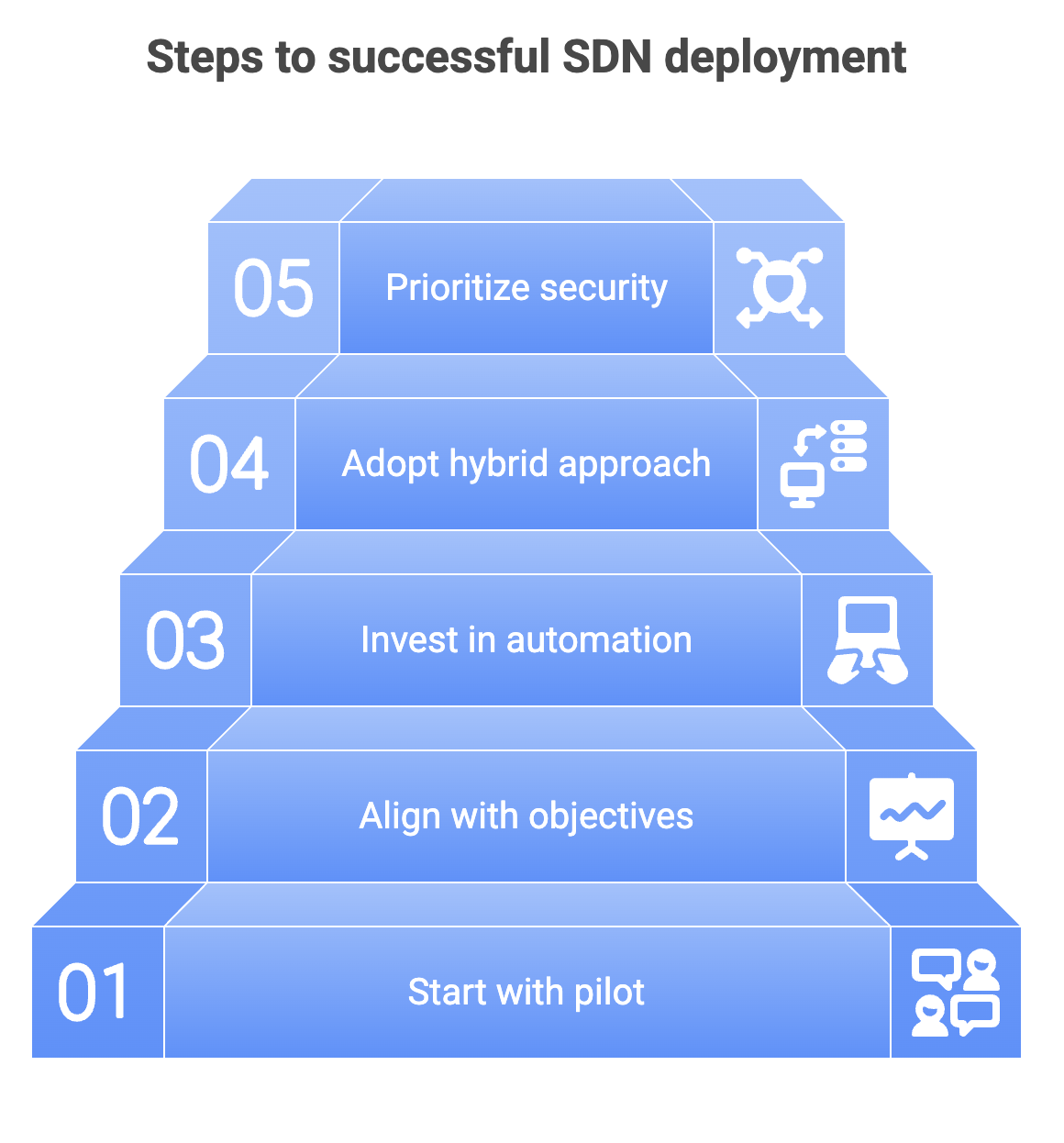
Successfully deploying an SDN architecture requires strategic planning and adherence to established best practices to ensure a smooth transition and maximize long-term value.
- Start with a pilot: Avoid "big bang" deployments. Begin by implementing SDN in a limited, non-critical domain, such as a new branch office, a specific data center pod, or a dedicated development environment. This allows the team to gain experience and validate the architecture without risking core operations.
- Align with business objectives: The deployment must be driven by clear business outcomes (e.g., reducing multi-cloud complexity, enabling faster application deployment, or enhancing specific security segmentation). If the network is not solving a defined business problem, the project risks becoming an expensive technical exercise.
- Invest in automation and skills: The true ROI of SDN comes from automation. Focus on writing policies and scripts that automate provisioning, security changes, and troubleshooting. Crucially, upskill IT staff from traditional networking CLI configuration to software programming, API interaction, and controller management.
- Adopt a phased hybrid approach: For most large organizations, a Hybrid SDN model is the most practical starting point. Gradually introduce SDN capabilities as an overlay to manage new services or traffic flows while allowing legacy infrastructure to remain operational until its scheduled refresh.
- Prioritize security segmentation: Use the centralized control of SDN to enforce microsegmentation from day one. This practice limits lateral movement of threats by creating granular security zones within the network, significantly boosting the enterprise's security posture.
Future trends shaping SDN
The evolution of SDN is tightly linked to broader advances in cloud and AI, driving the architecture toward greater intelligence and autonomy:
- Intent-based networking (IBN): This is the ultimate goal of SDN. IBN uses advanced analytics and machine learning to constantly monitor the network and proactively adjust configuration to maintain the defined business intent. It moves beyond automation to autonomy, handling performance optimization and self-healing without human intervention.
- 5G and edge computing integration: As organizations push workloads to the network edge (e.g., IoT devices, remote offices), SDN is essential for providing dynamic, on-demand network slicing and secure connectivity between the core data center, the cloud, and thousands of dispersed edge nodes.
- AIOps for network management: Integrating Artificial Intelligence for IT Operations (AIOps) tools with the SDN controller's centralized data stream will enable predictive maintenance, root-cause analysis, and automatic capacity planning, drastically reducing operational overhead and mean time to resolution (MTTR).
- Open source and disaggregation: The movement towards open-source controller platforms and the disaggregation of hardware (separating network operating system from the hardware vendor) will accelerate, driving down costs and further increasing vendor independence.
Software-defined networking (SDN) is the essential architectural leap for any enterprise serious about thriving in the digital economy. It moves the network from a static, hardware-dependent cost center to a dynamic, programmable business asset.
For CXOs, the value is simple: SDN delivers the agility, centralized control, and efficiency needed to accelerate cloud adoption, enforce pervasive security, and instantly adapt to market changes. By making the network policy-driven and automated, it eliminates complexity, reduces costs, and ensures infrastructure aligns directly with strategic business goals.