
Threat intelligence in Log360: Transform external threat data into defensive advantage

Enrich every alert with global intelligence. Log360 ingests, normalizes, and operationalizes threat feeds from more than 10 sources to add the crucial context that separates real threats from noise—turning raw indicators into actionable defense.

What you can do with Log360


Ingest and normalize more than 10 different threat feed formats including STIX/TAXII, CSV, JSON, and API to ensure seamless integration of global threat intelligence into your SIEM.


Enrich alerts with IP reputation scores, geolocation data, and known IoCs to prioritize incidents based on risk.


Prioritize alerts with context through risk scoring, severity levels, and threat intelligence enrichment to ensure critical threats are handled first.


Continuously updated threat intelligence empowers your SOC team to hunt for threats and stop data breaches before they occur.

  • Real-time threat feed integration
  • Operationalize threat intelligence for smarter detections
  • Dark web monitoring with Constella threat intelligence
  • Investigation acceleration with threat intel

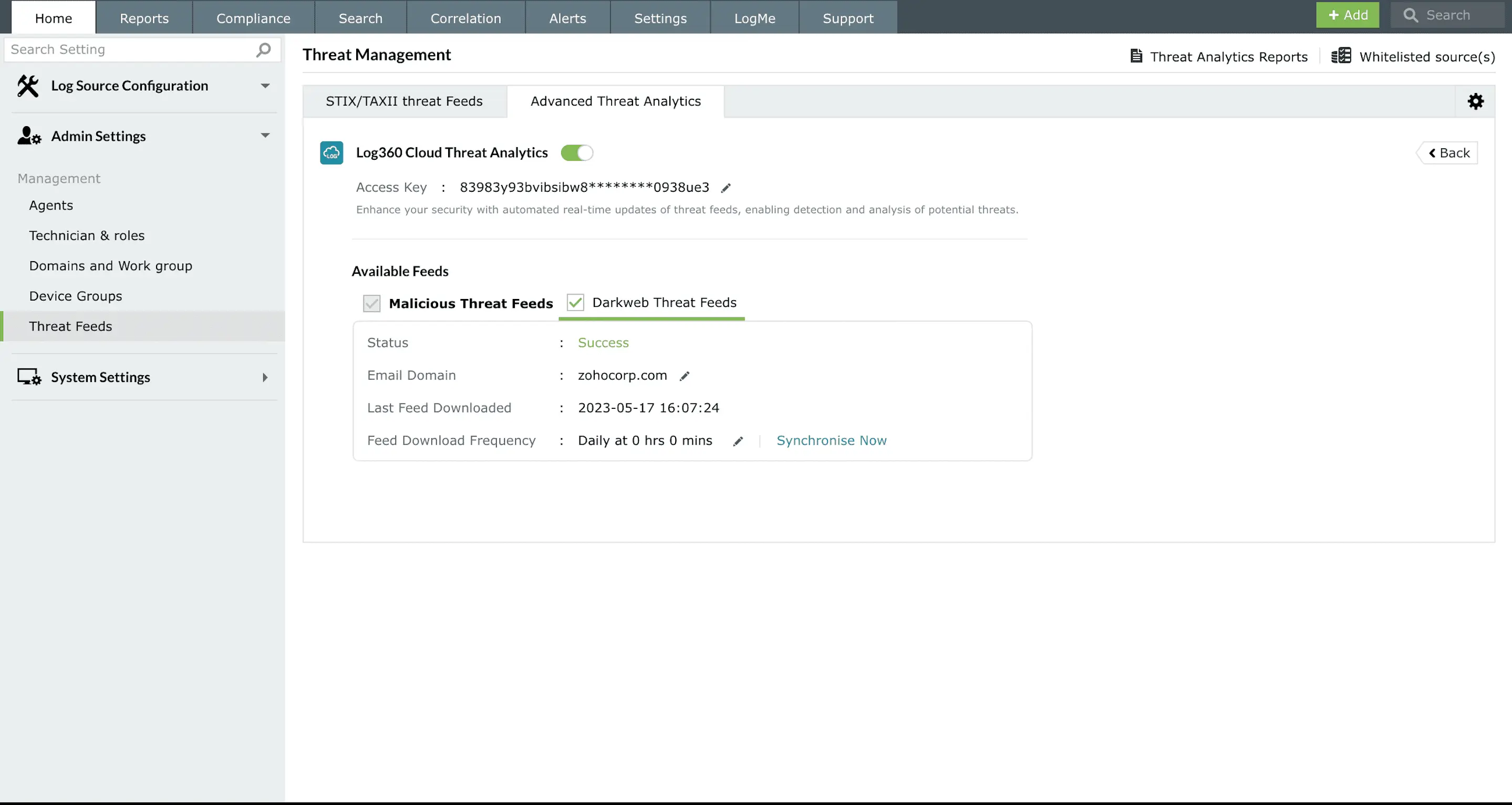
Real-time threat feed integration

Access global threat intelligence from Webroot, STIX/TAXII, VirusTotal, AlienVault OTX, and Constella. Log360 continuously ingests and normalizes IoCs like malicious IPs, domains, URLs, and file hashes to validate every security event against known threats.

  • Unified threat feed aggregation: Consolidate multiple external intelligence sources for holistic monitoring.
  • Alert enrichment: Add context to security events using threat feed data and flag malicious indicators instantly without manual IoC searches
  • Event correlation: Match internal events against global threat indicators to understand attack patterns and detect malicious activity.
  • Real-time updates: Access regularly updated threat intelligence to proactively respond to evolving risks.
Threat intelligence feeds

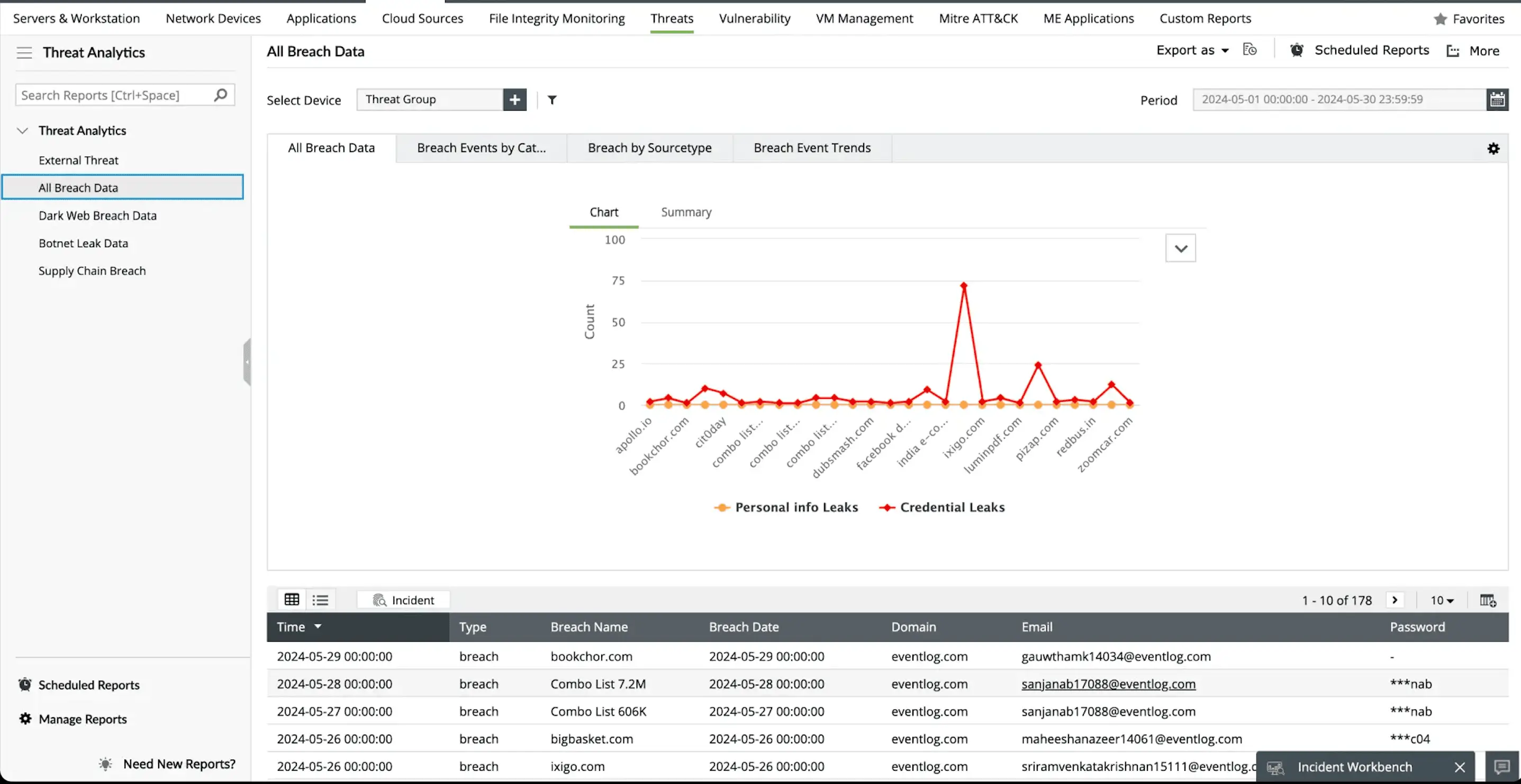
Operationalize threat intelligence for smarter detections

Log360 enhances your security operations by automatically enriching every detection with external threat intelligence, transforming suspicious activities into validated threats. Log360's multi-layered detection capability combines correlation rules, behavioral anomaly detection, and advanced threat analytics to identify threats across your environment, from simple policy violations to complex multi-stage attacks. These detection methods work together to catch everything from brute-force attempts and insider threats to APT campaigns.

Intelligence enrichment capabilities:

  • Malicious indicator flagging: Identify known malicious infrastructure by automatically checking IPs, domains, and URLs against integrated threat feeds like Webroot, STIX/TAXII, VirusTotal, and AlienVault OTX.
  • IP reputation and geolocation: Add reputation scores and geographic data to alerts, helping you identify high-risk connections and unusual access locations
  • MITRE ATT&CK® mapping: Map detections to specific adversary tactics and techniques for better understanding of attack progression
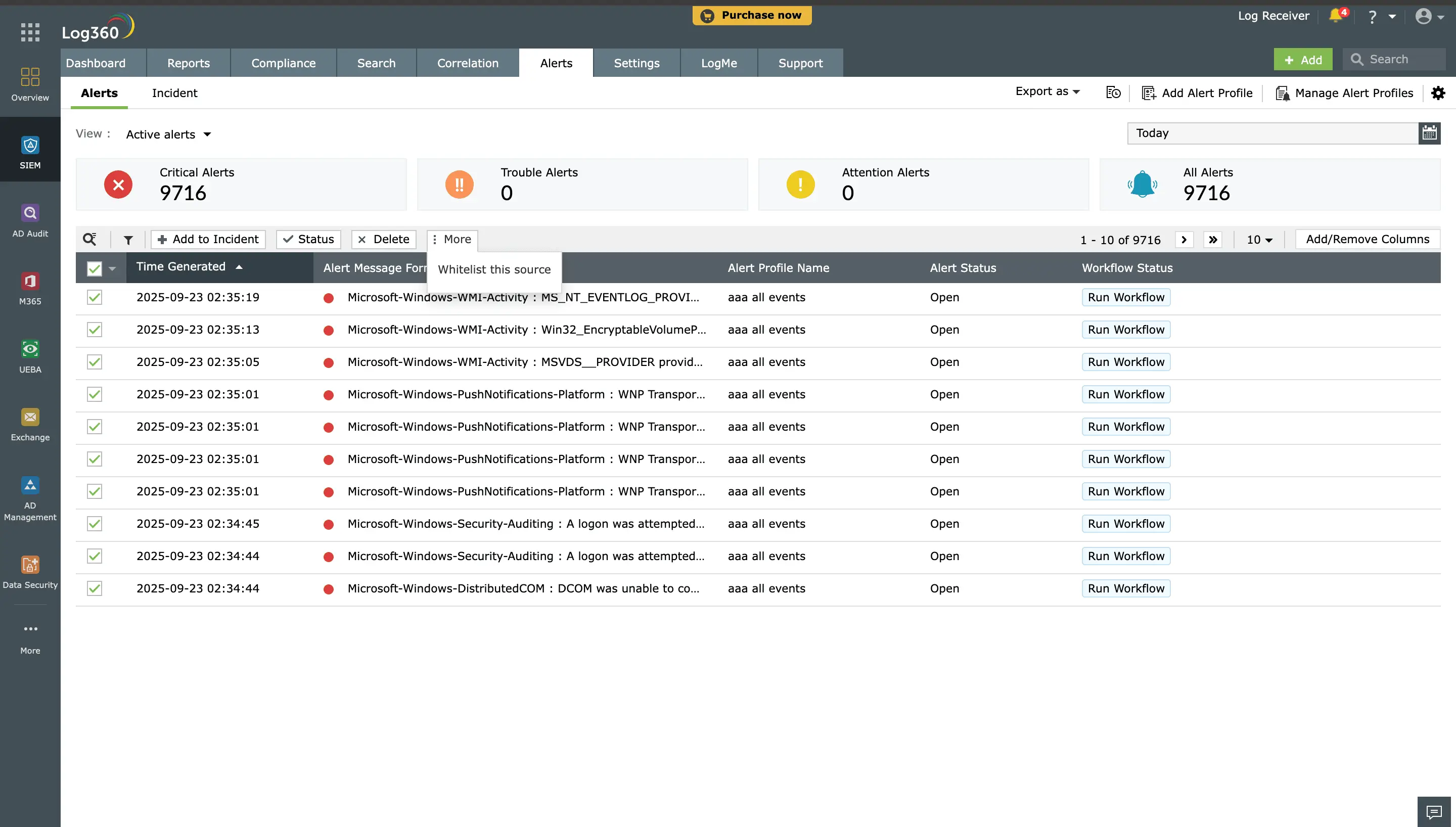
  • Alert prioritization: Use threat intelligence context to categorize alerts by severity (Critical, Trouble, Attention) for faster triage

This intelligence layer validates suspicious activities against global threat data, helping your team focus on confirmed threats rather than chasing false positives.

Threat intelligence for smarter detections

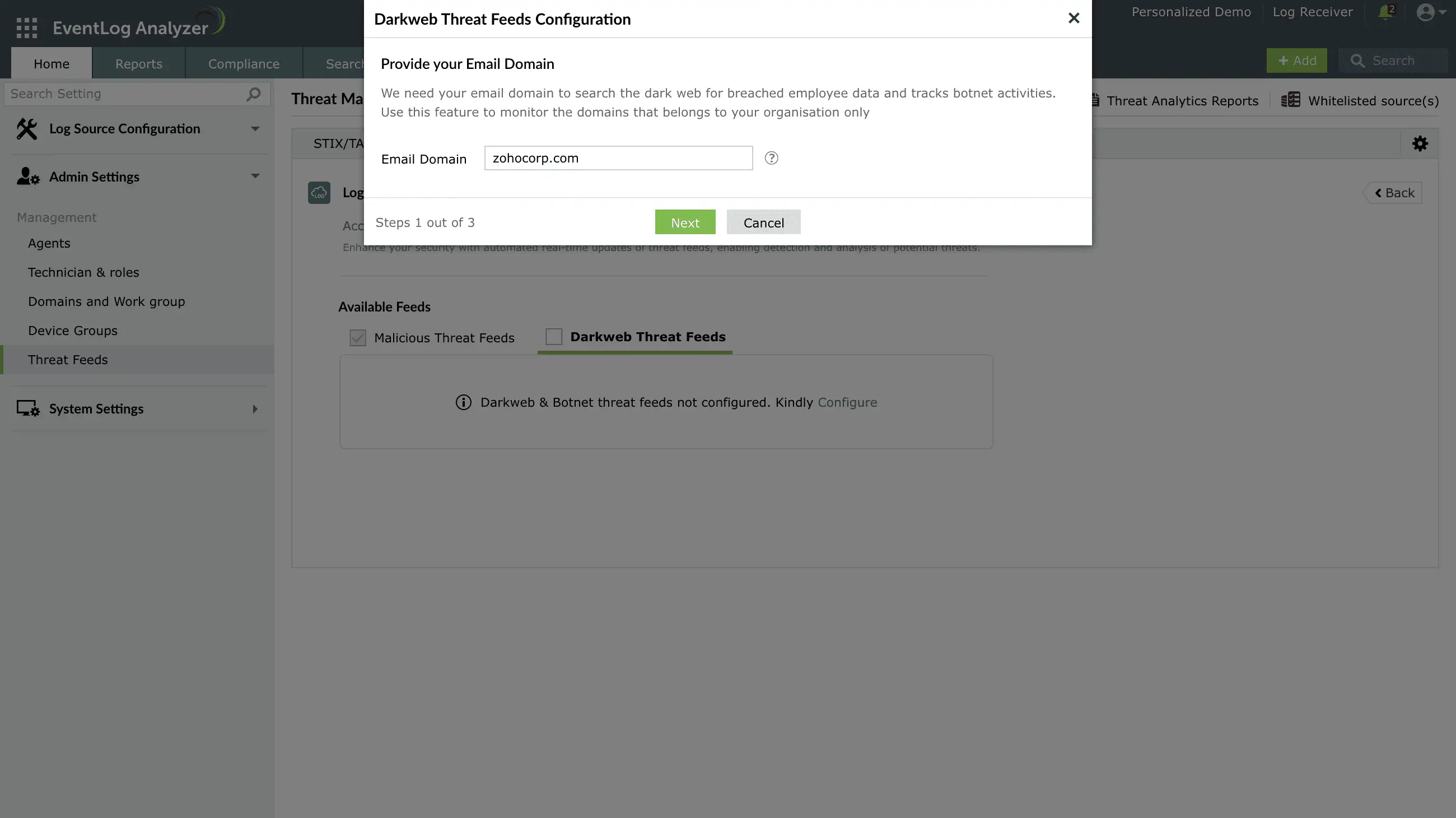
Dark web monitoring with Constella threat intelligence

Extend visibility beyond your perimeter. Monitor hidden forums, paste sites, and data marketplaces where attacks are planned and credentials are traded, catching threats before they reach your network.

  • Prevent credential attacks: Track your organization’s domains for exposed usernames, passwords, and email addresses. Early detection allows you to reset compromised accounts, revoke tokens, and prevent account takeover attacks.
  • Protect sensitive data: Receive instant alerts when PII, credit card numbers, or other payment details tied to your organization are found online, helping minimize fraud and compliance risks.
  • Validate breach scope: Correlate dark web findings with internal activity to confirm if exposed credentials were actually used.
Threat intelligence platform

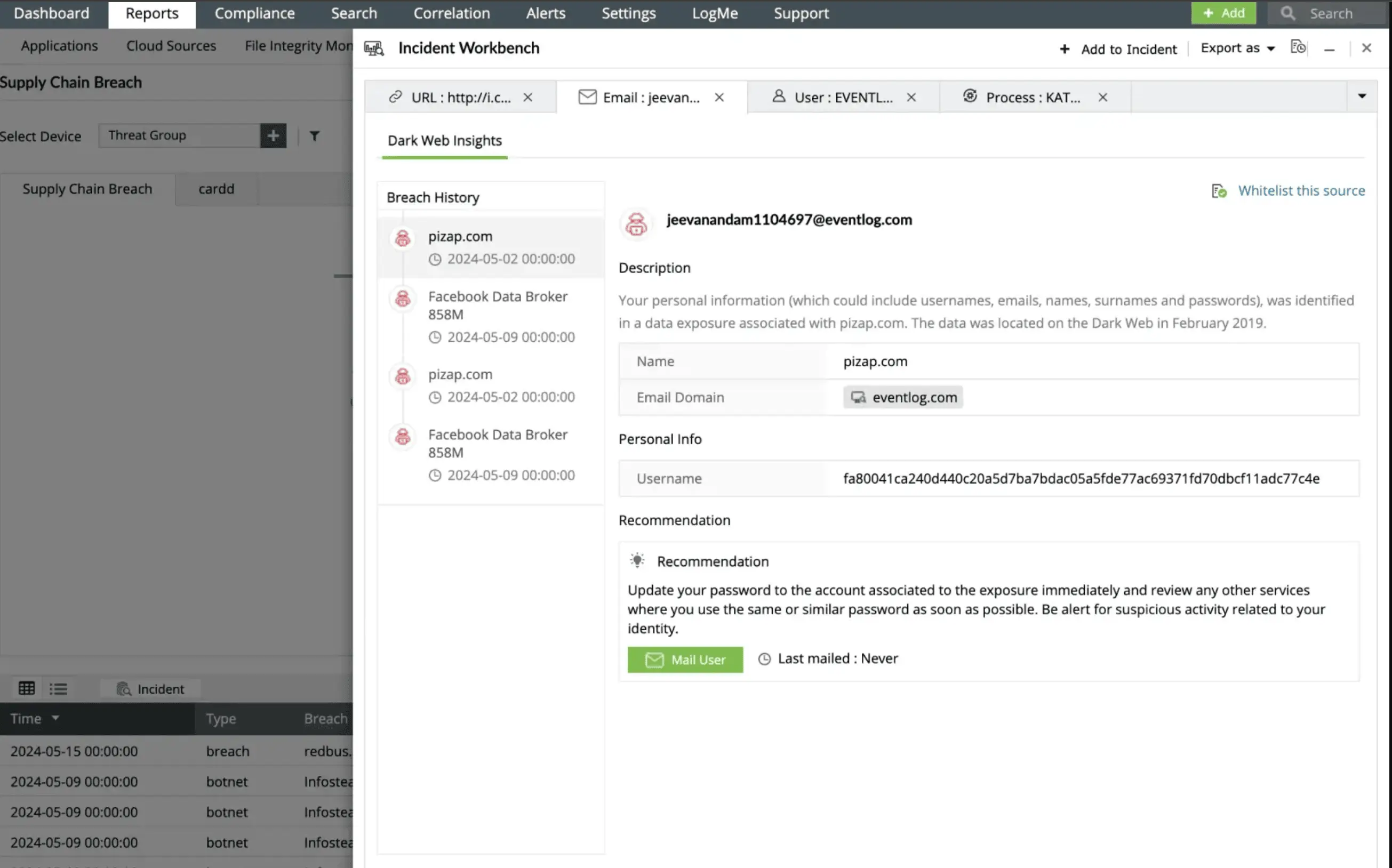
Investigation acceleration with threat intel

Transform investigations with intelligence context. When threats are detected, Log360's Incident Workbench automatically enriches every alert with threat data, eliminating manual lookups.

  • VirusTotal integration: Log360 integrates with VirusTotal that aggregates data from more than 70 antivirus scanners, URL/domain blacklists, and malware analysis tools. This integration enhances Log360’s threat intelligence capabilities helps you validate potential threats in real time and reduce false positives.
  • Accelerated incident response: Instantly verify whether files, URLs, or domains are malicious, to take swift remediation actions, such as isolating affected systems, blocking malicious IPs, or disabling compromised accounts.
  • Automated containment: Correlate internal logs with external threat feeds using VirusTotal intelligence to identify attack patterns, detect sophisticated threats, and strengthen proactive defenses.
  • Integration with ITSM tools: Push intelligence-enriched incidents to ticketing tools like ServiceNow or Jira for streamlined incident tracking.
Investigation acceleration with threat intelligence solution

Precision alert triage with advanced threat analytics

Cut through noise with intelligence-driven prioritization. Log360 uses threat feeds to validate and score every alert, ensuring you investigate real threats, not false positives.

  • Intelligence-based scoring: Automatically assign Critical, Trouble, or Attention levels based on IoC matches and reputation
  • Reduce false positives: Dynamically adjust alert thresholds based on historical patterns while enabling granular customization for your specific infrastructure, user behavior, and risk tolerance reducing irrelevant alerts without missing real threats.
  • Context-rich alerts: See reputation scores, threat categories, and MITRE techniques in every notification for faster triage and investigation.
 Advanced threat analytics

Security use cases that Log360's
Threat Intelligence Solution can solve

Exploiting public-facing machines and known vulnerabilities is still one method hackers use to intrude into a network. With Log360's preconfigured threat alerts, enterprises can stop not only the communication from a malicious source but also automatically trigger a workflow to add blacklisted IPs to the firewall and permanently block them.

If an attacker intrudes into the network using stolen credentials or any other means and tries to extort sensitive data and send it to their command-and-control server, Log360 can immediately detect and stop such communication. Log360's Threat Intelligence Solution checks all outbound communication; alerts the concerned SOC about communication to malicious IPs, domains, or URLs; and terminates the connection immediately. All of this happens in real time.

Learn more

Log360 enriches its real-time event response system with contextual information, such as the reputation score of an IP that's trying to remotely log in to critical servers, or the geolocation of an IP trying to remotely connect to the VPN. This provides more visibility into network behavior and helps differentiate suspicious activities from legitimate ones.

Learn more

Compromised third-party software or vendors can serve as an entry point for attackers. Log360 leverages threat feeds and IoC correlation to detect malicious activity originating from trusted integrations or vendor connections. This enables enterprises to quickly identify compromised components, isolate affected systems, and mitigate supply chain risks before they spread.

Learn more

Attackers often move laterally across the network after the initial compromise to escalate privileges and access critical systems. Log360’s detection rules, mapped to the MITRE ATT&CK framework, spot unusual authentication attempts, privilege escalation attempts, and suspicious traffic, helping you contain intruders before they reach high-value assets.

Learn more

Discover more with Log360


Insider threat detection

Identify risky user behavior and insider misuse with UEBA-powered baselining and anomaly detection. Log360 detects abnormal logins, privilege misuse, data access violations, and privilege escalation attempts, helping organizations stop data theft and insider-driven breaches before they escalate.

Learn more  
 

External threat detection

Defend against external cyberattacks like brute-force login attempts, phishing, port scans, and malware injections. Log360 continuously monitors authentication logs, firewall events, and network traffic to detect suspicious activities and block them in real time.

Learn more  
 

Automated incident response

Trigger automated playbooks to reduce mean time to respond (MTTR), send real-time alerts to SOC teams, and perform immediate remediation actions such as disabling compromised accounts or blocking malicious IPs. These automated workflows ensure rapid containment of threats and minimize business disruption.

Learn more  
 

Compliance management

Stay audit-ready with predefined reports for HIPAA, the GDPR, the PCI DSS, and other regulations. Log360 ensures tamper-proof log archiving and simplifies compliance workflows.

Learn more  
  •  

    We wanted to make sure that one, we can check the box for different security features that our clients are looking for us to have, and two, we improve our security so that we can harden our security footprint.

    Carter Ledyard

  •  

    The drill-down options and visual dashboards make threat investigation much faster and easier. It’s a truly user-friendly solution.

    Sundaram Business Services

  •  

    Log360 helped detect insider threats, unusual login patterns, privilege escalations, and potential data exfiltration attempts in real time.

    CIO, Northtown Automotive Companies

  •  

    Before Log360, we were missing a centralized view of our entire infrastructure. Now, we can quickly detect potential threats and respond before they escalate.Log360 has been invaluable for improving our incident response and ensuring compliance with audit standards. It’s a game-changer for our team.

    ECSO 911

Fill this form to schedule a
personalized web demo

  • By clicking " Submit", you agree to processing of personal data according to the Privacy Policy.

Your request for a demo has been submitted successfully. Our support technicians will get backto you at the earliest.

Frequently Asked Questions

Threat intelligence is a critical cybersecurity component that provides actionable insights into potential malicious actors, campaigns, and tactics. By aggregating and analyzing threat data from multiple sources such as STIX/TAXII feeds, open-source intelligence (OSINT), and internal telemetry organizations can detect potential attacks early, improve incident response, and strengthen their overall security posture.

Threat intelligence helps enhance proactive defenses, accelerate incident response with context-rich data, support risk management and compliance efforts, It improves collaboration between security teams and stakeholders to stay ahead of threats, make informed decisions, and strengthen their overall cybersecurity posture.

The three types of threat intelligence data are:

  • Strategic intelligence: It help organizations with strategic planning and decision-making by providing high-level insights into long-term trends, motives, and goals of threat actors.
  • Operational intelligence: It delivers real-time information about ongoing threats, vulnerabilities, and active attack campaigns, which helps swiftly detect and respond to security threats.
  • Tactical intelligence: It focuses on the specific tools, techniques, and procedures (TTPs) used by threat actors, helping security admins develop effective counter measures and enhance defensive capabilities.

The threat intelligence life cycle comprises six phases:

  • Planning and direction: Define the goals, resources, and scope of the threat intelligence program.
  • Collection: Gather relevant data from various sources, such as open-source intelligence, vendors, and threat feeds.
  • Processing: Organize and analyze the collected data to derive valuable insights.
  • Analysis: Comprehend threats, their impact, and the tactics employed by threat actors through pattern recognition and indicator identification.
  • Dissemination: Distribute intelligence with relevant stakeholders to guide decision-making and prompt appropriate actions.
  • Feedback and improvement: Gather feedback, evaluate the efficacy of the program, and use insights to improve future efforts.

The key sources of threat intelligence include:

  • OSINT: Publicly available data from blogs, forums, news sites, social media, and security research reports.
  • Commercial threat intelligence feeds: Subscription-based services that provide curated, high-fidelity threat data, including IOCs and threat actor profiles.
  • Government and ISAC reports: Alerts and advisories from entities like CISA, NIST, and industry-specific Information sharing and analysis centers (ISACs).
  • Internal telemetry: Logs, alerts, and incidents from your own infrastructure, including SIEM data, IDS/IPS events, and firewall logs.
  • Dark web monitoring: Intelligence gathered from hidden forums, marketplaces, and data dumps where threat actors plan attacks or trade stolen data.
  • Vendor intelligence sharing: Threat data shared by security vendors, partners, and consortium to strengthen collective defense.

By combining these sources, organizations gain a complete view of the threat landscape and can detect and respond to attacks faster.

Threat intelligence helps reduce dwell time, improve SOC efficiency, and prevent breaches by providing the right data at the right time. Log360 provides a unified platform to collect, correlate, and analyze threat data from multiple sources. Its real-time alerting, MITRE mapping, dark web monitoring, and customizable detection rules help SOC teams stay ahead of attackers.

Turn threat data into actionable intelligence

Cut through alert fatigue with real-time threat intel, contextual insights, and prioritized detections so your SOC team can focus on what matters.