- Related Products
- AD360
- Log360
- ADManager Plus
- ADSelfService Plus
- EventLog Analyzer
- Exchange Reporter Plus

 Click here to expand
The Domain Data Collection Account is the AD domain user (or gMSA) that ADAudit Plus uses to authenticate to domain-joined machines for agentless audit data collection. It is configured per domain in ADAudit Plus and is the primary method for providing authentication credentials.
| Field | Details |
|---|---|
| What it is | The account ADAudit Plus uses to authenticate to remote domain-joined machines |
| Where to configure | ADAudit Plus web console → Admin → Domain Settings → select a domain → Data Collection Account |
| Account type | AD domain user or Group Managed Service Account (gMSA) |
| Recommended privilege | Domain Admin |
| Minimum privilege | Least-privilege account with specific rights per data source |
| Minimum privilege | Least-privilege account with specific rights per data source |
This account is shared by all four Windows domain-based auditing modules within the same domain:
| Module | What it audits | Privilege guide |
|---|---|---|
| Active Directory & GPO | Domain Controllers — AD changes, GPO changes, authentication | AD & GPO Privileges |
| File Server | Windows File Servers — file access, modification, deletion | File Server Privileges |
| Windows Server | Member servers — logons, process tracking, service changes | Windows Server Privileges |
| Windows Endpoint | Workstations — logon/logoff, USB, endpoint security | Windows Endpoint Privileges |
The account needs the combined privileges for all data source types you are auditing.
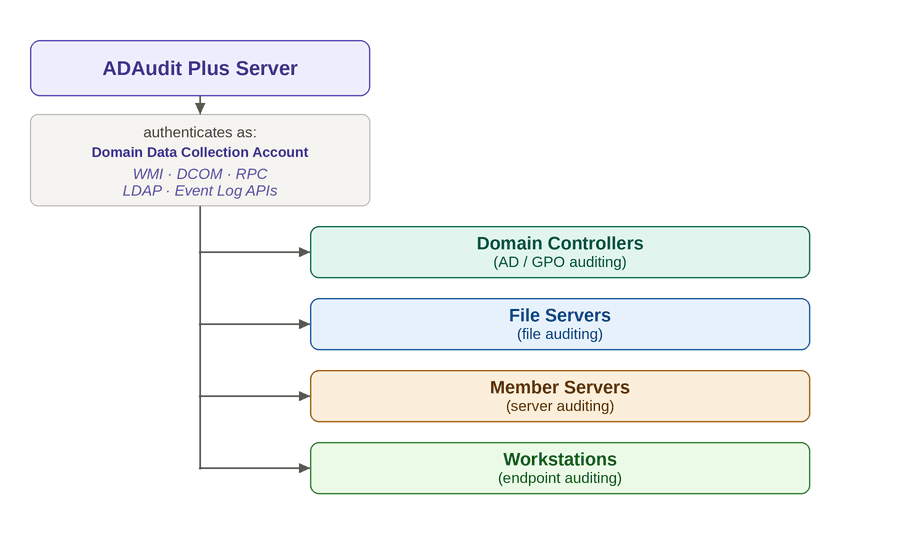
ADAudit Plus uses standard Windows remote management interfaces — WMI, DCOM, RPC, LDAP, and Event Log APIs — all of which require the Data Collection Account to have proper privileges on the target machines.
| Approach | Pros | Cons |
|---|---|---|
| Domain Admin | Works immediately, no per-machine configuration needed | Broad privileges — may not meet organizational security policies |
| Least-privilege | Follows principle of least privilege, passes security audits | Requires explicit configuration of each privilege per data source type |
ADAudit Plus works seamlessly when this account has Domain Admin privileges. If Domain Admin rights cannot be granted, assign the specific privileges documented in each module's privilege guide.
If using a least-privilege account, the following privileges are required per data source type:
| # | Privilege | Domain Controllers | File Servers | Windows Servers | Windows Endpoints |
|---|---|---|---|---|---|
| 1 | Remote WMI/DCOM/RPC Access | ✓(Optional) | ✓(Optional) | ✓(Optional) | ✓(Optional) |
| 2 | Read Access to AD Objects & Naming Contexts | ✓ | ✓ | — | — |
| 3 | Membership in Event Log Readers Group | ✓ | ✓ | ✓ | ✓ |
| 4 | Manage Auditing and Security Log | ✓ | ✓ | ✓ | ✓ |
| 5 | Read Access to SYSVOL | ✓ | — | — | — |
| 6 | GPO Permissions (optional — auto audit policy only) | ✓ Edit | ✓ Create | ✓ Create | ✓ Create |
| 7 | AD Group Management in CN=Users (optional) | — | ✓ Create/Write | ✓ Create/Write | ✓ Create/Write |
| 8 | Membership in Power Users Group | — | ✓ | — | — |
| 9 | Read Permission on Audited Shares | — | ✓ | — | — |
Note: For Domain Admin accounts, all the above privileges are already granted by default.
For detailed explanations of each privilege, see the individual module guides:
In ADAudit Plus, each domain is added separately under Admin → Domain Settings. Each domain entry has its own Domain Data Collection Account field.
| Scenario | Guidance |
|---|---|
| Single domain | One Data Collection Account is sufficient for all four modules (AD, File, Server, Endpoint) within that domain. |
| Multiple trusted domains | Configure a Data Collection Account per domain. While cross-domain authentication is technically possible via trust, using an account from each domain simplifies privilege management (group memberships, GPO delegation, etc.) |
| Non-trusted domains | Each domain must have its own account. No cross-domain authentication is possible without a trust relationship. |
Why per-domain accounts are recommended even with trusts:
Note: This is an alternative approach. Most deployments use the Data Collection Account configured in Domain Settings (described above). This section is for customers who prefer to change the Service Account instead.
If the ADAudit Plus service is configured to run as a domain user or gMSA (instead of the default Local System), the process identity can implicitly authenticate to remote machines. In this case, you do not need to configure a separate Data Collection Account in Domain Settings for the service account's own domain.
How it works: When no Data Collection Account is configured in Domain Settings, ADAudit Plus uses the service process identity for outbound connections to remote machines.
When to consider this approach:
Limitations:
Only works for the Service Account's own domain — additional domains still require a Data Collection Account in Domain Settings.
For full details on the Service Account, see ADAudit Plus Service Account.
Symptom: ADAudit Plus shows "Access Denied" or "Error 5" when attempting to read event logs from a target machine.
Resolution:
Symptom: ADAudit Plus reports WMI connection timeout or "RPC server is unavailable."
Resolution:
Symptom: The Data Collection Account is getting locked out.
Resolution:
In most cases, yes. The default Service Account is Local System, which cannot authenticate to remote machines. You must configure a Data Collection Account in Domain Settings.
The only exception: if you change the Service Account to a domain user or gMSA with the required privileges (single-domain only), the process identity acts as the data collection identity and you can skip configuring a separate account in Domain Settings. See Alternative: Using the Service Account.
gMSA (Group Managed Service Account) is ideal when:
A gMSA can be configured as:
Recommended for seamless operation. If not possible, configure least-privilege using the per-module guides.
No. Agents collect data locally and do not use the Domain Data Collection Account.
Copyright © 2020, ZOHO Corp. All Rights Reserved.