







What is Zero Trust?
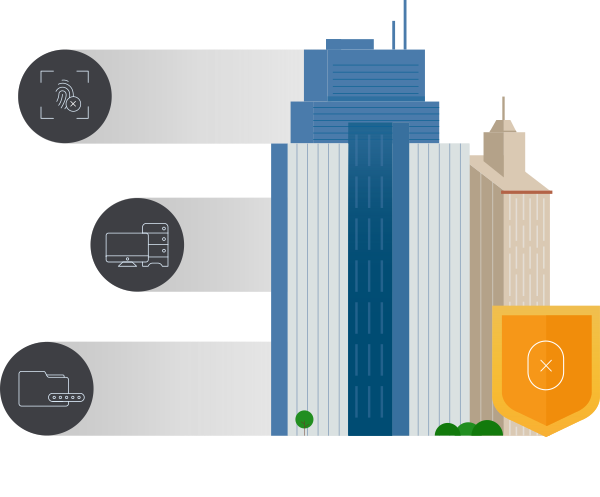
Zero Trust is a security model that operates on the principle of "never trust, always verify".
In this approach, all users and devices are considered untrusted until their identity is verified.
Even if a user or device has accessed enterprise assets before or is inside the enterprise network, they will have to be suitably verified and authenticated before being granted access.
Learn more Why do I need to adopt a
Zero Trust security model?
Zero Trust security complements and enhances traditional perimeter-based security.
It helps protect organizations against threats that traditional security approaches cannot defend against such as credential-based attacks and malicious insiders.
Zero Trust security can also help
your organization and its workforce:
Work from anywhere
Enable your workforce to
work from anywhere, at
any time—without
compromising on
organizational security.
Mitigate organizational risks
Reduce the risks posed
by insider threats, lateral
movement, and
credential-based attacks.
Protect against data breaches
Strengthen your security
posture to minimize the
chances and the potential
damage of a data breach.
Stay compliant
Ensure compliance with
various governmental
and industry specific
regulations and
mandates.
How do I implement
Zero Trust security in my organization?
To achieve Zero Trust security, you need to ensure you never trust, and
always verify any user, device, or application accessing corporate assets.
To accomplish this effectively, you need to have solutions that cover the
entire security lifecycle for all five pillars of Zero Trust - identity, data,
device, applications, and network security.
The security lifecycle can
be defined in terms of the
following four stages:

- 1. Visibility:
Knowing what’s
happening throughout
the network - 2. Deduction:
Detecting changes,
incidents, and threats - 3. Response:
Taking action to solve
incidents or threats - 4. Resolution:
Strengthening the
network to prevent or
mitigate the impact of
threats


Combining this with the five pillars of Zero Trust—identities, devices, data, applications and workloads, and networks—gives you ManageEngine’s take on achieving Zero Trust security:







-
Have complete visibility
into all identities, devices,
data, applications
accessing your network,
and their activities. -
Monitor and analyze all
entities and activity within
your network and flag any
suspicious activity or threats. -
Respond to threats and risks as
appropriate—by forcing additional
authorization and authentication,
restricting user privileges,
quarantining devices, terminating
sessions, and so on. -
Resolve security issues by
taking preventive action and
hardening your security—such
as by resetting credentials, and
patching vulnerabilities.
Besides the five pillars of Zero Trust, you also need to implement
security analytics and security automation tools to ensure
holistic security coverage.
These solutions can act as a force multiplier for your security
teams when it comes to detecting and responding to threats.
How can ManageEngine help you with your Zero Trust journey?
Zero Trust can be implemented in a variety of ways. The components remain the same, the only difference comes in how you begin your Zero Trust journey.
At ManageEngine, we recommend taking an identity-centric approach. Enterprises that focus on identity and device security seem to reduce security risks more quickly as per Forrester's 'A Practical Guide To A Zero Trust Implementation.'
Whichever approach you choose, ManageEngine's IT management solutions provide the technological foundation for your Zero Trust security model, or can fill in the security gaps in your existing approach.
Our solutions cover

Wondering how Zero Trust can help your organization?
Here are three common use cases for Zero Trust.

Learn more about Zero Trust security
Download our guide from the form below. Also,
don't forget to check out our other related resources.