Top 5 green coding practices for sustainable software development
Sep 29 · 8 min read

When we talk about climate change, we think of factories, vehicle emissions, and deforestation—but what about software? That's right; your endless doomscrolling has an impact on the planet. The carbon footprint of digital technologies accounts for 4% of global greenhouse gas emissions, matching the aviation industry. Every inefficient app, bloated website, and unnecessary background process adds to this growing environmental impact.
Sustainable software development should be a critical consideration for businesses and developers. Green coding is one such practice in software development that is focused on designing energy-efficient software to minimize its carbon footprint. While the benefits of energy-efficient software are significant, awareness on the subject remains low. To make a real difference, everyone involved—businesses, developers, and users—must educate themselves on the role they play in it.
From a business standpoint, one reason for the lack of awareness is that development and operational budgets are separate. This creates a paradox: Improving software efficiency takes extra development time, but inefficient software increases operational costs. To solve this, organizations should focus on sustainability as a key metric. Instead of just aiming for faster delivery and cost reduction, they should prioritize creating software that's productive from
start to finish.
The impact of software on energy consumption
Computers, like any other machines, consume energy based on the software they run. Every line of code contributes to a carbon footprint, so it's up to the stakeholders involved to ensure that footprint is minimized. More lines of code often mean more computing power and energy are required, which leads to higher carbon emissions. Developers may sometimes write code that isn't as streamlined as it could be, unintentionally increasing resource consumption. These extra lines of code or functions, while not necessarily needed by design, can still contribute to higher energy usage and carbon emissions.
When considering the broader landscape of cloud providers, businesses, and the vast array of devices such as desktops, smartphones, and tablets running software, there is significant potential to reduce energy consumption. This applies across verticals like general computing, business processes, and cloud services. Even minor improvements in code can make a difference. When applied on a larger scale, they lead to substantial energy savings and lower carbon
emissions worldwide.
5 green coding strategies for sustainable software
Here are five green coding strategies to minimize software's carbon footprint while maintaining performance and usability.
1. Choose sustainable architecture
The same energy-saving habits we use at home can apply to software design. Just as we turn off lights in empty rooms, idle and unused software components should be deactivated. Instead of cutting power to an entire house, we turn off individual lights. Likewise, software should be modular, allowing parts to be turned off independently.
This is the core concept in microservices and serverless architectures. Microservices architecture has become a widely adopted method for developing applications by breaking down complex software into smaller, independent components. Unlike monolithic architectures, where the entire application runs as a single unit, microservices operate individually and are utilized only
when needed.
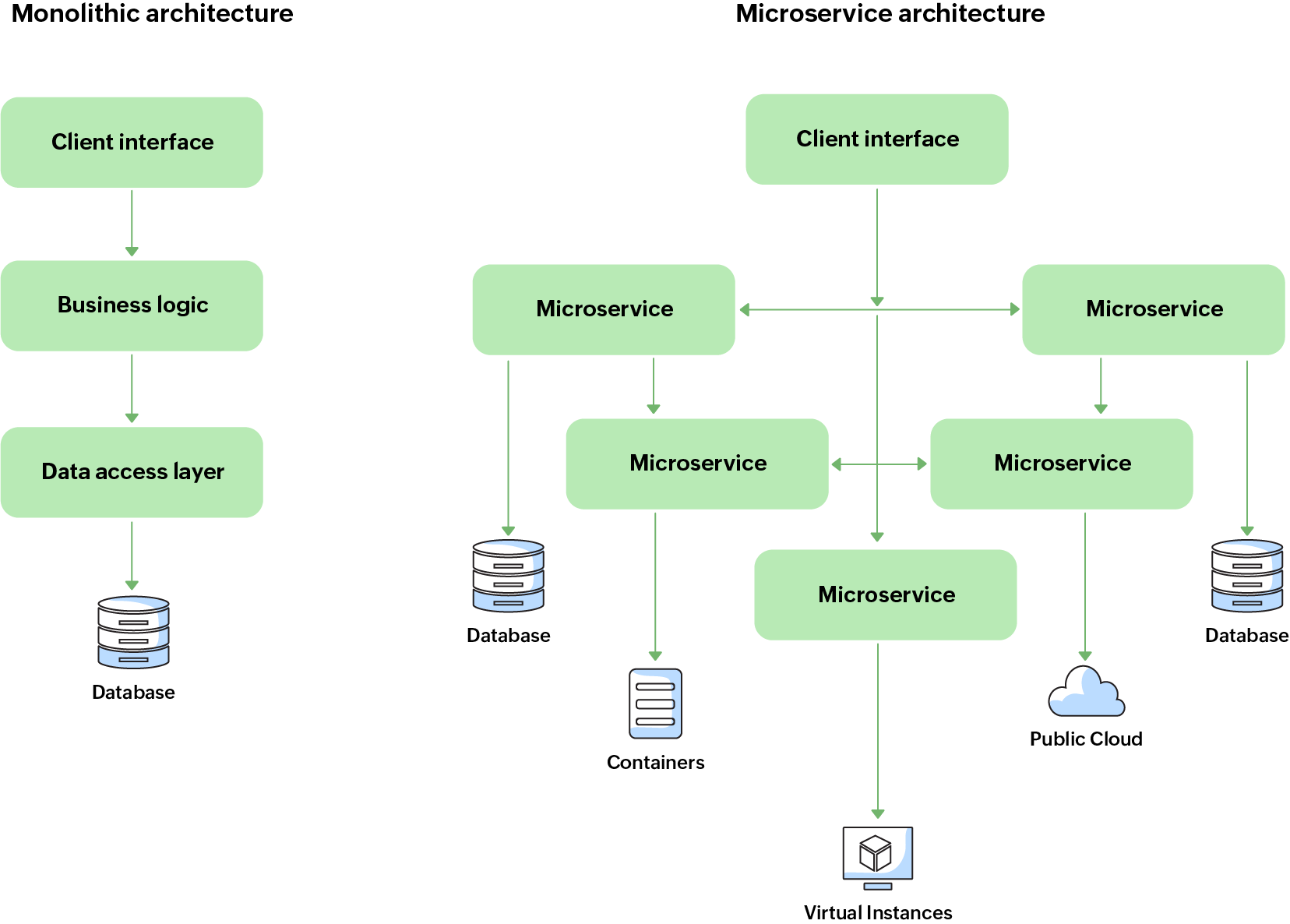
While microservices improve resource efficiency, their distributed nature can create challenges. Managing interservice communication effectively is important. By leveraging serverless or container-based solutions, it is possible to minimize the overall footprint and reduce energy consumption. However, frequent or disorganized data exchanges between services can introduce unnecessary overhead. Therefore, architects must ensure they optimize communication patterns to prevent excessive network traffic and resource waste.
Green coding also means managing workloads wisely. Since hardware manufacturing has a high carbon footprint, optimizing workloads helps extend hardware lifespan and reduces the need for new infrastructure. Developers can contribute by tracking carbon emissions, monitoring real-time energy use, and optimizing high-consumption areas.
Hosting applications and services on virtual private servers can also improve energy efficiency by optimizing server usage and minimizing environmental impact. Businesses can further reduce their energy consumption by adopting cloud-based virtual data rooms for secure storage and collaboration. These digital solutions not only enhance document management but also align with green coding principles by decreasing reliance on physical hardware and reducing overall
energy use.
Factor |
Monolithic architecture |
Microservices architecture |
| Resource efficiency | The entire application runs even for small tasks, leading to high energy waste. | Independent services run only when needed, reducing idle energy consumption. |
| Scalability and performance | Scaling requires replicating the whole system and increasing resource usage. | Only necessary components scale, optimizing resource use. |
| Carbon footprint | Always-on servers and high infrastructure demand increase emissions. | Auto-scaling and cloud optimization are used to lower energy use and emissions. |
| Server load and CPU utilization | High CPU and memory usage occurs due to a lack of modularity. | Distributed services balance the load, reducing unnecessary resource consumption. |
| Energy usage | Full system execution is required for any request, leading to energy waste. | Allows for container-based or serverless execution, reducing idle power consumption. |
2. Write efficient code
Well-structured, readable code is naturally more functional. When your code is clear and easy to understand, you reduce the chances of hidden performance issues. Additionally, maintaining clean code minimizes the need for constant rewrites, ultimately saving both time and resources.
To keep your code clean, use meaningful variable names instead of vague ones like X or Y to enhance clarity. Keep functions focused, ensuring each one handles a single, well-defined task for better maintainability. Finally, use comments wisely—while good code should largely explain itself, brief comments can help clarify complex logic without adding unnecessary clutter.
Beyond readability, optimizing for performance and energy efficiency is just as important. Avoid unnecessary calculations, as they consume extra processing power and slow down execution. Reuse code whenever possible to shorten development time and minimize redundant computations. Leverage energy-efficient libraries and frameworks designed to enhance performance while reducing resource consumption. Debugging can also be resource-intensive, especially on physical devices, so consider using emulators or virtualization technologies to reduce power usage during testing.
Example: The following code calculates the sum of even numbers up to n by iterating through
each number:
Code 1:

Code 2:
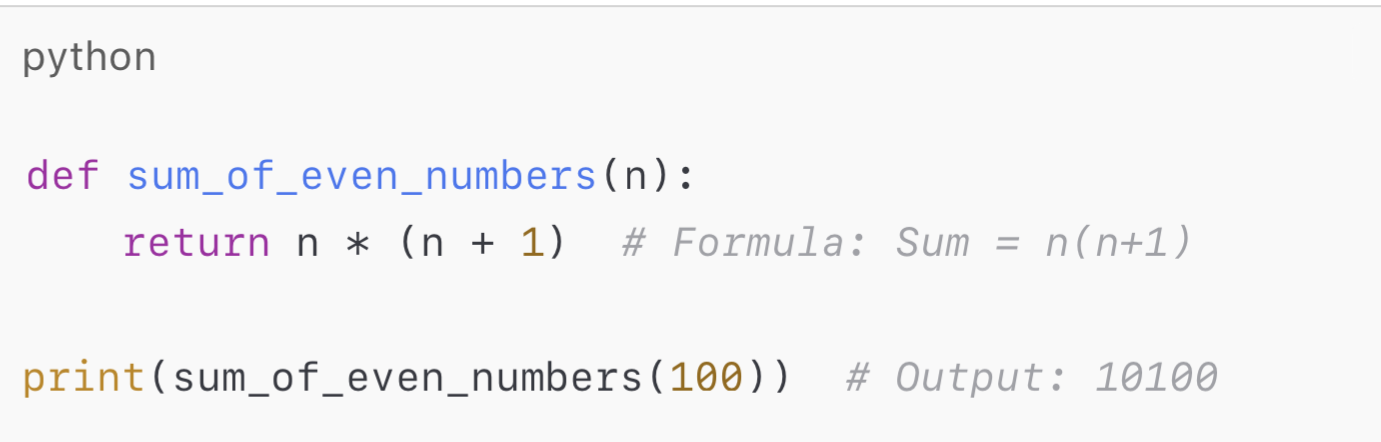
The approach for the first code snippet is energy-draining because it loops through every even number up to \( n \), adding them one by one. The bigger \( n \) gets, the more work the computer has to do, making it slower and more power-hungry.
In contrast, the second code snippet directly calculates the sum using a formula instead of iterating through each number. This makes it faster, as the computer performs only a single multiplication and addition instead of running a loop. Since this method runs in constant time \( O(1) \), the amount of work the computer does stays the same no matter how large \( n \) is. That means less CPU usage, lower memory consumption, and reduced energy waste.
By using a formula instead of a loop, we reduce unnecessary calculations, making the software greener and faster—a key principle in green coding.
3. Make better UI and UX choices
Good UX and UI design not only improves the user experience but also contributes to energy savings. Techniques like lazy loading and dark mode not only enhance performance but also create a better user experience and lead to long-term cost savings.
For example, YouTube's dark mode reduces power usage on OLED and AMOLED screens by using darker pixels, which require less energy. Google search's minimalist design keeps the interface clean and fast, making it easier for users to find information while consuming fewer resources.
Platforms like Instagram and Medium use lazy loading to ensure images and videos load only when needed, reducing unnecessary data transfer and improving page speed. E-commerce sites optimize media by using formats like WebP, which shrink file sizes without compromising quality, resulting in faster load times and lower bandwidth usage.
4. Practice lean coding
Green coding takes an approach of prioritizing efficiency over excess. By following lean coding principles, inspired by lean manufacturing, developers can eliminate unnecessary code. They can also optimize performance and create software that runs smoothly without wasting resources. This starts with setting clear development goals to reduce unnecessary work. Identifying and removing redundant steps, tools, or operations keeps the codebase streamlined.
Examples of lean coding:
- Start with a minimal, functional version to detect bugs early and reduce rework.
- Conduct regular code reviews to keep the code clean.
- Automate testing and deployment with CI/CD pipelines to enhance efficiency and minimize resource usage.
Beyond algorithmic improvements, lean coding also involves practical efficiency techniques. Moving database lookups to in-memory caches speeds up data retrieval and reduces
processing power.
5. Transition to renewable energy
While green coding primarily focuses on software design and operational efficiency, organizations can take broader steps to enhance their environmental sustainability. One impactful approach is integrating renewable energy into business operations.
Switching to sustainable energy sources like solar and wind can help cut down greenhouse gas emissions and significantly lower your organization's carbon footprint. At Zoho Corp., we have taken concrete steps toward this goal. Our commitment to climate action includes a large 2 × 5 megawatt on-grid solar farm near our Chennai headquarters. This facility generates clean energy, powers a major part of our operations, and reduces our dependence on fossil fuels. Additionally, we operate an on-site bio-gas plant that converts food waste into renewable energy. Beyond Chennai, our United Kingdom operations integrate 21% renewable energy, optimize efficiency through energy-saving measures, and adopt a hybrid work model to reduce overall
energy consumption.
Software developers
- Use energy-efficient libraries.
- Challenge wasteful features and rethink updates.
- Learn the energy costs of AI and blockchain.
Designers
- Every extra click, animation, or reload wastes power.
- Remove clutter. Excessive visuals and unnecessary features drain both users and devices.
- Fix problems through design.
Testers & QA teams
- Run energy efficiency tests. Measure how much power each version of your software consumes.
- Detect and fix spikes in energy use. Every version should be leaner, not heavier.
- Schedule resource-heavy tests wisely.
Software companies
- Make energy efficiency a core development goal.
- Optimize software architecture & infrastructure.
- Lead the way—adopt carbon-neutral policies and push industry-wide change.
General users
- Stream smarter—video streaming is a power hog. Reduce autoplay, lower resolution.
- Cut digital clutter. Fewer apps, notifications, and background processes mean lower energy use.
- Repair, don’t replace. Extending device life is one of the biggest energy-saving moves you can make.
How to measure the carbon footprint of software
The carbon footprint of software depends on energy consumption and carbon emissions.
According to the Green Software Foundation, calculating the environmental impact of software involves multiplying its energy consumption by the regional marginal emissions rate, which represents the emissions produced by generating additional electricity. A widely used formula for this is the software carbon intensity (SCI) formula:
Where:
E (energy consumption): The total electricity used by servers, networks, and devices. It depends on software efficiency, hardware performance, and workload intensity.
I (emissions factor): The amount of carbon emitted per kWh, which varies depending on whether the electricity comes from renewable sources or fossil fuels.
M (embodied emissions): The carbon footprint associated with manufacturing and maintaining hardware, such as servers and laptops.
R (functional unit): The unit of measurement used for analysis, such as emissions per user session, per day, or per transaction.
Challenges and the future
While green coding brings significant advantages, it also presents certain hurdles. One major obstacle is the learning curve—adopting eco-friendly coding practices requires a solid grasp of algorithms, data structures, and energy profiling tools. For those new to the concept, mastering these techniques can take time.
Another challenge lies in balancing efficiency and sustainability. The most energy-efficient approach isn’t always the fastest or most optimized in terms of performance. Developers must carefully evaluate trade-offs to determine the best course of action. Despite these difficulties, the long-term benefits of sustainable coding far exceed the challenges.
Green coding is shifting from an optional practice to an essential strategy for sustainable software development. It holds the potential to inspire a global movement among developers. Creating energy-efficient software requires both technical optimizations and a change in mindset. As energy consumption rises, developers must leverage AI-powered tools, automated energy profiling, and carbon-aware computing to optimize resource usage. Just as a well-designed city minimizes traffic congestion and pollution, smart infrastructure will help reduce emissions by dynamically adjusting resource allocation based on energy availability. Beyond technology, green coding requires a cultural shift. Companies can integrate sustainability into software engineering curriculum, while open-source communities will develop energy-efficient frameworks. Even small optimizations can lead to meaningful environmental impact.