Map Layering
Map Layering lets you add, remove, and manage multiple data layers on a single Geo Map. Each layer can represent a different IT operations data set or KPI, making it possible to compare related geographical information without switching between reports.
For example, an infrastructure team can shade regions by outage duration, plot data-center and branch locations above them, and add another layer for critical incidents. The combined map reveals areas where operational demand and infrastructure coverage do not align.
- Advantages of Map Layering
- Enable layers
- Create map layers
- Customize map layers
- Resolve unresolved locations
- Configure Drill Through
- Use a map layer as a dashboard filter
- Network Charts
Advantages of Map Layering
- Enhanced visualization: Display several related data sets in one geographical view.
- Contextual understanding: Compare operational conditions that may be difficult to relate when viewed in separate reports.
- Customization: Select the layers users need and hide unrelated information.
- Interactive exploration: Zoom, pan, select locations, and drill into the data represented by each layer.
Enable layers
- Open the required report, or click +Create and select Chart View.
- In the Chart Designer, enable the Enable Layers toggle at the top-right corner of the shelves section.
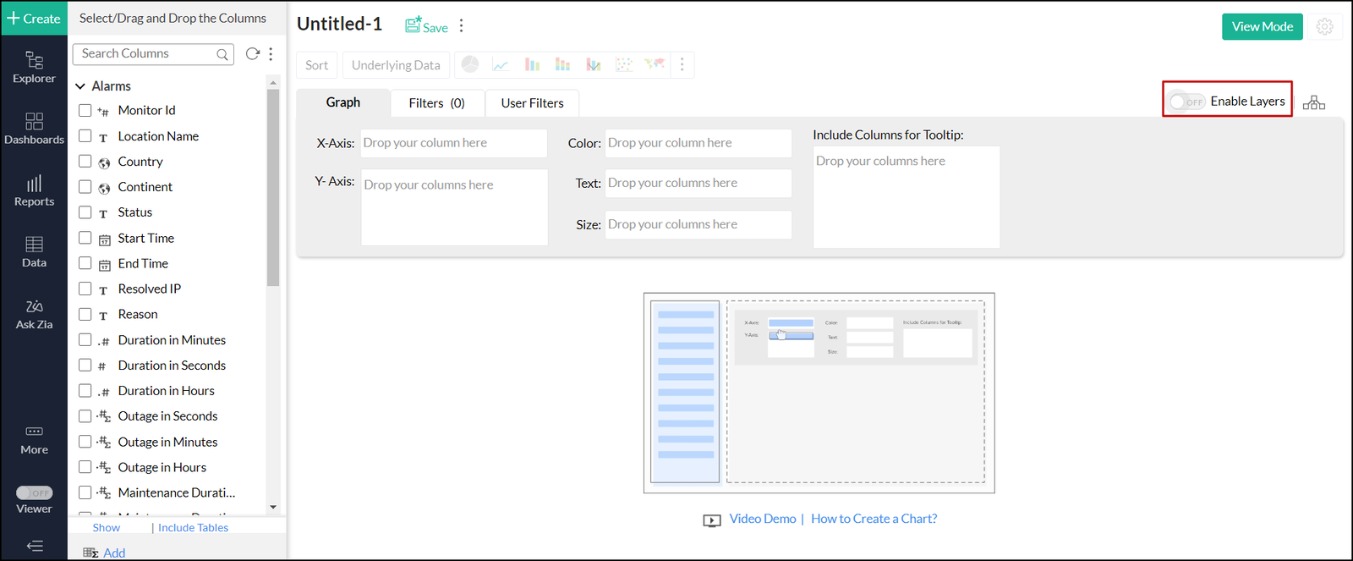
- Map Layering is available only for Geo Maps. Other chart types cannot be combined as map layers.
- You can add up to five layers to one Geo Map.
- While layers are enabled, the overall report type cannot be changed. Disable Enable Layers before switching to a different chart type.
- Cluster Map is not supported as a layer.
- Map - Hexbin is supported as an individual layer.
Create map layers
Creating map layers follows the same basic process as creating a Geo Map, except that each geographical data set is configured as a separate layer in the same Chart Designer.
- Enable Enable Layers. The X-Axis shelf changes to the multi-layer shelf.
- Drag the first geo column to the multi-layer shelf and add the measures and dimensions required for that layer.
- Drag another geo column to the multi-layer shelf to create the next layer.
- Repeat the process for the required layers, up to a maximum of five.
- Generate the map and use the Layer Controls panel to review each layer.
An IT operations map could use a filled layer for outage duration by state, a scatter layer for data-center locations, and a bubble layer for incident volume by support site.
Customize map layers
You can customize layers in both Edit Design and View modes using the Layer Controls panel.
Change the chart type of a layer
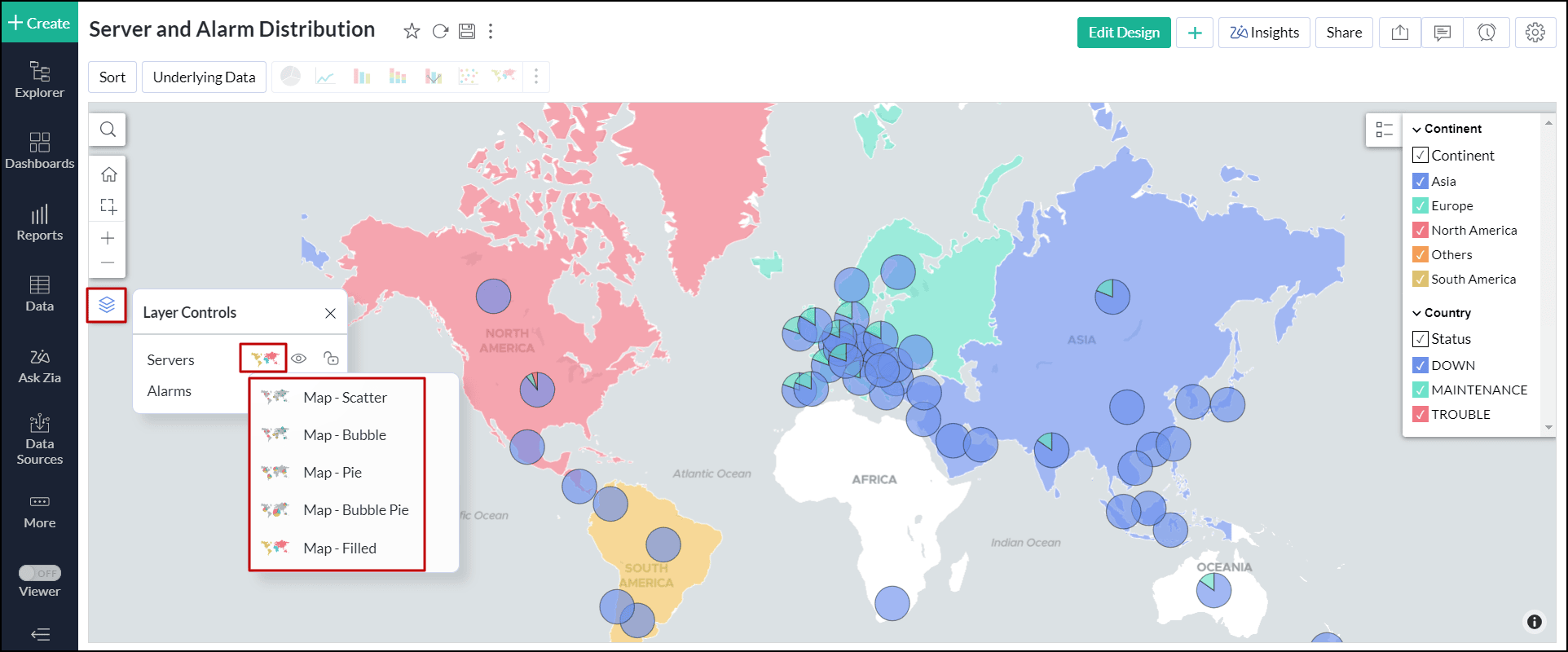
- Click the Layer Controls icon on the left side of the map.
- Click the Chart Chooser icon for the required layer.
- Select an applicable map type.
Hide a layer
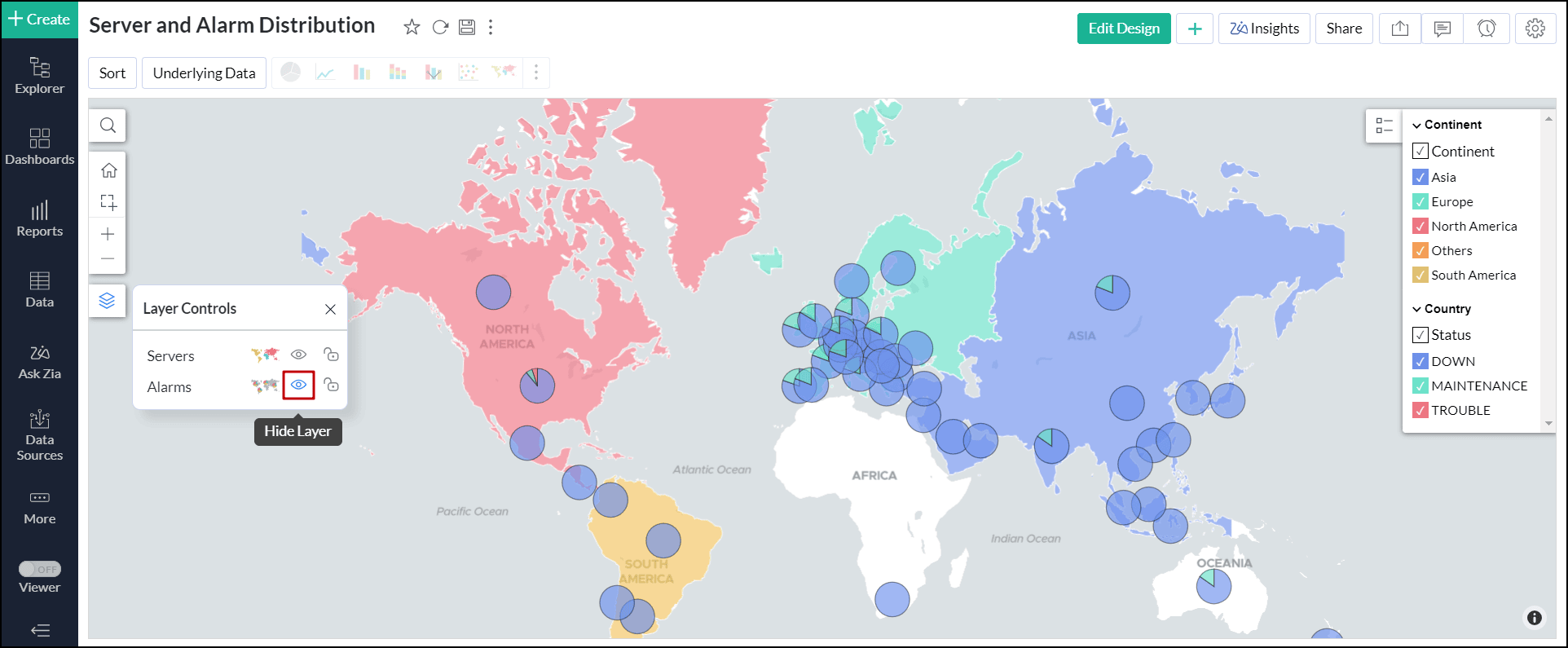
- Open the Layer Controls panel.
- Click the Hide Layer icon for the layer you do not want displayed.
The layer remains part of the report but is removed from the current map view.
Lock a layer
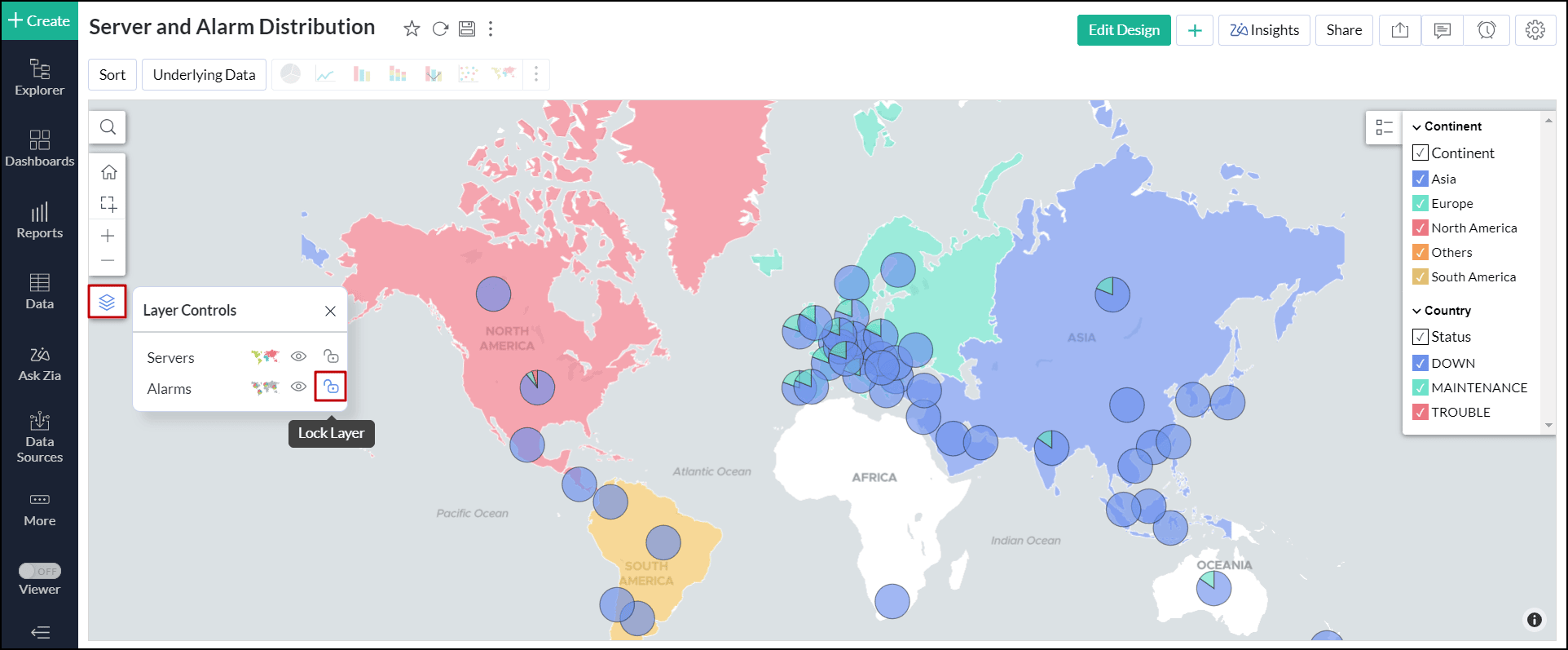
Lock a layer when it should remain visible but users should not interact with its data values in View mode.
- Open the Layer Controls panel.
- Click the Lock Layer icon for the required layer.
Resolve unresolved locations
You can identify and correct locations that Analytics Plus cannot plot directly from a layered map.
- Open the layered map and switch to edit mode.
- If unresolved locations exist, click the Unresolved Location(s) icon in the map toolbar.
- Review the entries in the Edit Unresolved Locations dialog.
- Correct the location data, map it to its geographical hierarchy, or provide coordinates.
For all resolution methods, see Unresolved locations.
Configure Drill Through
Drill Through opens a related report from a selected map location and passes that location as a filter. Each layer can have its own Drill Through configuration.
For example, a user can select a state in an incident-volume layer and open a city-level incident report filtered to that state.
- Click the Settings icon at the top-right corner of the chart and select the Map tab.
- Select the layer you want to configure and open its Drill section.
- Enable Drill Through.
- Select the target reports or views. Analytics Plus lists views created from the same table or related tables.
- Click Apply.
Use a map layer as a dashboard filter
A layered map can filter other reports on the same dashboard. When users select a geographical value such as a country, state, city, or site, Analytics Plus applies that selection to the dashboard reports configured to receive the filter.
Add the layered map to a dashboard and keep Use as Filter enabled for the report. For dashboard-level configuration, see Customizing Dashboards.
Network Charts
A Network Chart on a Geo Map represents relationships between geographical locations using points and connecting lines. IT teams can use it to visualize WAN connections, service dependencies between sites, traffic routes, or relationships between data centers and branch offices.
Create a Network Chart in two stages: generate geographical points and lines, and then add them as separate map layers.
Step 1: Create points and lines
- Open the table containing the source and destination latitude and longitude values.
- Create the source and destination points using the
makepoint()function. - Create the connecting line using the
makeline()function.
Examples:
makepoint(latitude1, longitude1)
makeline(source, destination)
makeline(makepoint(latitude1, longitude1), makepoint(latitude2, longitude2))
Step 2: Add the layers
- Open the Chart Designer and enable Map Layering.
- Add the source point and destination point as separate layers.
- Add the connecting line as a third layer and use Map - Filled for that layer.