Unified threat management software

Most security teams stitch together a SIEM, an EDR console, a threat intel feed, a hunting tool, and a ticketing system, and then spend the day jumping between them. Log360 puts those layers under one roof. Detection, hunting, intelligence enrichment, investigation, and automated response sit inside the same platform, so the work moves forward in one console instead of four.

How Log360 benefits your organization


One console for the whole threat workflow:

Advanced threat detection, threat hunting, threat intelligence, and automated response all run on the same backend, so an alert in one view carries through to the others without re-correlating.


Coverage across the full attack surface:

Endpoints, servers, network devices, Active Directory, databases, and cloud platforms feed into a single index. Lateral movement that touches three of them shows up as one story, not three disconnected alerts.


Context on every alert:

Every detection is enriched with IP reputation, geolocation, and IoC matches from feeds like Webroot, STIX/TAXII, VirusTotal, and AlienVault OTX. UEBA risk scores from the behavior analytics layer sit alongside them.


Response in the same workflow:

Prebuilt and custom playbooks act on the alert without a handoff to a separate SOAR product or a separate endpoint agent.

How Log360 unifies threat management across your environment

Log360 brings four layers together: detection, hunting, intelligence, and automated response. Each layer is useful on its own. Run them in the same platform and the SOC sees the full picture, not a stack of half-views.

  • Unified detection across endpoints, networks, identities, and cloud
  • Proactive threat hunting from the same console
  • Threat intelligence built into every alert
  • Automated response in the same platform
  •  

Unified detection across endpoints, networks, identities, and cloud

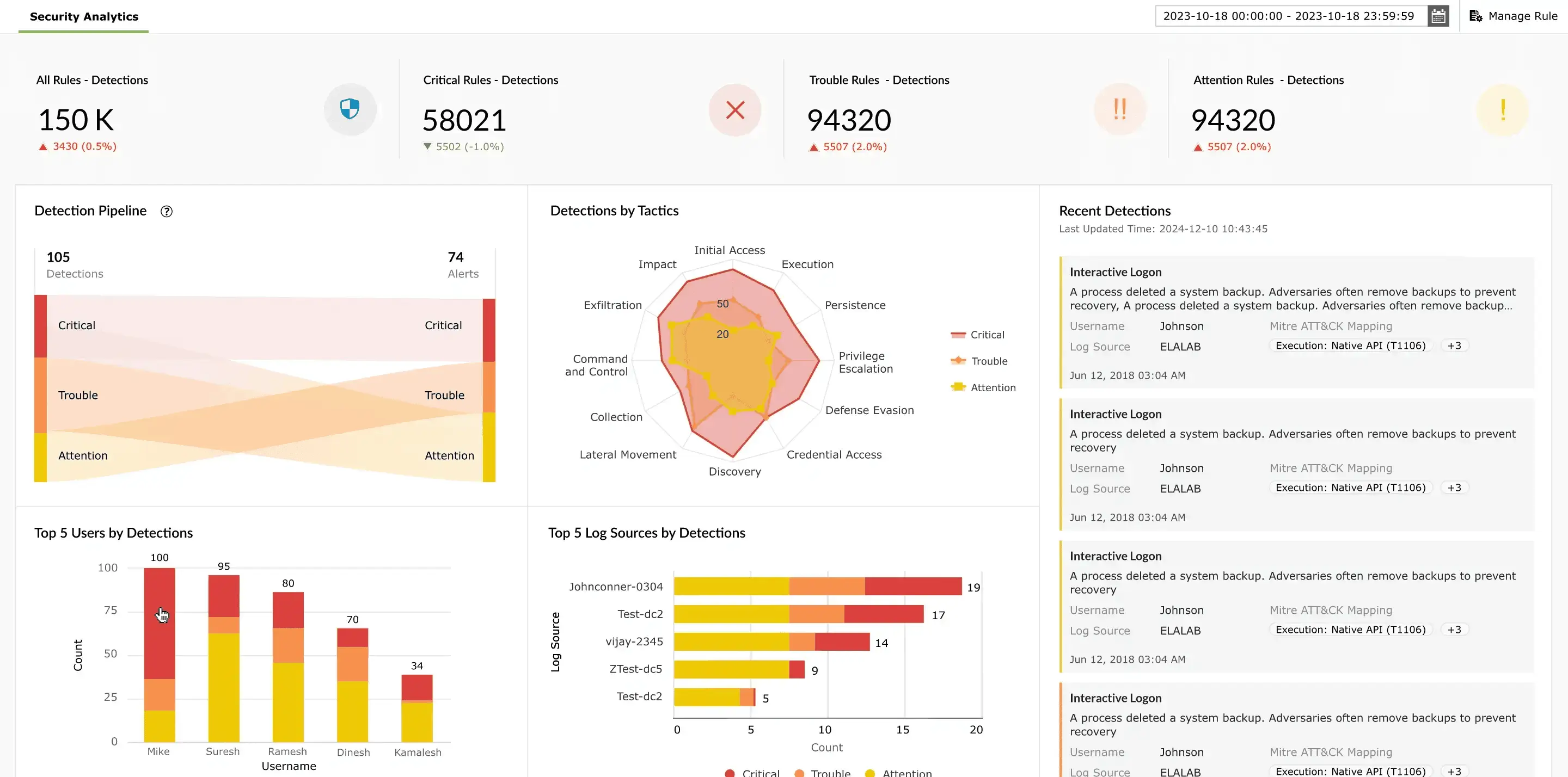
The first job of a threat management platform is to see what's happening. Log360 collects from every layer of the environment and runs detection logic against the combined dataset, not against one silo at a time.

  • 2,000+ cloud-delivered detection rules: Correlation rules, anomaly rules, and threat-intel matches ship ready to enable, all mapped to the MITRE ATT&CK framework.
  • Cross-source correlation: Events from AD, firewalls, endpoints, databases, and cloud platforms are correlated together, so a brute-force on the VPN followed by a privilege escalation on AD shows up as one chain.
  • Behavior-based detection with UEBA: User and entity behavior analytics baselines normal activity for every user and host, then flags deviations that signature-based rules will miss.
  • MITRE ATT&CK visualization: A dedicated dashboard shows which parts of the kill chain are active right now and which techniques are firing most.

Benefit: The SOC works from a single, prioritized view of what's happening across the environment instead of a tab per tool.

Unified threat management software

Proactive threat hunting from the same console

Detection covers what the rules already know about. Hunting is for what they don't. Log360 lets analysts pivot from any alert into the underlying logs and chase a hypothesis without exporting data into a separate tool.

  • Search and pivot across the full log set: Filter by user, device, IP, event type, file, or time range. Move from a hit on a malicious IP to the user that received it to the process that opened the connection.
  • IoC-based hunting: Match historical and live logs against external threat feeds and internally derived indicators, so threats that landed before a feed was added still get found.
  • Anomaly-based hunting with UEBA: Use behavioral risk scores to find compromised accounts and insider misuse that no IoC will catch.
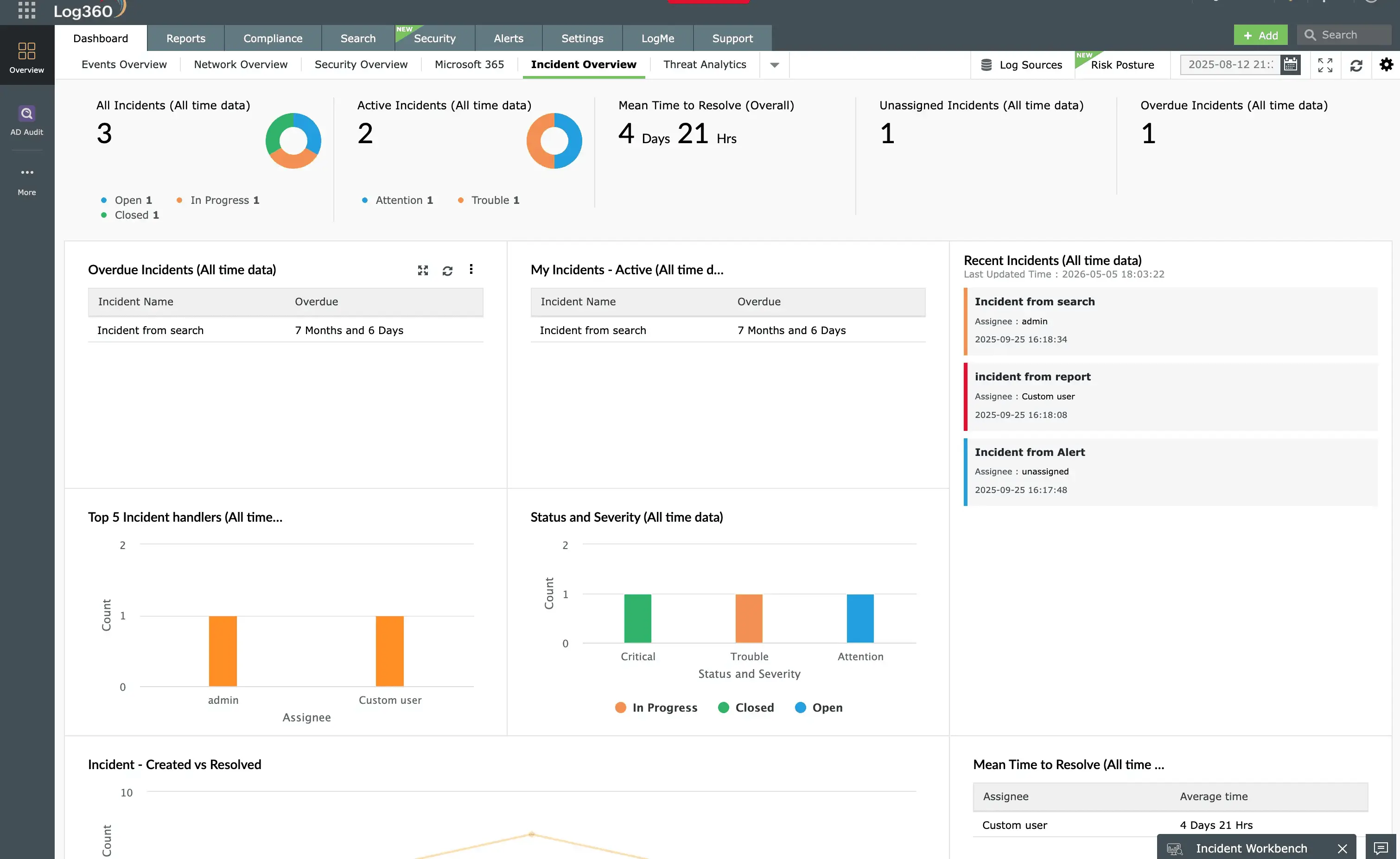
  • Incident Workbench: Reconstruct attack timelines visually, attach evidence, and trigger a SOAR playbook from the same screen.

Benefit: Hunting moves from a side project that happens "when we have time" to a routine that runs from the same console as detection.

Unified threat management software

Threat intelligence built into every alert

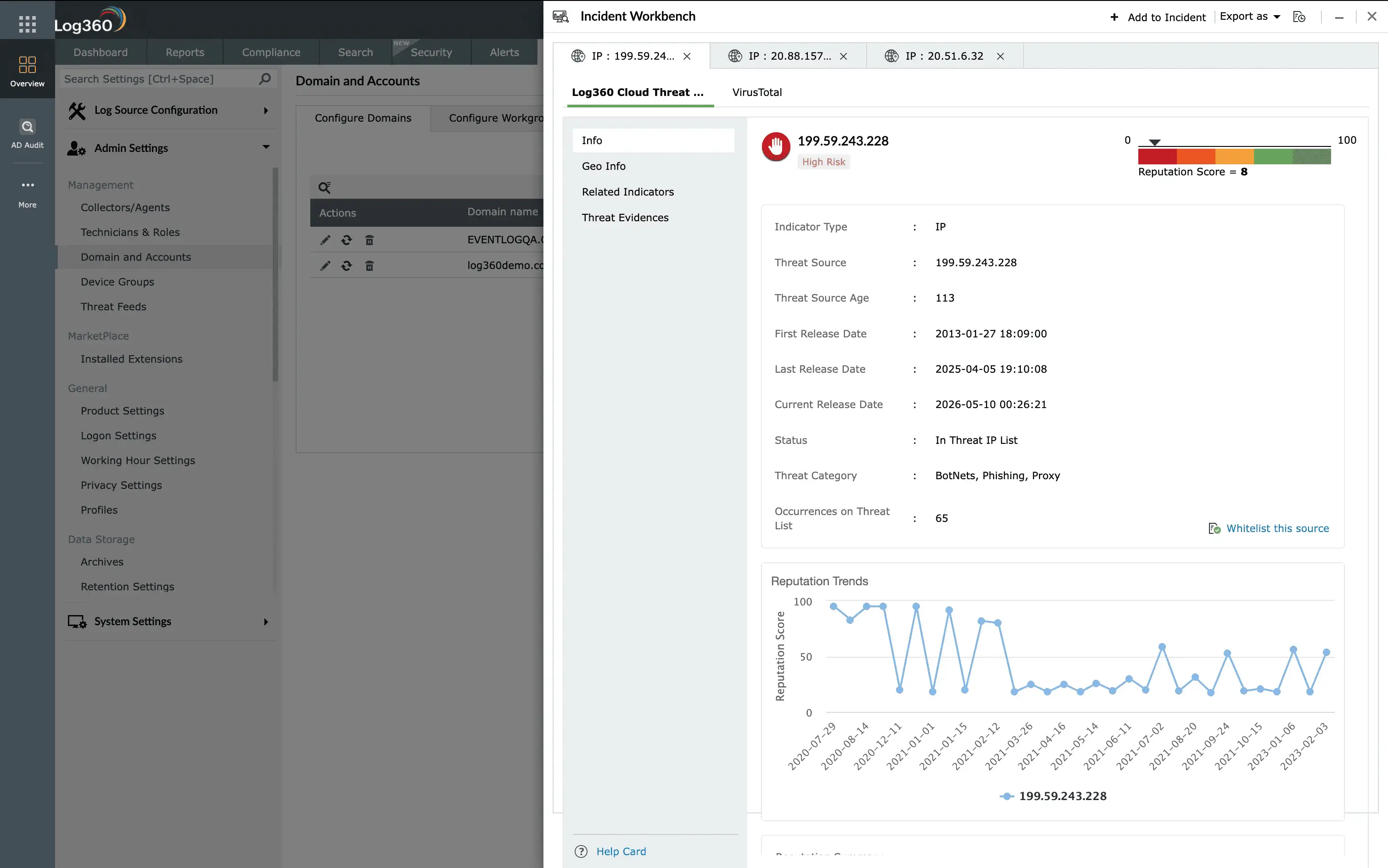
A raw alert says "this IP did this thing." A useful alert says "this IP is on three blocklists, was seen in a phishing campaign last week, and is geo-located somewhere your users don't travel to." Log360 turns the first into the second automatically.

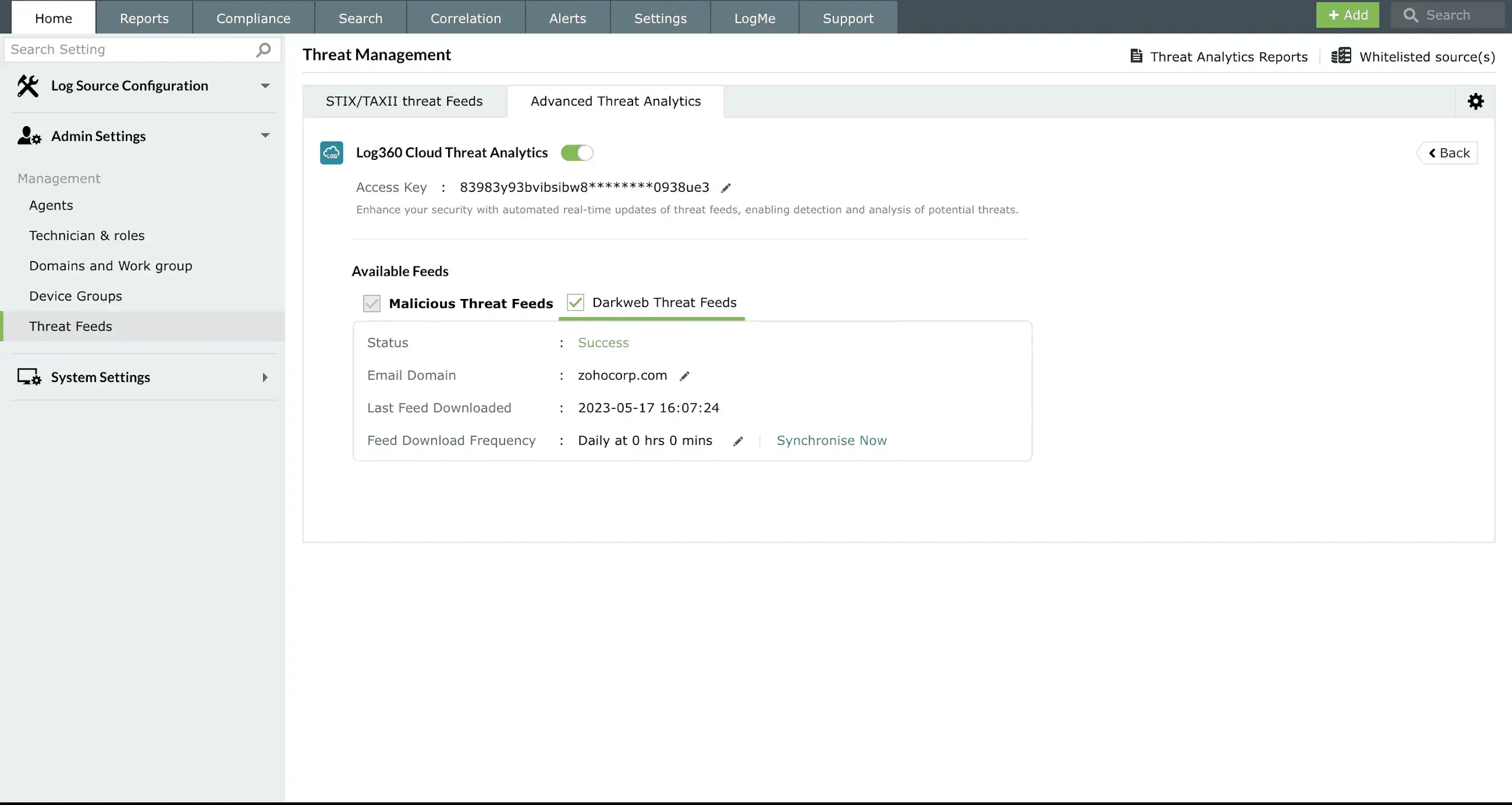
  • More than 10 feed formats: Ingest and normalize STIX/TAXII, CSV, JSON, and API-based feeds, including Webroot, VirusTotal, AlienVault OTX, and Constella.
  • Alert enrichment: Every external IP, URL, and domain on an alert is scored against IP reputation, geolocation, and known IoCs before an analyst sees it.
  • Dark web monitoring: Track exposed credentials, PII, and payment data tied to your organization so account takeover gets stopped before it starts.
  • Intelligence-driven prioritization: Alerts are scored Critical, Trouble, or Attention based on IoC matches and reputation, so the queue is sorted before triage begins.

Benefit: Analysts spend less time looking up IPs and more time deciding what to do about them.

Unified threat management software

Automated response in the same platform

Finding a threat is only half the work. Closing it out is the other half. Log360 ships native SOAR inside the same license, so the response runs from the same place the detection fired.

  • Prebuilt playbook library: Templates for brute force, ransomware, phishing, account compromise, and more. Import, adapt, deploy.
  • Drag-and-drop builder: Build custom workflows with Branch, Parallel, Wait, Batch, and Sub-playbook states. No SPL or KQL required.
  • Endpoint actions without an extra agent: The existing ManageEngine agent handles isolation, account disable, script execution, USB lockdown, and service management.
  • Two-way ITSM sync: Tickets in ServiceDesk Plus, Jira, or Zendesk stay aligned with the underlying incident as status and severity change.

Benefit: Response stops being a hand-off between products and starts being a step in the same workflow.

Unified threat management software

Unified threat management in action

Three scenarios that show what happens when detection, hunting, intelligence, and response sit in one platform. Each one would normally cross three or four tools.

  • Scenario 2: Insider data exfiltration attempt (High, MITRE T1567)

    Log360 spots a privileged user pulling abnormal volumes of data and stops the exfiltration in progress.

    Example scenario: A user with database admin rights starts exporting large query results to a personal cloud storage account outside business hours.

  • Scenario 3: Ransomware staging on an endpoint (Critical, MITRE T1486)

    Log360 ties a malicious download, a process-tree anomaly, and a file-encryption pattern together and isolates the host before encryption spreads.

    Example scenario: A user downloads a file from a domain that just appeared on threat feeds. The file spawns a process that starts walking shared drives.

How Log360 responds:

  • Detection: Email gateway and proxy logs flag the click on a URL that matches a threat intel feed. The AD logon from the new IP triggers a UEBA anomaly.
  • Correlation: Log360 ties the click, the logon, and the file-server access into one incident, mapped to T1566 and T1078.
  • Response: A playbook disables the account, forces a password reset, blocks the source IP at the firewall, and opens a ticket in ServiceDesk Plus.

How Log360 responds:

  • Detection: UEBA flags the volume and the timing against the user's baseline. The destination IP matches a Constella dark web feed entry.
  • Hunting: The analyst pivots from the alert into the Incident Workbench, reconstructs the database query history, and confirms the pattern.
  • Response: A playbook revokes the database role, kills the session, blocks the destination domain, and routes the incident to legal and HR via ITSM.

How Log360 responds:

  • Detection: The domain hits a threat-intel match. The process behavior triggers a correlation rule for ransomware staging.
  • Investigation: The Incident Workbench renders the process tree. Zia Insights writes a summary, maps the activity to T1486, and recommends containment steps.
  • Response: A playbook isolates the host, disables USB, adds firewall deny rules for the related IPs and domains, and attaches a forensic evidence pack to the incident.

Bring your threat management into one platform

Detection, hunting, intelligence, and response belong in the same console. Log360 keeps them there, with no separate hunting product, no separate intel platform, no separate SOAR fee.

Elevate your security posture

Log360's unified SIEM platform is built for modern SOCs, with scalable architecture, deep detection, and an extensibility layer that runs across every phase of the security lifecycle.


Scalable and resilient platform

A distributed, high-availability architecture that supports growing log volumes and keeps collection, indexing, and analysis running.

Learn more  
 

Real-time security analytics

Unified insight across endpoints, networks, and cloud, so detection, investigation, and response work from one view.

Learn more  
 

Advanced threat detection

Over 2,000 MITRE ATT&CK-mapped correlation rules and UEBA to spot multi-stage attacks like insider threats and anomalous behavior.

Learn more  
 

External and dark web intelligence

Real-time threat intel on every alert, with IP reputation, geolocation, and risk-based prioritization to speed up investigation and triage.

Learn more  
 

Streamlined compliance management

Coverage for over 30 regulatory mandates including GDPR, HIPAA, and PCI DSS, with secure log archiving and audit-ready reports.

Learn more  
 

Flexible, extensible security ecosystem

Native integration with hybrid infrastructures, with room to extend without disrupting the work already running.

Learn more  

  •  

    We wanted to make sure that one, we can check the box for different security features that our clients are looking for us to have, and two, we improve our security so that we can harden our security footprint.

    Carter Ledyard

  •  

    The drill-down options and visual dashboards make threat investigation much faster and easier. It’s a truly user-friendly solution.

    Sundaram Business Services

  •  

    Log360 helped detect insider threats, unusual login patterns, privilege escalations, and potential data exfiltration attempts in real time.

    CIO, Northtown Automotive Companies

  •  

    Before Log360, we were missing a centralized view of our entire infrastructure. Now, we can quickly detect potential threats and respond before they escalate.Log360 has been invaluable for improving our incident response and ensuring compliance with audit standards. It’s a game-changer for our team.

    ECSO 911

Fill this form to schedule a
personalized web demo

  • By clicking " Submit", you agree to processing of personal data according to the Privacy Policy.

Your request for a demo has been submitted successfully. Our support technicians will get backto you at the earliest.

FAQs

Unified threat management is an approach that runs multiple security functions, detection, hunting, intelligence, and response, from one platform instead of separate products. In Log360, those functions sit on the same SIEM backend, so an alert in threat detection flows directly into hunting, intelligence enrichment, and automated response without re-correlation.

Traditional UTM appliances combine network-perimeter functions like firewall, IPS, and content filtering into one box. Unified threat management in a SIEM context is broader: it consolidates the analytical and response layers that sit above the perimeter, including correlation, behavior analytics, threat intelligence, and SOAR.

Endpoints, servers, Active Directory, network devices, firewalls, databases, and cloud platforms (AWS, Azure, GCP, Microsoft 365). Detection runs against the combined dataset, so cross-source attacks are caught as one story.

Three ways: ML-powered adaptive thresholds that adjust per environment, UEBA risk scores that put behavioral context on each alert, and no-code rule tuning with object-level filtering. A 911 center used Log360 to cut alert noise by 90%.

Native SOAR is included in the Log360 Cloud license. No per-execution fee, no separate product, no extra agent on endpoints.

Every external IP, URL, and domain on an alert is scored against feeds like Webroot, STIX/TAXII, VirusTotal, AlienVault OTX, and Constella. Reputation, geolocation, and IoC matches are attached before the analyst sees the alert.

Yes. All 2,000+ correlation rules and UEBA models are mapped to the MITRE ATT&CK framework, and a dedicated ATT&CK dashboard shows which tactics and techniques are active right now.

Log360 collects from AWS, Azure, GCP, and SaaS platforms through native connectors, with a CASB layer for sanctioned and shadow-app monitoring. For a deeper view, see cloud detection and response in Log360.

From alerts to action

Use Log360 to detect, hunt, enrich, and respond from one console. Cut tool sprawl, cut hand-offs, and cut the time it takes to close out a real threat.