COMPLIANCE > GDPR
99
articles structured across
11 chapters of the regulation7
principles governing the lawful
processing of personal data8
rights granted to every
data subject under GDPR€20M / 4%
maximum fine of annual global
turnover for severe violations
The General Data Protection Regulation (GDPR) is the European Union's landmark privacy law governing how organizations collect, store, process, and share the personal data of EU residents. Enforceable since 25 May 2018, GDPR introduced a unified framework that applies to any organization offering goods or services to, or monitoring the behavior of, individuals within the EU and EEA, regardless of the organization's location.
GDPR is a principles-based regulation that requires organizations to demonstrate accountability across the entire personal data lifecycle, including collection, storage, access, disclosure, and erasure. Endpoint Central, ManageEngine's unified endpoint management and security solution, helps organizations operationalize GDPR's technical and organizational requirements at the endpoint layer through automated security enforcement, compliance management, and data protection across Windows, macOS, Linux, and mobile devices.
- Why Endpoint Central
- Scope of GDPR
- Principles & Rights
- How Endpoint Central helps
- Penalties
- GDPR, NIS2 & DORA
Why Choose Endpoint Central for GDPR Compliance?
- Privacy by Design at the Endpoint
- Lawful, Auditable Processing
- Rapid Breach Containment & Recovery
Operationalize GDPR's data protection by design and by default principle (Article 25) directly on user devices. Granular role-based access control, BitLocker and FileVault encryption, peripheral device control, and Data Leakage Prevention ensure personal data is protected at rest, in motion, and during processing, without disrupting end-user productivity.

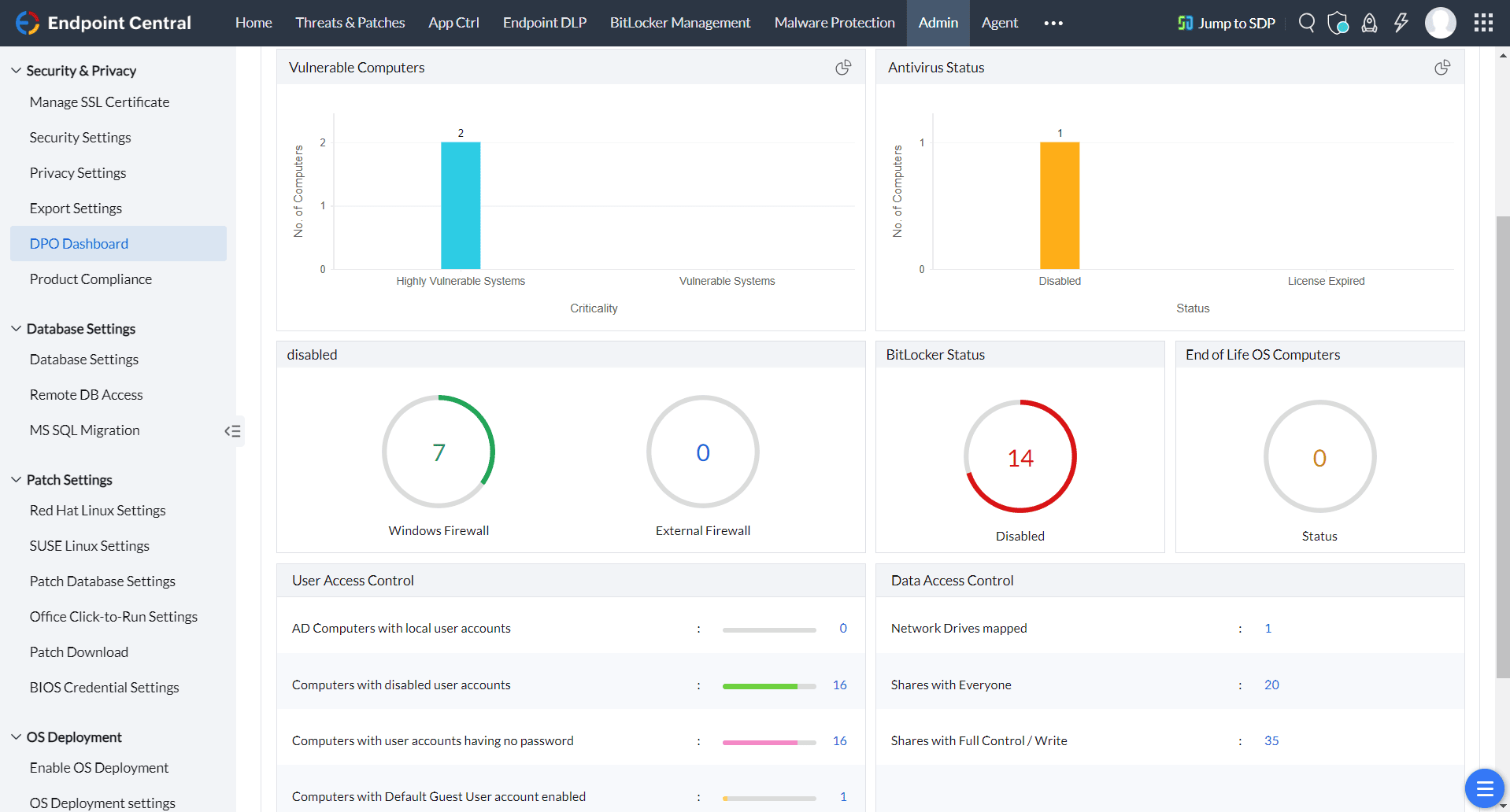
The built-in DPO Dashboard consolidates encryption status, vulnerability posture, firewall state, end-of-life devices, and user access controls into a single pane of glass. Comprehensive reporting and immutable audit logs help Data Protection Officers and IT teams evidence compliance during regulator audits and internal reviews.
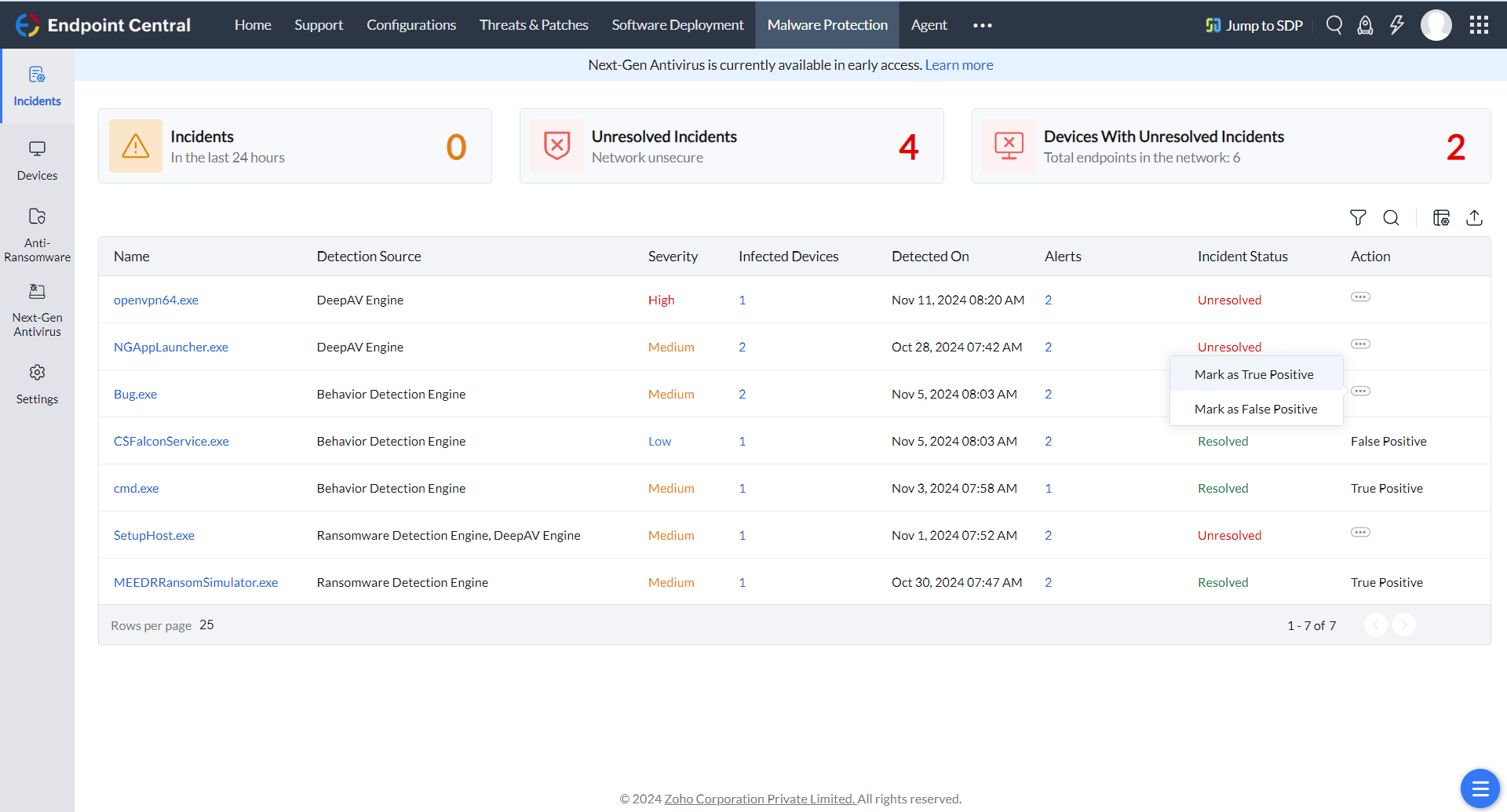
Accelerate the 72-hour breach notification window required by Article 33. Real-time vulnerability alerts, automated patching, ransomware detection with non-erasable backups, and endpoint quarantine capabilities enable IT teams to detect, contain, and remediate incidents before they escalate into reportable breaches.
Scope of GDPR
What constitutes personal data?
Personal data is any information relating to an identified or identifiable natural person, including names, identification numbers, location data, online identifiers, device identifiers, IP addresses, and any factor specific to the physical, physiological, genetic, mental, economic, cultural, or social identity of that person.
Territorial reach
The regulation has broad extraterritorial reach. It applies to any organization established in the EU/EEA that processes personal data, regardless of where the processing physically occurs, and to any organization outside the EU/EEA that offers goods or services to data subjects in the EU, or monitors their behaviour within the EU.
Key principles and data subject rights
The seven principles (Article 5)
- Lawfulness, fairness, and transparency: Processing must have a legal basis and be transparent to the data subject.
- Purpose limitation: Data collected for one purpose cannot be repurposed without a compatible legal basis.
- Data minimisation: Only data adequate, relevant, and limited to what is necessary may be processed.
- Accuracy: Personal data must be kept accurate and up to date.
- Storage limitation: Data is retained only as long as necessary for the stated purpose.
- Integrity and confidentiality: Data must be protected against unauthorized access, loss, or destruction using appropriate technical and organizational measures.
- Accountability: The controller must be able to demonstrate compliance with all of the above.
The eight rights of the data subject
- Right to be informed
- Right of access
- Right to rectification
- Right to erasure
- Right to restrict processing
- Right to data portability
- Right to object
- Rights related to automated decision-making and profiling
How Endpoint Central helps meet GDPR requirements
We have mapped Endpoint Central capabilities to the technical and organisational measures required under the GDPR. This mapping demonstrates how Endpoint Central supports secure processing, accountability, breach response, and data subject rights across managed endpoints.
| GDPR Requirement | How Endpoint Central helps |
|---|---|
Integrity, confidentiality, and security of processing | Endpoint Central enforces full-disk encryption through native BitLocker management for Windows and FileVault for macOS, protecting personal data at rest. FIPS 140-2 compliant algorithms secure agent-to-server communication, and TLS-protected channels safeguard data in transit between the server and integrated applications. |
Data protection by design and by default | Secure baseline configurations, application allowlisting, USB and peripheral device control, and granular file and folder permission management ensure that personal data is processed only by explicitly authorized systems and users by default. |
Records of processing activities | Inventory scans, asset reports, software metering, and the Data Protection Officer (DPO) dashboard maintain continuous, audit-ready records of every endpoint where personal data may be processed, including hardware, installed software, user accounts, and access patterns. |
Pseudonymisation and confidentiality of reports | The Report Settings module allows administrators to mask or anonymise personally identifiable fields such as user names, IP addresses, and machine names when exporting reports, preventing accidental disclosure of personal data during reporting and audits. |
Regular testing of effectiveness of security measures | Continuous vulnerability assessment, risk-based vulnerability management, patch compliance dashboards, port audits, and security misconfiguration detection help organizations test and demonstrate the ongoing effectiveness of their technical measures. |
Right to erasure | Personal data resides within the customer-controlled Endpoint Central database. When a user is removed from the product, no personal information is retained beyond the user name required for audit logging, supporting the right to erasure while preserving accountability records. |
Right of access and data portability | Because Endpoint Central is deployed within the customer's environment, organizations retain complete visibility and control over the personal data being collected, processed, and stored. Reporting capabilities support timely retrieval of personal data when a data subject access request is received. |
Notification of personal data breaches | Vulnerability and threat detection alerts notify administrators in real time when a security incident is identified. Endpoint quarantine, automated remediation, and patented ransomware protection with non-erasable backups support rapid containment and recovery, helping organizations meet breach notification timelines. |
Confidentiality through access control | Role-based administration and two-factor authentication restrict console and endpoint access to authorized technicians scoped to their job function. Pre-defined and custom roles enforce least-privilege access aligned with accountability principles. |
Ongoing confidentiality and resilience | Anti-malware, anti-ransomware, browser security, endpoint privilege management, and just-in-time access controls reduce the attack surface that could lead to a personal data breach. Instant, non-erasable backups taken every three hours support recovery from ransomware events. |
Restoration of availability and access | OS imaging, deployment, and one-click data restoration from non-erasable backups support the prompt restoration of access to personal data following a physical or technical incident. |
Data minimisation | Data Leakage Prevention identifies and classifies personal data on endpoints and prevents unauthorized transfers to cloud platforms, clipboards, removable media, and peripheral devices, minimizing exposure beyond approved boundaries. |
Processor obligations | Endpoint Central is deployed and operated within the customer's environment. Customers remain in full control of the personal data processed by the product, and Endpoint Central does not transmit personal data to ManageEngine, supporting clear controller and processor boundaries. |
Penalties for non-compliance
GDPR enforces compliance through a two-tier penalty framework, with fines calibrated to the severity of the infringement and the global scale of the offending organization.
Less severe violations
Breaches of obligations such as those covering records of processing, data protection by design, or processor contracts, can incur fines of up to €10 million or 2% of total worldwide annual turnover of the preceding financial year, whichever is higher.
Severe violations
Breaches of the core principles of processing, data subject rights, or rules on international transfers, can incur fines of up to €20 million or 4% of total worldwide annual turnover, whichever is higher.
Beyond financial penalties
Non-compliance carries durable reputational consequences, loss of customer and partner trust, civil claims from affected data subjects, and operational disruption from supervisory authority investigations.
Endpoint Central empowers organizations to translate GDPR's technical and organizational requirements into automated, evidenced controls, reducing the likelihood of a reportable incident and providing the audit trail needed if a regulator comes calling.
Europe's regulatory trifecta
GDPR is the centrepiece of EU privacy law, but it does not exist in isolation. Organizations operating in Europe are increasingly required to comply with parallel frameworks that share overlapping technical requirements. Understanding how GDPR, NIS2, and DORA complement each other helps security and compliance teams design controls that satisfy multiple regulations simultaneously.
| Criterion | GDPR | NIS2 | DORA |
|---|---|---|---|
Scope | Any organization worldwide processing personal data of EU residents. | Essential and important entities across 18 sectors in the EU. | Financial entities operating in the EU. |
Purpose | Protect the personal data and fundamental privacy rights of individuals. | Raise the baseline of cybersecurity across critical and important sectors. | Strengthen the digital operational resilience of the EU financial sector. |
Relationship with GDPR | NA | NIS2's cybersecurity measures and incident-reporting obligations operationally reinforce GDPR's security-of-processing requirements; a personal data breach may trigger reporting under both. | DORA acts as a sector-specific cybersecurity law for financial entities, displacing NIS2 obligations for those entities while remaining complementary to GDPR's data protection requirements. |
Penalties | Up to €20M or 4% of global turnover (severe); up to €10M or 2% (less severe). | Essential entities: up to €10M or 2% of global turnover. Important entities: up to €7M or 1.4%. | No fixed cap; penalties set by competent authorities of EU member states. |
Endpoint Central helps in achieving the following compliances

CIS

FERPA
NIST 800-171

UK CYBER ESSENTIALS

NCA

ISO 27001
PCI DSS
NIST 2.0 CSF

HIPAA

DORA

GDPR
NIS2

RBI

Essential 8
Recommended reads
Real Stories, Real Impact: Endpoint Central and Compliance

"Endpoint Central has allowed us to move towards our goal of a centralized application to cover off IT support activities. The deployment was really simple with no real issues. We use it mainly for the integration with ServiceDesk Plus and the reports it provide for our ISO implementation"

Talk to Us About Your Compliance Needs
Feel free to connect with our experts to address your specific queries and discover how Endpoint Central can assist you in meeting GDPR requirements.