Bulk Configuration of Monitors
The Bulk Configuration feature in Applications Manager allows you to manage and update multiple monitors simultaneously from a single view. It displays the complete list of monitors that are available in Applications Manager and enables you to perform bulk administrative operations on multiple monitors at the same time, reducing manual effort and ensuring consistency while configuring availability, performance, and other monitoring settings across multiple resources. This can be accessed by navigating to Monitors tab and selecting Bulk Configuration option from the Select View dropdown located around the top right corner of Applications Manager web client.
Bulk configuration view is categorized into three major tabs, where each tab provides specific configuration options to efficiently manage multiple monitors:
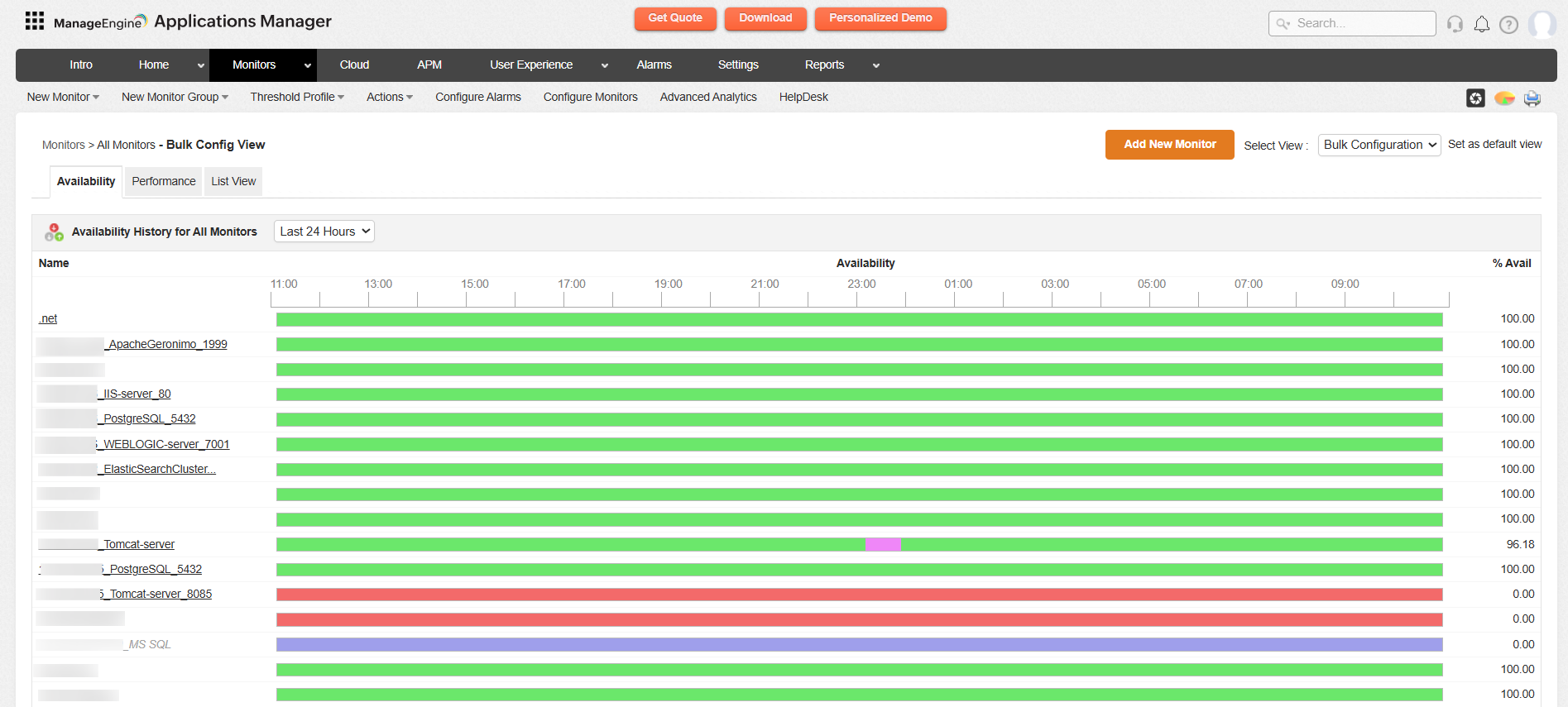
Availability
The Availability view provides a consolidated overview of the availability status of all monitored resources over a selected time period. You can choose to view data for the last 24 hours or last 30 days using the available dropdown option.
This view presents key details such as the monitor name, monitor type, availability status over the selected time period, and the corresponding availability percentage. The status is visually represented using color-coded indicators, making it easy to quickly assess the health of your infrastructure. The different availability states include:
- Available, indicating the monitor is up and functioning normally.
- Unavailable, indicating downtime or inaccessibility.
- Unmanaged, where monitoring is temporarily disabled.
- Scheduled Maintenance, where the monitor is intentionally taken offline for maintainance purposes.
- No Data, when data is not available/collected for the monitor.
Clicking on a monitor name will redirect you to its respective monitor dashboard for detailed analysis.
Performance
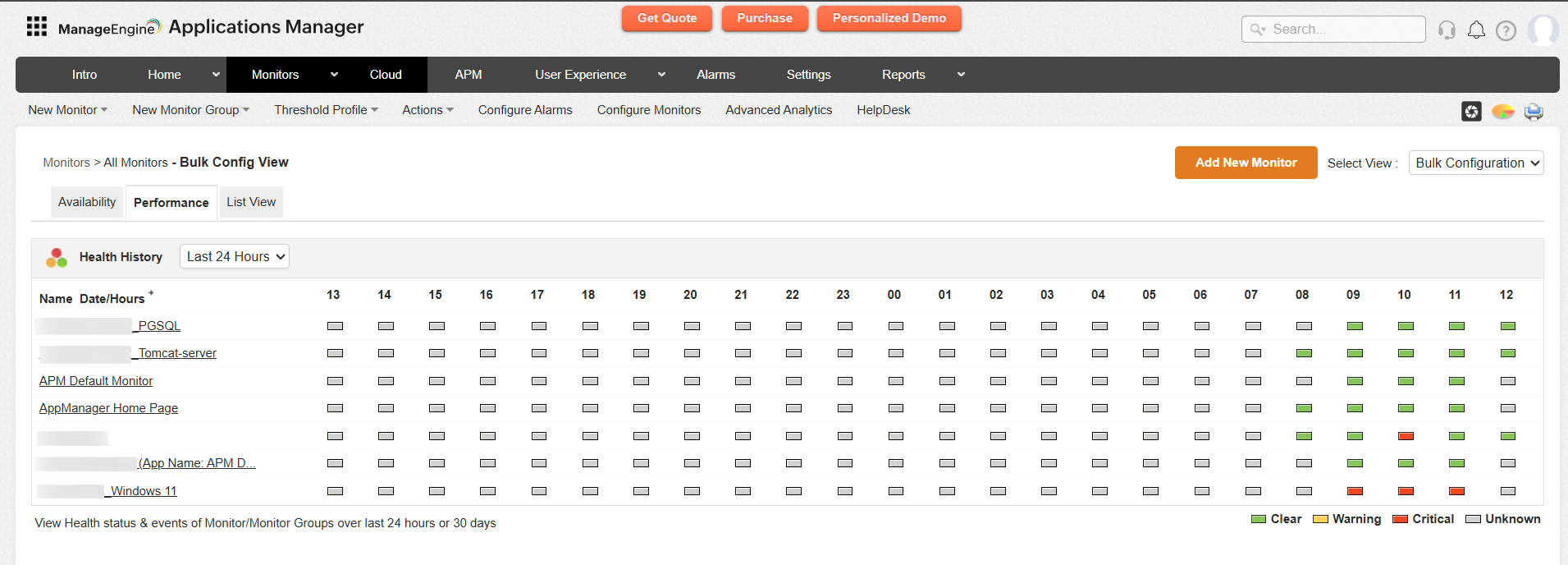
The Performance View provides a consolidated view of the health status and events of all monitored resources over a selected time period. Similar to the Availability view, you can switch between the last 24 hours or last 30 days using the available dropdown option.
This view displays the monitor name along with their corresponding Health statuses for the selected duration, where the health status of each monitor is displayed as a timeline, broken down into individual hours (for 24-hour view) or days (for 30-day view). This allows you to easily identify patterns, recurring issues, or periods of instability. The health status is represented using color-coded indicators:
- Clear, indicating normal operation.
- Warning, indicating potential issues.
- Critical, indicating severe problems requiring immediate attention.
- Unknown, indicating insufficient or unavailable data.
Clicking on a monitor name will take you to its respective monitor dashboard, where you can analyze detailed performance metrics and events.
List view
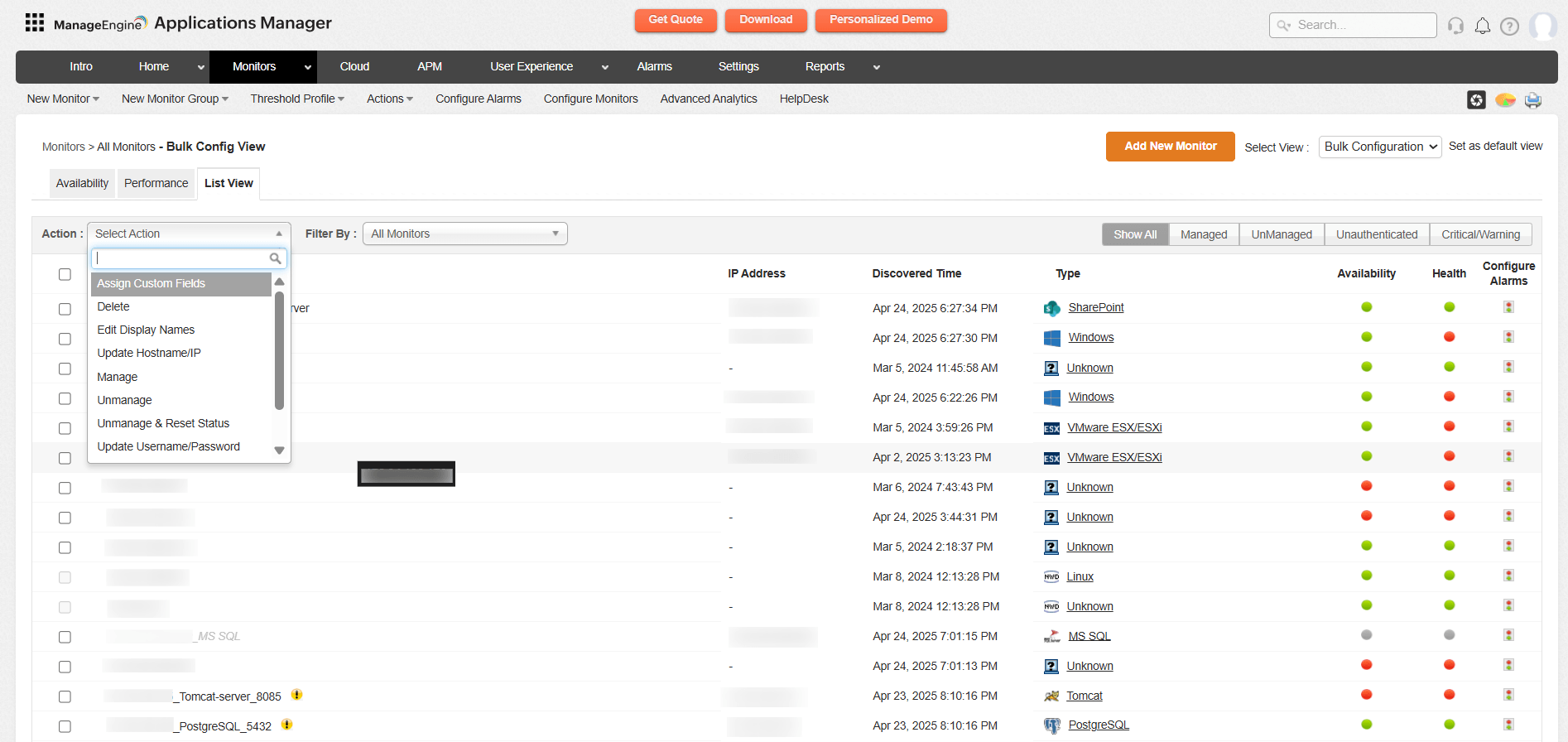
The List View provides a comprehensive, tabular overview of all resources that are monitored in Applications Manager and includes key details such as monitor name, IP address, discovery time, monitor type, and the current availability and health status. You can click on any monitor name to access its detailed dashboard for further analysis.
In contrast to the Availability and Performance views, the List view serves as both a monitoring and management interface, enabling you to view and control multiple resources from a single location. In addition to monitoring, this view supports bulk administrative operations, allowing you to manage multiple monitors efficiently. You can filter monitors, configure alarms, and perform various actions simultaneously without navigating to individual monitor pages. Some of the commonly supported operations include:
- Assign Custom Fields
- Delete
- Edit Display Names
- Update Hostname/IP
- Manage
- Unmanage
- Unmanage & Reset Status
- Update Username/Password
- Update Polling Interval
- Copy and Paste Monitor
- Filter By
Assign Custom Fields
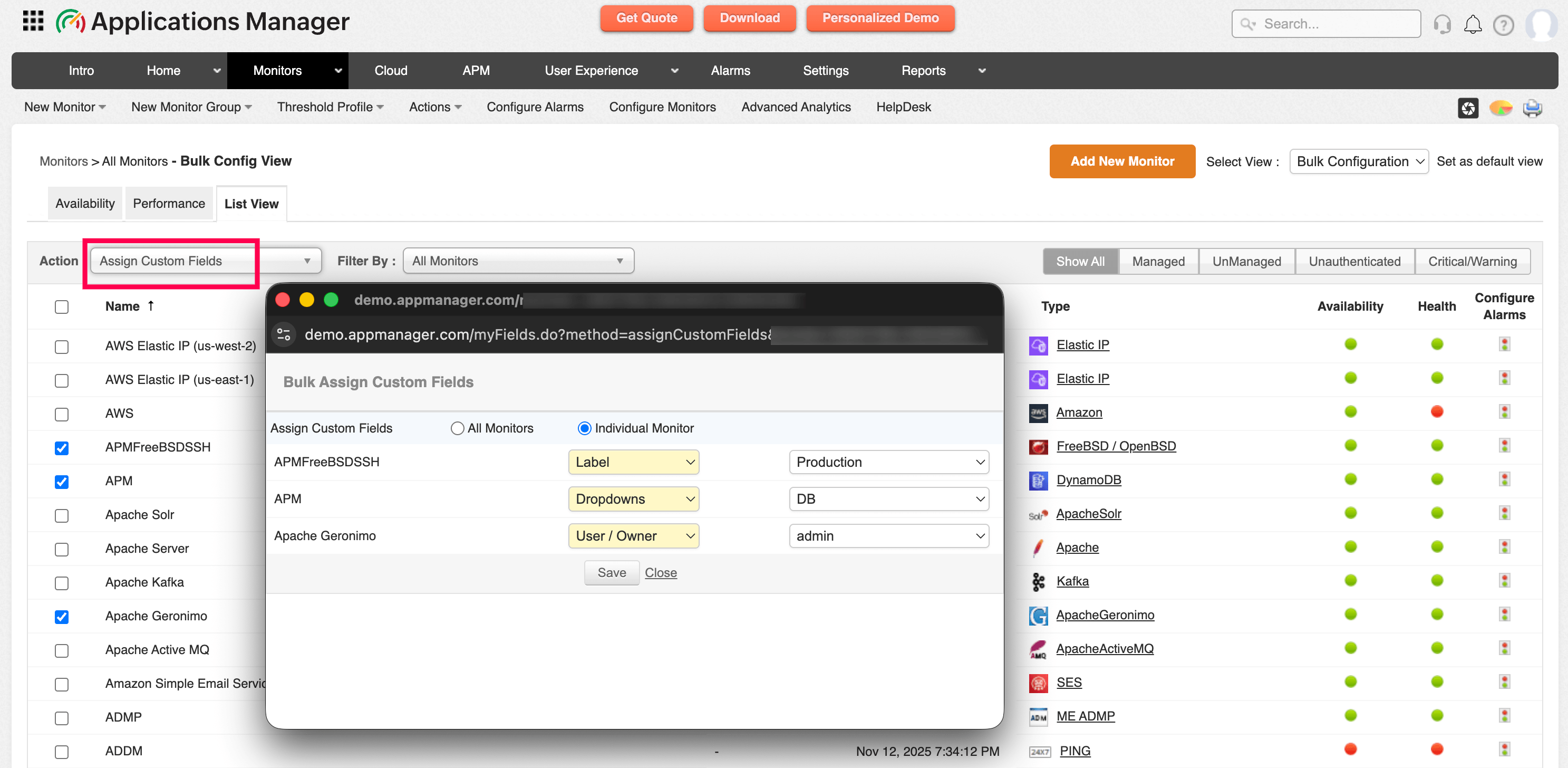
This option enables you to assign custom fields to multiple monitors simultaneously. You can choose from the following options:
All Monitors: Assigns the selected custom field value to all monitors in the Bulk Configuration view at once.
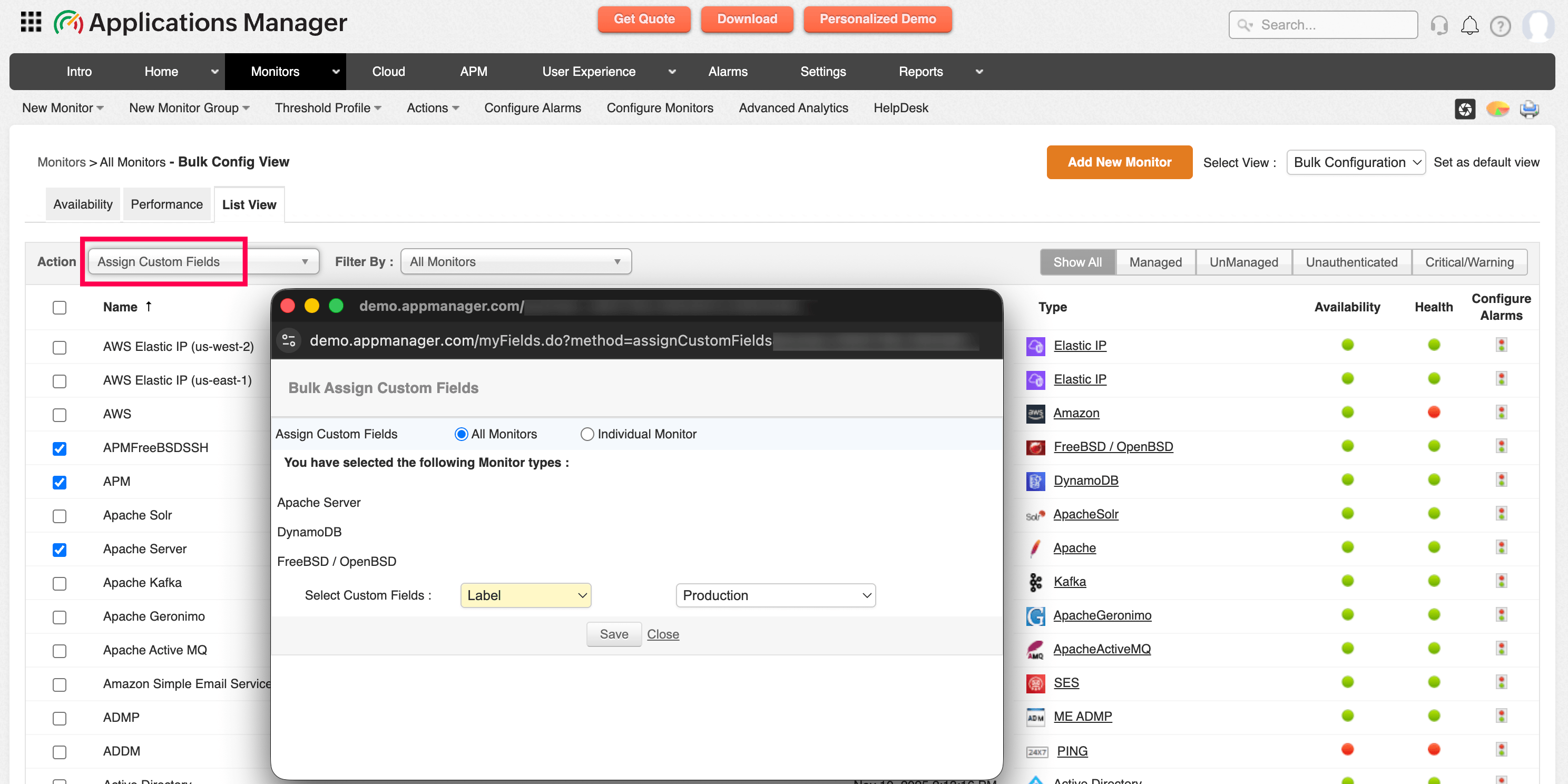
Individual Monitor: Assigns the custom field value to a specific monitor selected from the list.
Delete
This option enables you to delete the selected monitors from Applications Manager. Select the monitors you want to remove and click Delete to permanently remove them from monitoring.
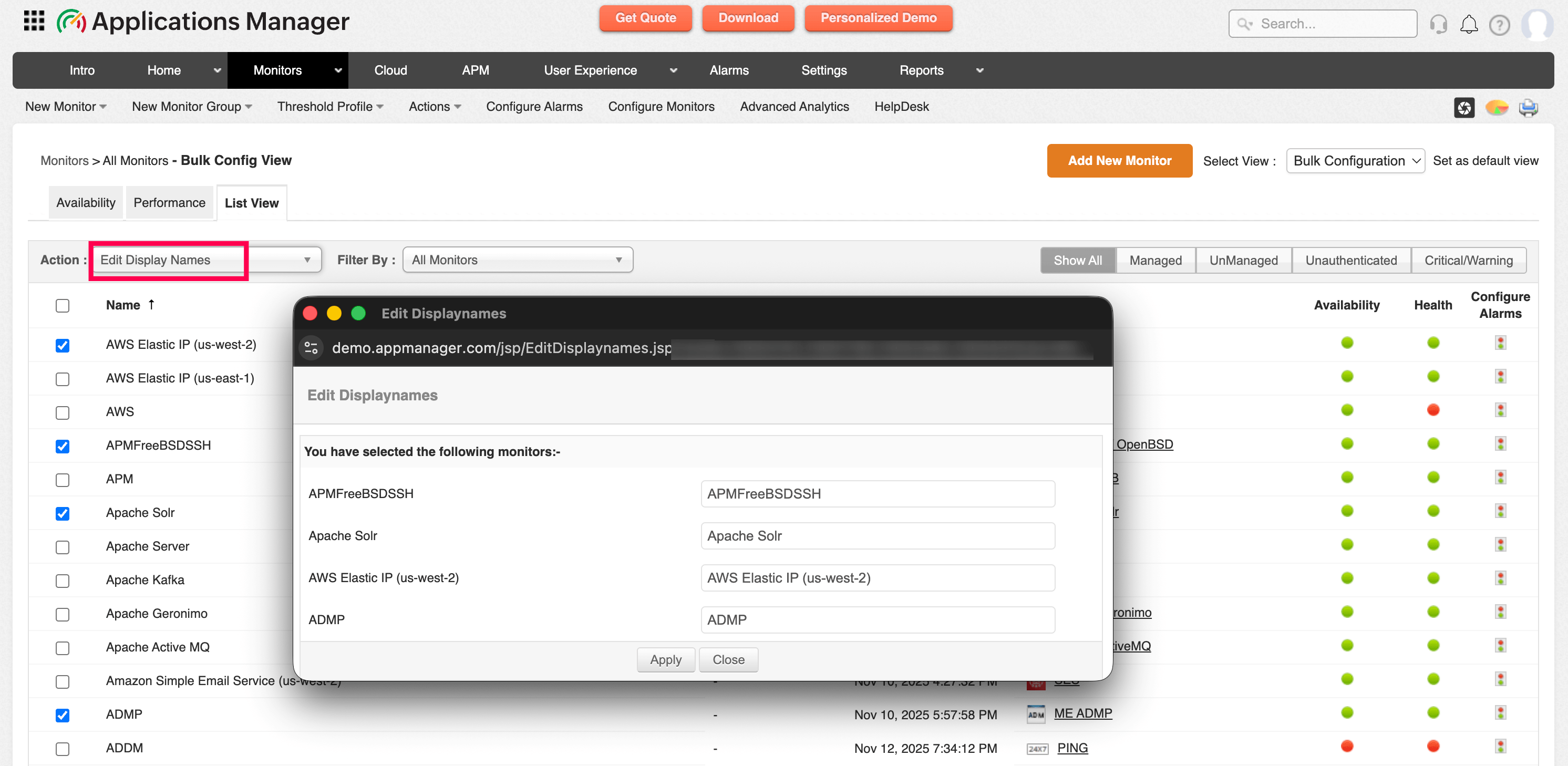
Edit Display Names
This option enables you to bulk edit the Display Names of the Monitors.
Update Hostname/IP
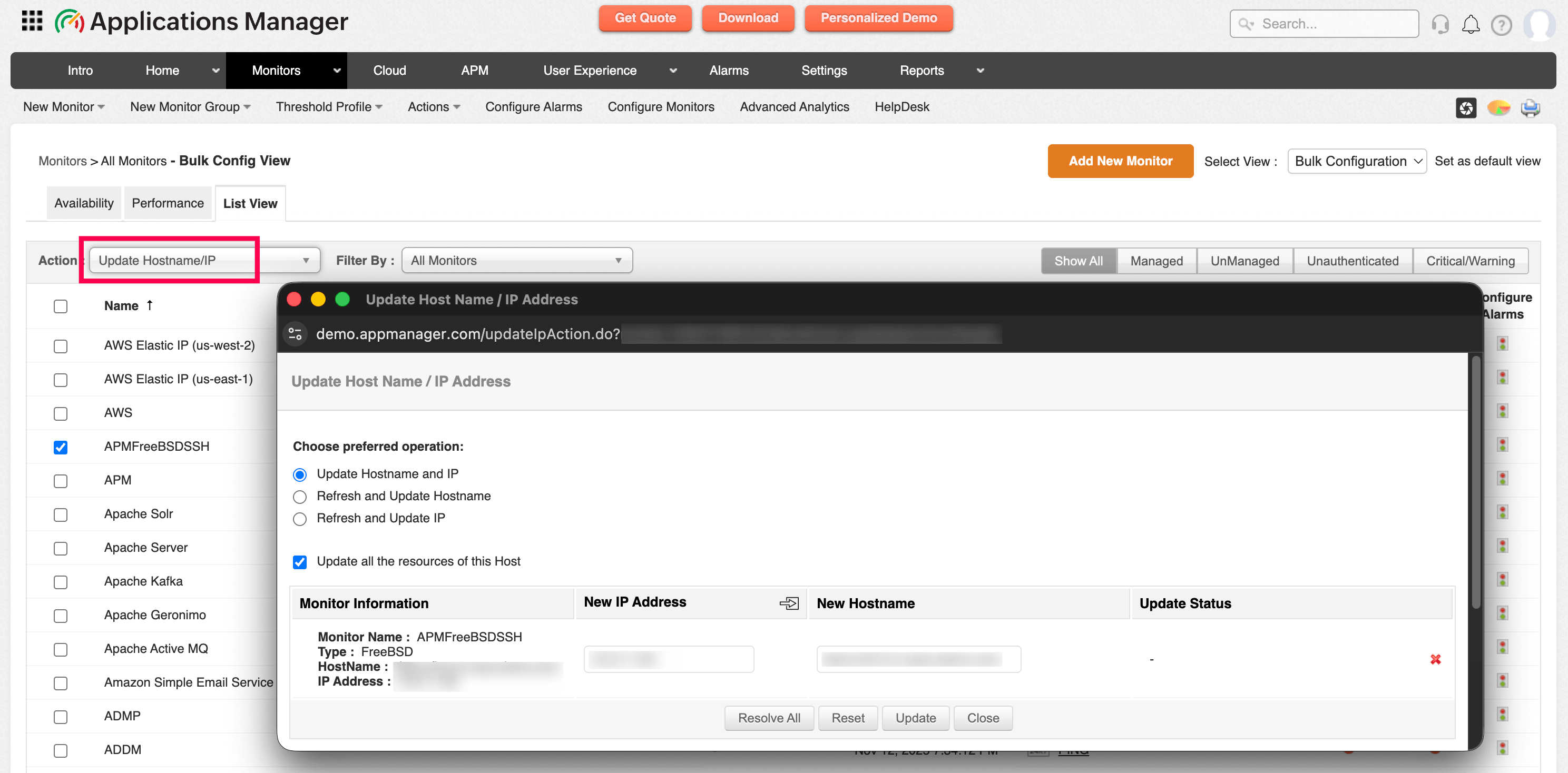
You can update the hostname/IP address of a host. Using the Update Hostname/IP option, you can also perform the following operations:
- Update Hostname and IP: Replaces the existing hostname and IP address with the given resource information.
- Refresh and Update Hostname: Resolves the existing IP address to fetch and update the latest hostname.
- Refresh and Update IP: Resolves the existing hostname to fetch and update the latest IP address.
- Update all the resources of this host: Enabling this option allows you to update the latest hostname/IP address for all the resources running in this host server.
A shortcut to edit the host name or IP Address:
- Log in to Applications Manager
- Select the resources for which the Hostname/IP address needs to be updated.
- After selecting the required resources, choose 'Update Hostname/IP' from the 'Action' drop down menu.
- In the pop-up window, select any one of the required options: 'Update Hostname and IP', 'Refresh and Update Hostname' or 'Refresh and Update IP'. Enable the 'Update all the resources of this host' checkbox, if you wish to update the latest hostname/IP address for all the resources running in the given host server.
- Click Update.
- Check if the Hostname/IP Address has been changed.
Note: This option is supported only for the following monitors: MSSQL, MySQL, DB2, SYBASE, APACHE, .NET, ORACLE AS, JDK 1.5, SAP, WebLogic Server, SNMP, JMX, WINDOWS, LINUX, Solaris, AIX, AS400, NOVELL, MAC, and FREEBSD.
Manage
This option enables you to choose the monitors for which you want data collection to occur. Under Monitors tab, select Bulk Config view. Here all the monitors discovered are listed. Select the monitors for which data collection needs to be done and click the Manage link. For license information, the count of the 'number of monitors' would be based on the number of Managed Monitors.
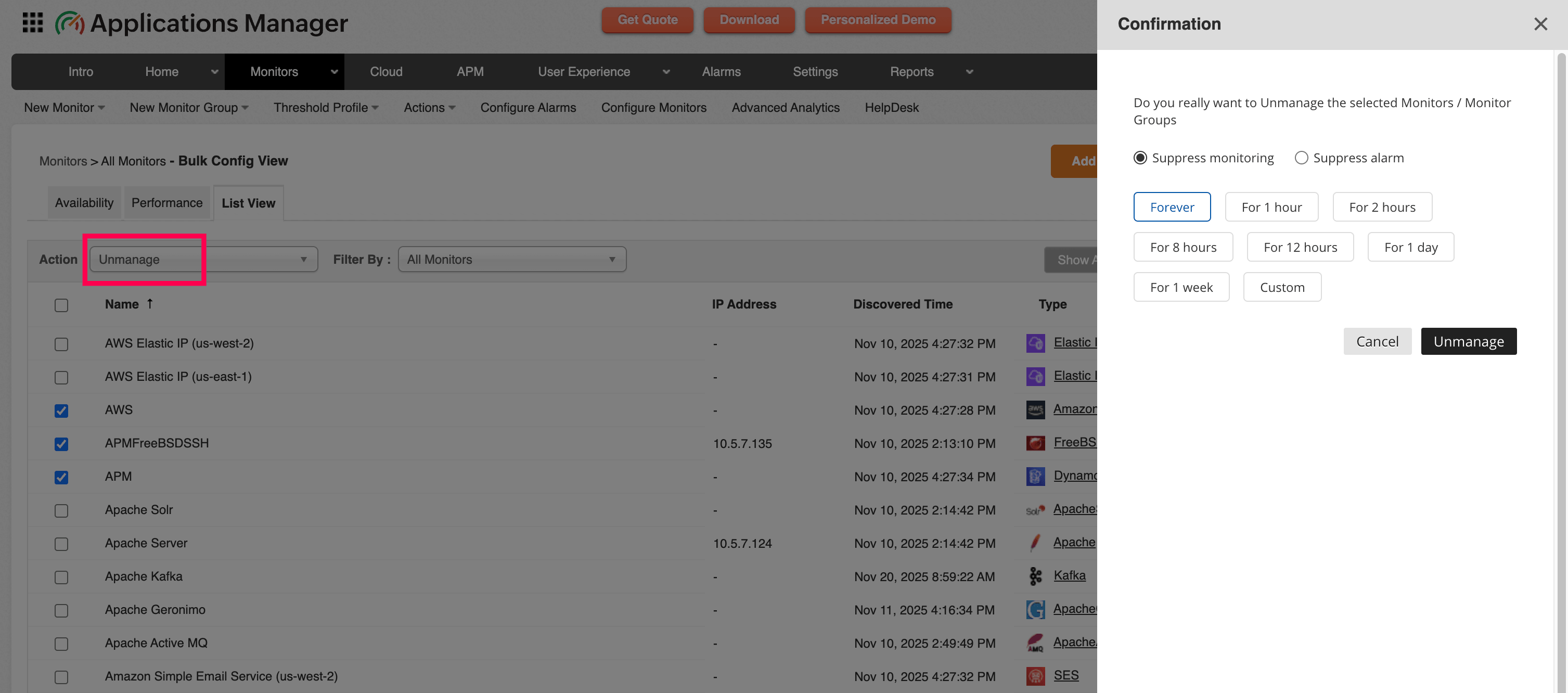
Unmanage
This option enables you to stop data collection for the selected monitors. Select the monitors for which you do not want data collection to happen and click the Unmanage link. On clicking Unmanage, a Confirmation dialog appears where you can choose the unmanage type and time period. Options available for selecting time period are, Forever, For 1 hour, For 2 hours, For 8 hours, For 12 hours, For 1 day, For 1 week and custom. Also there are two options available for choosing type of monitoring:
- Suppress Monitoring: Selecting this option will stop the data collection for the selected monitors during maintenance. These monitors will not be applicable for licensing. By default, this option will be selected.
- Suppress Alarms: Selecting this option will allow the data collection to occur but alarms will not be generated for the selected monitors during maintenance. These monitors will be applicable for licensing.
Unmanage & Reset Status
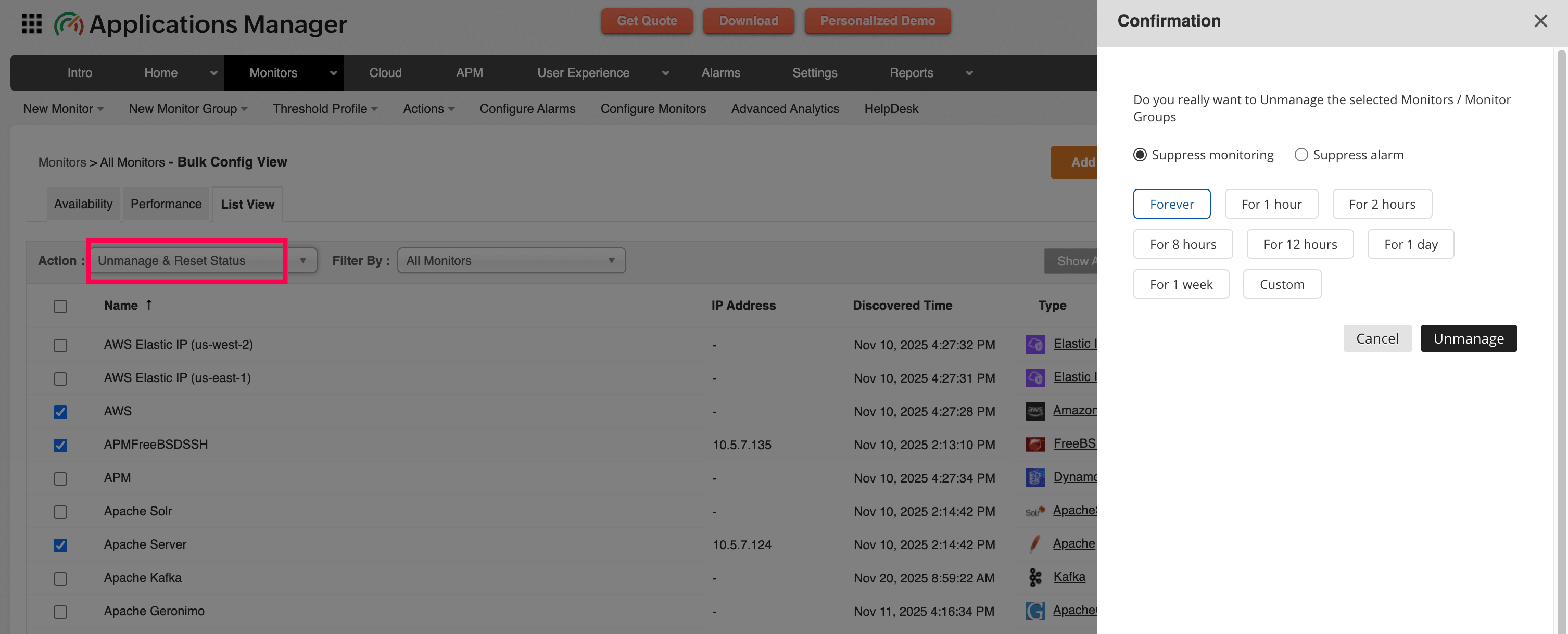
This option enables you to choose the monitors that you want to unmanage. Also you can reset the status of the selected monitors using this option. Under Monitors tab, select 'Bulk Config' view, here all the monitors discovered are listed. Select the monitors for which you do not want data collection to happen and then click on Unmanage link. On clicking unmanage, an iframe page appears, where you will have various options to choose unmanage type and time period. Options available for selecting time period are, Forever, For 1 hour, For 2 hours, For 8 hours, For 12 hours, For 1 day, For 1 week and custom. Also there are two options available for choosing type of monitoring :
- Suppress Monitoring : Selecting this option will stop the data collection for the selected monitors during maintenance. These monitors will not be applicable for licensing. By default, this option will be selected.
- Suppress Alarms : Selecting this option will allow the data collection to occur but alarms will not be generated for the selected monitors during maintenance. These monitors will be applicable for licensing.
Update Username/Password
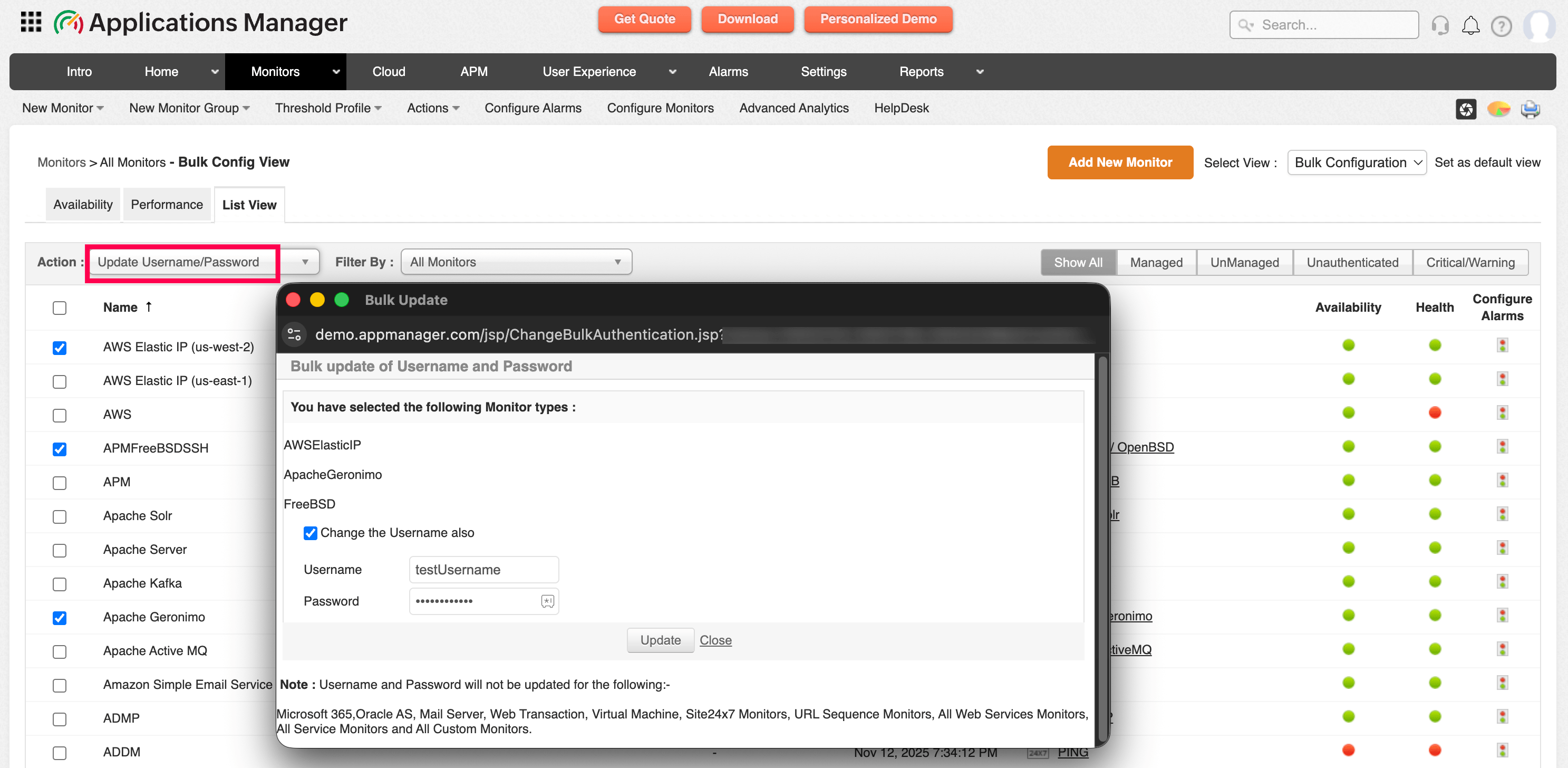
This option enables you to bulk update usernames and passwords across monitor types.
For eg., if you have five tomcat servers running, you can select all the five tomcat servers from the list. Click on Update Username/Password. Your selection would be listed and you can enter the username and password that is common across all the five tomcat servers.
Update Polling Interval
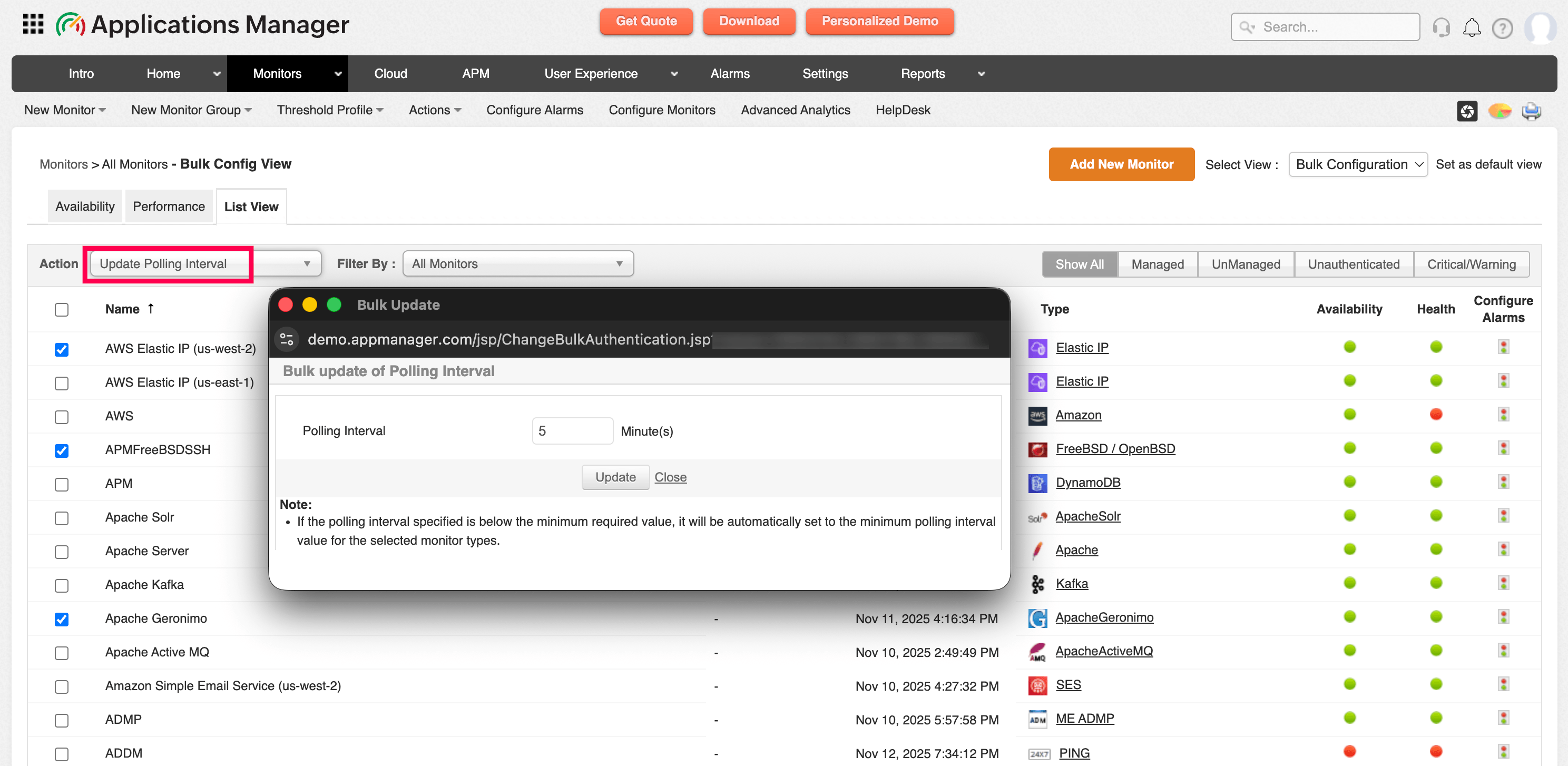
This option enables you to bulk update poll intervals across monitor types.
For eg., if you have five apache servers running, you can select all the five apache servers from the list. Click on Update Polling Interval link. Your selection would be listed and you can enter the desired poll interval.
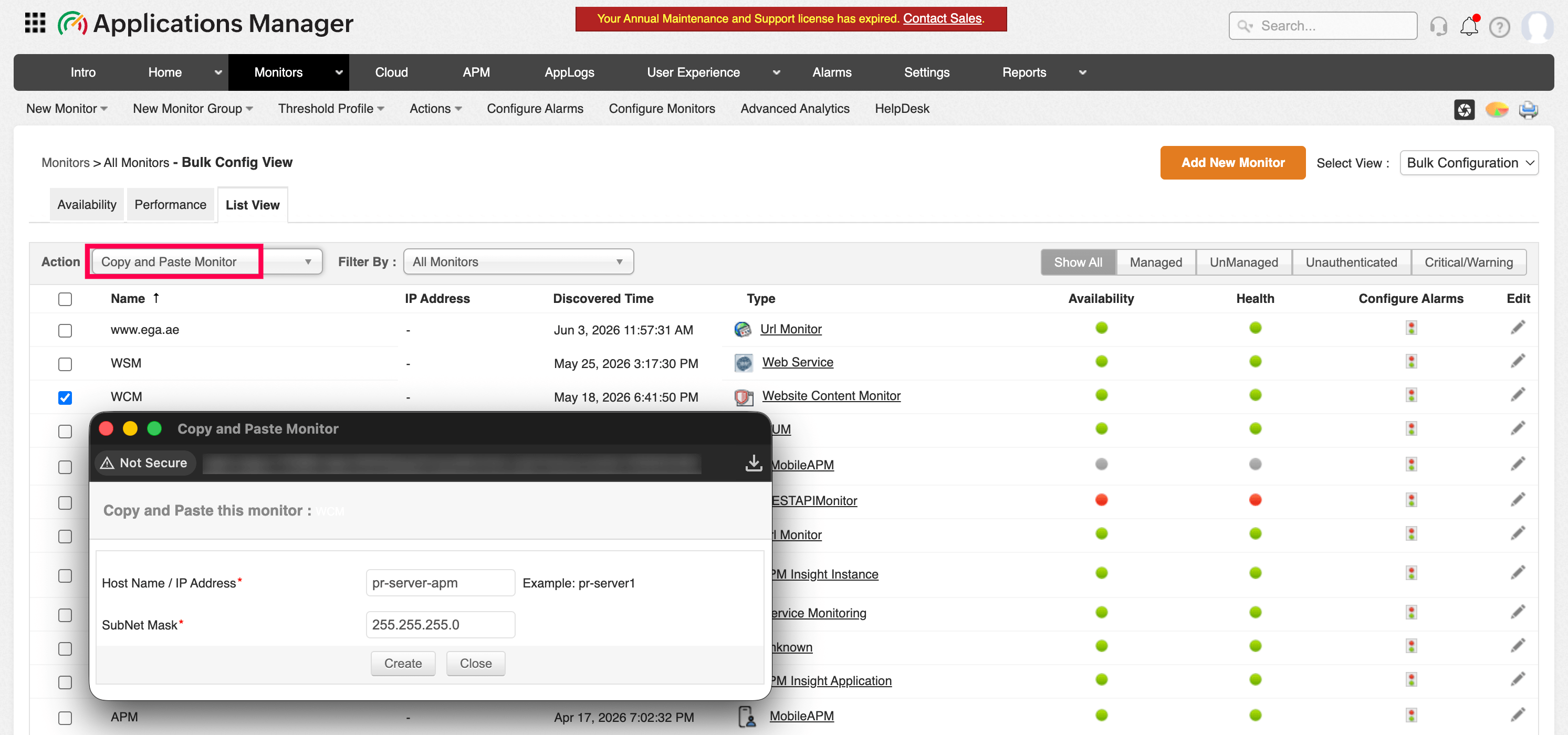
Copy and Paste Monitors
This option enables you to copy and paste the configuration of one monitor to create new monitors of the same type.
For eg., if you want to monitor the apaches running in 10 different servers, then you can configure the monitoring parameters of one apache in Host1 and copy those configurations to the other apaches in Host2 , Host3 ..to..Host10
On clicking copy and paste icon, you need to enter the host names of the servers to which the configurations have to be pasted (the host names can be given comma separated). Enter the SubNet mask too.
Note: If you want to copy and paste the configurations of server monitor, then you can choose to copy the configuration of the services running inside the server or only the server configuration.
Currently we do not support the copy and paste function for the following monitors:
- Custom Monitors
- Java Runtime
- PHP
- HTTP URLs
- HTTP URL Sequence
- Web Services
- Web Server
- JMX Application
- Ping Monitor
- Glassfish
- Silverstream
- IBM WebSphere MQ
- MS Office Sharepoint
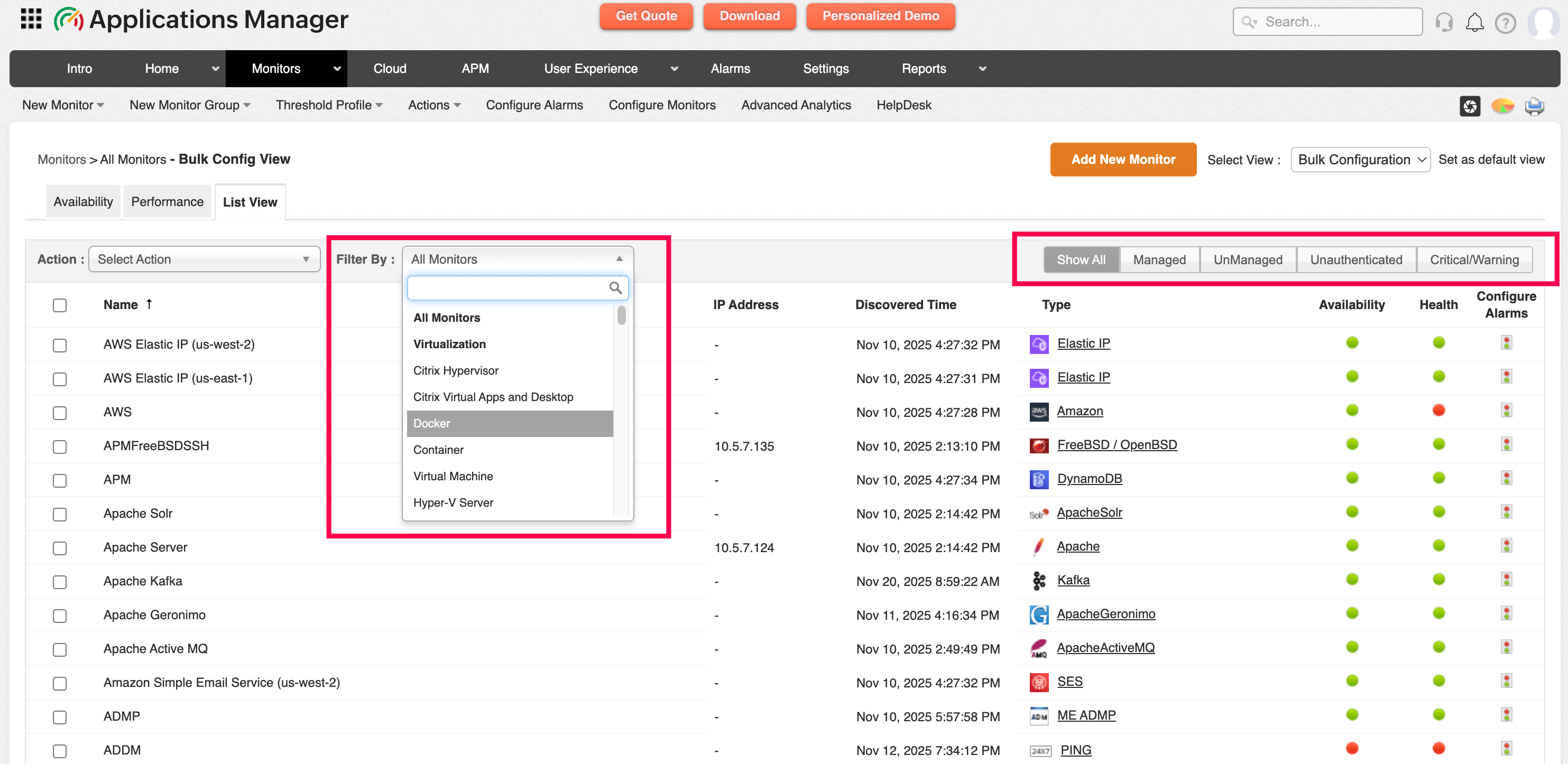
Filter By
The Filter By dropdown in the List view allows you to filter monitors by type. Set to All Monitors by default, it lets you narrow the display to a specific monitor category (such as Virtualization, Docker, Hyper-V, and others). Additionally, the status tabs on the right - Show All, Managed, UnManaged, Unauthenticated, and Critical/Warning - let you quickly filter monitors by their current state.