×
×
×
×

Frequently Asked Questions | Endpoint Central

Server

Server Migration

1. When do you remove the old setup after server migration?
Do not remove the old setup until all the agents start reporting to the new setup.The agents and the distribution servers, during their next contact, will pick up the details of the new server and start communicating with the new server subsequently. You will need to run the Endpoint Central Servers at both the installations till all the agents start reporting to the new server. Once all the agents have contacted the new server, you can then uninstall the old server.
2. Do you have to reapply the server license after server migration?
No, you need not reapply the server license after server migration.

Build Number and Versions

Where do I find my current build number?

Click the profile icon at the top-right of the console. Your build number appears in the panel that opens — for example, Build: 11.5.2605.01. Click the build number itself to open the Version Details panel, which shows the individual version installed for each component: Central Server, Distribution Server, and each agent type (Windows, Mac, and Linux).

How do I know if an upgrade is available for my current setup?

Click the profile icon at the top-right of the console. If a newer build is available, an upgrade prompt appears in that same panel alongside your current build number. For a broader view to plan the upgrade ahead, the ManageEngine's Endpoint Central lists the latest released build and the recommended upgrade sequence for your version but rather wait for the in-console upgrade notification.

What is the difference between a Service Pack and a Hotfix?

A Service Pack is a cumulative release that consolidates all fixes from prior builds into a single new baseline. Every customer upgrading beyond it must pass through it — there is no way to skip it. In the build string, the SP level is the second digit: in 11.5.2605.01, the 5 denotes SP5. An SP release also significantly reduces the size of subsequent PPM files, because older patch-handling code gets cleaned up during consolidation.

A Hotfix is smaller and targeted — it addresses specific bugs found after the last SP and applies on top of it. Hotfixes can be applied incrementally and are lighter than a full Service Pack.

The practical rule: install the SP first to establish the baseline, then apply hotfix builds on top as they are released.

My console shows a build number which is higher than the "latest released" build. How?

This is a custom fix or specialised hotfix build — not a general release. ManageEngine engineers assign a version number at the time a custom fix is compiled, which can produce a service-pack segment (2534) that appears numerically higher than the current public GA release (2528). This does not mean your environment has a "newer" or superior build — it means it's on a non-standard release branch.

Implications for upgrades:

  • Standard PPM files for the GA release path (2528.x) will likely be rejected by your Update Manager, because the installer detects a higher version number already installed.
  • Standard in-product upgrade notifications may not appear, since the server knows it deviates from the GA release path.
  • You must not attempt to downgrade or apply a lower-versioned PPM without Support guidance.

Recommended action: Contact ManageEngine Support and provide:

  • Your current build number as shown in the console
  • The contents of <UEMS_CentralServer>\conf\fixes_id.properties

Support will confirm your correct upgrade path — typically a custom-to-GA consolidation PPM — and whether the fix from your custom build has been merged into the current GA release.

Upgrade notification not appearing — but the server has internet access. Why?

Internet access alone does not guarantee that the upgrade notification will appear. There are four distinct causes, each requiring a different resolution. Work through the table below to identify which applies to your environment before resorting to a manual PPM download.

CauseHow to IdentifyResolution
Customised or Hotfix Build InstalledConsole build number ends in an unusual patch suffix (e.g., .12 on a build not listed on ME's official website). The server knows it deviates from the standard release path and suppresses standard notifications.Contact ManageEngine Support with your current build number. They will confirm the correct next step and whether a standard notification will appear once you return to the standard build path.
AMS (Annual Maintenance & Support) Subscription ExpiredNavigate to Admin → License. If the AMS expiry date is in the past, notifications for builds released after that date are suppressed.Renew your AMS subscription via your ManageEngine account manager. Notifications will resume once the subscription is active and the console re-contacts the update server.
Proxy or Firewall Blocking Update ServerFrom the server, try to reach autoupgrade.manageengine.com on port 443 using a browser or curl/telnet. If the connection times out, outbound traffic is being blocked despite general internet access being available.Whitelist autoupgrade.manageengine.com and downloads.manageengine.com on port 443 in your firewall or proxy. After whitelisting, click "Check for updates" again in the console.
In-Product Notification Setting DisabledNavigate to Profile Icon → Build Version → Settings. Check whether "Display in-product notifications about updates" is disabled.Enable the notification setting and save. The notification will appear at the next update-check interval (typically within a few minutes).
Info

If none of the above causes apply and notifications are still missing, download the PPM manually from ME's official website using the build number shown in your console and apply it via UpdateManager.bat. Refer to the Downloading the PPM section for instructions.

How do I distinguish between a Service Pack and a Minor Version from the build string alone?

The position and digit count of each segment tells you the upgrade type required:

SegmentPositionExampleUpgrade Type Required
Service Pack3rd (4 digits)2528Manual PPM download + planned downtime required
Minor Patch4th (2 digits)21Auto Upgrade eligible — no PPM download or downtime needed

Side-by-side comparison examples:

  • 11.4.2528.1911.4.2528.21 — only Segment 4 changed → Minor Version → Auto Upgrade eligible
  • 11.4.2516.3911.4.2528.21 — Segment 3 changed → Service Pack → manual PPM required
  • 11.4.2528.2111.5.2528.21 — Segment 2 changed → Major version upgrade → check ME's upgrade path guide first
Info

Practical rule: Compare builds left-to-right. If only the last two digits changed, it's a minor patch. If the 4-digit segment changed, plan a maintenance window. If Segment 1 or 2 changed, verify the full upgrade path on ME's official website before proceeding.

PPM Upgradation

Where do I find my current build number?
To find your current build number, click the profile icon at the top-right corner of the Endpoint Central console. The build number is displayed in the panel that appears (for example, Build : 11.5.2605.01). To view a detailed breakdown of the version for each component — Central Server, Distribution Server, and Agents (Windows, Mac, Linux) — click on the build number to open the Version Details panel.
How do I know if an upgrade is available for my current setup?
Endpoint Central notifies you of available upgrades directly within the console. Click the profile icon at the top-right corner — if a newer build is available, an upgrade prompt will be displayed in the panel alongside your current build number. You can also refer to the Service Packs page to check the latest available build and the recommended upgrade path for your current version.
Do agents and Distribution Servers need to be upgraded manually after a PPM upgrade?
No. Agents and Distribution Servers upgrade automatically — no manual intervention is required. Distribution Servers upgrade automatically based on their configured replication interval. WAN Agents associated with a Distribution Server upgrade within 90 minutes after their respective Distribution Server has completed its upgrade. Direct Agents upgrade automatically within the 90-minute refresh interval upon their next contact with the Central Server.
Is it necessary for all component versions to match the upgraded server build version?
No. A component upgrade is triggered only when the PPM build includes a version change for that specific component. If no version change is introduced for a component in the PPM build, its existing version remains fully compatible with the upgraded Central Server and continues to operate without any reinstallation. Therefore, it is not mandatory for all component versions to match the server build version at all times.
Why do I need to apply multiple PPM upgrades to reach the latest version?
If your current build is older than the latest Service Pack (SP) build, you must first upgrade to the SP build before applying any subsequent hotfix builds. Skipping the SP is not supported — the upgrade must follow the prescribed path. The recommended upgrade sequence for your specific version is always displayed on the Service Packs page.
What is the difference between a Service Pack (SP) and a Hotfix?

A Service Pack (SP) is a major cumulative release that consolidates all fixes and changes up to that point into a single unified build. It is introduced primarily for code maintenance and to establish a common baseline across all customers. Any customer wishing to upgrade to a build beyond the SP must pass through the SP first — it cannot be skipped. In the build number format, the Service Pack level is indicated by the second digit (for example, in 11.5.2605.01, the 5 denotes the Service Pack). An SP release also significantly reduces the PPM file size and the time taken to apply it, since all prior patch-handling code is consolidated and cleaned up.

A Hotfix is a smaller, targeted release that addresses specific bugs or issues identified after the last SP. Hotfixes can be applied incrementally on top of the SP baseline and are lighter in size compared to a Service Pack.

In summary: Apply the SP first to establish the baseline, then apply hotfix builds on top to stay current.

Backup

Does the server go down during a scheduled backup?

No. Scheduled backup is an online backup — the Endpoint Central server stays fully operational while the backup runs in the background.

What happens if the server is stopped at the scheduled backup time?

The backup will not run. There is no retry — it will only attempt again at the next scheduled time. Make sure the EC service is running.

How much disk space do I need?

At least 2—2.5× the current database size of free space on both the local drive and your backup destination. For example, if your DB is 10 GB, keep at least 20—25 GB free.

Can I back up to a network folder?

Yes. Ensure the Endpoint Central service account has write access to the network folder. For MSSQL, the SQL Server service account also needs write access. Test the connection before relying on it.

My backup is taking a long time. Is this normal?

It depends on your database size and storage speed. Network backups are slower than local ones. For Remote PostgreSQL, the backup runs over the network — speed depends on bandwidth between the EC server and the remote DB server. Schedule backups during off-peak hours to minimize impact.

What is the recovery key email I keep receiving?

Every 45 days, a recovery key is emailed to all administrators. This key lets you restore a backup even if you forget your custom password. Do not delete these emails.

Backups have stopped running. Are they disabled?

No. Backups are never automatically disabled. If 3+ consecutive failures occur, a dashboard warning appears, but backups continue to run on schedule. Fix the underlying issue (disk space, permissions, or network access) and the next run should succeed.

Can I disable scheduled backups?

It is not recommended. VM snapshots and SQL-only backups do not cover application files . We recommend keeping Endpoint Central's built-in backup enabled for complete protection.

Is a backup taken automatically before updates?

Yes. The system automatically creates a pre-upgrade backup before every update or patch.

Is it safe to delete files in the ScheduledDBBackup folder?

No, it is not safe to delete files in the ScheduledDBBackup folder manually. It is recommended to have atleast 7 days of backup files in the folder. The system automatically manages the backup files based on the retention count you set in the Admin → Database Settings → Database Backup section. Deleting files manually can lead to loss of critical backup data and may affect your ability to restore in case of an issue.

Restore

Can I restore a backup taken on a different build version?

No. The backup must be from the exact same build number. If you need to restore on a newer build, install the matching version first, restore, then upgrade.

Do I need to stop the server before restoring?

Yes, always. The restore will not proceed if the service is running. Stop the service via Windows Services before starting the restore.

Will I lose data made after the backup date?

Yes. Restoring replaces all current data with the backup data. Any changes made after the backup date will be lost.

I forgot my backup password. What can I do?

Use the recovery key emailed to all administrators every 45 days. Check your email archive for a message from Endpoint Central containing the key. If you can't find it, contact ManageEngine Support.

Do I need to reinstall Endpoint Central before restoring?

Only if you're restoring on a new server. On the same server, just stop the service and run the restore utility — no reinstallation needed.

Will managed agents reconnect after the restore?

Yes, if the server hostname and IP address remain the same. Agents reconnect automatically within few minutes.

Can I restore a backup from a different database type?

No. Cross-type restore is not supported. The backup must match the exact database type of your installation (e.g., you cannot restore a Remote PostgreSQL or MSSQL backup on a Bundled PostgreSQL setup).

Can I restore to a different server?

Yes. Install the exact same version on the new server, copy the backup file, and restore. The build number, database type, and architecture (32-bit/64-bit) must all match.

Server won't start after VM snapshot restore

VM snapshot restore not recommended, in Endpoint Central files and database should be in sync so restoring either files or database alone separately using VM snapshot might lead to inconsistency, so always use the Backup-Restore Utility instead of VM snapshots.

I need the exact installer version to restore but my server crashed

Contact support with your backup file details. They can help you locate the exact build installer matching your backup so you can install it on the new server and restore.

How do I change or reset my backup password?

Go to AdminDatabase SettingsDatabase BackupBackup Protection. The new password applies only to future backups. For existing backups, use the original password or the recovery key.

How do I change the backup schedule, location, or retention count?

Go to AdminDatabase SettingsDatabase Backup. You can change the backup time, retention count, and destination path. After saving, new backups use the updated settings. Existing backups at the old location are not moved automatically.

How do I change the backup failure notification recipients?

Go to AdminDatabase SettingsDatabase Backup. Update the email addresses under the failure notification section. A working mail server must be configured in AdminMail Server Settings.

What is the default backup location?

<Install Dir>\UEMS_CentralServer\ScheduledDBBackup\. We strongly recommend changing this to a different drive or network share.

How do I check which database type my server is using?

Go to AdminDatabase Settings. The database type (Bundled PostgreSQL, Remote PostgreSQL, or Microsoft SQL Server) is displayed on this page.

How does backup work with a Failover Server (FOS)?

Backups should always be performed on the primary server. The Failover Server does not run independent backups. After restoring on the primary, run SyncSecondary.bat Restore from the primary server's bin folder to sync the secondary server.

Kingbase Database

Does the migration tool create the database automatically?

No. Unlike PostgreSQL migration, the KingBase migration tool does not create the database. The database must be pre-created on the KingBase server before migration.

What if the version validation fails?

The migration tool only supports KingBase V9R1C10. If you have a different version, you must upgrade or install V9R1C10 before proceeding.

What is the kbcrypto extension and why is it required?

The kbcrypto extension provides SM4 symmetric encryption functions. Endpoint Central uses SM4 encryption for sensitive columns in the database. Without this extension, encrypted columns cannot be read or written.

What happens if database_mode is not set to 'pg'?

KingBase supports multiple compatibility modes (PostgreSQL, Oracle, MySQL). Endpoint Central requires PostgreSQL compatibility mode (database_mode=pg). The migration tool will block the migration if the mode is incorrect.

What if the migration fails midway?

If migration fails, the database_params.conf file is not updated. The server remains on the original database. You can safely retry the migration after resolving the issue. It is recommended to drop and recreate the KingBase database before retrying (as it may contain partial data).

Can I migrate from KingBase to KingBase?

Yes. You can migrate from one KingBase instance to another (e.g., moving to a different server). The process is the same — select KingBase in the migration tool and provide the new connection details.

Is SSL/TLS required?

SSL/TLS is strongly recommended for production environments but is optional. Without SSL, all JDBC traffic (including credentials and SQL queries) is transmitted in plaintext over the network. Configure SSL on the KingBase server and the product will automatically detect and use it.

What is ci_x_icu collation and why is it needed?

The ci_x_icu collation provides ICU-based case-insensitive text comparison. Endpoint Central requires this for case-insensitive search operations on certain columns. This must be available in the KingBase instance before migration.

What authentication methods are supported?

Endpoint Central connects to KingBase using username + password authentication (scram-sha-256 recommended in sys_hba.conf). Trust authentication (no password) is detected and blocked by the product at startup.

Mail Server Settings

Which mail servers support OAuth?
OAuth authentication is tested with Microsoft Outlook (Office365) and Gmail (Gsuite).
Can I configure OAuth for an existing mail account?
Yes, OAuth authentication can be configured for an existing mail account.
Why should I switch to OAuth2.0?
Google and Microsoft deprecated basic authentication for mail servers on May 30, 2022, and October 1, 2022, respectively.To ensure secure and uninterrupted mail communication, it is recommended to use OAuth authentication.
What is a Redirect URL, and where should I configure it?
A Redirect URL (Reply URL) is where the Authorization Server sends response data. Copy and paste the Redirect URL into the application details in the Authorization Server settings.
Why do I get an error stating "Redirect URL invalid/mismatch" when saving settings?
Ensure that the Redirect URL is added to the authorization server’s list of allowed Redirect URLs and that the settings are saved correctly.
What happens when my access token expires?
When the access token expires, a new token is automatically generated using the refresh token.

Network Settings

Can I configure network settings even if my agent count is below 200?
We recommend configuring the network settings only for over 200 agents, to avoid unnecessary delays in deployment. However, this can be used for a slightly lower agent count as well.
Why am I getting the "File download delayed due to bandwidth limitation" error for deployments?
When bandwidth restrictions are applied, the deployment to a large number of endpoints happens sequentially in batches to optimize the deployment time. The deployment to the remaining endpoints will resume in eventual refresh cycles.
If I configure bandwidth restriction for the central server, does it also apply for the distribution servers?
The bandwidth restriction configured for the central server does not affect the communication between distribution servers and the agents under it.
How can I find the NIC capacity?
On the server machine, navigate to Control panel -> Network and Internet -> View network status and tasks -> Ethernet -> Speed

Agent

Agent Installation

How do I install the Endpoint Central agent on devices in my organization?

Endpoint Central supports multiple agent installation methods — manual install, GPO push, AD-based automatic install, push via CLI, Azure/Intune, and bulk install for AWS instances. Refer to the Agent Installation guide for the complete list of methods.

What is the most effective way to deploy the agent to all machines in a specific OU?

Use the automatic agent push installation method. Details are available in the Agent Installation guide.

How do I install the agent on a remote machine (e.g., located in a US office)?

Use any of the supported remote installation methods documented here. Push install via CLI or self-install URL are common choices for remote endpoints.

Can the agent be installed on Linux? Are Linux agents distro-agnostic?

Yes. Linux agents are not tied to a single distribution. Refer to Managing Linux computers.

How does Azure Autopilot agent deployment work?

Refer to Windows Autopilot enrollment. Intune licenses are required for each user when using Azure Autopilot.

Can the agent be pre-installed on a Windows image (OS deployment)?

Yes. The agent can be installed via imaging or as a post-deployment step in OS Deployment. See the Agent Installation guide.

What are the various methods of agent installation?
Endpoint Central agents can be installed using multiple methods including: manual installation using the agent package, Active Directory Group Policy Object (GPO) deployment, using a GPO startup script, through the lightweight GPO tool, by configuring the GPO Scheduler, installing agents on cloud instances such as Microsoft Azure, or deploying directly via the product console.
How to use "Waiting for Approval" after agent installation?
Add the device to the Scope of Management and then mark it as "excluded" from management in the settings. This ensures the device is inventoried but will not receive configurations or deployments.
Is it possible to use Endpoint Central to manage computers without installing agents?
No, Endpoint Central needs agents to perform any desktop management activity.
Do I need to uninstall the old agent before installing the new one?
Yes, only one agent can be installed on a machine at a time. If an existing agent is detected, the installer will block the installation and display an error. Please uninstall the existing agent first before proceeding.

Agent Troubleshooting Tool

How do I run the agent troubleshooting tool?

Windows: Right-click the agent tray icon in the system tray → select Agent Troubleshoot > Troubleshoot → click Start Troubleshooting. Alternatively, run the executable directly from C:\Program Files (x86)\ManageEngine\UEMS_Agent\bin\agent_troubleshooting_tool.exe.

Linux (v2203+): Open Terminal, navigate to /usr/local/manageengine/uems_agent/bin and run sudo ./dctroubleshootingtool.

macOS (v11.4.2544.01.M+): Click the agent menu bar icon → Tray Icon > Troubleshoot > Run troubleshooting tool. Or open Terminal and run /Library/ManageEngine/UEMS_Agent/bin/troubleshoot.

How do I run the troubleshooting tool from the command line?

Windows: Open Command Prompt and run: "C:\Program Files (x86)\ManageEngine\UEMS_Agent\bin\agent_troubleshooting_tool.exe"

Linux:cd /usr/local/manageengine/uems_agent/bin then sudo ./dctroubleshootingtool

macOS:/Library/ManageEngine/UEMS_Agent/bin/troubleshoot. To view all available options, run troubleshoot --help.

What does the agent troubleshooting tool check?

Windows: Agent Service status, Agent Identity (machine UUID and OS details), Agent Binaries integrity, WMI connectivity, Active Directory connection, Antivirus software installed, Server connection (ping and port), Distribution Server connection (if applicable), Notification Server idle connection, and RDS connectivity.

Linux: Product details (version, directory, remote office name), machine hostname/FQDN/IP/MAC, server connectivity (Central Server, Distribution Server, on-demand, remote control), patch tool availability (apt/yum/zypper), minimum 20 GB free space check, vendor connectivity (cloud agents only), and dcservice/process status.

macOS: Server connection, Distribution Server connection (if applicable), on-demand action capability, service and process health, agent version, server address, and MDM enrollment status.

How do I use the UEMS troubleshooting tool to fix agent issues?
Run the tool and wait for the scan to complete. Components showing a warning or error will be highlighted. Click the affected component — this expands the detailed status and links to the KB article for that specific issue. Follow the KB steps to resolve the issue, then click Scan Again to confirm the component is now healthy. If the issue persists, click Export to generate a diagnostic report and contact ManageEngine Support.
How do I interpret the troubleshooting tool output?
Each component displays one of three states: Pass (green) — healthy, no action needed; Warning (yellow) — functional but has a potential issue, click the component for details; Error (red) — failed, click the component to see the error and the linked KB article with resolution steps. The Troubleshooting Summary tab gives a consolidated view of all results. Note: results are cached for 24 hours — click Scan Again at any time to get a live status.
Where are the agent logs located?
Access logs directly from the troubleshooting tool via View Logs — logs are segregated by component (system, configuration, patch, and others). To access log files directly on disk:
  • Windows:C:\Program Files (x86)\ManageEngine\UEMS_Agent\logs\
  • Linux:/usr/local/manageengine/uems_agent/logs/
  • macOS:/Library/ManageEngine/UEMS_Agent/logs/
  • macOS dump (--dump):/Library/ManageEngine/UEMS_Agent/logs/UserLogs/dumps/
How do I collect and share agent logs with support?
Click the Export button inside the troubleshooting tool. This packages all diagnostic data — component status, logs, and system details — into a single report file ready to share with ManageEngine Support. On macOS, you can also generate a detailed dump using Terminal: troubleshoot --dump. The dump is saved to /Library/ManageEngine/UEMS_Agent/logs/UserLogs/dumps/.
How do I verify agent connectivity to the server using the troubleshooting tool?
Run the troubleshooting tool and check the Server Connection component — it automatically tests ping and port connectivity to all server addresses used by the agent. For a quick manual check, run telnet <Server Address> <Server Port> in Command Prompt on the agent machine. A blank screen indicates a successful connection. You can also verify file download connectivity by opening https://<Server_Address>:<Server_Port>/client-data/ns-status-details.xml in a browser on the agent machine — if an XML file loads, the connection is successful.
How do I check if the agent is connected to the Distribution Server?
In the troubleshooting tool, look for the Distribution Server component. It only appears if the agent is managed under a Distribution Server (remote office setup). It tests ping and port connectivity to the DS address and highlights any issues in the error column. If the Distribution Server component is not visible in the tool, the agent communicates directly with the Central Server — no Distribution Server is in use for this agent.
How do I check agent connectivity on a Linux system?
Run the troubleshooting tool from Terminal: navigate to /usr/local/manageengine/uems_agent/bin and run sudo ./dctroubleshootingtool. For quick manual checks without the tool:
  • Test server port connectivity: curl -sk https://<server>:8383/dcapi/agentInfo
  • Check agent service status: systemctl status uems-agent
  • View last communication log: tail -50 /usr/local/manageengine/uems_agent/logs/AgentComm.log | grep heartbeat
How do I check the UEM agent status on Linux?
Use the following commands in Terminal:
  • systemctl status uems-agent — checks if the agent service is running
  • ps aux | grep uems — lists running agent processes
  • sudo systemctl restart uems-agent — restarts the agent service if it is stopped

Scope of Management

What is Scope of Management (SoM)?
Scope of Management is a feature that is used to specify which computers you can manage using Endpoint Central. You can add and manage computers that are from an Active Directory, a workgroup or any other directory service like Novell eDirectory. The computers can either be in the same Local Area Network (LAN) or in a remote location connected through a Virtual Private Network (VPN) connection or through the Internet. For more information, see Defining the Scope of Management.
How to add a device to the SoM, but exclude it from being managed?
Add the device to the Scope of Management and then mark it as "excluded" from management in the settings. This ensures the device is inventoried but will not receive configurations or deployments.
Is it possible to use Endpoint Central to manage computers without installing agents?
No, Endpoint Central needs agents to perform any desktop management activity.
How to add computers to be managed in LAN? / How to define the Scope of Management (SoM)?
Navigate to Admin >> Scope of Management and select the option to add computers. You can add systems from Active Directory, workgroups, or by specifying IP ranges. Computers added here will automatically be included for management by Endpoint Central.
What will happen if the agents are unable to reach the Endpoint Central Server to report the status after performing any task?
Agents will report the status to the Endpoint Central server after performing every task. In case if the Endpoint Central Server is not reachable, then the agents will update the status during their subsequent refresh interval.
How will the agent reach the Distribution Server if the port number used for their communication has been changed?
When the agents of the remote location are unable to contact the Distribution Server, they contact the Endpoint Central Server directly during the next 90 minutes refresh interval. They receive the modified port numbers of the Distribution Server and communicate with it henceforth.
Can I use Endpoint Central to manage computers that does not belong to a domain?
Yes, it can be used to manage computers even if they do not belong to a domain.
Is it mandatory for all the managed computers have connection to the internet?
No, it is not necessary for all the managed computers to have internet connection. However, the product server would need connection to the internet in order to download the patches and software applications from the respective vendors website.
Is Endpoint Central capable of managing Virtual computers?
Yes, it is capable of managing virtual computers.
How to remove a computer that has been taken offline?
To remove a computer that has been taken offline, navigate to Admin>>Scope of Management>>Computers, select the computers that have been taken offline, and click on "Remove Computer(s)"
What are the minimum rights/privileges required to make any domain-related changes using Endpoint Central?
Domain Admin credentials are required to make any Domain-related changes. You can also use the Local Admin, if it is same for all the computers in that domain.
Can I manage two computers with the same name but situated in different domains using Endpoint Central?
Yes, this can be achieved. Once the individual domains are added in Endpoint Central, all available computers can be added and managed, even if they have similar names.
Do we have any option for multiple active directory inputs in Endpoint Central?
Yes, We accept multiple active directory inputs.
What is IP Scope and What are its advantages?
Endpoint Central has different agents for different locations, for example a local office agent will not be the same as the remote office agent. Similarly every remote office has different agents as well. When you are managing computers one or more remote locations, you can have a defined set of IP ranges for different offices. This enables the product Server to identify the agents with respect to the IP range. So whenever a computer is moved from a local office to a remote location, IP scope is used to automatically detect and deploy the respective WAN agent. Endpoint Central will check for the change in the IP address periodically and will deploy the appropriate agents whenever a change is detected.
Why is UES Agent service running in my machine?
The UES agent runs in the background as part of Endpoint Central when a user subscribes to the Enterprise edition/UEM edition/Security edition. The UES Agent service is necessary for the proper functioning of secure usb configuration and Device Control policies. Even if the above mentioned policies are not applied, the UES Agent service will be running in the background in idle state.
What is "dcagentupdater" scheduled task?
This is a scheduled task created in the agents. This task runs on the client computer and scheduled every hour to ensure that the agent version is up to date.
How to add details of remote offices?
To add a remote office, go to Admin >> Scope of Management >> Remote Offices and provide details such as office name, IP range, WAN agent type, and the communication port. You can also configure distribution servers for bandwidth optimization.
Does a replication policy and network settings serve the same purpose once configured?
Replication policies can be used to optimize bandwidth consumption when data is being replicated from the central server to the distribution servers. Network settings on the other hand, can be configured to limit the central server's maximum outgoing bandwidth during patch/software deployments to managed endpoints.
How to manage roaming users' desktops?
Roaming users can be managed by configuring the agents to communicate with the Endpoint Central server over the internet. When the user moves outside the LAN, the agent continues to check in with the server using HTTPS communication. VPN or public IP configurations may also be applied.
How to uninstall agents using various methods?
To uninstall, go to Admin >> SoM >> Computers, select the computer, and choose Uninstall Agent. End users can also uninstall if enabled in Add/Remove Programs.
How do I reconnect agents after server migration?
When an agent tries to contact the old server, the agent will get to know the changes automatically and start communicating with the new server. As a best practice, we recommend to wait (persist the old server — do not remove it) until all agents communicate with the new server.
How do I verify agent connectivity to the server?
Check the console to see if all the devices are visible after migration.

Distribution Server

Can one distribution Server support multiple remote offices?
Yes, it is technically possible if all the remote offices use the same agent and if all the remote office computers can reach the Distribution Server. However this is not applicable for Patch Manager Plus cloud, since every remote office needs a unique Distribution Server.
If distribution server is stopped so whether client will be able to communicate to main server?
Yes, the agents will contact the server to post the failure messages. But, no deployment will happen.
Does the distribution server need to be dedicated? Does it need to run on a server OS?
No, it is not required to be a Server OS, it can be a simple desktop. Dedicated machines is also not required. The only requirement would be the availability of that machine with zero down time.
Is it required to move to the distribution server to edge/ public communication?
Moving a distribution to the edge is not necessary, distribution server will replicate the required data from Endpoint Central and the agents within the respective remote office will communicate with the distribution server.

Tools

What if the computer is inactive when an announcement is scheduled to display only once?
The status will be marked as "Expired", indicating the announcement was not shown within the time limit.
What happens when I deploy to a large number of users at once?
The message displays instantly to the first 200 users. Remaining users will receive it during the next 90-minute refresh interval.
Can I reuse an existing announcement to create a new one?
  1. Navigate to Announcement → User/Computers.
  2. Select the existing announcement.
  3. Under Actions, click Save As New.
  4. Make changes and click Save.
What happens when I suspend an announcement that was to display only once?
It will not display unless resumed. It will only display again if the end date hasn't passed and it hasn’t been shown to the targeted device yet.
If a targeted user is logged into multiple computers, will the announcement show everywhere?
Yes, it will appear on every computer where the user is currently logged in.
Is there a limit to the number of devices/users I can target?
No. Announcements can be shown to any number of managed computers or users, either once or repeatedly.

Remote Control
Which ports must I open to use the Remote Control feature?
The following ports must be open in the endpoint where the Endpoint Central server is installed to use the Remote Control feature:

  • 8443 — for secure connections
  • 8444 — for normal connections
By default, the Remote Control feature uses a secure connection.
Which ports must I open to use the File Transfer feature during a remote control session?
To use the File Transfer feature during a remote control session, open the following ports in the endpoint where the Endpoint Central server is installed:

  • 8443 — for secure communication
  • 8444 — for normal communication
The File Transfer and Remote Control features use the same port.
Can I view multiple monitors of a remote computer simultaneously?
Yes, you can view multiple monitors of a remote computer simultaneously by using the Remote Control feature. You can switch between monitors using the multi-monitor icon available in the Active X viewer. Viewing multiple monitors simultaneously is currently not supported in a Java viewer. To know more about viewing multiple monitors during a remote session refer to this page.
The UI-rendering while using the Remote Control feature is slow. How can I improve its speed?
To enhance page-rendering speed, set the compression level to Fast while using the Remote Control feature. Although this setting increases bandwidth consumption compared to the Best compression level, it provides faster page rendering.
What is the difference between Fast and Best Compression levels?
When you set the compression level to Fast, the compression ratio is lower, resulting in an increase in the speed of the rendering of the UI. This is recommended when the computer that you are connecting remotely to is in the same LAN as the computer you are connecting from.

When you set the compression level to Best, the compression ratio is higher, resulting in a decrease in the consumption of the bandwidth. However, the rendering of the UI will be comparatively slower. This setting is recommended when the computer that you are connecting to remotely is at a different geographical location.
On which browsers can I use the Remote Control feature?
You can use the Remote Control feature on the following browsers:
  • Mozilla Firefox
  • Google Chrome
  • Microsoft Internet Explorer
  • Zoho Ulaa
Is it possible for multiple users to login remotely to a computer at the same time?
Yes, it is possible for multiple users to login remotely to a computer at the same time. However, only one of the users who has logged in can take control. The other users can only view the changes that are being made.
How do I lock a keyboard or a mouse or blacken the display on a remote computer?
To lock the remote computer's keyboard and mouse, click the Lock Keyboard/Mouse icon from the viewer.
To blacken the remote monitor, click on the Blacken Monitor icon from the viewer. You can blacken the monitor of a remote computer when you do not want the user to view the changes that you are making.
What will happen when I take a remote session of a Virtual Computer?
When you take a remote session of a Virtual Computer, the session behavior depends on the virtualization platform. The Remote Control feature connects to the guest OS running inside the virtual machine in the same way it connects to a physical computer. Ensure the virtual machine is powered on and the Endpoint Central agent is running inside the guest OS before initiating the session.
How to locate the file where the remote control session is recorded?
To locate the file where a remote control session is recorded, first navigate to the directory where the Endpoint Central server is installed. Then, go to:

<Installed_Directory>\DesktopCentral_Server\webapps\DesktopCentral\server-data\<customerID>\rds\scr-rec

Chat

How to clear chat history?
To clear chat history follow the steps mentioned below;
  1. Click Tools Tab and select Chat
  2. Under History click on Chat History Settings
  3. Specify the number of days to maintain the chat history, so that the previous chat history will be deleted.
What will happen if port # 8022 is already in use?
If port # 8022 is already in use, you can use configure chat in other ports. To change the port used by chat, follow the steps mentioned below;
To change the port number after the Endpoint Central server is installed, follow the steps given below:
  1. Stop the Endpoint Central server.
  2. Click start
  3. Point to Programs>ManageEngine Endpoint Central
  4. Click Stop DesktopCentral
  5. Open the websettings.conf located in <Install_Dir>\DesktopCentral_Server\conf. For
    example, C:\Program Files\DesktopCentral_Server\conf.
  6. Change the port numbers of the following key with the required values:
  7. httpnio.port
  8. Save the file and close it
  9. Start the Endpoint Central server.
  10. Click start
  11. Point to Programs>ManageEngine Endpoint Central
  12. Click Start DesktopCentral
You can now connect the chat sessions, using the Endpoint Central server.
Under which circumstances will chat session fail?
Chat session will fail in the following scenarios;
  • Agent not reachable in the client computer
  • If the user is inactive in the computer
  • If the "chat connection" session is time-out
What will happen when we try to initiate a chat session with the user who is inactive?
You will not be able to chat with the user if the user is offline.
How often will the logged on User names be refreshed?
The list of user names will be updated in three scenarios as specified below.
  • During 90 minutes refresh interval while the agent communicates with the server.
  • During every user log on if it is configured in the User Logon Settings.
  • During every user logoff.
With adding or managing software licenses, I have ran into issues with tracking the license count. Some of the software like MS Office consists of several versions. Is there any way to consolidate all these software versions using Endpoint Central and allocate the licenses in one place?
Yes, you can use Endpoint Central to group the software based on versions. "Group Software" is the feature which allows you to group different versions of same software for better visibility and license management.
If a software is rejected as prohibited software, when a user asks for permission to use it, and the permission is granted, can that rejection be revoked in the application?
If a software was rejected, then the software would be removed from the target computer based on the auto-uninstall policy specified. However, if the admin again approves it, it can be reinstalled and won't be removed. Lets imagine there is a delay in approval. So, it would be automatically uninstalled if it was not approved till the given threshold day count. If the uninstall threshold is yet to reach then the software would be available.
When you add a program to the prohibited software list, does it take all the version of the software into account? Do I need to update the prohibited software list every time a new version is released?
If the new version of program is automatically upgraded then it is not required to add the new version into prohibited list. Else, you will have to add it manually. Create a software group with all versions of the particular software and include the software group to the prohibited software list. It also provides a great way to have software version control in the network by not allowing other versions of same software.
Why are file scan and software metering rules applied to all endpoints? How can file scan and software metering rules be managed effectively?
In Endpoint Central, file scan and software metering rules gather minimal, aggregated information from all endpoints in the network. These rules are designed to give a complete organizational overview rather than focusing on isolated or specific endpoints. This ensures that audits and decisions are based on comprehensive, accurate data. Restricting them to a limited set of endpoints would lead to incomplete and less valuable reports. Users with full access to the Inventory module can add, modify, or delete these rules as needed.

To maintain consistency, it is recommended for a single administrator or a small group of authorized users to manage these rules, preventing duplication and ensuring standardized data collection.
If the software that you want to be prohibited is not already installed on your network, how can I block it using Endpoint Central?
You can use "Block Executable", to block the application/software in a pro-active manner. However, the product positions this feature as a procedure to block non-standard executable which are used in your network, It would help you to prevent your network from data leak and other security threats.
If I want to disable office 2013 what about 'outlook' as everyone uses outlook for as their business mails?
You can choose to disable specific applications using the 'Block executable'. This allows you to block only the specific required application. For example, if, you want to block Microsoft Excel you need to do it by mentioning its specific name, excel.exe. This doesn't prevent you from using word.exe. Similarly, Outlook continuous to work unless it is specifically blocked.
Why am I recieving the Inventory alerts when I have not configured it?
You might be receiving the Inventory alerts because other users have configured the alerts and have configured the team email ID.

Integration

Service Desk Plus Integration

After integrating Endpoint Central with ServiceDesk Plus, is it necessary to use both their agents?
No, it is not necessary to use both agents. The ServiceDesk Plus agent primarily collects asset data, which can also be gathered using the Endpoint Central agent. In addition, the Endpoint Central agent enables you to perform several desktop management tasks such as raising help desk tickets from the tray icon, deploying patches and software, and taking remote control of systems. Therefore, you can uninstall the ServiceDesk Plus agent and use only the Endpoint Central agent.
I have license to manage 1000 nodes in ServiceDesk Plus and have purchased license to manage 500 computers in Endpoint Central. How does integration work in this scenario?
In this case, if you have 700 computers out of the 1,000 nodes, you can manage only up to 500 computers in the integrated console, as per your Endpoint Central license. For seamless integration and consistent management, it is recommended that the license count in both ServiceDesk Plus and Endpoint Central matches the number of computers you intend to manage.

Analytics Plus Integration

How long does it take for Endpoint Central data to appear in Analytics Plus after integration?
After configuring the integration, the initial data synchronization may take some time to complete. Depending on the volume of data in your Endpoint Central setup, it may take up to 5 minutes for reports and dashboards to display all metrics. Accessing the workspace before the initial fetch is complete may result in no data being displayed.
What should I do when the data synchronization fails?
The import or synchronization process of your Endpoint Central data can sometimes fail, when the API key becomes invalid or if Endpoint Central is moved to another server. To resolve this issue refer to the below mentioned documents:
How frequently can I synchronize my Endpoint Central data in Analytics Plus?
You can synchronize your data at the following intervals:
  • Daily: Synchronizes data once every day at a specified time.
  • Hourly: Synchronizes data every 3, 6, or 12 hours, based on your selected interval.
Can I collect and create report on data from multiple Endpoint Central accounts in a single Analytics Plus workspace?
Yes, Analytics Plus enables you to import and consolidate data from multiple Endpoint Central accounts into a single workspace for reporting and analysis.
Can I synchronize my Endpoint Central data instantly?
Yes, you can synchronize your Endpoint Central data instantly in Analytics Plus. To synchronize your Endpoint Central data instantly follow the steps given in this document.
Can I set up the Endpoint Central integration in existing workspaces of Analytics Plus?
Yes, you can setup the Endpoint Central integration in an existing Analytics Plus workspace. To setup your Endpoint Central integration in an existing workspace refer to this document.
Can I modify the pre-built reports provided with the Endpoint Central integration in Analytics Plus?
Yes, the pre-built reports included with the Endpoint Central integration can be modified to suit your reporting requirements.
Can I modify the tables imported from Endpoint Central in Analytics Plus?
No, the data imported from Endpoint Central is automatically synchronized with Analytics Plus and stored in predefined tables. As a result, you cannot manually add or modify the data in these tables.
Can I add new columns to the tables imported from Endpoint Central into Analytics Plus?
No, you cannot add new data columns to the imported tables. However, you can create Formula Columns and Aggregate Formulas to derive custom metrics and build tailored reports.
Can I import new tables into the Endpoint Central workspace?
Yes, you can import the new tables to the Endpoint Central workspace. To do this, open the Endpoint Central Analytics workspace, click Create from the side panel and select the New Table / Import Data option. You can integrate with other applications, or choose to import data stored in local files, web URLs, local databases, and cloud databases.
Can other users create reports using the tables in the Endpoint Central workspace?
Yes, other users can create reports using the tables in the Endpoint Central workspace. To enable this, share the required tables with them and assign the appropriate permissions and filters.
Which type of software repository is recommended for computers in remote location; is it a network share or HTTP share?
We would recommend using a HTTP share as the software repository for computers in the remote location. This would ensure that all the computers can reach the software repository easily.
Why must I specify "Run As" when Endpoint Central already has the credentials stored under Agent > Scope of Management > Computers>Edit Credentials?
"Run As" is the option which is used for the applications that need to be installed as a different User. Since the product supports Multiple Active Directory domains and work-groups, we need to associate the credential supplied in SoM with the corresponding Domain or work-group.  In order to handle such scenarios, the product gets the additional user name and password for RunAs.  However, if "Run As" is not specified then system credentials will be taken by default.
Why must I specify the MSI Root Path? It is identical to the MSI file name with network path.
The MSI Root Path is mainly used for the following:
  • Copying the files to the client computer.
  • Setting the working directory for installation.
If the MSI file is browsed and chosen then the MSI Root Path is automatically taken.  It becomes mandatory only when the MSI file name with network path is manually entered.
The configuration seems to have been deployed successfully but the application is not installed on the target machines.  How do I resolve this?
  • To make sure that there are no issues with the created software package, try deploying it via the command line.
  • The application to be installed can be user or system specific. Ensure that you have deployed the right configuration type (user/computer based) accordingly.
  • The application may need admin rights to install, so try deploying it with the RUN AS ADMIN option.
Can I install a software application if the User Account Control (UAC) setting is enabled?
Yes, you can install a software application when the UAC feature is enabled if you are not required to enter information during installation. However, if you have to enter information during the installation of a software application, you must create a user configuration without selecting the Run As option. When you use the Run As option in a user configuration, use the Default Administrator account.
Can I extend my file upload limit beyond 12 GB in the Software Deployment manual package creation?
Yes, you can extend your file upload limit beyond 12 GB in an On-Premise setup. Contact endpointcentral-support@manageengine.com to extend your file upload limit.
Can I access the Self Service Portal using a local administrator account?
No, Self Service Portal can be accessed only by Domain User accounts present in the Domain joined machines.
For how many target computers can I deploy the software immediately?
You can deploy the software for 50 target computers immediately.
Do you have some protection in the http repository to prevent some outsiders from stealing the installation media?
It depends on your deployment type:Endpoint Central On-PremisesIf you are using Endpoint Central On-Premises, the HTTP repository is hosted within the customer's own network. This means the responsibility of securing it — including preventing unauthorized external access to the installation media — lies with the customer. The customer will need to ensure their network-level controls, firewall rules, and access policies are in place to protect the repository from outside access.Endpoint Central CloudIf you are using Endpoint Central Cloud, you do not need to worry about this. ManageEngine takes care of the HTTP repository security and ensures the installation media is protected on your behalf, in accordance with Zoho's security standards and practices.
Is there an option for an HTTP software repository on Endpoint Central Cloud?
No, the HTTP repository is not available in Endpoint Central Cloud. Instead, end devices can download the software directly from the vendor's website.

License

Server Licensing

How to identify servers? Are all Linux machines considered servers?

Currently, if the operating systems meet any of the following criteria, we consider them as server machines:

  • If the machine has Windows server operating system
  • If the machine with Red Hat Enterprise Linux OS has a Server subscription
  • If the machine has Oracle Linux OS
  • If the virtual machines have any of the above OS' installed

We recommend purchasing server licenses for any Linux machine when deploying them as servers within the organization.
How many servers can be managed with the free edition?
The free edition allows management of any number of servers, as long as the total number of endpoints does not exceed 25.
What happens to an existing customer upgrading to the latest build? Will server licensing take immediate effect?
Existing customers can upgrade to the latest build without any issues. Server licensing will only become active once the new license is applied. Until then, they can continue managing any number of servers.
How to identify servers from the Endpoint Central web console?
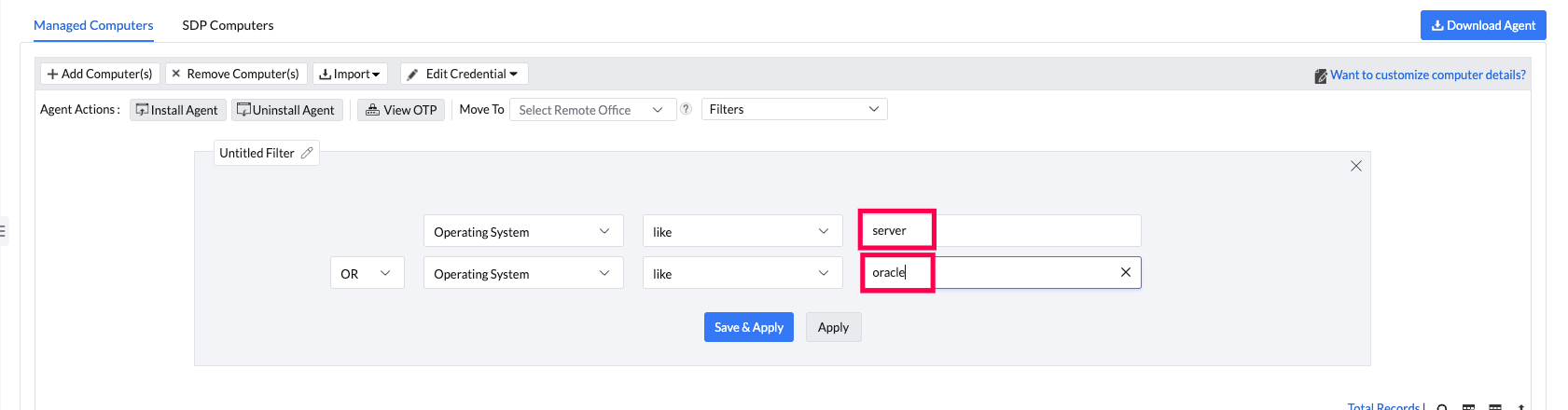
Navigate to Agent --> Computers in the console interface. Create a filter for Operating System with tags "server" and "Oracle". The Red Hat Enterprise Linux OS server machines cannot be identified using the web console as its subscription have to be checked.

identify servers

What capabilities are offered in the server management domain by Endpoint Central?

Below are some capabilities that are offered in the server management space:

- Correlate vulnerability intelligence with corresponding patches for seamless remediation.
- Pre and post deployment scripts for orchestrating server patching.
- Customizable self-service portal for patches and software for servers.
- Customized deployment policies specific to servers.
- Test and approve patches before deployment for ensuring quality and reliability.
- Comprehensive support for server applications.
- Efficient and customizable folder backup solutions.
- Centralized registry controls for server configurations.
- 12+ system tools for server maintenance.
- Inbuilt remote control and troubleshooting capabilities.
- Server OS imaging and deployment capabilities.
- Unified product for server administrators and end-user computing, tailored with scope and technician segregation.
- User logon details to keep in line with audit requirements.
- Granular control over the services and processes running on a server.

Why the change in pricing?
Our understanding of the evolving server needs has led us to develop features specifically for server environments, making us one of the only three vendors in the Gartner Magic Quadrant with in-built capabilities for servers, without the need for integrations (Other than Microsoft and Ivanti). Even though the competitors have made server pricing an industry norm, we have waited over 2 decades to be rightfully able to claim separate pricing for servers. Over the years, we have stitched together a bundle of features natively into the product for a unified experience for users.
I have both server and workstation licenses. If I add more workstation machines, why does it consume from my server license count?
While assigning licenses to endpoints, if the available workstation license count is exhausted and there are unused server licenses, the system automatically uses the remaining server license to manage the additional workstation. This ensures that the workstation still gets managed in the console without any disruption. However, the reverse is not possible—a server will not consume a workstation license.

UEM Edition

How are licenses consumed in the UEM edition of Endpoint Central?

The license consumption count is based on the number of endpoints managed. When the Endpoint Central agent/MDM profile is installed on an endpoint, it automatically detects the MAC address, and is accounted as a license consumed.
Let's consider an organization that has bought 1000 Endpoint Central UEM licenses, and they're looking to manage workstations (including OS imaging and deployment) and mobile devices. Assume they have to manage

  • 100 workstations (with OS deployment)
  • 200 workstations (without OS deployment)
  • 200 mobile devices

In this scenario, a total of 500 licenses are consumed, with the other 500 still remaining.
If the org decides to retire 100 devices, they can uninstall the agent and remove those machines from the Endpoint Central server. By doing so, these 100 licenses can be reused to manage other devices. Now, there are 600 licenses left for the org to use. However, OS deployment cannot be performed on these retired machines.

I manage 5000 desktops and 2000 mobile devices in my network. I have a need for OS imaging and deployment on 1000 computers. How many UEM licenses should I purchase altogether?
One UEM license accounts for the management of a single endpoint, be it desktop or a mobile device. The license that you purchase for managing desktops can be used for OS imaging and deployment. So, you do not require additional license for this purpose. You need to purchase 7000 UEM licenses for managing the endpoints in your network.
I have iOS, Android and Windows devices in my network. Is it mandatory to hold an MDM add-on apart from UEM license?
No, it is not required to purchase the add-on. Apart from Windows machines, iOS and Android devices can also be managed using UEM licenses.
I use Enterprise edition currently. Can I upgrade to UEM edition right away or should I wait until renewal of my license?
No, you need not wait until your renewal. Refer this document for upgrading from Enterprise edition to UEM edition.
Does OS Deployment support Windows Surface Pro?
Yes, OS imaging and deployment is supported on Windows Surface Pro machines.
Can you run OS Deployment as a standalone product?
Yes we do have a standalone product ManageEngine OS Deployer
Why is WinPE media required?
WinPE media is required to boot the machines in to Windows Pre-installation environment to perform deployment and offline imaging.
How is OS Deployment Licensed?
OS Deployment supports machine based licensing, that is the number of workstation and server machines on which you want to perform deployment. Here the licenses are tied to the machine's MAC address and once you purchase a license for a machine, you can perform any number of deployments on that machine. Depending on the operating system, you need to have either a workstation or a server license. E.g., to perform deployment on 100 workstation machines, you need to purchase 100 workstation licenses.
We have Dell and HP machines in our organisation. Does OS deployment support deployment of image on dissimilar hardware?
Yes, you can deploy images on dissimilar hardware as hardware-independent imaging is supported in OS deployment.
How to delete a driver repository?
A driver repository is used to store the drivers which are collected during image creation process. You can delete the repository from the product console itself. However, the repository will get deleted only in the UI and the drivers in the network share has to be manually deleted by the user. It is always required to have at least one configured driver repository to store the automatically collected drivers.
When will the driver repositories get synced?
All driver repositories will get synced every 4 hours.
Where will the applications be replicated for remote office deployments?
The applications required for remote office deployment will be replicated automatically to the Endpoint Central Distribution Server installed location (<DesktopCentral_DistributionServer installed location>\replication\osdrepository) in the Distribution Server computer.
Where will the drivers be replicated for remote office deployments?
The drivers required for remote office deployment will be replicated automatically to the driver repository available in the remote office.
How to copy an image from one image repository to another?
Currently, the image has to be manually copied from one repository to another. After copying the image to a new repository, you have to modify the repository path in the image details. To modify the repository, select the image and view the image details. Here, near the image repository, select the edit icon to modify the repository path.
How does OS Deployer activate the Windows license?
  • OEM license: If the Windows OS version of the image is the same as the OEM license, then the license will be automatically activated.
  • Volume-based license: Let us assume you've created an image by imaging a machine with a volume-based license. Depending on the availability of the license, if you deploy it to another machine the license will be automatically activated.
How to resolve insufficient space for creating image?

To resolve the “Insufficient space for creating image” issue, please increase the available free space in the existing image repository. Alternatively, you can create a new image repository at a different location with sufficient free space and use that repository to create the new image.

How to resolve the error "The specified path cannot be found" during USMT backup?
  • Navigate to the server installed directory: Server Installed Directory\webapps\DesktopCentral\agent
  • Locate the zip file named "USMTComponents.zip". If the size of the file is 1kb, it indicates that its empty.
  • Delete the USMTComponents.zip file and initiate USMT again. The zip must be recreated with required files.
Note
Make sure the Windows ADK is installed properly on the server machine.
How to resolve Inaccessible Boot device?
  • Download the target machine's model specific rapid storage driver. Extract the driver files and add them to your driver repository.
  • Once drivers were added, do a scan for the driver repository and try deployment.
  • Alternatively access the BIOS settings of one of the target machines affected by the BSOD.
  • Change the SATA configuration to AHCI or AHCI to RAID mode vice versa and attempt to boot the machine into Windows.
  • Verify whether the system successfully boots into Windows.

If the issue persists, kindly contact support.

Software Deployment Integration in OS Deployment

How are software packages attached to an OS deployment template?

Open or create a deployment template via OS Deployment → Customize → Deployment Templates. In the template editor, scroll to Configure Post-Deployment Details, click Select Software Packages, and select the required packages. Save the template to apply changes to all future deployments using it.

In what order do software packages install?

Packages install in the order shown in the Package Install Order list — top to bottom. Drag the handle to reorder. Place dependencies above the applications that require them.

What is Auto-Update and when should I use it?

Auto-Update makes the deployment pull the latest published version of a package instead of the version saved in the template. Enable it for frequently updated apps (browsers, PDF readers). Disable it for compliance-pinned or compatibility-sensitive packages.

What happens if a software package fails to install?

The OS deployment is not rolled back. The failure is recorded against the individual package in the Software Deployment Packages tab under Deployment Status. Review the error details or refer to the Software Deployment Knowledge Base for remediation steps.

Are macOS or Linux packages supported?

No. Only Windows software packages are supported for OS deployment integration.

What permissions are required to add packages to a deployment template?

A minimum of Software Deployment Read permission is required. Refer to User Roles for the full permissions matrix.

Does the deployment wait for Remote Office package replication to complete?

Yes. Remote Office deployments automatically pause until all required software packages have been replicated to the local Distribution Server. Installation begins only after replication is confirmed.

Does Software Deployment Package Installation and Uninstallation both supported?

No. Only Windows Software Package installation is supported for OS Deployment integration.