
Published on June 24, 2026 | 6 min

Using algorithms to charge different customers different prices for the same products or services is not illegal. We encounter such dynamic pricing every day. Rideshare apps have surge pricing; hotel prices fluctuate nightly, and there are countless other examples of algorithmic pricing based on supply and demand.

However, things get dicey when companies combine algorithmic pricing with troves of personal consumer data, and then use that personal data to set individualized prices. In my opinion, this pernicious practice, called "surveillance pricing," should be illegal.

Thankfully, certain actions are being taken at the state level. Maryland, Connecticut, and New York have passed surveillance pricing laws, and already in 2026, 40 more bills have been put forth in over 24 different states.

Over the past few months, surveillance pricing has gone from a wonky tech policy issue to a mainstream issue with a lot of cross-partisan appeal. Much of surveillance pricing's newfound awareness can be traced back to a December 2025 investigation of Instacart.

Instacart investigation

According to an investigation from Consumer Reports and Groundwork Collaborative, Instacart allegedly was conducting "widespread AI-enabled experiments that price identical products differently from one customer to the next, sometimes by as much as 23 percent." In the wake of the report, Instacart stopped doing these "pricing experiments."

Lindsey Owens, executive director of Groundwork Collaborative, went on the record, saying, "Once we pulled back the curtain on Instacart’s hidden pricing experiments, the company had no choice but to reverse course. But it shouldn’t take investigative research, public outcry, and the threat of FTC action to convince companies not to treat consumers like lab rats."

JetBlue's alleged surveillance pricing practices under scrutiny

By no means are surveillance pricing accusations limited to the tech industry. As a quick example, JetBlue was recently accused of using individual's internet search histories to charge customers different prices for the same flights.

Responding to a social media post from the New York-based airline, Texas congressman Greg Casar (D-Austin, TX) wrote, "Using people's personal data to charge them more should be illegal." In February 2026, Sen. Ruben Gallego (D-Arizona) brought even more awareness to these surveillance pricing accusations, when he formerly asked JetBlue CEO Joanna Geraghty for more information.

A class action lawsuit against JetBlue is making its way through the courts. For his part, Casar put forth a "Stop AI price gouging and wage fixing" bill last July; however, it didn't gain much traction.

In fact, there hasn't been any surveillance pricing legislation at all at the federal level. Although an FTC study under Lina Khan did find that a wide range of personal data was, indeed, being used to set individualized consumer prices, the current administration downplayed the findings. Current FTC chair Andrew Ferguson has described the report as "a rush job."

Given Ferguson's take, I don't expect anything to happen at the federal level, but it is heartening to see some action being taken at the state level.

Maryland becomes the first state to pass a ban on surveillance pricing

On April 28, 2026, Maryland Gov. Wes Moore signed the Protection From Predatory Pricing Act into law. Taking effect on October 1, 2026, this law prevents grocery stores, food retailers, and third-party delivery services from setting higher prices based on individual customers' personal data.

Although anti-surveillance advocates are happy to see an increased focus on surveillance pricing, they lament that Maryland's law has a bunch of industry carve-outs. Tom McBrien, counsel at the Electronic Privacy Information Center (EPIC), says, “We’re excited Maryland took this step, but we do have serious concerns. The exemptions allow other ways of arriving at the same outcome that are just harder for consumers to detect.”

In addition to providing exemptions for promotional offers and loyalty programs, the Maryland law does not address the reduction of prices. If a grocery store were to raise prices across the board and then offer individual discounts to certain individuals, "suddenly you've arrived at the same outcome," McBrien points out.

Also, the Maryland law has no private right of action; all enforcement comes via the state Attorney General.

Connecticut passes its own law

On June 4, 2026, Connecticut Gov. Ned Lamont signed a surveillance pricing ban into law. Connecticut's law is significantly stronger than Maryland's, as it casts a much wider net, covering retail sellers and third-party delivery services. Unlike Maryland's law, this one isn't solely limited to food sales.

Additionally, the Connecticut law has a disclosure requirement, which forces retailers that use surveillance pricing to disclose whenever a price has been raised due to a customer's personal data.

Like Maryland's law, the Connecticut law doesn't have a private right of action, and the loophole of raising prices across the board and subsequently offering discounts to certain individuals is not addressed.

The New York state legislature follows suit

Not to be outdone, the New York legislature passed its own surveillance pricing bill on June 4. New York's One Fair Price Act, which is currently on the desk of Governor Hochul, is much broader than the Maryland bill, and it carries various civil penalties for violating companies. Hochul has until December 31, 2026 to sign this bill.

New York already has a disclosure law in place, which requires companies to disclose whenever they've used an algorithm to set a price using customers' personal data. This law, the Algorithmic Pricing Disclosure Act, has been in effect since November 2025; however, the One Fair Price Act would go much further. If passed in its current form, it would essentially be an outright ban on surveillance pricing. Between now and the end of the year, we can expect tech lobbyists and industry trade organization representatives to be in Horchul's ear.

Colorado Gov. Jared Polis and tech industry lobbyists have a different viewpoint

On June 3, 2026, Gov. Polis (D-CO) vetoed a surveillance pricing bill that would have banned the use of surveillance pricing to set worker's wages and the price of consumer goods.

To be fair, this bill was larger in scope than the Maryland, Connecticut, and New York bills, as it would have applied to all sorts of industries, and workers' wages as well. For example, it would have prevented rideshare companies from setting drivers' wages based on data collected on them.

Tech and retail industry lobbyists agreed with Polis' judgment, as they argued that the law was overly broad, likely to disrupt markets, and spur frivolous lawsuits. A common argument from lobbyist groups is that surveillance pricing bans prevent companies from offering customer discounts and loyalty programs, although we've already seen carve-outs for such things in the Maryland and Connecticut laws.

Given the situation with JetBlue, I suppose the argument that these surveillance pricing bans will spark class action lawsuits has some credence as well. However, I'd argue that a few class action lawsuits are warranted, at least in some instances.

Advice for organizations using surveillance pricing mechanisms

As a reminder, dynamic pricing is perfectly legal. Changing prices based on supply and demand, time of day, and inventory is all permitted; what is not permitted under these new laws is surveillance pricing: using individuals' personal consumer data to set different prices for the same goods and services.

To get ahead of the privacy legislation, organizations should examine their pricing strategies to assess exactly what, if any, personal consumer data goes into the organization's pricing algorithms. Under certain circumstances, state Attorney Generals, and possibly the FTC, will demand this information, so it is best to be prepared.

Also, Maryland and Connecticut now have bans on surveillance pricing of retail and food delivery services. New York could have an even stronger law coming down the pike, and at least 24 other states have similar legislation in the works. Surveillance pricing is no longer a low-risk business activity. Even if the federal government remains on the sidelines, it looks like some states will take data privacy matters into their own hands.

Related reading

John Donegan

John Donegan

Enterprise Analyst, ManageEngine

Want to read<br>this article on the go?

Want to read
this article on the go?

Do it on the ManageEngine
Insights app.

Published on November 21, 2025 | 6 min

The government shutdown may be over, but there won’t be much federal data privacy legislation being passed in 2026. Given the current dysfunction in Congress, the onus will continue to fall onto the states.

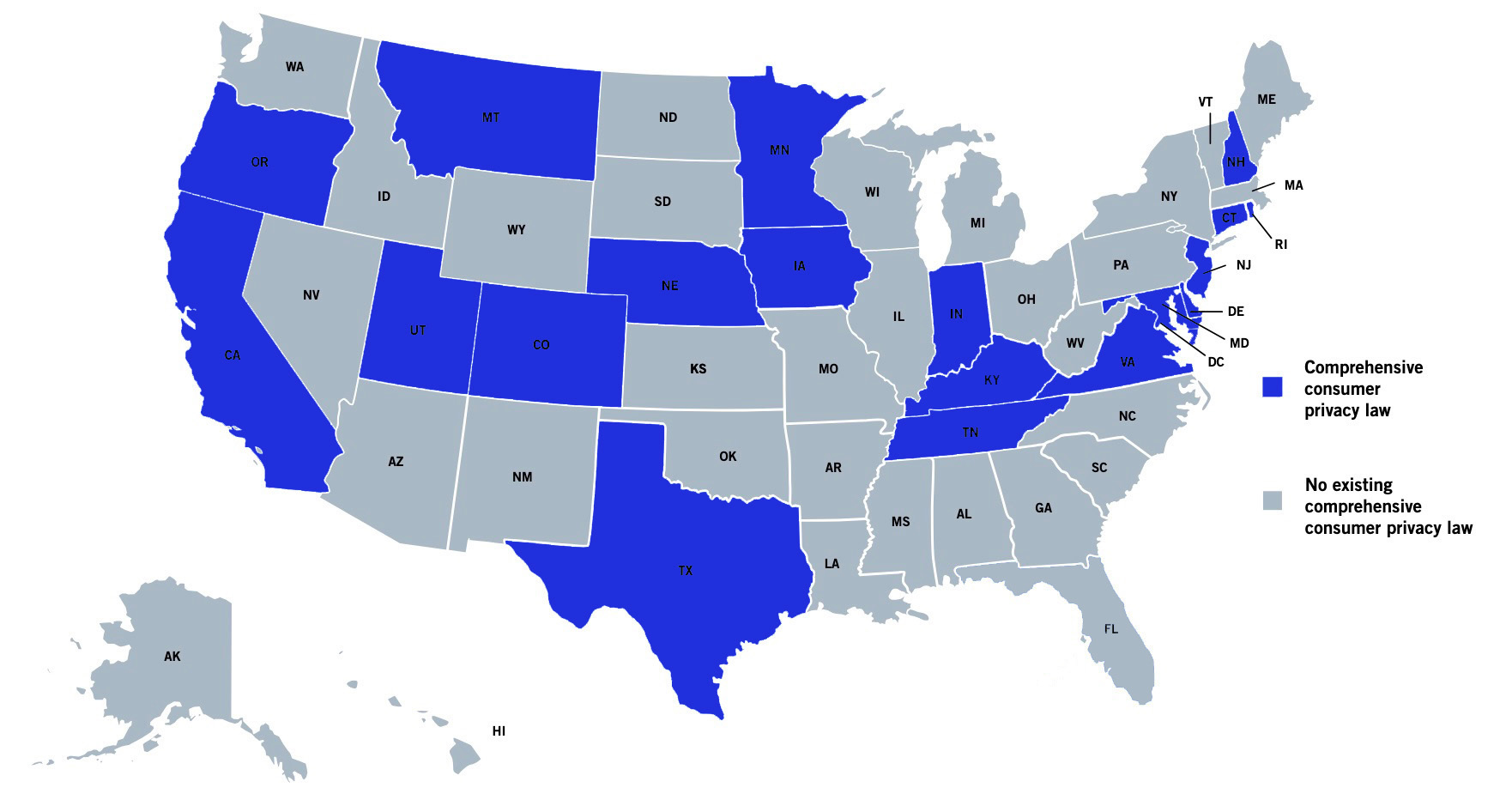
In fact, 8 states—Delaware, Iowa, Maryland, Minnesota, Nebraska, New Hampshire, New Jersey, and Tennessee—have already enacted new data privacy laws in 2025. According to the IAPP Weston Research Center, there are now 19 states with comprehensive data privacy laws on the books. As a quick caveat, different trackers have different qualifications; some trackers list 20 states and include Florida.

As seen above, the 19 states are California, Colorado, Connecticut, Delaware, Indiana, Iowa, Kentucky, Maryland, Minnesota, Montana, Nebraska, New Hampshire, New Jersey, Oregon, Rhode Island, Tennessee, Texas, Utah, and Virginia.

Although similar bills in Alabama, Georgia, Oklahoma, Maine, and Vermont failed to pass in 2025, other states—Massachusetts, Michigan, North Carolina, Pennsylvania, and Wisconsin—are currently considering data privacy legislation. Moreover, new laws from Indiana, Kentucky, and Rhode Island are expected to arrive in 2026.

Of the 19 states with comprehensive data privacy laws, 9 states (more specifically, 10 regulators across 9 states) have joined the Consortium of Privacy Regulators, a bipartisan initiative formed last April to protect consumers across different jurisdictions.

State-level data privacy bills generally include both protections for consumers and obligations for businesses. On the consumer side, these state laws allow consumers to control how their data is collected, stored, and shared with other parties. These rights—e.g., consumers’ right to delete, correct, and opt-out of data collection—are similar in nature to provisions in the GDPR and CCPA. On the business side, organizations are often obligated to adhere to various data minimization requirements.

Of course, not all states’ data privacy bills are created equal

Big Tech lobbyists have historically been extremely adept at watering down state-level bills. Speaking at the Capitol Forum’s 2025 Tech Conference, the Electronic Privacy Information Center’s Sara Geoghegan opines that Big Tech lobbyist involvement often results in watered-down bills.

Geoghegan describes the current landscape of state-level data legislation as a “mixed bag.” As Geoghegan explains, “Unfortunately, some states’ laws have kind of been written by Amazon and Big Tech; so it really depends a lot on the state. Some states have some really interesting proposals, and then Big Tech gets involved during the process and the final result is watered-down. But some [other] states have passed bans on the sale of geolocation information, special protections for things like abortion care. So, it’s kind of a mixed bag.”

With artificial intelligence progressing at a rapid pace, many state lawmakers are calling for more forms of data privacy regulation, particularly in regard to the data brokerage industry and surveillance pricing.

States are cracking down on the data brokerage industry

Recently, Texas and Oregon joined California and Vermont in requiring data brokers to register in their respective states and disclose their activities. (Data brokers are third-party entities that purchase our personal data, often unbeknownst to us.) All data brokers that process data not collected directly from the data subjects themselves now have to register with these four states. However, as of today, it is not exactly straightforward for data subjects to delete their information from these brokers’ databases.

On the Capitol Forum’s recent “Anticipated Trends for the Data Broker Industry and Enforcement” panel, cybersecurity and data privacy consultant Justin Sherman makes the case that we need a one-stop deletion request tool across the board.

Speaking specifically about states with data broker registries, Sherman says, “It’s not realistic to say to a consumer, here’s this registry in Vermont or Oregon—four states, Vermont, Oregon, Texas, and California, [each] has 500 or 600 entries—to go click on each one individually. No one is doing that, right? […] Having a one-stop shop is essential for actually effectuating those rights.”

He makes a good point. There should be a single button where one can have his or her information removed from all registered brokers in the state. California’s new Delete Act (SB 362) provides such a mechanism for Californians; this law, which is set to take effect in August 2026, is a welcome development—one that other states should follow.

Of course, there are other carve-outs and loopholes that need to be rectified as well. For example, Montana, which has been ahead of the data privacy legislation curve, recently became the first state to close the infamous data broker loophole for law enforcement. In May 2025, Montana signed their bill SB 282 into law.

Essentially, SB 282 prevents law enforcement from purchasing citizens’ data from data brokers when ordinarily they would need a warrant to access such information. This is another welcome step in the right direction.

Efforts are also being made to combat surveillance pricing at the state level

As I’ve written about in the past, surveillance pricing is the practice of surreptitiously collecting behavioral data on individuals and using that information to set prices. On the surface, it seems legitimate; much like dynamic pricing, surveillance pricing is a subset of algorithmic pricing that allows businesses to react quickly to market changes. However, by definition, surveillance pricing also includes surreptitious data collection.

Essentially, surveillance pricing is the use of one’s personal data—collected through geographic locations, credit scores, or browsing patterns—to set different prices for different users for the exact same products or services. As an example, think of a mechanic that charges different prices for the same car service depending on the customers’ location or browsing history.

In another panel at the Capitol Forum Tech Conference, “Personalization or Discrimination: Outlook for Surveillance Pricing Law,” a group of pundits addressed recent state-level developments on surveillance pricing.

Brad Weber, an attorney at Troutman Pepper Locke, points out that “over twenty states now have data privacy laws that somehow implicate surveillance pricing.” Another panel member, Javier Mabrey, a member of the Colorado House of Representatives, suspects that this number will increase.

Mabrey says, “I have very little faith in the institution of the United States Congress to step in and provide any meaningful protections for consumers any time soon […] Of course, we no longer have consumer friendly cops on the beat at the FTC and the CFPB. And, so if we’re going to do anything to protect the people in Colorado, we need to do it at the state level.” Maybrey recently brought a bill to ban surveillance pricing in Colorado; however, it didn’t pass. A similar bill proposed in California also did not pass.

Even without new state laws on the books, Mabrey makes the case that, given the size and scope of many of these companies, surveillance pricing might already be in violation of existing federal antitrust law.

Transparency alone is not an adequate policy solution

Some states have opted for transparency, rather than outright bans on surveillance pricing. As an example, New York’s recent Algorithmic Pricing Disclosure Act requires companies to disclose when they use consumers’ personal data to set a price.

Hannah Garden-Monheit, senior fellow at the American Economic Liberties Project, takes umbrage with this pivot to transparency. Garden-Monheit opines, “Transparency cannot be an end, in itself […] When you see something that is taking advantage of people, and your policy solution is ‘Let me tell you more information about how you’re being taken advantage of,’ but then you don’t actually stop it, that fundamentally undermines citizens’ trust that their institutions are capable of standing up for them.”

From a policy perspective, transparency is not as good as an outright ban on the practice; however, it certainly is yet another step in the right direction.

Breaking down the larger issue at hand, Garden-Monheit hits the nail on the head with her call for an assessment of the current mass collection of our personal data. She says, “I think we need to be thinking too about the mass collection of data in our society. One of my biggest regrets from my time in the last administration is that we didn’t succeed in passing comprehensive data minimization laws in this country; surveillance pricing is the latest pernicious symptom of an economy in which companies are amassing huge amounts of data to understand our innermost thoughts, wishes, and desires—and manipulate us with it.”

To be sure, getting companies to stop surreptitiously amassing large quantities of our personal data will not happen overnight. However, if and when these companies are reined in, one thing is certain: it will be the states leading the charge.

Related reading:

John Donegan

John Donegan

Enterprise Analyst, ManageEngine

Want to read<br>this article on the go?

Want to read
this article on the go?

Do it on the ManageEngine
Insights app.

Subscribe to surveillance pricing

Thanks for subscribing to ManageEngine Insights. If you do not receive our welcome email, please check your SPAM folder.