How AI agents actually help with IT operations management
Summary
AI agents are reshaping IT operations by moving beyond alert detection to intelligent decision-making and execution. This article explores how they accelerate root cause analysis, automate routine remediation, reduce alert fatigue, and proactively prevent incidents while highlighting the observability, topology, governance, and telemetry foundations required for safe, effective adoption.
An alert fires. An engineer opens a terminal. Forty minutes later, the root cause is found to be a degraded load balancer that any system with access to the right logs could have identified in seconds.
That gap, between detection and resolution, is where downtime gets expensive.
This is where AI agents step in.
AI agents are the most credible answer ITOps has seen. It can reason across context, execute multi-step tasks, and act on decisions rather than just surface them.
What makes AI agents different from automation
Automation executes a defined sequence. An agent reasons about what to do.
A traditional workflow detects disk usage crossing 85% and triggers a cleanup script. That works when the problem is predictable and the fix is known. It breaks when the symptom is ambiguous, the cause requires correlating signals across multiple systems, or the right action depends on context — what service is affected, what changed recently, what time of day it is.
That is precisely where most IT incidents live.
Root cause analysis for a complex incident takes long because establishing what is actually wrong requires holding multiple signals in context simultaneously, across systems. The core issue is that these systems are not designed to be read together. That reasoning layer is where agents operate.
Where the problem actually is
The numbers make the scale visible. A recent report found that the average on-call engineer receives roughly 50 alerts per week — but only 2—5% require human intervention. The rest is noise. And navigating it has a compounding cost: operational toil rose to 30% in 2025, the first increase in five years, even as 51% of organizations had already deployed AI initiatives.
The early wave of AI in operations improved observability and correlation. It did not close the action gap. ServiceNow's 2025 report found that less than 1% of enterprises have achieved truly autonomous remediation. Almost every organization is still routing every alert through a human before anything gets fixed. 73% have experienced outages linked to alerts that were ignored entirely.
The bottleneck is not detection. It is the workflow that follows it.
What AI agents do in practice
Root cause analysis at machine speed: When an incident fires, an agent does not wait. It queries logs, checks recent deployments, maps the affected service against the live topology, correlates the current pattern against historical incidents, and surfaces a ranked hypothesis in seconds. The engineer who would have spent 40 minutes building that picture spends five minutes validating it.
Intelligent alert triage: Agents assess incoming alerts against live context: open incidents, recent changes, service criticality, current topology. Alerts that are symptoms of a known incident get suppressed. Alerts that are genuinely novel get routed with context already attached. The signal-to-noise ratio improves before it reaches a human.
Automated remediation for known patterns: Cache clears, pod restarts, certificate renewals, disk cleanup on non-critical systems — these resolve the same way every time. Agents handle them end-to-end, log the action and outcome, and escalate only when the expected fix does not hold. AI-powered observability can cut incident resolution time by up to 70%.
Proactive drift detection: Agents do not only respond. They watch for resource utilization trending toward a threshold, latency climbing incrementally across a service, configuration state diverging from a known-good baseline and act before the threshold becomes an incident. The 3 AM page that never fires because the issue was caught at 11 PM is the best version of this.
Post-incident documentation: After resolution, agents reconstruct the full incident timeline, summarize actions taken, and draft a post-mortem. The work that takes a senior engineer two hours after an exhausting incident gets done automatically, with better fidelity than human recall produces under pressure.
What needs to be in place before agents can act
Agents are only as capable as the context they have access to. Deploying them without the underlying data and topology layer produces confident-sounding recommendations built on incomplete information.
Live topology: An agent reasoning about which services are affected by a failing component needs an accurate, real-time map of service dependencies. A stale CMDB is not enough. The topology must reflect the current state: what is running, what depends on what, what changed recently.
Unified telemetry: Metrics, logs, traces, and events need to be accessible in correlated form. An agent reasoning across siloed monitoring tools cannot build the complete picture that effective RCA requires.
Defined action boundaries: Before an agent acts autonomously, the organisation must define what it can and cannot do without human approval. Restarting a pod on a non-production service is different from initiating a failover on a payment processing cluster. These boundaries need to be explicit, enforced at the platform level, and revisited as confidence builds.
Reversibility as a design principle: Actions agents take autonomously should, wherever possible, be undoable. This is the condition that makes expanding autonomy safe over time.
How far should agents go?
The right answer depends on infrastructure maturity, risk tolerance, and how much operational history the agent has to draw from. But the progression is consistent across organisations that do this well.
Start with recommendation: The agent surfaces a diagnosis and a suggested action. A human approves and executes. This builds trust in the agent's reasoning before any execution rights are extended.
Then move to selective autonomy: The agent handles a defined class of low-risk, high-frequency tasks end-to-end and routes everything else for human review. This is where the return starts to compound. Engineers stop being interrupted by routine resolutions and focus on the incidents that actually need them.
Most organisations will not move through these levels quickly. They should not try to. The goal is a graduated expansion of agent authority, tied to what the agent has proven it can handle.
The decade of investment in monitoring, observability, and AIOps built the foundation. Agents close the loop. From alert to action, without a human in the middle for the class of problems that do not need one.
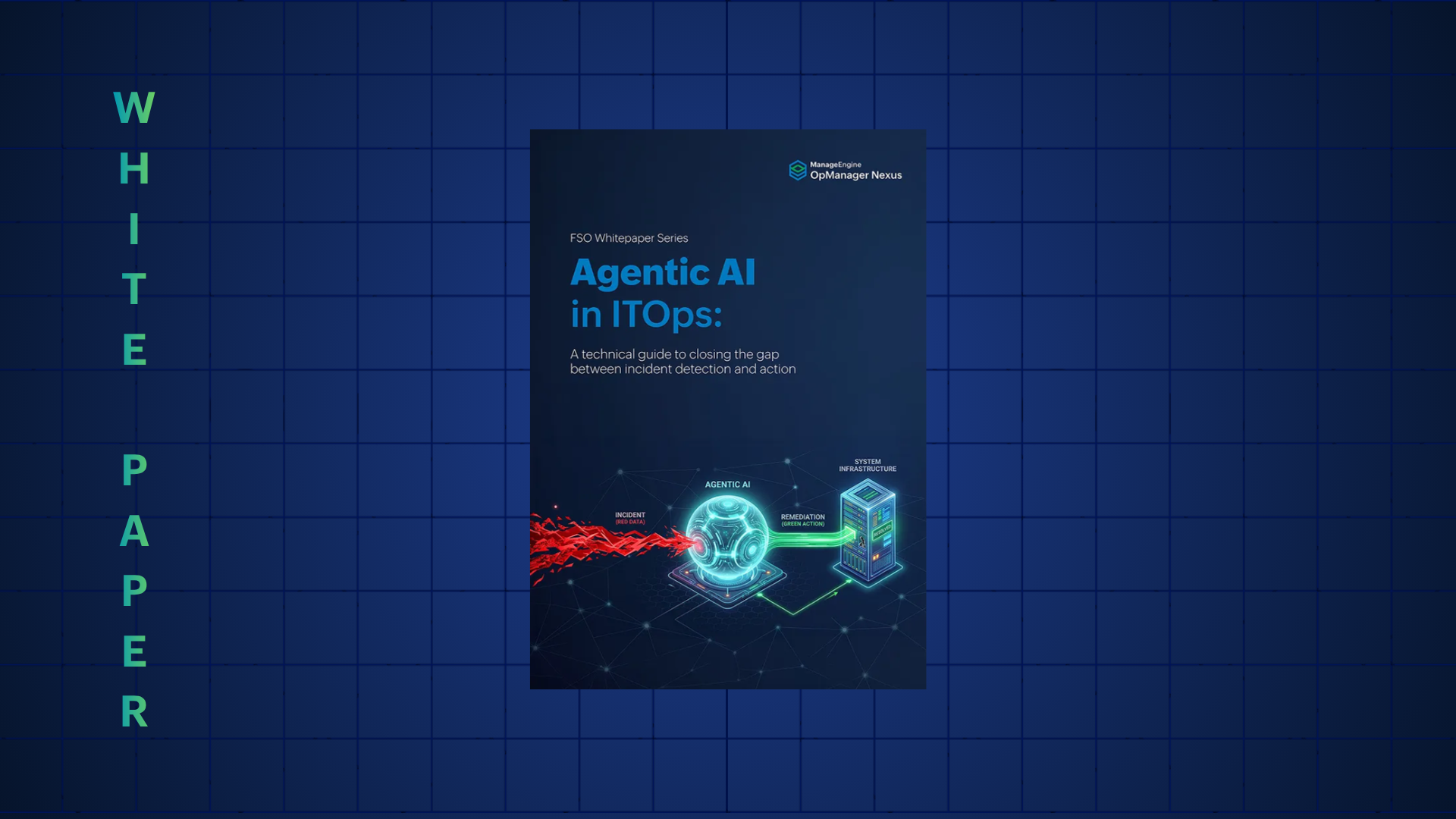
For more insights, download our latest white paper.