Skip multi-level integrations. Make your AI agents smart with MCP servers.

Summary
For most of the last decade, the bottleneck in enterprise AI was the model efficiency. But with models now becoming faster and more accurate, the problem is how we connect to them. An AI assistant is only as useful as the data it can access and the actions it can safely take, and connecting it to the systems where that data lives has historically been a custom, brittle, and expensive engineering effort.
The Model Context Protocol (MCP), an open standard introduced by Anthropic in late 2024, has emerged as the way enterprises solve that connection problem at scale. Enterprise AI teams are now looking to deploy MCP-backed agent in production, and the public registry of MCP servers has grown from around 1,200 in early 2025 to more than 9,400 by April 2026.
For CXOs, MCP is no longer a developer curiosity. It is the integration layer that determines how quickly your enterprise can deploy agentic AI, how broadly it can reach into existing systems, and how safely it can act on what it finds.
Imagine this: your finance team wants an AI assistant that can answer questions about quarterly performance, customer churn, vendor spend, and pipeline health. To be useful, it needs to read your CRM, your ERP, your data warehouse, your contract management system, and your internal financial reporting tools. Six months and several engineering sprints later, you have working integrations for two of those five systems. The other three are stuck in security review, vendor approvals, and a pile of custom glue code that no one wants to maintain.
This pattern is the M × N problem. Multiply M models by N tools and the integration count grows without bound. MCP exists to turn that into M + N. Build one MCP server per system, and any compliant AI assistant can talk to it.
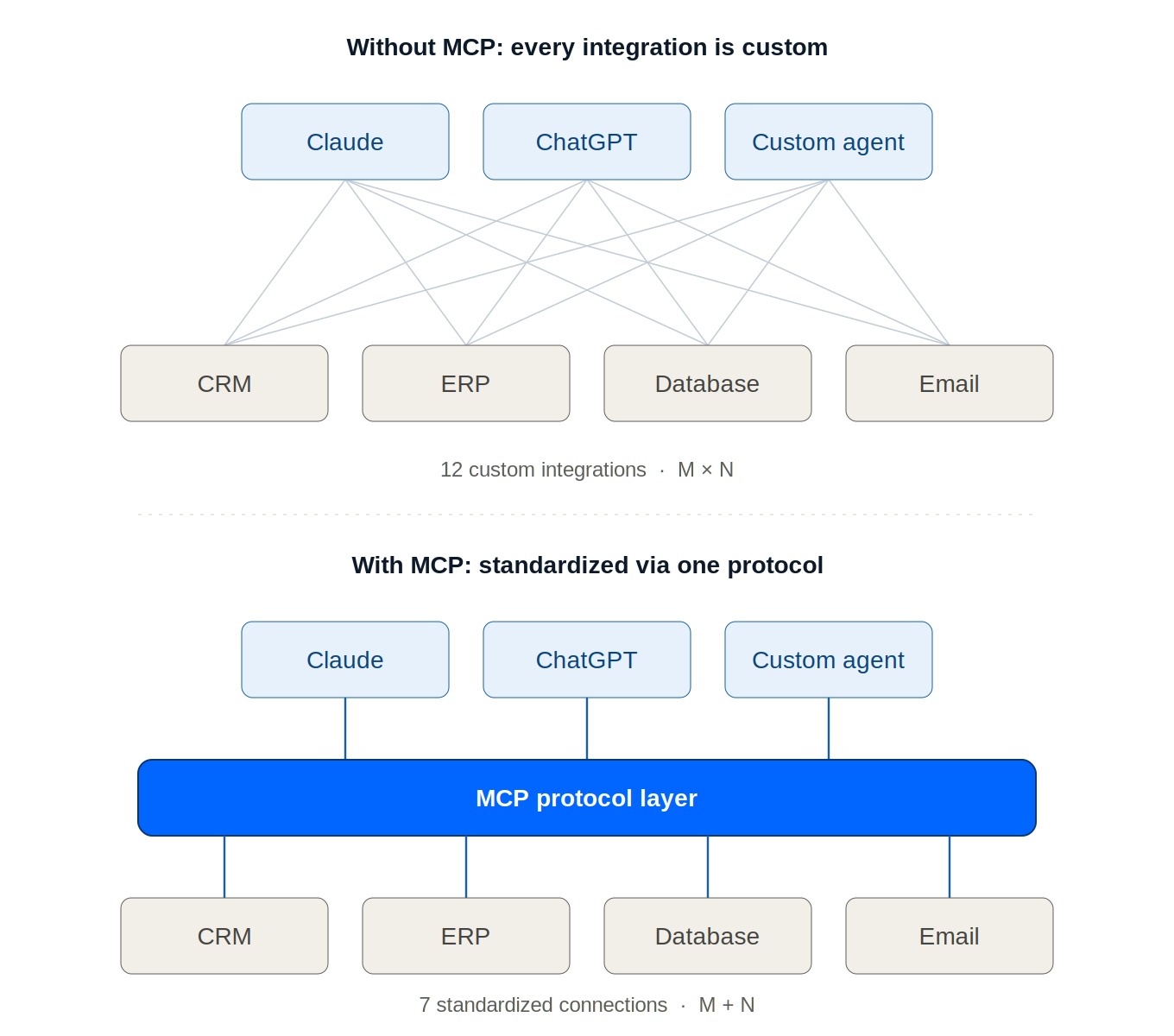
Why MCP has become a CXO concern, not a developer one
Three forces have pushed MCP onto the executive agenda.
Universal vendor adoption: Within roughly eighteen months of its launch, MCP has been adopted by every major AI provider including Anthropic, OpenAI, Google, Microsoft, and AWS. Anthropic donated MCP to the Linux Foundation's newly formed Agentic AI Foundation in late 2025, with OpenAI and Block as co-founders. When five competing AI vendors agree on a protocol, that protocol becomes a procurement reality.
Integration economics: Industry research shows that organizations using MCP-based integrations report substantially faster time-to-integrate compared to custom function calling, with some analyses citing improvements of more than four times. For a CIO under pressure to show AI return on investment, that compounds rapidly across portfolio-wide initiatives.
The rise of agentic AI itself: Gartner has projected that approximately 40% of enterprise applications will include task-specific AI agents by the end of 2026, up from less than 5% today. Agents are different from chatbots. They take actions, modify data, send messages, and execute workflows. They cannot do any of that without a reliable, governed way to connect to enterprise systems. MCP is the layer that makes that possible, or, if poorly governed, dangerous.
How an MCP-connected enterprise actually works
MCP is conceptually simple. The total MCP process bifurcates as client in the user's end and server in the MCP provider's end.
MCP client: A host is the application your user interacts with, for instance, an AI assistant on a desktop, a coding tool, an internal copilot, or a customer-facing agent. A client lives inside the host and speaks the MCP protocol. A server sits in front of each tool, database, or system you want the AI to be able to use, and exposes that system in a standardized way.
MCP server: An MCP server runs its tools, resources, and prompts. Here:
MCP server tools are functions the AI can call, such as create_ticket, run_query, or send_invoice.
Resources are data the AI can read, such as a document, a customer record, or a log file.
Prompts are reusable templates that guide the AI's behaviour for a given task.
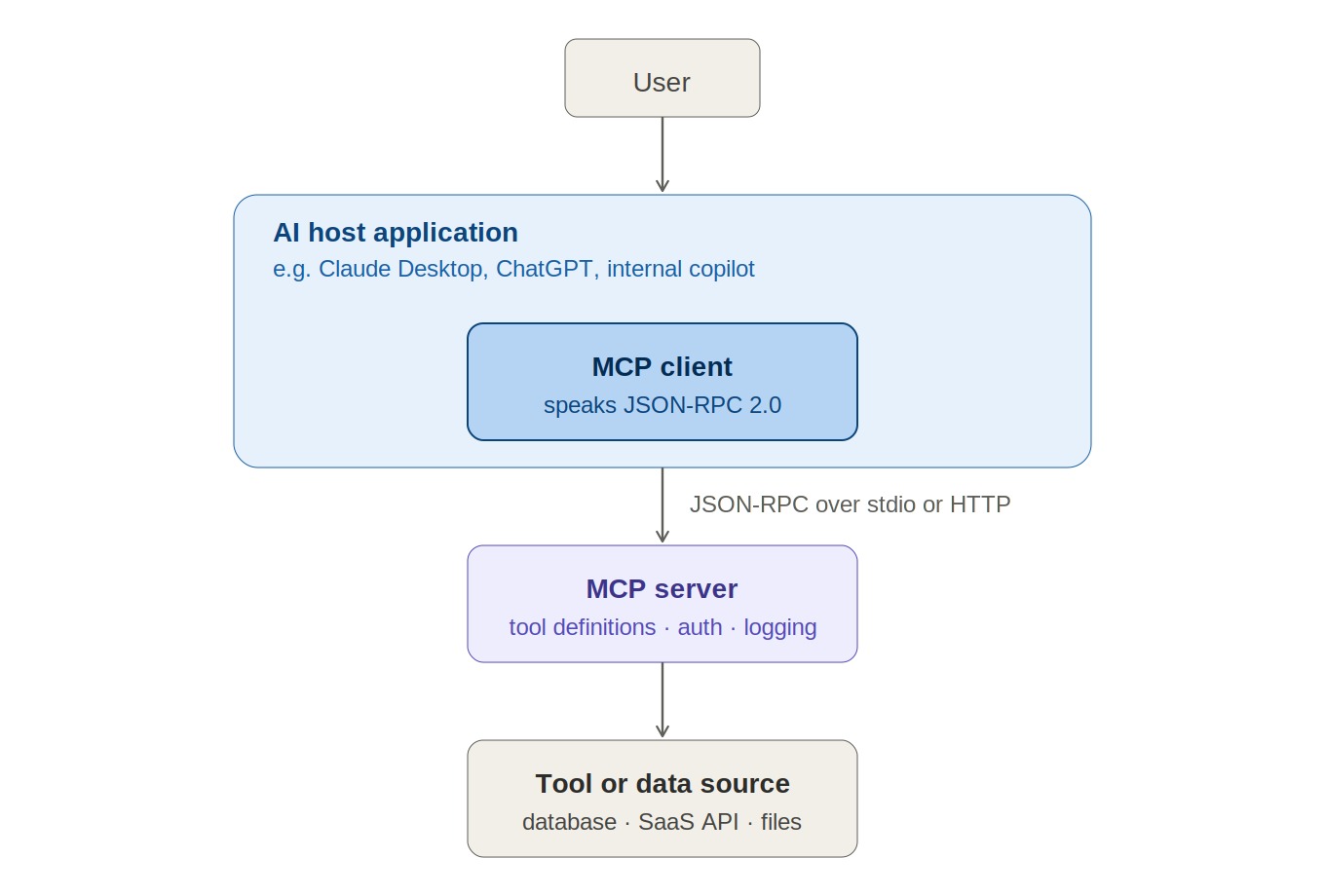
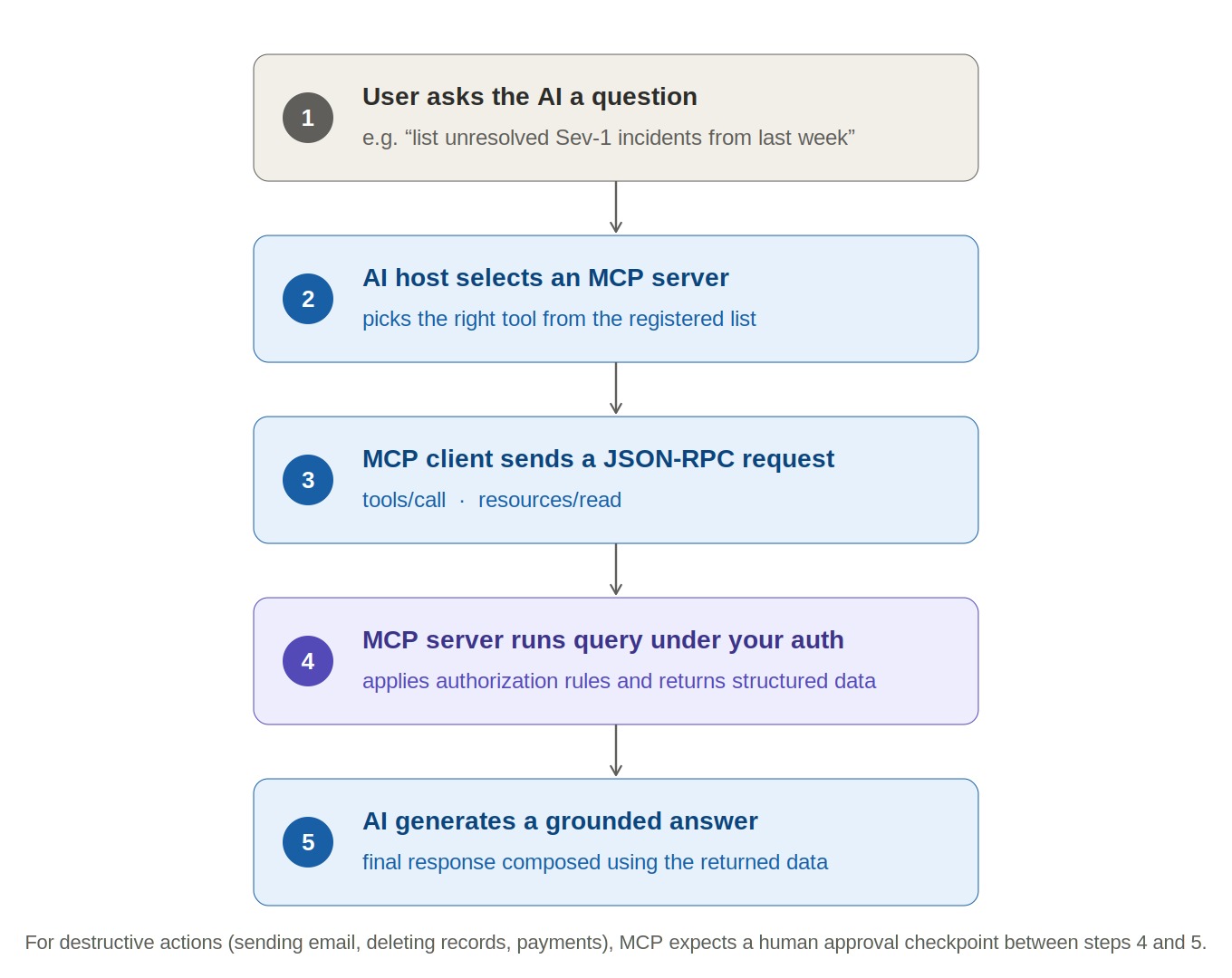
The user asks the host a question. The host's reasoning layer determines which tools or resources are needed. The MCP client sends a request over JSON-RPC to the appropriate server. The server queries the underlying system, applies authorization rules, and returns a structured result. For destructive or irreversible actions like sending emails, deleting records, or executing payments, the protocol explicitly expects a human-in-the-loop checkpoint before execution. The AI uses the returned data to compose its response.
Key takeaway: MCP is not an AI model, a product, or a vendor. It is a protocol, similar to how HTTP standardized the web or how USB-C standardized device connections. The strategic question is how well your organization deploys it, governs it, and integrates it with the security and identity controls you already run.
Why your C-suite should own MCP strategy
Treating MCP as a back-office engineering decision misses what is actually at stake.
Speed of AI deployment: Every system that has an MCP server is one your AI agents can connect to without bespoke engineering. Organizations that build a portfolio of well-designed internal MCP servers compound integration velocity over time. Organizations that don't will keep paying the integration tax with every new AI initiative.
Security and trust: MCP servers store credentials, handle business logic, and connect AI agents to real systems with real consequences. Industry security research has identified two attack categories that did not exist before MCP. Tool poisoning, where an attacker plants hidden instructions in a tool's description that the AI obeys without the user seeing them. And prompt injection, where adversarial content in retrieved data hijacks the agent's behavior. These are AI-native threats that traditional firewalls and endpoint controls do not detect.
Vendor strategy and lock-in: Because MCP is model-agnostic, an MCP server you build today works with whatever AI provider you choose tomorrow. CXOs who insist on MCP-compliant integrations preserve negotiating leverage and avoid being locked into a single AI vendor's proprietary extensions.
Audit and compliance: As AI agents take consequential actions on behalf of your organization, regulators and auditors will increasingly ask the same question they ask of human users. Who did what, when, and under what authority. MCP gives you the structural place to enforce, log, and audit that. Native AI logs alone will not satisfy DORA, NIS2, the EU AI Act, or sector-specific frameworks.
Procurement and SaaS strategy: Asking vendors about MCP support during procurement is rapidly becoming standard practice, in the same way single sign-on and SAML support became standard a decade ago.
The CXO mandate is to fund and govern your enterprise's MCP layer the way you fund and govern your API gateway, your SSO provider, and your security information and event management platform. It is shared infrastructure with disproportionate strategic leverage.
Current trends reshaping MCP
The MCP landscape is moving quickly, and a few shifts deserve direct executive attention.
Enterprise readiness as a first-class priority: The MCP project's published 2026 roadmap explicitly elevates enterprise needs including audit trails, SSO-integrated authentication, gateway behavior, and configuration portability. Expect cleaner enterprise deployment patterns through the year.
Managed MCP and gateways: A new class of platforms is emerging to do for MCP what API gateways did for REST. Centralized authentication, observability, rate limiting, policy enforcement, and tool registries. For most enterprises, running MCP through a managed gateway will be the default rather than direct host-to-server connections.
Agent-to-agent coordination: Adjacent protocols including Google's A2A are emerging to let agents coordinate across organizations. MCP handles agent-to-tool. A2A handles agent-to-agent. Together, they form the substrate for multi-agent enterprise workflows.
Security tooling for MCP: A wave of tooling is emerging specifically for MCP environments, including tool-poisoning scanners, anomalous-behavior detectors for AI agents, and verified registries of trusted MCP servers. Expect this category to look more like a recognizable security discipline by year-end.
For CXOs, MCP is one of the strategic primitives that is simultaneously about speed, safety, and economics. The organizations that treat MCP as core infrastructure today will deploy AI agents faster, govern them more credibly, and avoid the integration sprawl that quietly bankrupted previous waves of digital transformation.
For more insights, subscribe now to CXO Focus: A resource hub for the C-suite.