

Trusted bytop brands

Saint Gobain
NASA
Time Warner Cable
Loreal Paris
Siemens
DHL

Azure OpenAI integration for enterprise AIOps

For enterprises in regulated industries, routing sensitive network telemetry through a public AI API is not an option. OpManager integrates with Azure OpenAI to bring AI-powered analysis into your monitoring workflow while keeping data inside your own Azure subscription. Because the models run within your Azure tenant, nothing passes through shared public infrastructure — your compliance boundary stays intact.

Get AI-powered device health summaries through your Azure environment

  • Generate instant health overviews for any monitored device using Azure-hosted OpenAI models running within your organization's own Azure subscription.
  • Summarize performance conditions across individual devices or device groups to identify trends and recurring anomalies at scale.
  • Surface CPU, memory, and process metrics alongside probable root causes and troubleshooting recommendations processed through infrastructure your organization already controls.
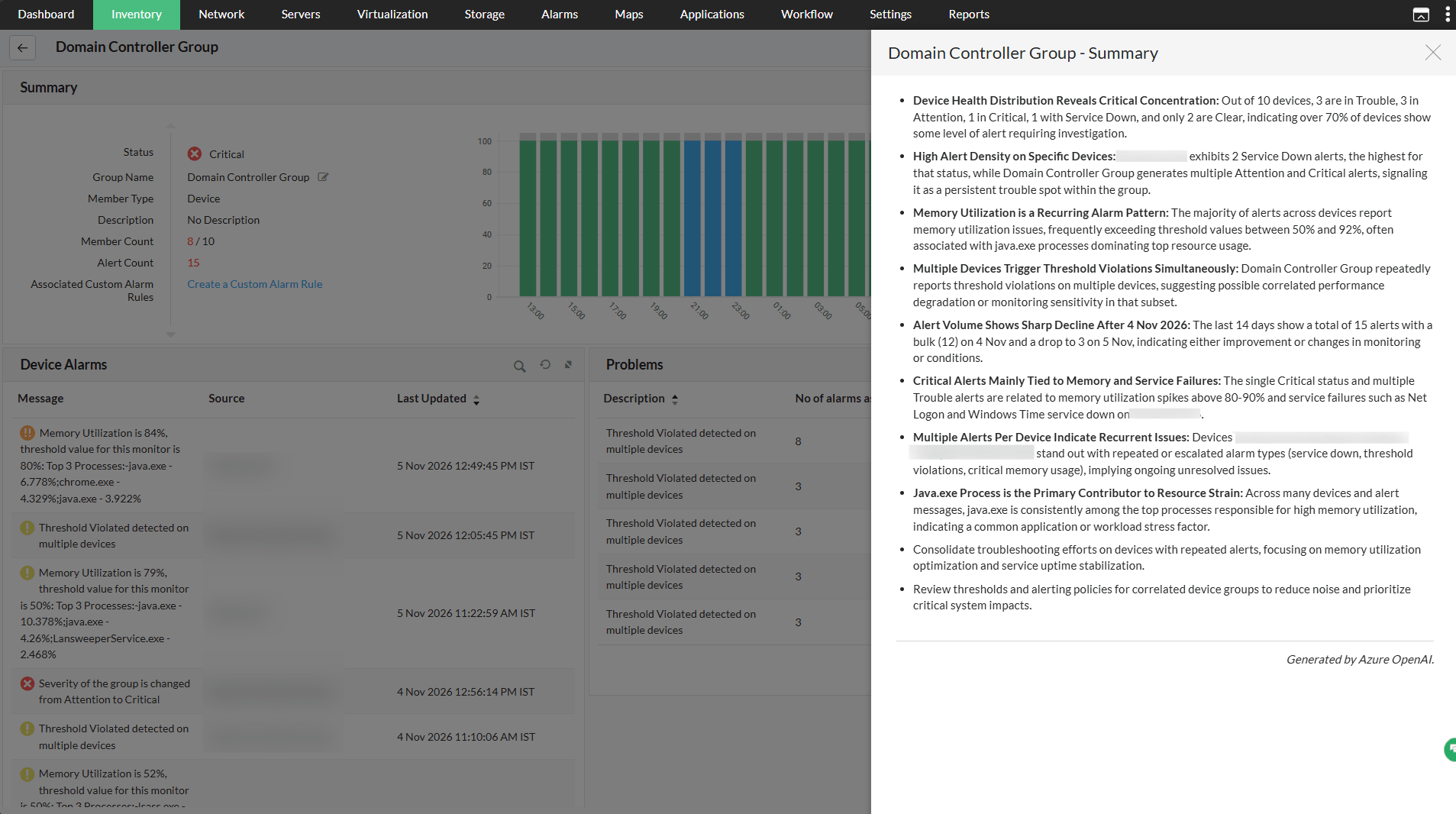
Device group summary generated by the Azure OpenAI integration
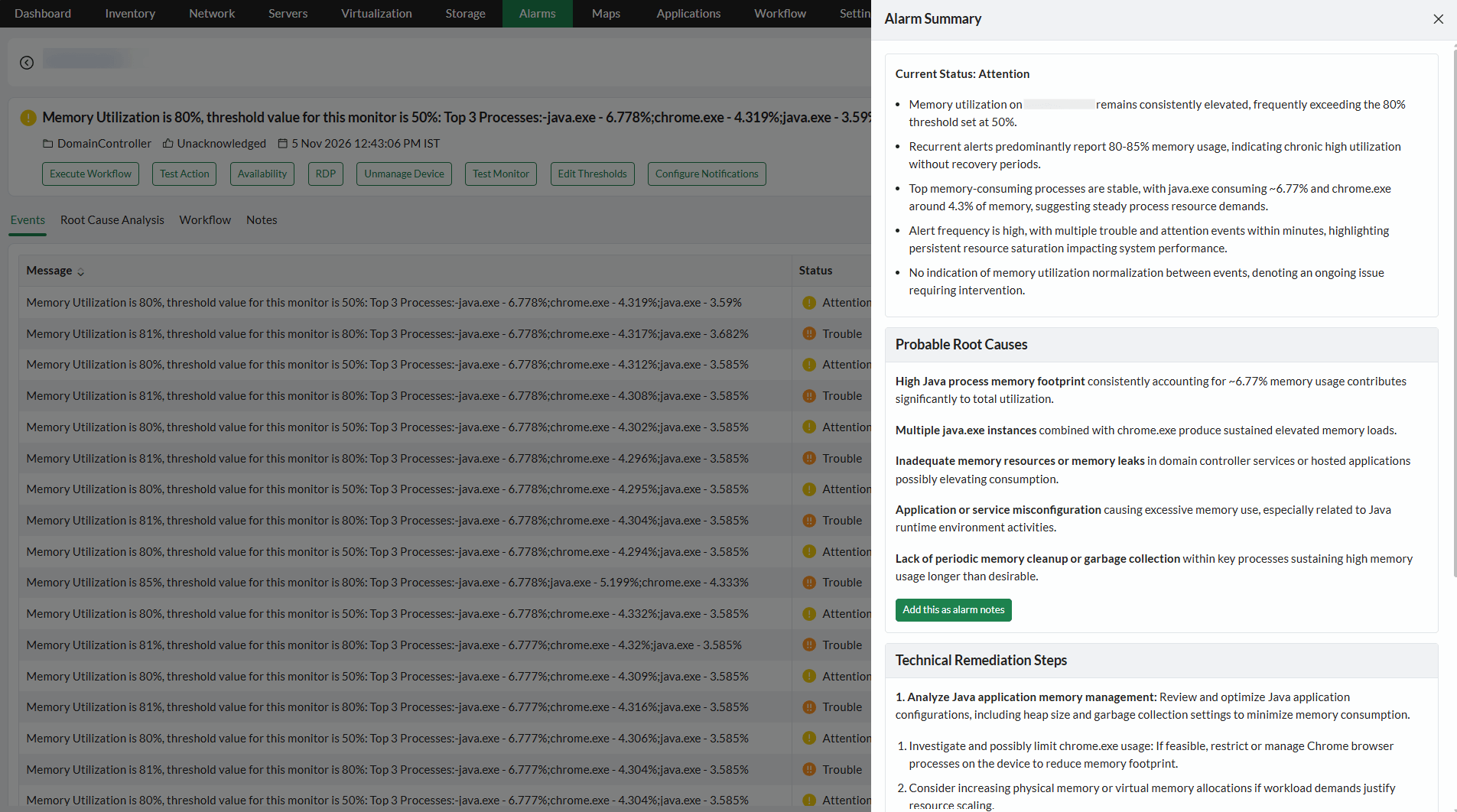
Individual alarm summary generated by the Azure OpenAI integration

Analyze incidents with enterprise-grade AI on your own terms

  • Process all active alarms collectively to surface infrastructure-wide trends, or analyze individual alarms for device-specific history and root cause analysis.
  • AI-generated summaries include severity classification, estimated network impact, probable root cause, and structured remediation guidance.
  • Because Azure OpenAI runs within your organization's Azure tenant, sensitive telemetry stays within your compliance boundary.

Generate monitoring scripts from plain language using your Azure deployment

  • Describe your monitoring requirements in natural language and Azure OpenAI will produce a fully formed, ready-to-deploy script template — PowerShell, Linux shell, VBScript, Perl, or Python.
  • Script generation runs through your Azure OpenAI deployment, keeping generated templates and the prompts that produced them within your organization's environment.
  • Review and edit every generated script before deployment; OpManager retains complete operator control.
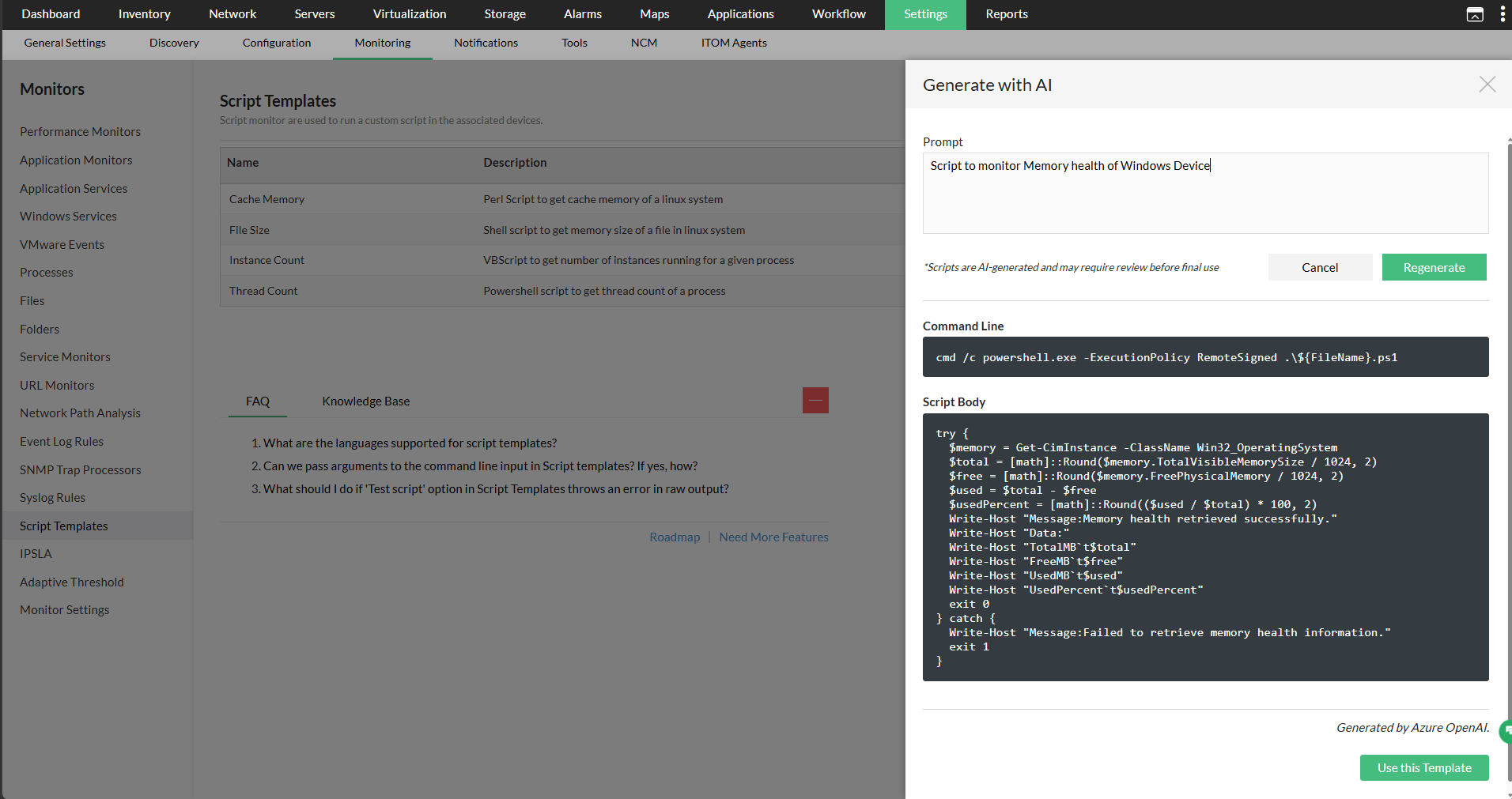
Monitoring script generated from a plain-language prompt by the Azure OpenAI integration
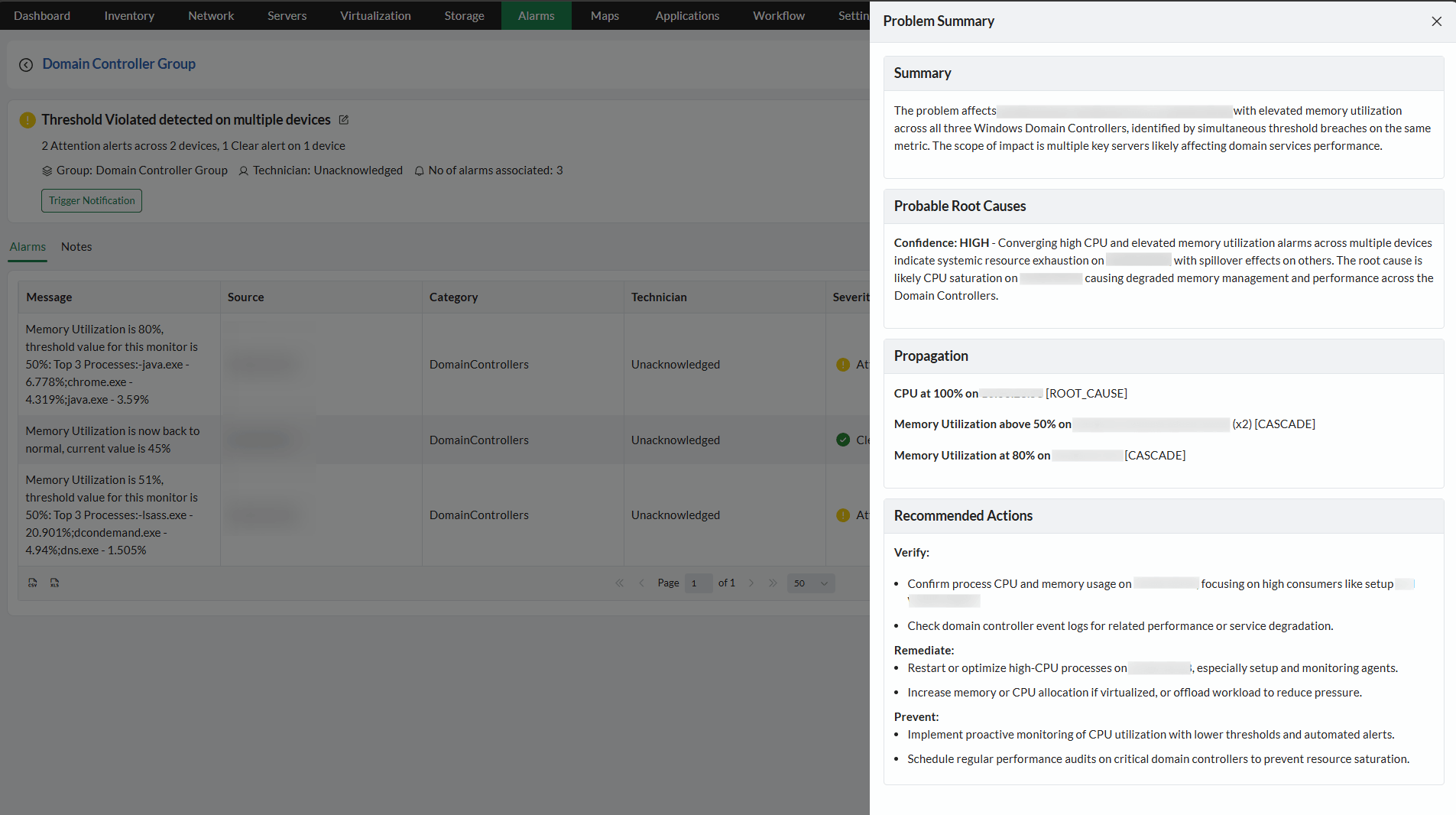
Problem summary with probable root cause generated by the Azure OpenAI integration

Pinpoint the root cause of complex incidents with Azure-powered analysis

  • When related alarms are correlated into a single Problem through OpManager's Event Correlation engine, Azure OpenAI analyzes the full set of associated alarms to identify the probable root cause.
  • Each analysis is tagged with a confidence level — high or medium — along with structured remediation steps, giving your team a clear path to resolution.
  • Because the analysis runs through your Azure deployment, sensitive incident data stays within your organization's compliance boundary throughout.

Use cases for all teams and verticals

Compliance-first AIOps for regulated enterprises

A financial services organization has a strict data residency policy: no telemetry data may leave the organization's Azure tenant. By connecting OpManager to Azure OpenAI, the IT operations team can run alarm summaries and device health analysis entirely within their existing Azure environment — satisfying compliance requirements while gaining the full benefit of OpenAI's models. The connection is established with the organization's own hosted URL and API key, requiring no data routing through shared public endpoints.

Centralized AI governance for large IT organizations

An enterprise IT team with thousands of managed devices wants a single, auditable AI vendor for all OpManager AI features. By configuring Azure OpenAI as the default vendor through the AI Settings page's "Apply to all features" checkbox, the team ensures every AI-generated summary and script routes through the same Azure deployment — making it straightforward to audit usage, manage access, and enforce data handling policies centrally.

Regional deployment flexibility for global organizations

A multinational organization has Azure OpenAI resources deployed in multiple regions. The IT administrator uses OpManager's custom deployment option to specify the exact Azure deployment name for each regional environment, ensuring that AI workloads are processed by the geographically appropriate Azure resource — critical for data sovereignty compliance in jurisdictions with strict localization requirements.

AI-augmented NOC for government and defense contractors

A defense contractor's network operations center needs AI-powered incident triage capabilities but cannot use public cloud AI endpoints. Azure OpenAI, hosted within the organization's FedRAMP-compliant Azure Government subscription, provides the capability they need. The OpManager integration points directly at their Azure Government resource endpoint, enabling AI-generated alarm summaries and device analysis without leaving the compliant environment.

What sets OpManager's Azure OpenAI integration apart?

Your Azure environment, your data

Absolute privacy

Azure OpenAI runs within your organization's own Azure subscription. Unlike direct public API integrations, telemetry data is processed through infrastructure your organization already provisioned and controls — making it the right choice for teams with strict data residency or compliance obligations.

PII protection as a standard layer

Cost-effectiveness

OpManager masks sensitive identifiers — IP addresses, device hostnames, and serial numbers — before any data is transmitted to Azure OpenAI. Masked data is restored automatically in the response, keeping summaries accurate and actionable without exposing raw infrastructure details.

Custom deployment support

Real-time visibility

Because Azure uses deployments rather than models, and deployment availability is region-dependent, OpManager supports manual custom deployment name entry for cases where the globally listed deployment is unavailable in a specific region. This ensures the integration works regardless of where your Azure resources are provisioned.

Unified control from AI Settings

Zero downtime

Azure OpenAI can be applied uniformly across all AI features with a single checkbox, or assigned selectively to individual features while other vendors handle the rest. Either way, configuration is managed from a single AI Settings page — no per-feature setup required beyond the initial integration.

FAQs on Azure OpenAI Integration

How is Azure OpenAI different from the standard OpenAI integration?


The standard OpenAI integration routes data through OpenAI's public API. The Azure OpenAI integration routes the same workloads through a model deployment hosted within your organization's own Azure tenant, which matters for organizations with data residency requirements, compliance obligations, or internal policies that restrict use of shared public cloud endpoints.

What credentials do I need to configure the integration?


What if my Azure deployment isn't listed in the Model dropdown?


Can I use Azure OpenAI alongside other vendors like Ollama or OpenAI?


Leverage secure AIOps with OpManager's Azure OpenAI integration!

Loved by customers all over the world


“Easy Implementation, Excellent support & Lower Cost Tool - Team Lead, IT Services Industry”

Reviewer Role: Infrastructure and Operations

Company size: 500M - 1B USD

We have been using OpManager since 2011 and our overall experience has been excellent. The tool plays a vital role in providing the value to our organization and to the customers we are supporting. The support is excellent and staff takes full responsibilities in resolving the issues. Innovation is never stopping and clearly visible with newer versions.

“OpManager - 10 steps ahead of the competition, one step away from being unequaled - Network Services Manager, Government Organization”

Reviewer Role: Infrastructure and Operations

Company size: 5,000 - 50,000 Employees

I have a long standing relationship with ManageEngine. OpManager has always missed one or two features that would make it truly the best tool on the market, but over it is the most comprehensive and easy to use the product on the market.

“Easy Implementation with a feature rich catalogue, support has some room for improvement - NOC Manager, IT Services Industry”

Reviewer Role: Program and Portfolio Management

Company size: 500M - 1B USD

The vendor has been supportive during the implementation & POC phases providing trial licenses. Feature requests and feedbacks is usually acted upon swiftly. There was sufficient vendor support during the implementation phase. After deployment, the support is more than adequate, where the vendor could make some improvements.

“Great Monitoring tool - CIO in Finance Industry”

Reviewer Role: CIO

Company size: 1B - 3B USD

ManageEngine provides a suite of tools that have made improvements to the availability of our internal applications. From monitoring, management and alerting, we have been able to peak performance within our data center.

“Simple Implementation, Easy To Use. Very Intuitive. - Principal Engineer in IT Services”

Reviewer Role: Enterprise Architecture and Technology Innovation

Company size: 250M - 500M USD


ManageEngine support was responsive to all our queries.

Capterra
Getapp
Software Advice
G2
Altaleb Alshenqiti

“OpManager helps me monitor all aspects of the data-center and equipment like servers, switches and routers. It is fast, intuitive and centralized and you do not need to be an expert to deal with OpManager.”

Altaleb Alshenqiti

NGHA

Donald Stewart

“Donald Stewart, IT Manager of Crest Industries is happy with ManageEngine OpManager for its end-to-end network monitoring software. It is easy-to-use and offers fault and performance management for router.”

Donald Stewart

IT Manager, Crest Industries

John Rosser

“John Rosser, MIS Manager of Yale Chase talks about the proactive nature of ManageEngine OpManager & how his organization gained value from it.”

John Rosser

MIS Manager