
What are virtualization challenges?
Virtualization challenges are the operational, performance, financial, and security risks that emerge when organizations abstract physical infrastructure into virtual compute, storage, network, and GPU environments.
Virtualization undeniably improves utilization and agility. However, without disciplined governance and unified visibility, the abstraction layer can quietly introduce inefficiencies, blind spots, and control gaps that only surface when performance degrades or costs escalate.
As enterprises expand across hybrid and multi-cloud architectures, these challenges begin to influence workload stability, cost predictability, compliance posture, and long-term architectural flexibility.
Why virtualization is more complex today
Virtualization today is no longer just about consolidating servers. It has evolved into a distributed, multi-layered infrastructure strategy spanning on-premises data centers, public clouds, edge locations, and AI clusters.
Several forces are increasing this complexity:
The Shift to Subscription Licensing: Subscription and per-core licensing models now tie infrastructure density directly to operating expenditure, making architectural decisions financially sensitive.
AI and GPU Workloads: Machine learning models demand near bare-metal performance, drastically reducing the tolerance for hypervisor latency or scheduling inefficiencies.
Hybrid Fragmentation: Distributing workloads across environments with completely different governance, API, and security models creates operational silos.
Expanding Attack Surfaces: Software-Defined Networking (SDN) and micro-segmentation increase agility but obscure internal traffic flows from traditional security tools.
As virtualization stretches across more systems and environments, the real constraint is no longer hardware capacity; it is maintaining visibility, coordination, and operational alignment at scale.
Virtualization challenges by infrastructure domain
Virtualization challenges do not manifest in isolation. They appear differently across compute, storage, networking, GPU infrastructure, and hybrid environments. Understanding how each layer behaves under abstraction is essential for enterprise resilience.
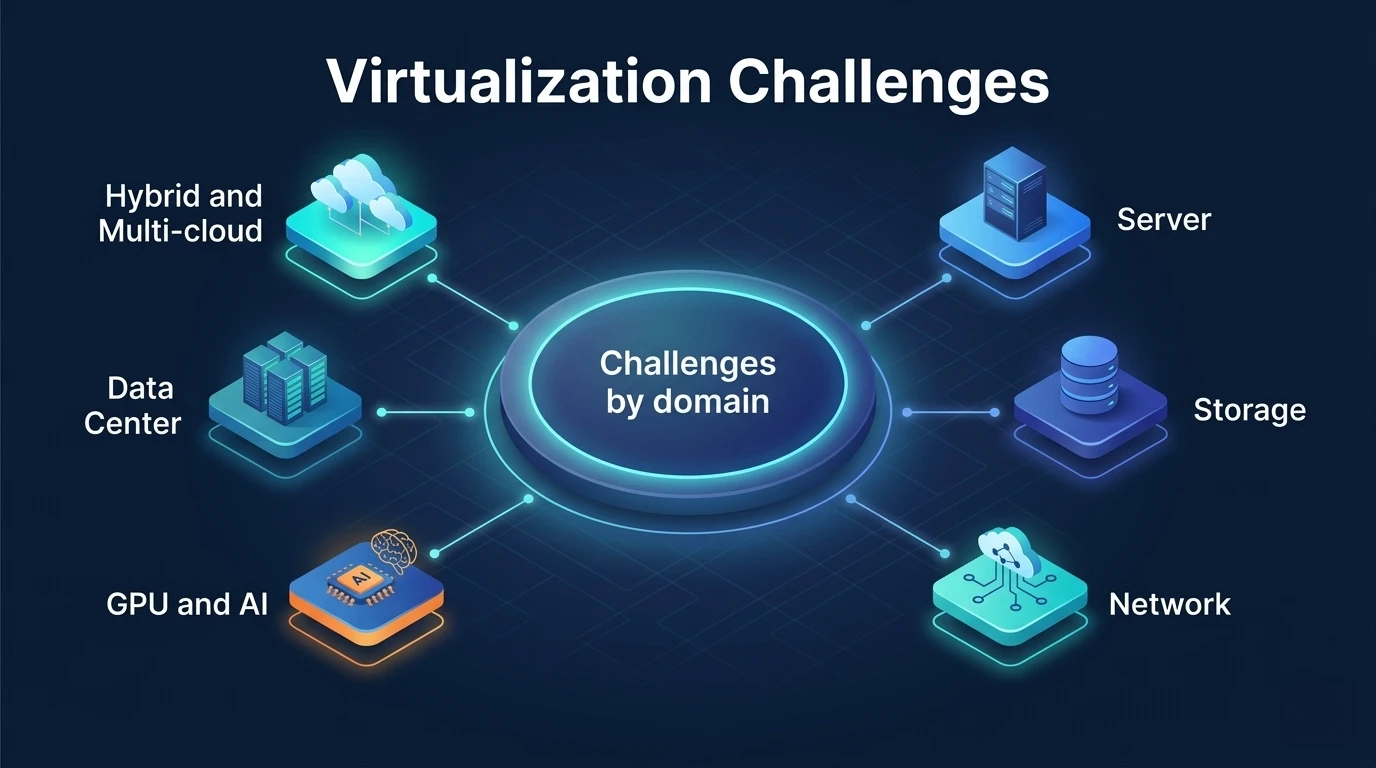
1. Compute and server virtualization challenges
Server virtualization improves hardware utilization, but unmanaged density can undermine stability and cost control.
Enterprises commonly encounter:
- CPU contention under oversubscription When multiple resource-intensive virtual machines compete for shared host resources, latency becomes unpredictable. Applications that are stable in physical environments may exhibit intermittent performance degradation under heavy consolidation.
- The noisy neighbor effect A single workload consuming excessive compute or memory can silently degrade adjacent applications. Without workload isolation and monitoring discipline, performance issues appear random and difficult to trace.
- Rising per-core licensing costs Modern high-core processors improve compute density but inflate subscription-based licensing models. As clusters scale, software costs can grow faster than hardware investment.
- VM sprawl due to frictionless provisioning Rapid VM creation without lifecycle governance results in idle or oversized workloads that consume capacity and budget without delivering business value.
In enterprise environments, unmanaged compute virtualization impacts both service reliability and financial predictability.
2. Storage virtualization challenges
Storage virtualization adds flexibility, but it also introduces layered dependencies that can amplify performance sensitivity.
Common challenges include:
- Latency amplification across abstraction layers (The I/O Blender Effect) I/O requests pass through hypervisors, virtual storage controllers, and physical arrays. Each layer adds processing overhead, increasing the risk of application slowdowns during peak demand.
- IOPS bottlenecks under transactional load High-volume databases and analytics systems can overwhelm shared datastores, affecting not just one workload but entire clusters.
- Snapshot sprawl and backup complexity Frequent snapshots improve recovery posture but consume capacity quickly and complicate restore workflows when poorly governed.
- Reduced visibility into datastore health Without clear performance correlation between virtual disks and physical arrays, troubleshooting becomes time-consuming and reactive.
Because storage directly influences application responsiveness, even small inefficiencies can escalate into user-facing disruptions.
3. Network virtualization and SDN challenges
Software-defined networking increases agility but reduces the direct visibility teams once had into traffic flows.
Enterprises frequently face:
- Overlay network latency that is difficult to isolate Virtualized traffic flows add encapsulation layers that can obscure the root cause of performance degradation.
- Limited visibility into east-west traffic Internal traffic between workloads often becomes opaque, increasing exposure to lateral threat movement and slowing incident response.
- Micro-segmentation misconfigurations Improperly defined policies can unintentionally block legitimate application communication, creating service instability.
- Controller dependency risks Centralized SDN controllers introduce potential single points of operational failure.
Balancing agility with operational transparency becomes essential to maintaining network resilience.
4.GPU and AI virtualization challenges
As AI workloads become business-critical, GPU virtualization introduces unique performance and architectural trade-offs.
Enterprises encounter:
- Performance overhead in shared GPU environments vGPU allocation can introduce latency or reduce throughput during model training, particularly in resource-constrained clusters.
- PCIe bandwidth bottlenecks Concurrent GPU workloads may compete for shared data paths, impacting deterministic performance.
- NUMA alignment complexity Optimizing memory and compute alignment becomes critical for AI efficiency but increasingly difficult at scale.
- Scalability limitations in partitioned GPU environments Resource slicing can restrict workload flexibility, prompting evaluation of bare-metal alternatives.
For AI-driven enterprises, virtualization flexibility must be carefully weighed against predictable performance outcomes.
5. Physical Data center challenges
As virtualization density increases, physical infrastructure limitations become more pronounced.
Organizations often experience:
- Power and cooling constraints High-core and high-memory configurations raise rack-level density, stressing facility infrastructure.
- Cluster imbalance Uneven resource distribution reduces overall utilization efficiency despite available capacity.
- Licensing cost spikes Subscription models amplify costs as clusters scale, making consolidation financially complex.
- Workforce readiness gaps Traditional virtualization skill sets may not fully align with hybrid or cloud-native operational models.
Sustainable virtualization requires alignment between physical infrastructure, financial planning, and workforce capability.
6. Hybrid and multi-cloud virtualization challenges
Hybrid models improve flexibility but increase operational fragmentation.
Enterprises commonly encounter:
- Cost Unpredictability: Moving workloads between on-premises VMware/Hyper-V environments and AWS/Azure introduces complex data egress fees and pricing variability.
- Portability Friction: Differing hypervisor formats and orchestration APIs restrict seamless, bi-directional workload migration.
- Vendor Lock-in: Deep integration with specific proprietary hypervisor ecosystems reduces long-term architectural flexibility and negotiation leverage.
As hybrid strategies expand, consistency and unified oversight become more critical than raw capacity.
How enterprises can overcome virtualization challenges
Overcoming virtualization challenges requires more than reactive troubleshooting. It demands structured governance, continuous optimization, and unified observability.
Enterprise leaders can reduce risk by:
- Conducting proactive workload audits Regularly identifying idle or oversized virtual machines prevents silent resource waste and restores capacity before expansion becomes necessary.
- Aligning infrastructure management with FinOps practices Integrating financial visibility into infrastructure operations improves cost forecasting and reduces surprise licensing spikes.
- Validating micro-segmentation
Ongoing review of micro-segmentation and hybrid security policies reduces misconfiguration risk. - Implementing centralized infrastructure monitoring Consolidated visibility across compute, storage, network, and cloud layers shortens mean time to resolution and prevents blind spots.
A unified monitoring platform such as ManageEngine OpManager enables cross-domain visibility by correlating physical servers, virtual machines, storage systems, and network devices in real time. This integrated perspective helps enterprises detect contention early, improve capacity planning, and make data-driven infrastructure decisions without increasing operational complexity.
The goal is not virtualization at scale but virtualization with measurable control and predictable performance.
FAQs about network virtualization
What are the biggest virtualization challenges?
Performance overhead, VM sprawl, rising licensing costs, storage bottlenecks, limited network visibility, hybrid governance fragmentation, and vendor lock-in are among the most significant challenges enterprises face.
Why can virtualization reduce performance?
The hypervisor layer introduces CPU scheduling delays, memory overhead, and additional I/O processing. In oversubscribed environments, this can lead to noticeable latency.
Is virtualization more expensive in 2026?
Operating costs have increased for many enterprises due to a market shift toward subscription-based licensing models, the necessity of high-core processors, expensive GPU investments, and unpredictable hybrid cloud egress fees.
What security risks exist in virtualized environments?
Storage virtualization can introduce latency, IOPS constraints, snapshot sprawl, and complex recovery workflows if not properly governed.
How can enterprises reduce virtualization risks?
Through proactive workload optimization, centralized monitoring, FinOps alignment, micro-segmentation validation, and unified observability across infrastructure domains.

By Monicaa,
Product Marketer, ManageEngine