OpenAPI Specification for PAM360 REST APIs
The PAM360 OpenAPI Specification provides a comprehensive, machine-readable definition of all supported PAM360 REST APIs. Built using the OpenAPI 3.0 standard, the specification serves as a centralized source for developers, integrators, and automation platforms interacting with PAM360.
The specification documents API endpoints, request and response structures, parameters, authentication requirements, reusable schemas, and example payloads. It enables developers to understand and integrate with PAM360 APIs more efficiently while reducing implementation effort and improving consistency. This is machine-readable specification used to generate MCP tools and power AI agents that interact with PAM360, allowing them to discover available operations, call the right endpoints, and act on privileged-access data without hand-written integration code.
At the end of this document, you will have learned the following topics in detail:
1. What is OpenAPI Specification?
OpenAPI is an industry-standard specification for describing RESTful APIs in a structured and machine-readable format. By defining PAM360 APIs using a standardized specification, developers and tools can automatically understand available operations, required parameters, request formats, response schemas, and authentication requirements.
The PAM360 OpenAPI Specification serves as both technical documentation and a blueprint for the API integrations with the PAM360 application.
2. What is Included in the PAM360 OpenAPI Specification?
The PAM360 OpenAPI specification (YAML) contains detailed definitions for:
- API Endpoints - Documents all supported REST API operations, including available request methods and endpoint paths.
- Parameters - Defines path, query, header, and request body parameters required by each API operation.
- Request and Response Schemas - Provides detailed schema definitions, including field names, data types, validation requirements, and example values.
- Authentication Requirements - Documents the authentication mechanisms and headers required to access PAM360 APIs.
- Examples - Includes sample request and response payloads to simplify implementation and troubleshooting.
- Reusable Components - Defines shared schemas, parameters, and responses that can be referenced across multiple API operations, ensuring consistency and maintainability.
3. Benefits of PAM360 OpenAPI Specification
The PAM360 OpenAPI Specification is built to be widely useful, whether you are exploring the PAM360 API surface for the first time, building a production integration, or wiring PAM360 into an automated pipeline.
| Use case | Why it matters | How to use it |
|---|---|---|
API discovery | Explore PAM360 APIs from a single source, eliminating the need to navigate multiple documentation pages. | Browse the YAML specification to understand available endpoints, supported HTTP methods, required parameters, and response formats before writing any code. |
Integration development | Build reliable integrations faster using accurate, versioned schema definitions rather than trial-and-error against a live server. | Use the documented request and response schemas, field types, and example payloads to build custom integrations between PAM360 and external applications. |
AI and MCP integrations | AI agents and MCP servers can discover and call PAM360 APIs programmatically without manual configuration, enabling intelligent automation workflows. | Load the OpenAPI YAML directly into an MCP server as the tool definition. The agent can then resolve, invoke, and chain PAM360 API operations autonomously. |
SDK generation | Avoid hand-writing API client code. Generated SDKs stay in sync with the specification and reduce integration maintenance overhead. | Use any OpenAPI-compatible code generation tool to produce client libraries. Supported targets include Java, Python, JavaScript, TypeScript, C#, Go, and PHP. |
API testing and validation | Catch integration issues before they reach production by testing against the specification directly. | Import the YAML into testing tools such as Postman or similar platforms to build and run automated test suites against PAM360 endpoints. |
Automation workflows | Automate and standardize routine PAM360 workflows, from user onboarding to compliance management, without writing custom scripts for every use case. | Leverage the specification to build workflows for resource onboarding, account management, password rotation, reporting, and compliance operations. |
4. Download the OpenAPI Specification
Download the latest OpenAPI specification using the link below:
- OpenAPI Specification: Download Link
- Format: YAML
- Specification Version: OpenAPI 3.0
- Last Updated Date: 19-June -2026
5. Using the PAM360 OpenAPI Specification
When integrated with an MCP server that supports OpenAPI-based tool generation, the PAM360 OpenAPI specification serves as the definition of available tools and operations. By consuming the OpenAPI YAML file, the MCP server can expose PAM360 API operations to AI agents, including the required parameters, request formats, and response schemas. This enables AI agents to discover and invoke PAM360 functionality through standards-based interfaces without requiring custom integration code for each operation.
Communication between the MCP server and PAM360 is authenticated using an authentication token generated for a dedicated REST API user account in PAM360. The token is configured in the MCP server and is automatically included in the authorization header of every API request sent to PAM360.
5.1 Create a REST API User in PAM360
Before integrating PAM360 with an MCP Server, create a dedicated REST API account for the agent. The account should follow the principle of least privilege and be granted access only to the resources and operations required for its intended tasks using PAM360's custom roles. Using a dedicated account enables granular access control, auditing, credential rotation, and activity tracking while reducing the risks associated with shared or over-privileged credentials. Refer to this document to learn more about creating a PAM360 API user account.
Additional Details
Ensure that the authentication token associated with the dedicated REST API account is regenerated before it is configured in the MCP server.
5.2 Load the OpenAPI YAML into the MCP Server
Once the API user is created and the token is available, configure the MCP server to use the PAM360 OpenAPI specification as its tool source.
The MCP server reads the YAML at startup and registers each API operation defined in the specification as an available tool. When the agent needs to perform a PAM360 operation, it selects the corresponding tool, constructs the request using the parameter definitions from the specification, and includes the authentication token in the request header automatically.
6. Real-Time Scenario
The following use case document demonstrates a complete, real-world implementation of the PAM360 OpenAPI Specification within an enterprise. It describes how an MCP server and AI agent uses PAM360 OpenAPI tools to broker credentials at runtime, enabling secure privileged operations without storing hard-coded credentials.
Use Case Document - Secure Privileged Access for AI Agents using MCP Servers, and PAM360 Credential Brokering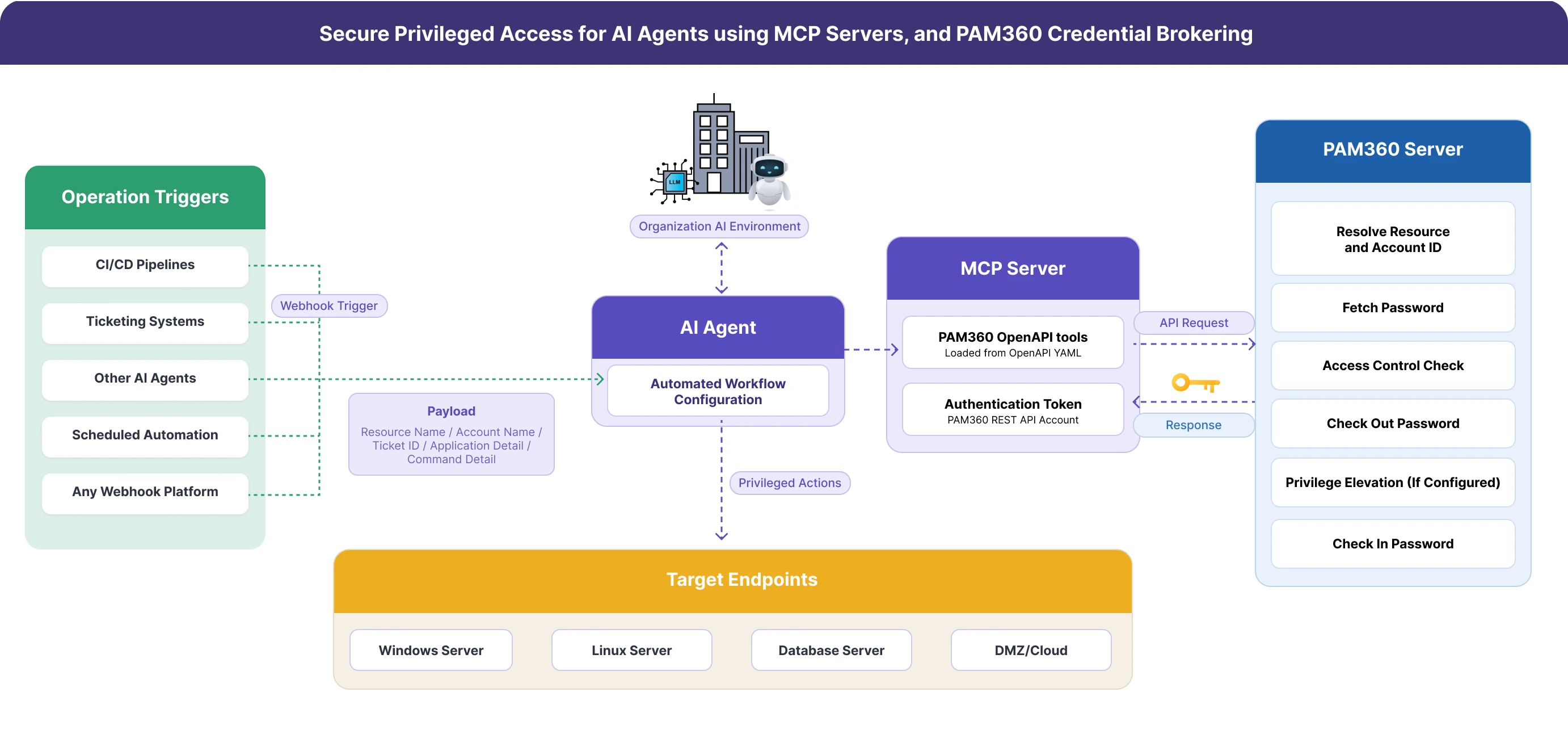
7. Best Practices
Follow these guidelines to build integrations that are secure, maintainable, and compatible with future PAM360 releases.
- Always use the latest specification version - PAM360 REST APIs evolve with each product release. Using an outdated specification may cause integrations to rely on deprecated parameters or miss newly introduced fields. Verify the latest OpenAPI YAML before starting a new integration project and after every PAM360 upgrade.
- Apply the principle of least privilege - Grant the dedicated REST API account access only to the resources and operations required by the integration. For example, an automation workflow that retrieves credentials for a specific set of resources should not be granted access to administrative accounts or unrelated resource groups.
- Secure authentication tokens - Treat REST API account authentication tokens with the same level of protection as privileged credentials. Store them in a secure secrets manager, rotate them periodically, and never expose them in source code, configuration repositories, or log files. Whenever a token is regenerated, update the MCP server configuration with the new token, as previously generated tokens become invalid.
- Review access controls before deployment - Verify that PAM360 access controls, including approval workflows, time-limited access, and ticketing-system-based access controls, align with the expected behavior of the integration. Test scenarios involving policy-denied requests, expired authentication tokens, and insufficient permissions to ensure predictable and secure operation.
- Validate integrations in a non-production environment - Before deploying an integration to production, test it thoroughly in a staging or UAT environment. Validate authentication flows, request and response schemas, error handling, and version-specific API behavior.