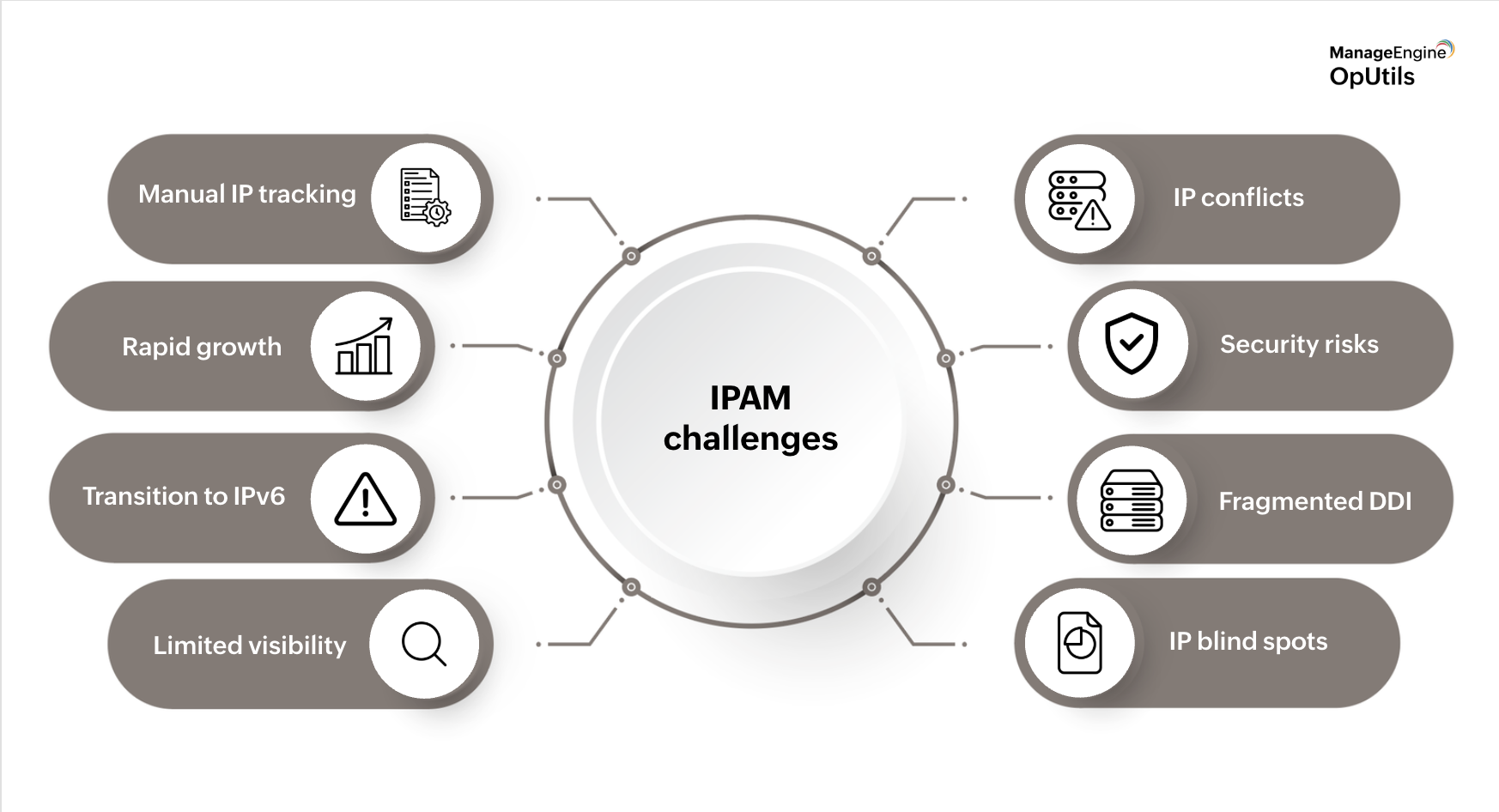
Top 8 IP address management challenges
IP address management (IPAM) is the practice of assigning, tracking, and organizing IP addresses within a network. Every device including servers, laptops, printers, or IoT devices needs an IP to communicate, and as networks grow, manually managing these addresses becomes inefficient.
Effective IPAM is critical for business continuity, security, compliance, and scalability. Without it, organizations risk downtime, operational inefficiencies, and vulnerabilities that can affect both internal operations and customer-facing services.
On this page, you’ll read about the key challenges of IP address management and why effective IPAM is essential for modern networks.
On this page, we will read:
- Manual IP tracking inefficiencies
- Complexity from rapid network growth
- IPv4 exhaustion and dual-stack transition
- Limited network visibility
- IP address conflicts and downtime risks
- Security vulnerabilities from weak IPAM
- Fragmented DNS, DHCP, and IPAM systems
- Inadequate IP monitoring and reporting
- How OpUtils helps overcome IPAM challenges
- More on IP address management challenges
1. Manual IP tracking inefficiencies
Many organizations still rely on spreadsheets or semi-automated methods to manage their IP addresses. While this might work for small networks, these approaches quickly become unmanageable as the network grows.
Human errors such as outdated entries, inconsistent records, or duplicate IP assignments are almost inevitable in manual systems. These mistakes can lead to IP conflicts, wasted address space, extended troubleshooting efforts, and even compliance violations, all of which can disrupt network performance and impact business operations.
Scaling beyond a handful of devices without a structured IPAM solution exposes organizations to ongoing inefficiencies and operational risk.
2. Complexity from rapid network growth
Modern networks are expanding rapidly with the addition of cloud workloads, virtual machines, and IoT devices. Each of these components adds its own layer of complexity to IP address management. For instance, virtual machines and containers are highly dynamic such that they can spin up and shut down within seconds, often reusing IPs or drawing them from different subnets across multiple environments.
Similarly, IoT deployments can introduce thousands of low-cost sensors or controllers, each requiring unique IPs but often connecting intermittently, making it difficult to track active versus idle addresses. When combined, these factors create a constantly shifting address landscape that traditional IP tracking methods like static spreadsheets can’t keep up with.
Hybrid and multi-cloud deployments often create overlapping subnets and fragmented IP spaces, making it difficult to maintain a clear view of the network. Additionally, distributed teams and remote offices introduce further layers of complexity. In such dynamic environments, static or manual tracking methods quickly become inadequate, leaving IT teams struggling to keep up with rapid changes and increasing the risk of misconfigurations, conflicts, and downtime.
3. IPv4 exhaustion and dual-stack transition
The limited availability of IPv4 addresses has forced organizations to rely on techniques like network address translation (NAT) and subnet fragmentation, which only add to operational complexity. While the shift to IPv6 promises a vastly larger address space, the transition comes with a steep learning curve for IT teams.
Many enterprises operate in a dual-stack environment, running IPv4 and IPv6 side by side, which introduces several layers of complexity for IP address management. Transitioning from IPv4 to IPv6 is not simply a matter of assigning new addresses; it requires rethinking the entire network architecture, from routing and subnetting to DNS and DHCP configurations. IPv6 addresses are longer and use a completely different notation, making manual tracking and legacy tools insufficient. Existing applications, security policies, and monitoring systems often need updates or replacements to recognize and handle IPv6 traffic properly.
Moreover, devices and endpoints that only support IPv4 must coexist with IPv6-enabled systems, leading to potential communication gaps or misconfigurations. All of this creates a dynamic environment where IP address allocations, utilization, and conflicts are harder to predict and manage, demanding robust automation and visibility to maintain network reliability and security.
This setup introduces DNS complications, routing and configuration challenges, and difficulties in enforcing consistent policies. For example, DNS must now handle much longer IPv6 addresses and support reverse lookups for both IPv4 and IPv6, which can lead to misaligned records or resolution failures if not managed carefully.
Routing tables become larger and more complex, and network devices must support dual-stack operation without introducing bottlenecks. Without proper planning and visibility, organizations risk mismanaged, conflicting, or underutilized addresses during migration, undermining the very benefits IPv6 was meant to deliver.
4. Limited network visibility
When IP address management is fragmented across multiple sites, teams, or tools, visibility into the overall network suffers. Networks spread across large supernets or geographically distributed locations make it even harder to track address utilization, as route aggregation and overlapping subnets can obscure the true state of the network. Outdated or missing documentation further complicates matters, making it difficult to track real-time IP utilization.
Without centralized oversight, auditing becomes inefficient and enforcing policies is inconsistent at best. The result is slower troubleshooting, higher chances of non-compliance, and elevated operational risk, all of which directly impact business continuity and security posture.
5. IP address conflicts and downtime risks
An IP conflict occurs when two or more devices on a network are assigned the same IP address. These conflicts often arise from manual errors, outdated records, or misconfigured DHCP servers. The immediate consequences include connectivity failures, degraded performance, and downtime of critical systems.
What makes conflicts particularly damaging is their cascading effect. A single subnet issue can disrupt multiple applications and dependent services. When left unresolved, IP conflicts directly impact business-critical operations, leading to productivity losses and potential customer-facing outages.
6. Security vulnerabilities from weak IPAM
Weak IP address management can open the door to serious security threats. Poorly monitored DHCP environments are vulnerable to DHCP spoofing or rogue DHCP servers, which can mislead devices into trusting malicious configurations. Similarly, ARP spoofing and poisoning attacks enable adversaries to intercept traffic through man-in-the-middle techniques.
Networks without centralized IP visibility are also prone to rogue or shadow devices joining unnoticed, creating blind spots for administrators. Unauthorized use of IP space not only leads to breaches but can also go undetected for long periods. Real-world incidents have shown that lack of proper IPAM plays a direct role in enabling such attacks, highlighting its importance in any layered security strategy.
For instance, modern IPAM solutions may integrate or support network-level mitigation techniques such as DHCP Snooping and Dynamic ARP Inspection. DHCP Snooping helps prevent rogue DHCP servers from assigning unauthorized IP addresses, while Dynamic ARP Inspection validates ARP packets against trusted bindings to block spoofing attempts. By combining these controls with accurate IP address tracking and automated policy enforcement, organizations can significantly reduce the attack surface and maintain tighter control over network integrity.
7. Fragmented DNS, DHCP and IPAM systems
While IPAM is essential, it cannot operate in isolation. Effective IP management requires tight integration with DNS and DHCP, together forming the DDI triad. When these systems are managed separately, organizations often face inconsistent data, conflicting allocations, out-of-sync records, and delayed troubleshooting.
The complexity grows further in cloud and virtualized environments where IPs are spun up and torn down dynamically. Without a unified approach, administrators struggle to maintain accurate records and real-time visibility. To overcome these challenges, organizations need a single source of truth that synchronizes IPAM, DNS, and DHCP, ensuring end-to-end control and reliability across the network.
8. Inadequate IP monitoring and reporting
Monitoring and reporting are critical functions of IP address management, but they become increasingly difficult in complex environments. Integrating modern IPAM practices with legacy hardware or disparate tools often creates compatibility gaps.
Without real-time visibility into IP allocation, conflicts, or utilization, administrators are left reacting to issues instead of preventing them.
Limited reporting capabilities further reduce the ability to forecast capacity needs or demonstrate compliance during audits. The absence of proactive alerts for abandoned IPs, unused subnets, or policy violations only amplifies these risks, resulting in inefficiencies and higher chances of costly oversights.
How OpUtils helps overcome IPAM challenges
OpUtils simplifies IP address management and switch port mapping with a single platform designed to address the common challenges enterprises encounter with IPAM.
- Centralized dashboard: Gain end-to-end visibility into IP address usage across subnets, sites, and devices in real time.
- Automated IPAM: Eliminate manual errors with automated IP discovery, allocation, and conflict detection.
- Seamless DDI integration: Sync IPAM with DNS and DHCP to ensure consistent records, reduce conflicts, and enable a single source of truth.
- Built-in IP toolset: Troubleshoot connectivity issues and perform audits faster with integrated IP utilities.
- Improved security and uptime: OpUtils strengthens security, reduces downtime, and improves efficiency by minimizing human error and offering advanced features such as DHCP reservations and MAC filtering.
- Scalable reporting: Generate in-depth reports for compliance audits, capacity forecasting, and hybrid or multi-cloud environments.
With OpUtils, organizations can move beyond fragmented, manual tracking methods and adopt a future-ready IPAM solution that scales with their business needs.
Try OpUtils for free for the next 30 days or schedule a free personalized demo and we will connect you with the right product expert.
FAQs on IP address management practices
1. How do manual processes impact IPAM efficiency?
2. How does OpUtils help overcome IPAM challenges?
3. What security risks arise from poor IP address management?
Tired of IP conflicts and fragmented tracking? See how OpUtils simplifies IPAM!