How to create and deploy a Windows 10/Windows 11 image?
Microsoft ended support for Windows 8.1 on January 10, 2023, ceasing security updates, feature enhancements, and technical assistance for this version. As a result, upgrading to a newer Windows version is critical to maintaining device security and compatibility.
One effective way to upgrade is by creating a system image backups of Windows 10/Windows 11 machine and deploying it to the necessary devices using imaging software. This article outlines the steps to create a system image backup and explores the various deployment options available.
The following steps will help you to download and create a Windows 10/Windows 11 ISO installation media using the media creation tool offered by Microsoft.
- Navigate to the Microsoft website and download the Media creation tool under Create Windows 10/Windows 11 installation media from.
- Double-click the MediaCreationTool22H2.exe and run the Media Creation tool. Read and accept the relevant license terms to proceed further.
- Select Create installation media (USB flash drive, DVD, or ISO file) for another PC and click Next.
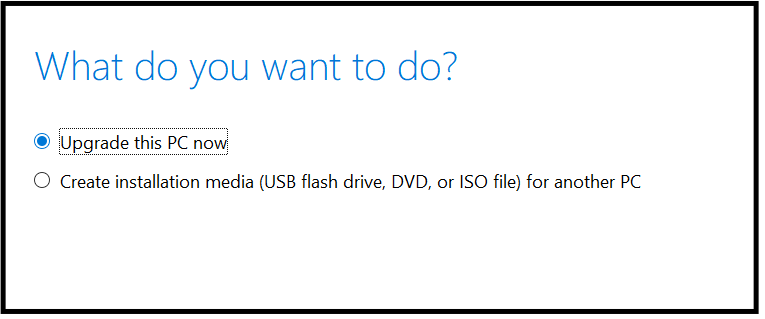
- Choose the relevant language, edition, and architecture, and click Next.

- Select ISO file to create a Windows 10/Windows 11 bootable ISO.

- Click Save to download the Windows 10/Windows 11 bootable ISO.
Thus, you can create a Windows 10/Windows 11 installation file that can be used to boot the target computers which can be used for deployment. However, the Media Creation tool doesn't offer you the option to customize the Windows 10/Windows 11 installation according to your requirement.
Windows 10/Windows 11 image backup is a file that contains a copy of the OS and other data partitions present in the target computer's hard drive. OS Deployer allows you to create a Windows 10/Windows 11 image for deployment using USB, ISO, and PXE. This image created using a Windows image creation tool includes the applications to be installed, computer name, SID, user profiles, user accounts, and much more.
You can also deploy the Windows 10/Windows 11 image to multiple computers simultaneously right from your desk. The Windows 10/Windows 11 image backup can be deployed seamlessly to users working from home outside your network and in remote offices. Also, hardware-independent deployment can be performed using automatic collection of drivers.
Let us discuss how to perform Windows 10/Windows 11 imaging and deploy the Windows 10/Windows 11 images using OS Deployer.
The prerequisites for Windows 10/Windows 11 imaging process in OS Deployer involve creating 2 repositories: an image repository and a driver repository. These two repositories must be configured with a network share path to store the created Windows 10/Windows 11 images and relevant drivers in our Windows 10/Windows 11 imaging software.
Follow the steps given below to configure the image repository:
- Navigate to Create > Repository -> Image Repository -> Add Image Repository.

- Enter a name for the image repository.
- Select the remote office under which the image repository is to be located.
- Enter the share path of the computer where the image repository is to be located. This path should have Read and Write permissions for the required users.
- Add an administrator credential for the repository.
You can also configure the driver repositories using the same steps given above and continue imaging Windows machines.
Ensure that you set up the desired system with the Windows 10/Windows 11 OS and applications, before initiating the Windows 10/Windows 11 image creation process. After setting up the system, follow the steps given below to create an image using our Windows 10/Windows 11 imaging solution:
- Navigate to Create -> Image & Backup -> Online Imaging -> Create Image.

- Select the office in which the imaging computer (target computer) is located. It can be either local or remote office for on-premise edition whereas it can only be remote office for cloud edition.

- Specify the computer details to install image creator components:
Specify the details of the computer (the desired system which you have set up with the required OS and applications) from which you want to capture the image. Ensure that the desired system where imaging will be performed has the following privileges,- Admin$ privileges.
- The system user should have administrator privileges.
- Remote access privileges.
Image creator components will now be installed on the desired system to perform imaging.

- Disk Partitions:
Select the disk partitions which you want to image. You can select/deselect the partitions depending on your requirements. System/Firmware partitions, OS reserved partitions, and OS partitions will be selected by default. As these partitions are necessary for booting and deployment, it is recommended to include these partitions in imaging. - Image compression rate:
Select the image compression rate.- Low Compression rate - Image creation speed will be faster.
- Medium Compression rate - Image creation speed will be moderate.
- High Compression rate - Image creation speed will be slow.
- Memory Usage:
Select the Memory usage level. This memory (RAM) will be used for the imaging process on the computer where the imaging is performed. - Image Repository:
Select the appropriate image repository where you want to store the image. - Now click Start Imaging or Shrink partition & start imaging. The Shrink partition & start imaging option allows you to shrink the partitions before creating the image. Click here to know more about shrinking partitions.
Imaging will now be started on the selected machine. If needed, you can pause, stop, and re-start the imaging process. The created image backups will then be stored in the selected image repository.
You have now successfully captured the image using our Windows 10/Windows 11 imaging tool. You can also perform offline imaging by creating Bootable media.
The next step in our Windows 10/Windows 11 imaging and deployment guide is to customize the image for deployment using the deployment template. Finally, let us understand the steps involved in scheduling and deploying the created Windows 10/Windows 11 image using a deployment task.
- Under Deployment, select Deployment Task.
- Select Add Deployment Tasks.
- Deployment Template
- Specify a unique name for the deployment task.
- Select the deployment template using which you have customized the image. You will be able to view the details of the deployment template now.
- Remote Office(s)
- Ensure that the selected image in the template is successfully replicated in the remote office.
- The remote offices to which the selected image has been replicated will be automatically added here.
- Deployment Mode
You can deploy an image either by generating a passcode or by using a MAC address. The MAC address option will allow you to remotely wake the computer up and deploy the created image.
- Deployment Settings
You can select the deployment method to deploy the images.
- Multicast Deployment method
In multicast deployment, the server sends the image copy to multiple computers simultaneously, preventing excess bandwidth consumption. This method is recommended when deploying images to multiple computers.
- Unicast Deployment method
In unicast deployment, target computers reach the image repository and copy the image one by one. This method is recommended for deployment of up to 5 computers.
- Deployment waiting time
- Multicast Deployment method
Specify the time interval for the target computers to connect to the server. The waiting time will start once you click the Deploy Now button. If you enable the Schedule Deployment option, the waiting time will start at the scheduled time. During this time interval, the server will wait for the target computers to connect, and deployment will initiate once a target computer connects.
- Schedule Deployment
You can schedule the time interval for deployment based on the feasible time in your organization.
Deployment task has been created successfully. Boot the computer using bootable media and initiate deployment. You can view the status of the deployment under the Deployment Status tab.
You can now deploy this image using three different bootable media types: USB, ISO, or PXE. The images can also be deployed using the Standalone task or Zero-touch task.