Top network monitoring trends redefining enterprise IT
Published on: Oct 13, 2025
6-8 mins read
Network isn’t just a technical backbone; it’s the foundation of digital trust, user experience, and business agility. With AI-driven operations, hybrid infrastructures, and edge ecosystems reshaping how organizations function, network monitoring trends have evolved far beyond traditional uptime checks.
Here’s how the world’s most forward-thinking IT leaders are reimagining network visibility and performance management.
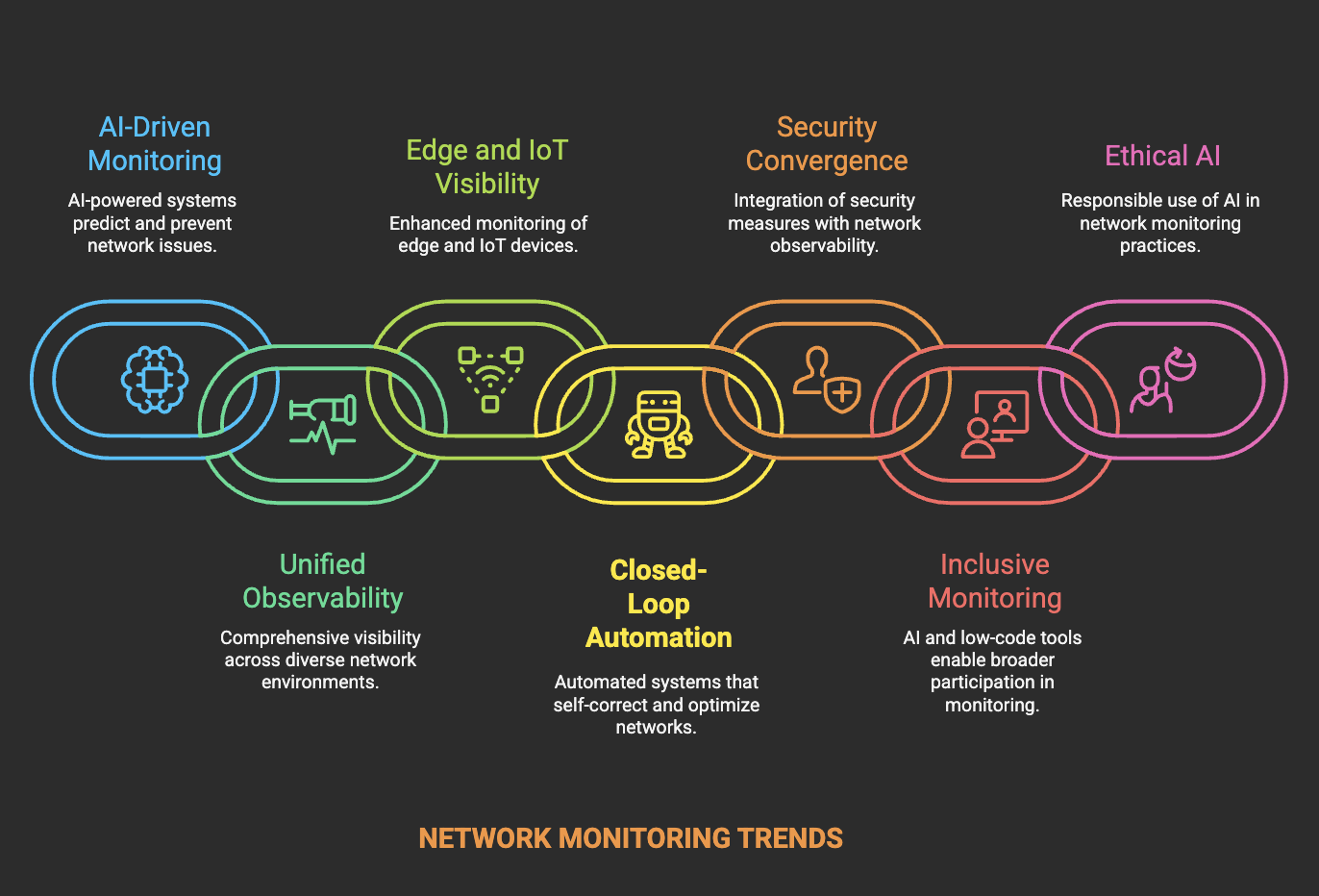
1. AI-driven and predictive monitoring becomes the default
- From reactive to proactive monitoring: AI now anticipates network anomalies before they cause downtime, reducing MTTR to a massive extent.
- Predictive analytics at scale: Machine learning models detect patterns in latency, bandwidth use, and packet loss revealing issues long before thresholds break.
- Natural Language Monitoring (NLM): Admins can now “ask” their monitoring tools questions in plain English, democratizing network intelligence.
- Self-learning systems: Algorithms continuously refine baselines, improving accuracy and cutting false alerts.
Why it matters: Predictive monitoring has moved from a premium feature to a baseline expectation for enterprise-grade visibility.
2. Unified Observability for hybrid and multi-cloud networks
- The multi-cloud reality: Most enterprises now operate across AWS, Azure, Google Cloud, and on-prem demanding unified observability.
- End-to-end visibility: Tools now correlate telemetry across layers (network, app, and user experience) into a single, actionable view.
- Cloud-native instrumentation: Lightweight agents and API-based collectors enable deep insights without heavy infrastructure overhead.
- Business-service mapping: Observability isn’t just about metrics anymore; it connects uptime directly to revenue and customer satisfaction.
Why it matters: True observability transforms network data into strategic intelligence, giving decision-makers a clear picture of business health.
3. Edge and IoT visibility goes mainstream
- The network perimeter has vanished: Thousands of connected IoT devices now operate at the edge, demanding real-time visibility and control.
- Decentralized analytics: Monitoring is shifting closer to the data source reducing latency and bandwidth dependency.
- 5G and industrial IoT acceleration: Edge ecosystems in manufacturing, logistics, and energy now rely on continuous telemetry to ensure uptime and safety.
- Unified IT-OT monitoring: Converged visibility helps enterprises manage both traditional IT systems and operational technology under one platform.
Why it matters: Edge and IoT monitoring are no longer niche; they’re mission-critical for modern industries and smart infrastructure.
4. Closed-loop automation and self-healing networks
- Automation takes the wheel: Routine network tasks like configuration updates, log clearance, and basic fault remediation are now handled autonomously.
- Event-driven response: When anomalies are detected, workflows trigger corrective actions automatically, minimizing human intervention.
- Feedback loops for continuous improvement: AI models learn from past resolutions to fine-tune future responses.
- Seamless integration with ITSM tools: Closed-loop monitoring connects directly with platforms like ServiceNow or Jira for incident lifecycle automation.
Why it matters: Self-healing networks mark the shift from manual firefighting to intelligent resilience; a must for 24/7 uptime.
5. Network security and observability converge
- Unified NetOps and SecOps workflows: Shared telemetry and correlated insights now help teams detect both performance degradation and security threats.
- Encrypted traffic monitoring: Advanced flow analytics ensure visibility without compromising privacy.
- Zero-trust observability: Continuous validation of every connection, device, and user is now embedded into network monitoring tools.
- Threat-aware performance management: AI correlates network performance anomalies with potential cyber incidents.
Why it matters: Security and performance are now two sides of the same coin; observability is the bridge between them.
6. Inclusive network monitoring with AI and low-code automation
- AI copilots for IT: Conversational assistants now help admins build dashboards, configure alerts, or diagnose issues instantly.
- Low-code workflows simplify automation: IT teams can design remediation flows without deep scripting or coding knowledge.
- Empowerment beyond IT teams: Business units and non-technical staff can access simplified insights, promoting data-driven decisions.
- Adaptive UX design: Monitoring platforms now offer modular, intuitive interfaces that scale from SMBs to enterprises.
Why it matters: Democratizing network monitoring brings speed, transparency, and collaboration which is essential for agile digital operations.
7. Ethical and responsible AI in network monitoring
- Transparent AI models: Enterprises now demand explainable AI to understand how anomaly detection and decisions are made.
- Data privacy by design: Tools must comply with evolving data governance standards like GDPR and AI Act mandates.
- Bias and fairness audits: Ethical AI practices ensure models don’t misinterpret patterns from limited or skewed datasets.
- Human-in-the-loop validation: Automation runs alongside human oversight, ensuring accountability and trust in AI-driven insights.
Why it matters: Ethical AI isn’t a compliance checkbox; it’s the foundation of trustworthy, enterprise-grade observability.
Network monitoring trends: Impact snapshot
Each trend isn’t just a technological leap; it’s a strategic shift that redefines how IT leaders measure success, allocate budgets, and maintain digital trust.
| Trend | Impact on IT operations | Business benefit |
|---|---|---|
| AI-driven predictive monitoring | Early anomaly detection, reduced downtime | Improved reliability and SLA performance |
| Unified observability | Correlated visibility across hybrid systems | Faster root cause isolation, better user experience |
| Edge & IoT visibility | Continuous telemetry from distributed assets | Operational efficiency and resilience |
| Closed-loop automation | Automated fault isolation and remediation | Cost savings and reduced human dependency |
| Security-Observability convergence | Unified telemetry for NetOps & SecOps | Better threat detection and compliance posture |
| Low-code & AI assistants | Simplified setup and automation | Democratized IT control and faster deployment |
| Ethical AI in monitoring | Transparent and fair AI decision models | Trust, compliance, and sustainability assurance |
These network monitoring trends collectively define the future of IT blending AI precision, human oversight, and data ethics to create autonomous, secure, and resilient networks.
How OpManager leverages these network monitoring trends
As these trends reshape the monitoring landscape, ManageEngine OpManager is already turning them into measurable business value.
- AI-powered predictive analytics for anomaly detection and capacity forecasting.
- Unified observability across hybrid, multi-cloud, and edge infrastructures.
- Integrated NetOps and SecOps through flow-based traffic and log correlation.
- Closed-loop automation for faster remediation and workflow orchestration.
- Low-code configuration tools and AI assistants that simplify complex monitoring tasks.
- Compliance-ready architecture ensuring responsible AI and data governance.
In essence, OpManager doesn’t just follow these network monitoring trends; it powers them, helping enterprises move from visibility to autonomous intelligence.
Wrapping up
The modern network is evolving into a self-aware, AI-assisted ecosystem spanning data centers, clouds, and the edge.
Organizations that embrace these network monitoring trends aren’t just improving uptime; they’re building digital trust, operational agility, and future-ready IT infrastructures.
Platforms like OpManager empower businesses to stay ahead of these changes combining predictive intelligence, automation, and ethical AI to keep networks secure, resilient, and intelligent.
Download our 30-day free trial now.