
Last updated on: August 08, 2025
Achieving five-nines (99.999%) availability—the gold standard for uptime—requires more than just ambition. It demands real-time visibility into infrastructure health and rapid, coordinated incident response. While full-stack observability (FSO) helps detect performance anomalies, incident response teams need access to these insights for swift recovery during critical incidents. However, the disconnect between ITSM and monitoring tools often lead to operational siloes and fragmented IT visibility. This hinders resolution, resulting in reactive firefighting and costly downtime.
By unifying ITSM and FSO, organizations can adopt a proactive, context-aware approach to incident management, maximizing service uptime and agility. In this article, we explore how the integration between ManageEngine solutions ServiceDesk Plus, OpManager, and Site24x7 enables real-time visibility and intelligent workflows to boost service resilience.
To understand this better, let's follow the journey of Zylker, a fictional e-commerce company that revamped its incident management strategy with the integration.
A Cyber Monday Catastrophe: Zylker's lesson in availability

Zylker prided itself on delivering seamless shopping experiences. On Cyber Monday, its leadership was optimistic—expecting record-breaking traffic, soaring conversions, and unprecedented revenue. But what unfolded was a wake-up call.
The moment the sale went live, customers encountered sluggish app performance. Many couldn't log into their accounts, leading to abandoned carts and incomplete transactions. Phone lines were flooded. Social media was ablaze. And before the IT team could respond, the damage was done. What should have been a blockbuster sales event collapsed into chaos, resulting in a significant loss of revenue and reputational damage.
The incident exposed critical flaws in Zylker's incident response framework: missed alerts, slow diagnosis, unclear collaboration, and disjointed remediation. Recognizing the need for a systemic overhaul, Zylker embarked on a transformative journey—revamping its entire incident management process by integrating ServiceDesk Plus, OpManager, and Site24x7.
How Zylker accelerated incident response and resolution with ServiceDesk Plus, OpManager and Site24x7
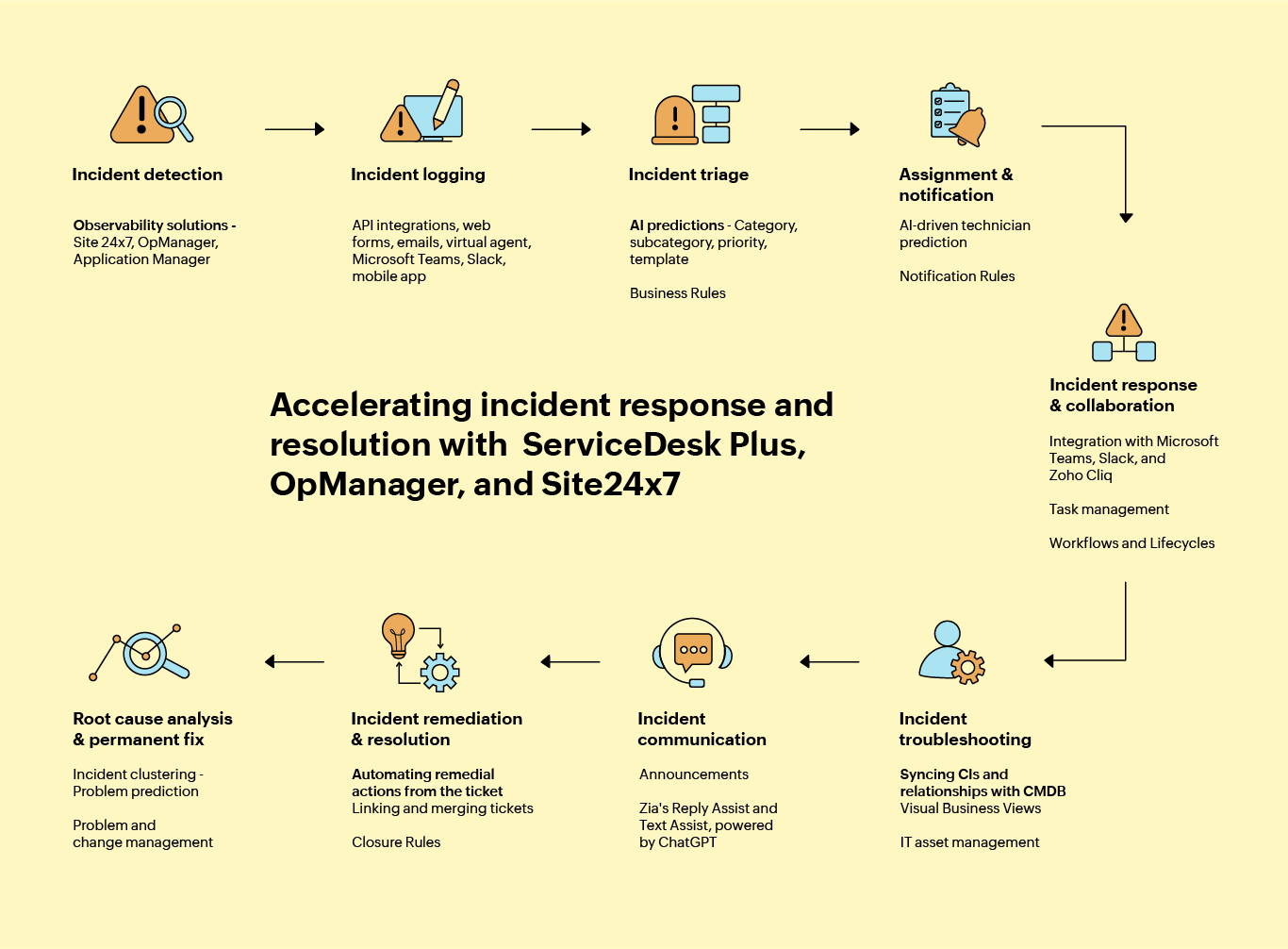
1. Incident detection and logging
Due to a fragmented IT landscape, Zylker's incident response team (IRT) often missed critical alerts. It used to be dependent on external sources such as phone calls, an influx of emails, or outcry from angry customers on social media. This approach resulted in unnecessary delays in understanding the gravity of the situation and identifying major incidents.
The integration advantage
By leveraging the integration between OpManager and Site24x7 with ServiceDesk Plus, Zylker now combines the power of FSO with ITSM workflows from the outset. Whether it is an application performance issue flagged by Site24x7 or a faulty Layer 2 device detected by OpManager, alerts are automatically converted into tickets in ServiceDesk Plus.
Each ticket now carries rich context from the observability solutions, placing critical information at the fingertips of the incident response team. Further, defining ticket attributes, mapping notification profiles to specific IT components, and setting relevant trigger conditions make alerts even more actionable.
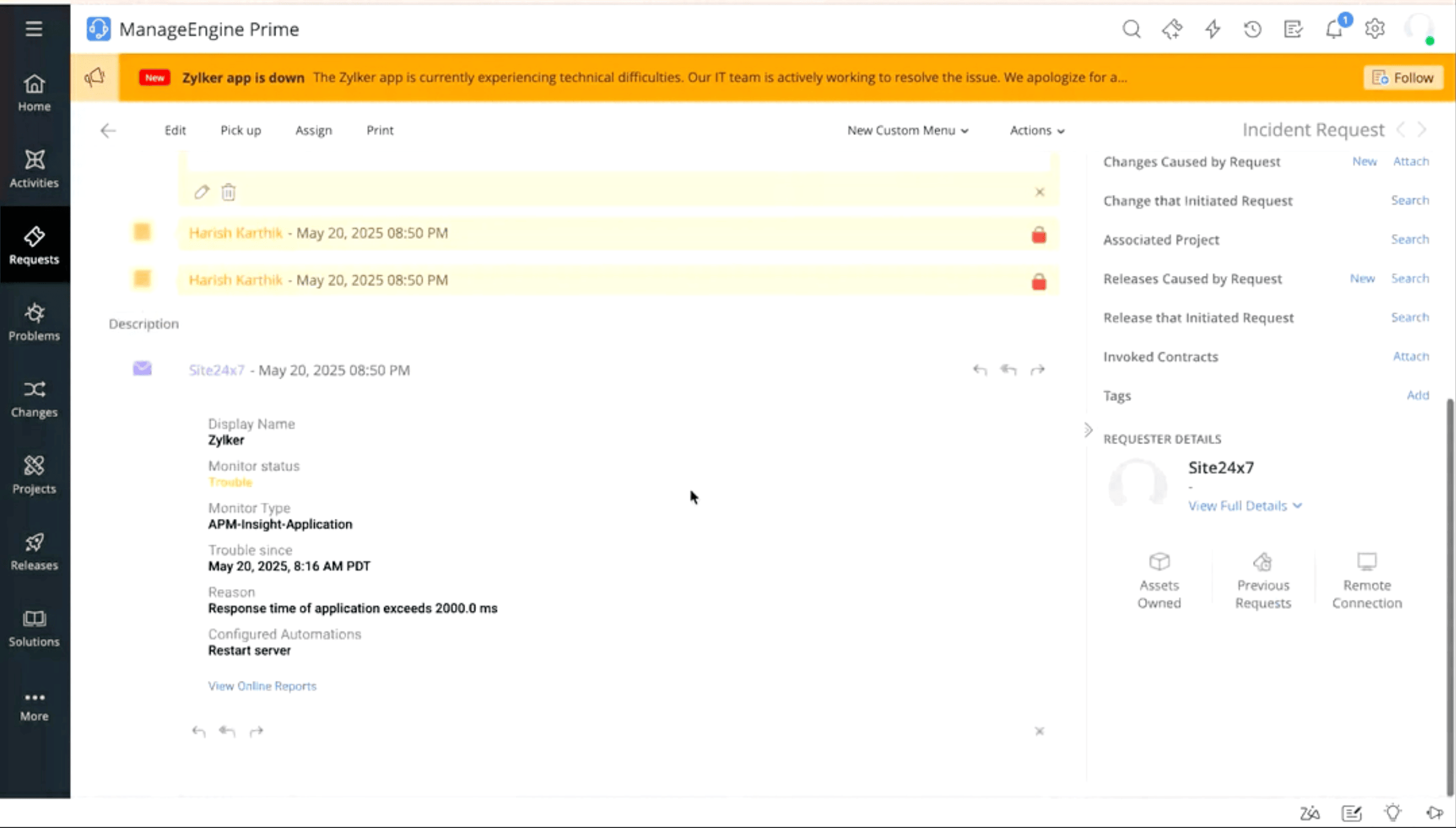
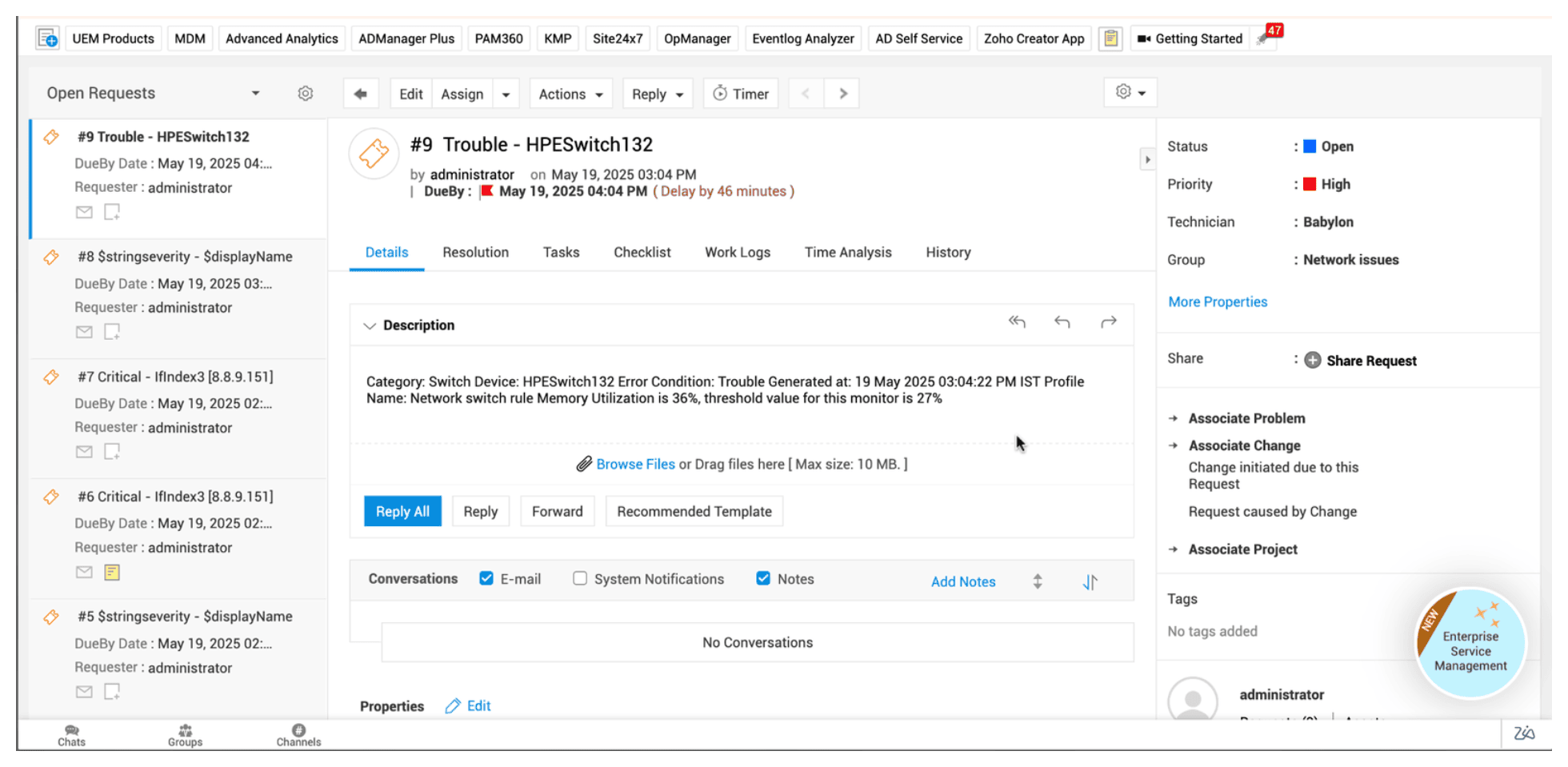
Beyond conversion of alerts from OpManager and Site24x7, incidents can also be logged in ServiceDesk Plus by employing API integrations, web forms, email, virtual agents, Microsoft Teams, Slack, and mobile apps—supporting an omni channel approach. Custom incident templates further ensure that relevant information is captured accurately.
With this as Zylker's first line of defense, no critical issues slip through the cracks.
2. Incident triaging, assignment, and automated notifications
When a flood of tickets poured in, Zylker's IRT used to expend a disproportionate effort manually categorizing and prioritizing them, resulting in inconsistent management of tickets. Compounding this situation, tickets were haphazardly assigned without considering a technician's expertise. Throughout the ticket life cycle, critical updates slipped through the cracks, eroding the team's ability to act decisively.
The ServiceDesk Plus advantage
To eliminate these manual efforts, Zylker adopted the predictive AI capabilities of Zia, the AI-powered virtual assistant. Based on historical ticket data, Zia delivers intelligent recommendations for ticket attributes like the category, sub-category, item, priority, and template. With categorization and prioritization automated, Zia also suggests appropriate technician groups and technicians, quickly routing tickets to the appropriate experts.
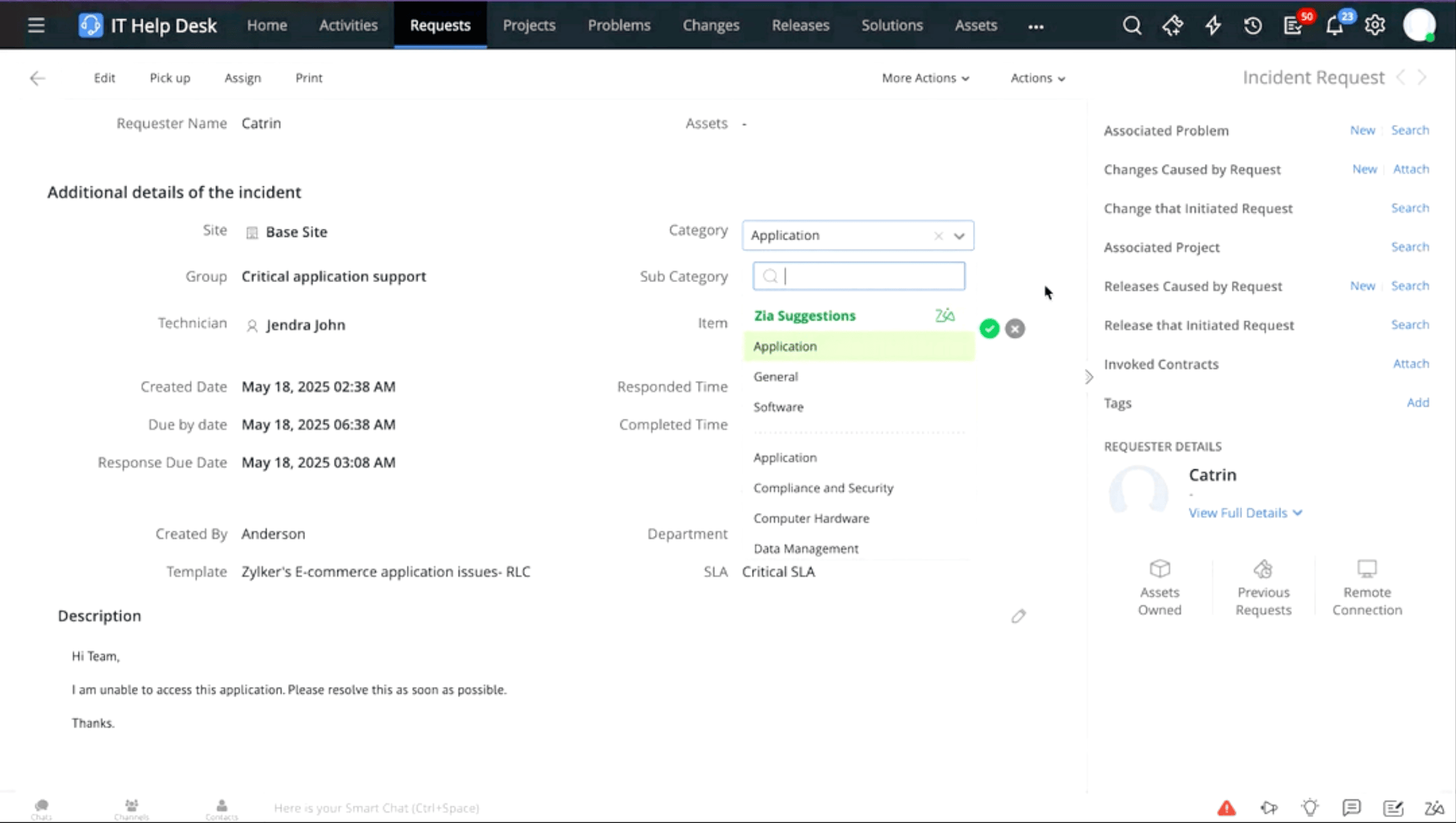
Beyond AI-driven triaging, Zylker leverages business rules to execute condition-based actions on incoming tickets. For instance, Zylker is now empowered to automatically flag critical incidents related to application performance as Tier 4. While expert technicians are looped in, algorithms like Load Balancing and Round Robin ensure equitable ticket distribution through Technician Auto Assign, preventing burnout.
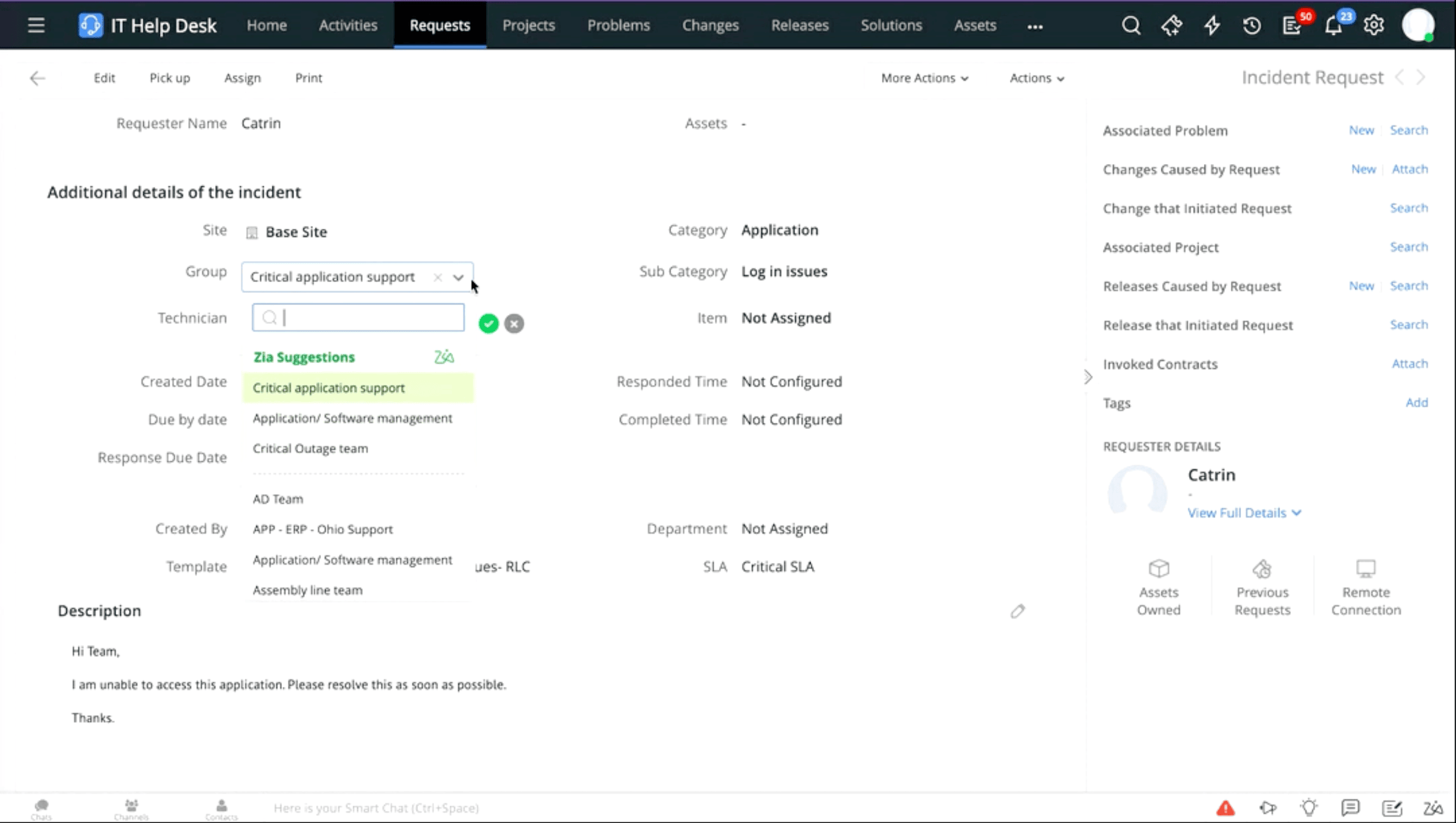
To streamline outreach, Zylker uses Notification Rules to alert technicians and end-users about key events during ticket administration, keeping them well-informed while closing existing communication gaps.
By simplifying triaging, automating assignments, and strengthening communication, Zylker eliminates bureaucratic red tape, making ticket management faster, smarter, and more reliable.
3. Incident response and collaboration
While tackling the outage, Zylker's IRT previously lacked clear guidance on the next steps. Without a standardized response mechanism, technicians handled incidents inconsistently, leading to delays. Relying on manual processes made incident remediation both cumbersome and error-prone.
As Zylker's IT teams were geographically dispersed, they operated without shared visibility into the progress of resolution efforts. This hindered effective collaboration, stalling knowledge sharing among technicians and delaying critical decisions by C-suite executives.
The ServiceDesk Plus advantage
Thanks to visual workflows and life cycles in ServiceDesk Plus, Zylker now streamlines incident management while gaining refined control at every step. Using Request Life Cycles, it maps the entire resolution journey, from initiation to closure, guiding technicians with recommendations and automating contextual actions such as updating ticket details, adding tasks, sending notifications, and executing custom functions.
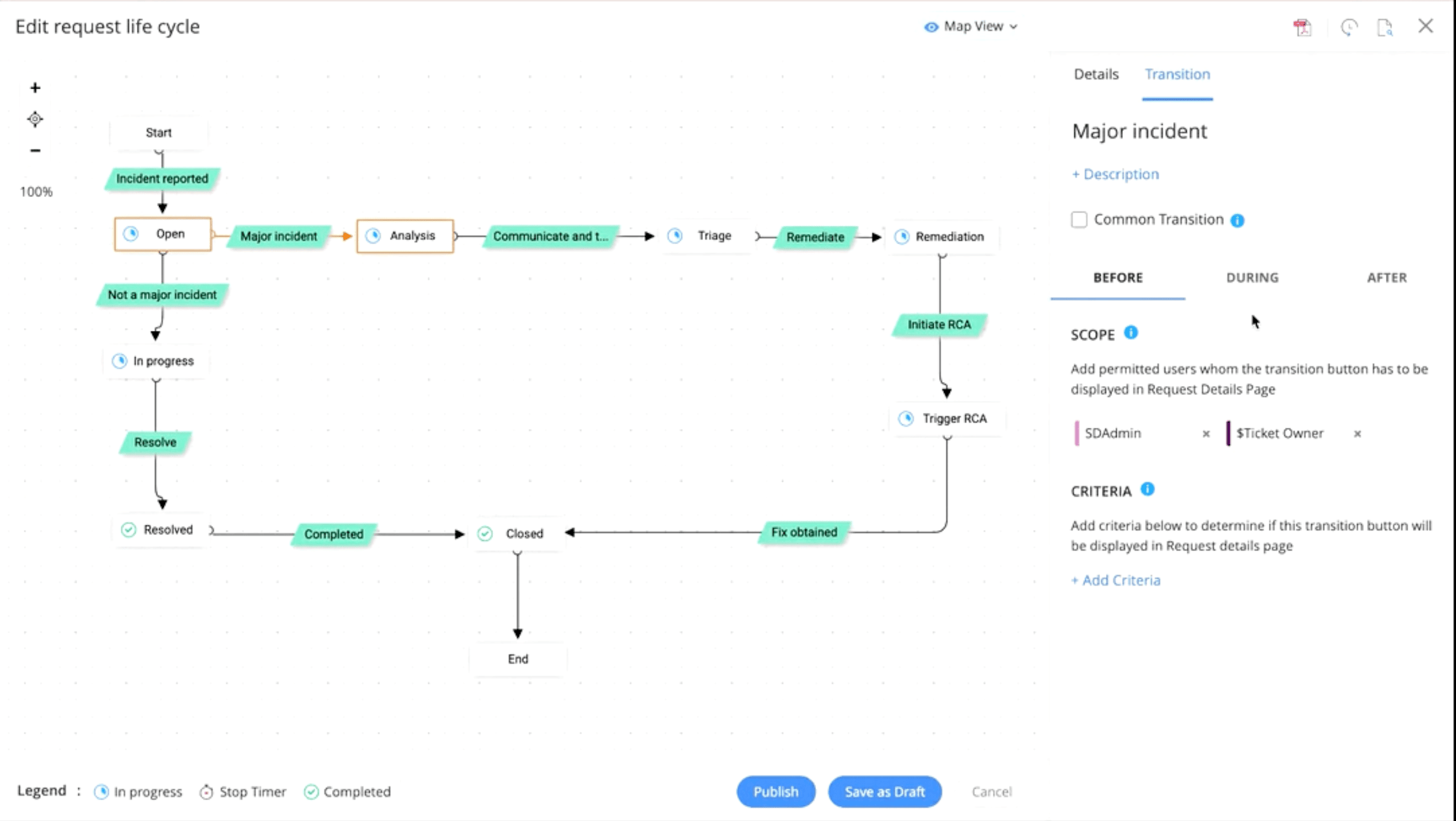
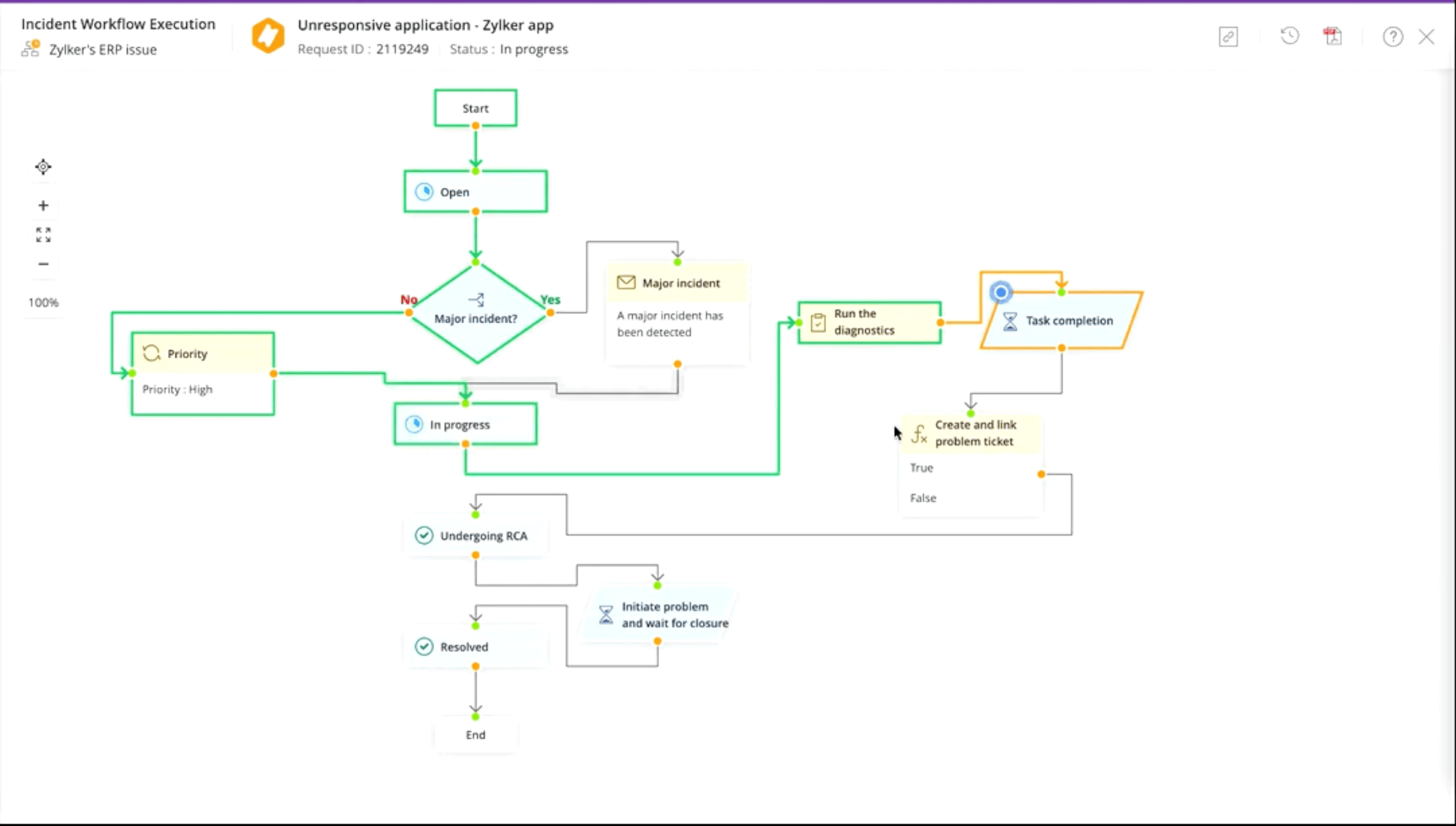
To blend flexibility with robustness at scale, Zylker designs highly programmable, multi-stage incident response workflows that deliver end-to-end automation enriched by precision-crafted user transitions. These workflows automate a wide range of actions, from approvals and condition checks to executing custom functions for last-mile customization.
User transitions act as guided control points within the workflows—enabling human intervention where needed to fulfill mandatory requirements or trigger contextual actions, all without breaking the automated flow.
Zylker now seamlessly orchestrates complex operations across multiple enterprise systems, setting impressive new benchmarks for process excellence within its workflows. It accomplishes this by leveraging the single-touch workflow automation capability in ServiceDesk Plus, powered by Zoho Circuits, the no-code/low-code orchestration engine.
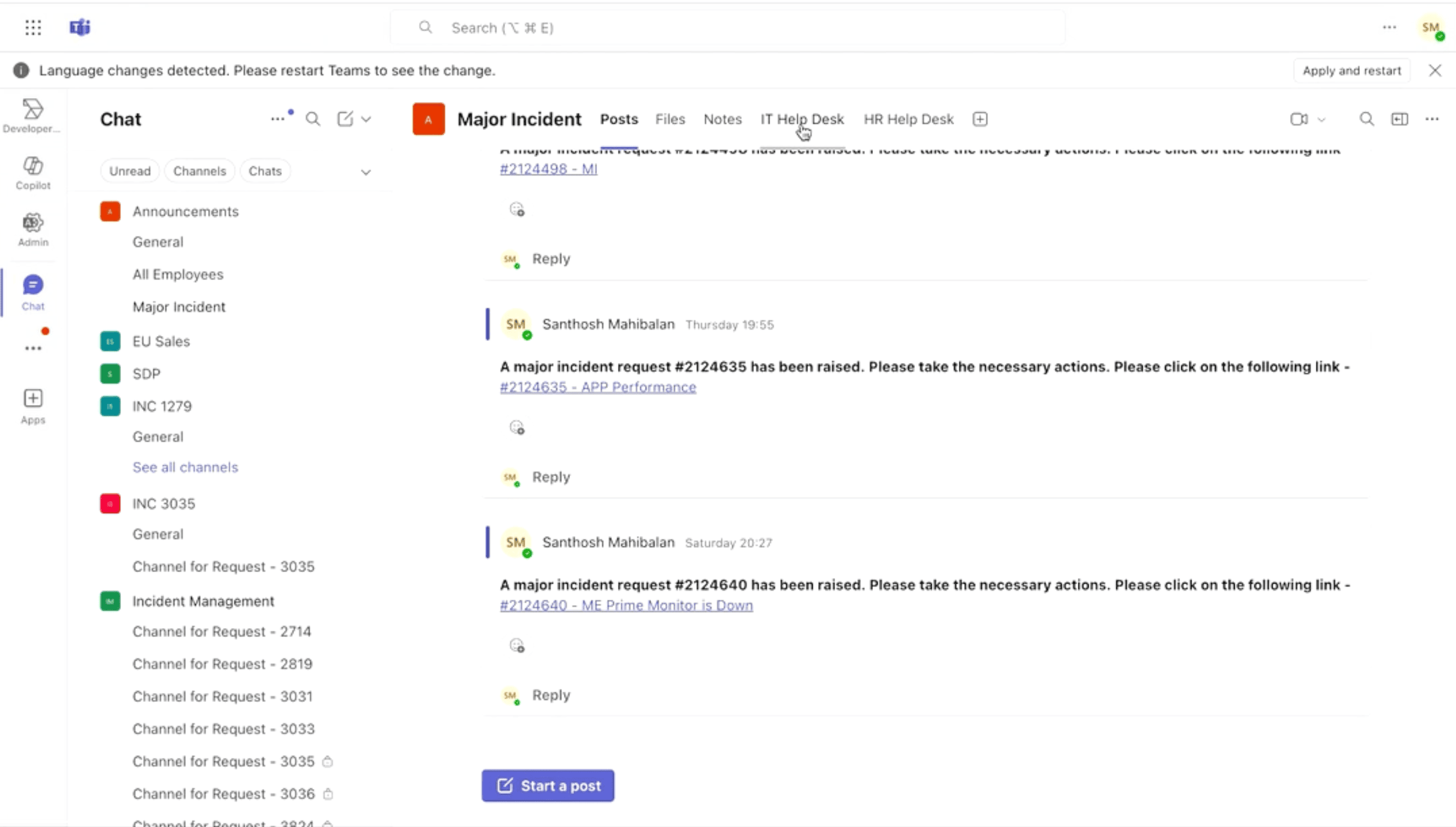
To drive real-time collaboration, Zylker integrates ServiceDesk Plus with Microsoft Teams, connecting digital workspaces with its service desk. Whenever Zylker faces a major outage, all key stakeholders—be it the IRT, employees, or C-suite executives−receive real-time updates directly within the Microsoft Teams channel. The IRT also accesses ServiceDesk Plus from within the same interface, enabling it to initiate incident resolution instantly without switching contexts. This empowers Zylker's IRT to coordinate seamlessly without hopping tabs and accelerates collective decision-making.
4. Incident troubleshooting
Zylker used to rely on a manual, outdated CMDB, resulting in inaccurate visibility over its IT infrastructure and the complex web of dependencies. Specifically, it failed to map the interconnections between its e-commerce application and the supporting components—database and application servers, Layer 2 devices, and more. As a result, Zylker struggled to assess the impact and trace the root cause, delaying critical decisions.
The integration advantage
After the Cyber Monday incident, Zylker leveraged the integration between ServiceDesk Plus, OpManager, and Site24x7 that keeps its CMDB continuously updated. It began by syncing inventory data from these observability tools as configuration items in ServiceDesk Plus, ensuring accurate, real-time tracking. But effective incident resolution requires more than just an up-to-date inventory—it demands clear visibility into how these components were interconnected.
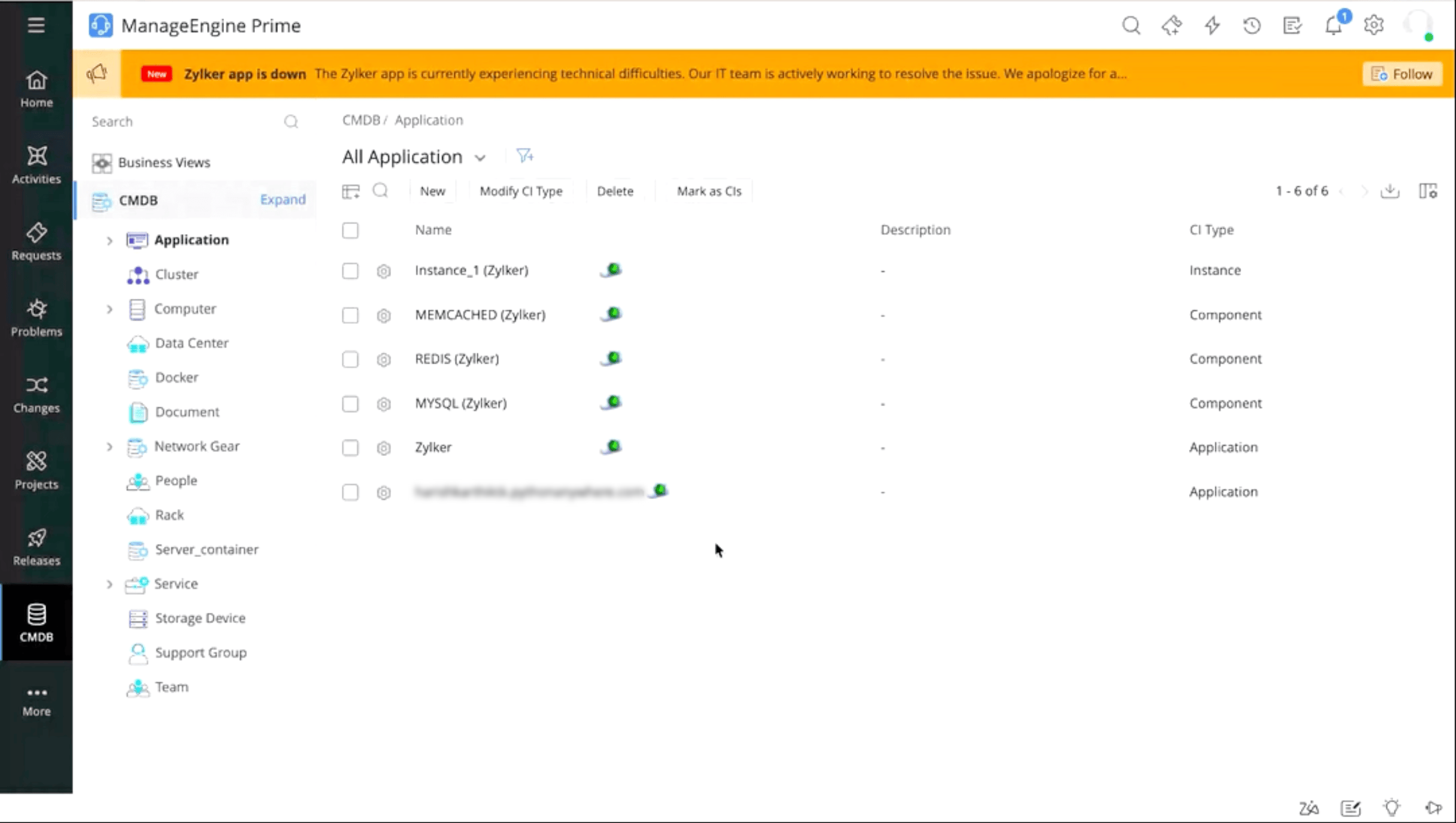
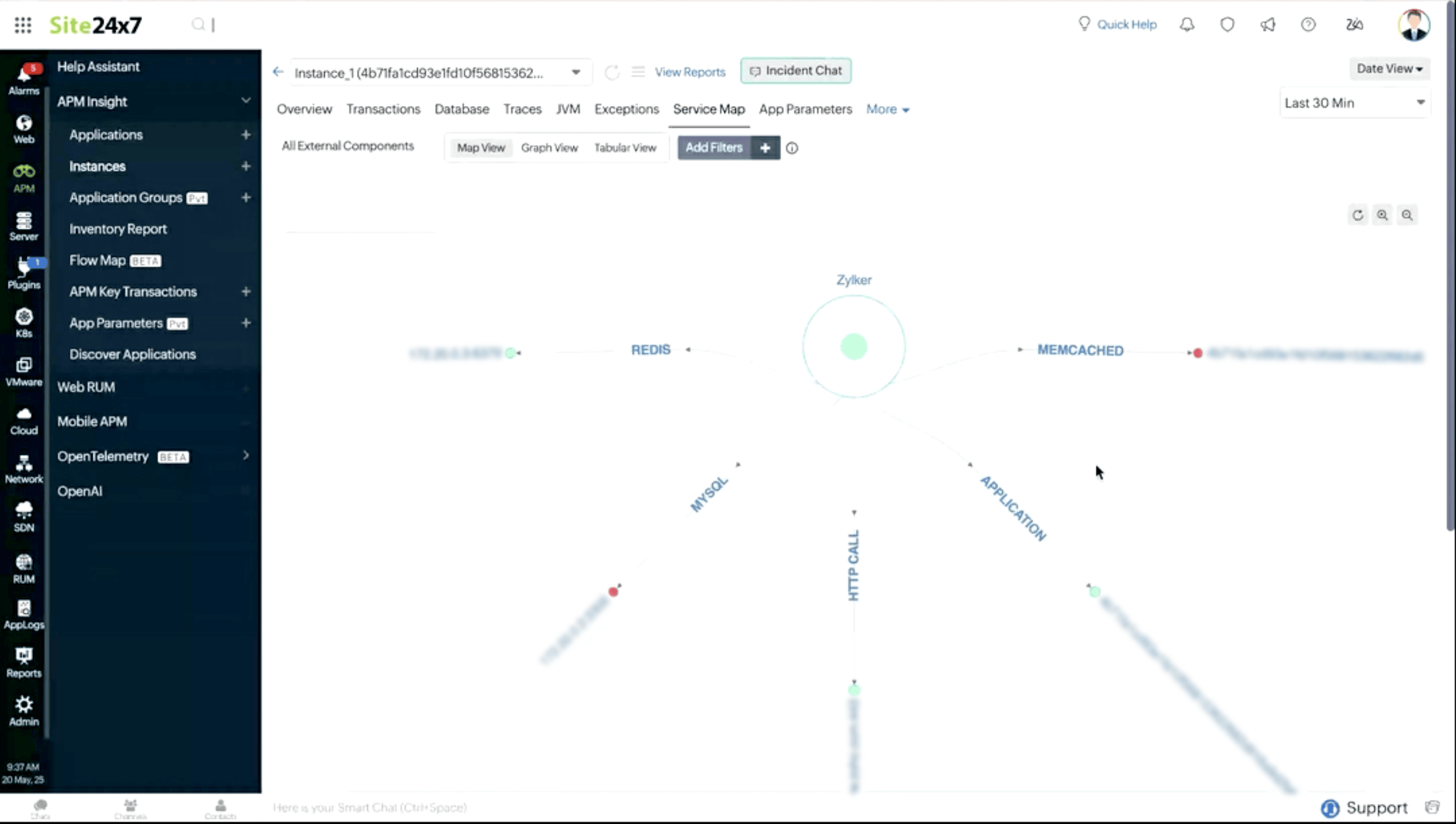
To build this context, Zylker syncs relationship data from Site24x7 and OpManager into the CMDB, creating a dynamic, end-to-end view of its IT environment. Site24x7's service maps reveal the interconnected components of the e-commerce application−such as database and application servers—along with their real-time interactions and availability status. Meanwhile, OpManager's Layer 2 maps trace the links between the application and underlying network devices like switches and routers.
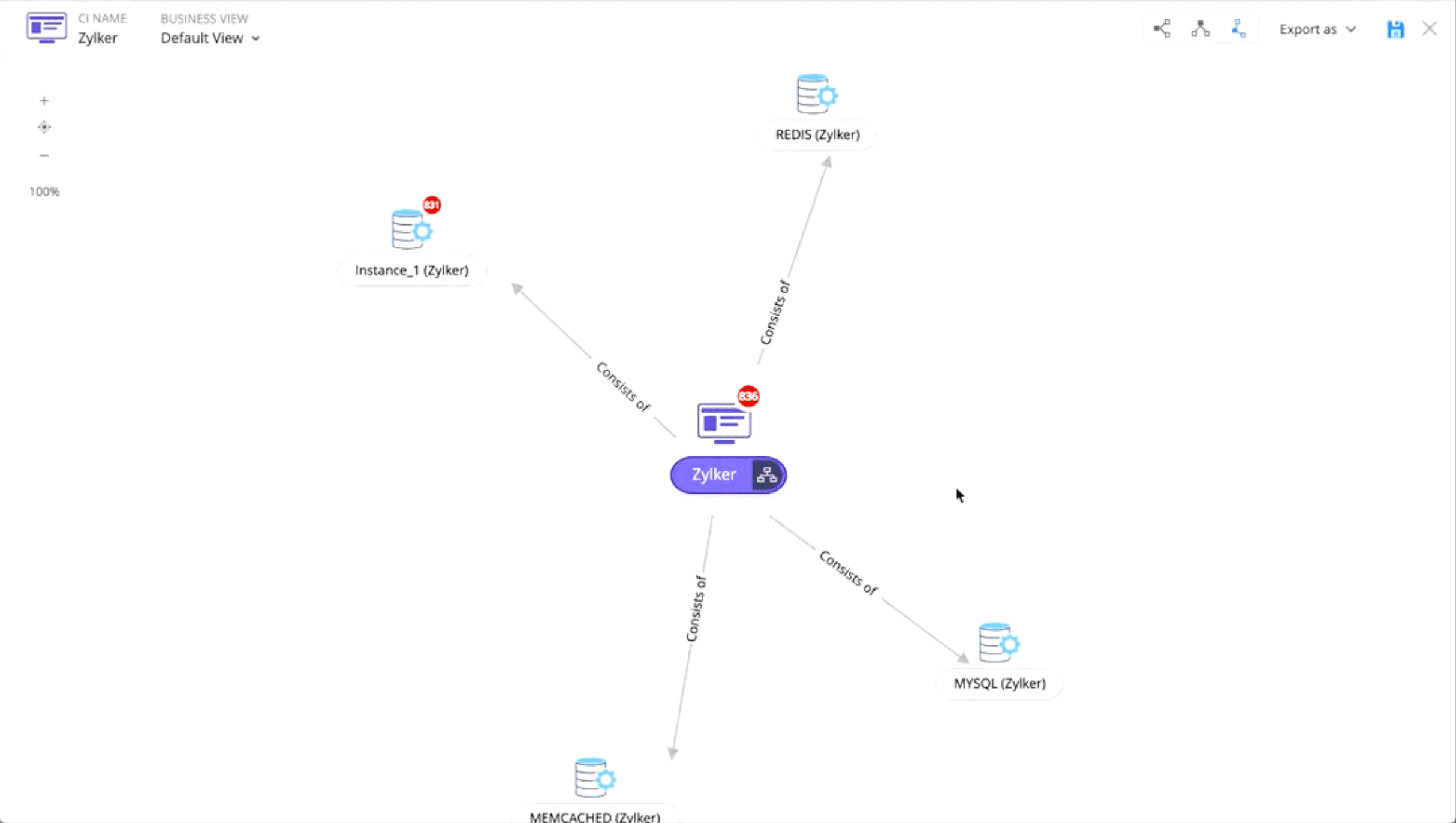
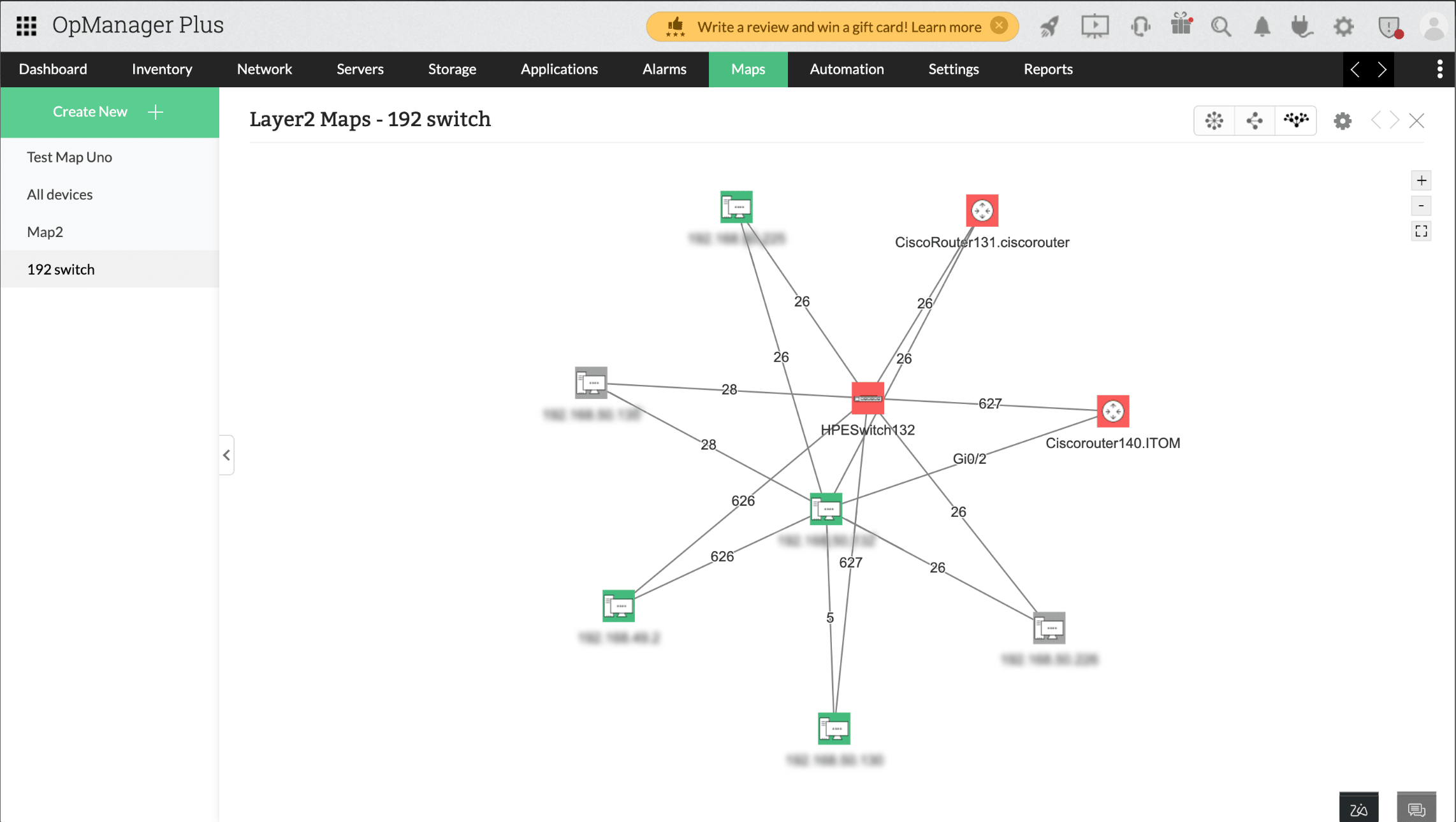

(ServiceDesk Plus On-premises)
By aggregating service map data from Site24x7 and Layer 2 topology from OpManager into relationship maps within ServiceDesk Plus, Zylker established a single source of truth, giving its IRT holistic IT visibility, accelerating impact analysis and decision-making.
5. Incident communication
In the absence of timely communication surrounding the Cyber Monday incident, customers were left in the dark about the resolution progress despite the IRT's efforts. Frustrated, they flooded the service desk with repetitive queries, diverting technicians from critical tasks. These queries came from across the globe, but responses were impersonal and generic, lacking relevance to users' issues. Zylker's previous one-size-fits-all communication approach eroded trust and escalated a manageable incident into a brand-damaging crisis.
The ServiceDesk Plus advantage
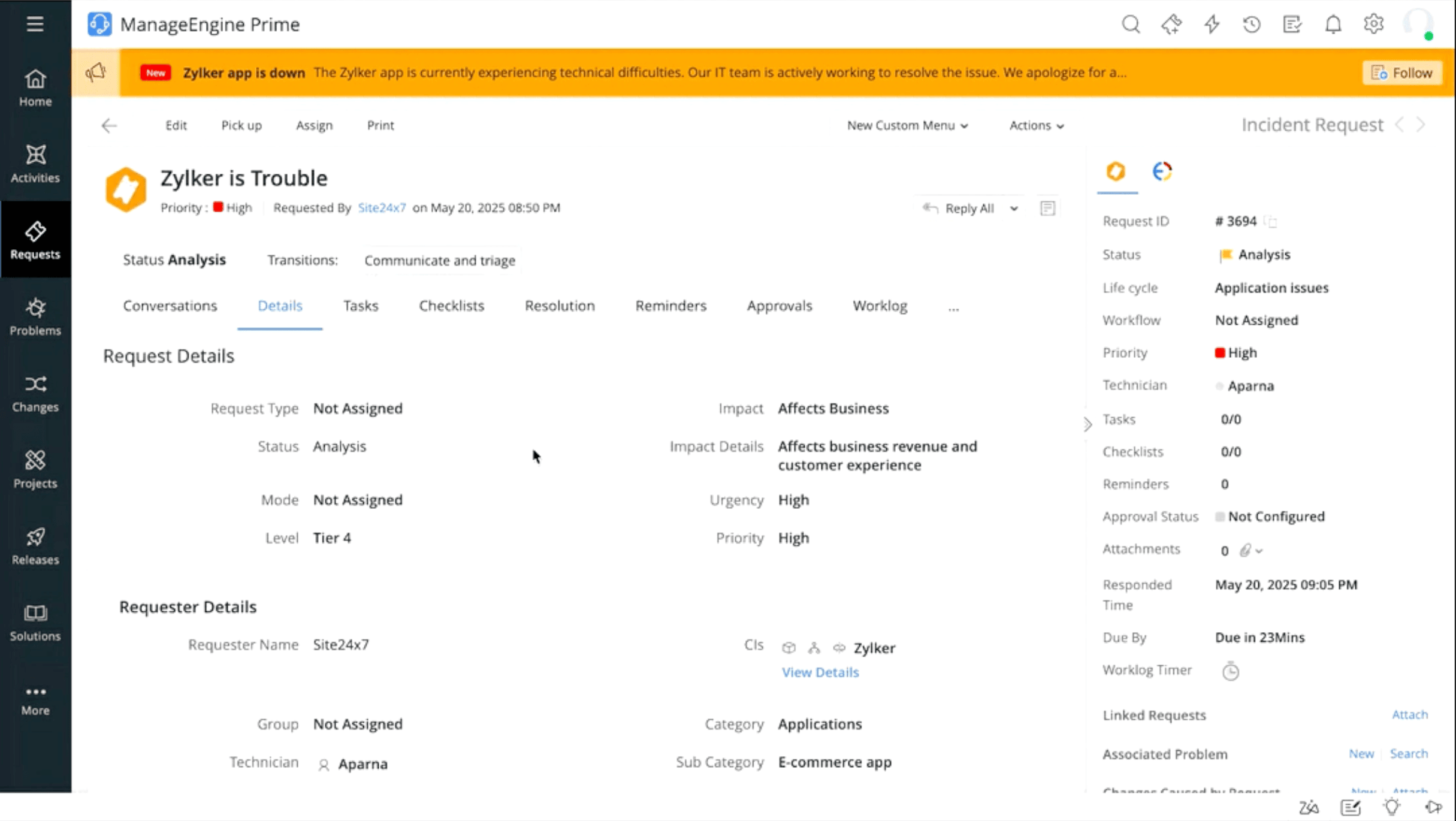
To rebuild trust, Zylker adopted a multi-pronged, proactive communication strategy. Announcement banners in ServiceDesk Plus now deliver real-time updates on availability and resolution progress on even minor service issues−keeping users informed and effectively dissuading them from submitting unnecessary tickets.
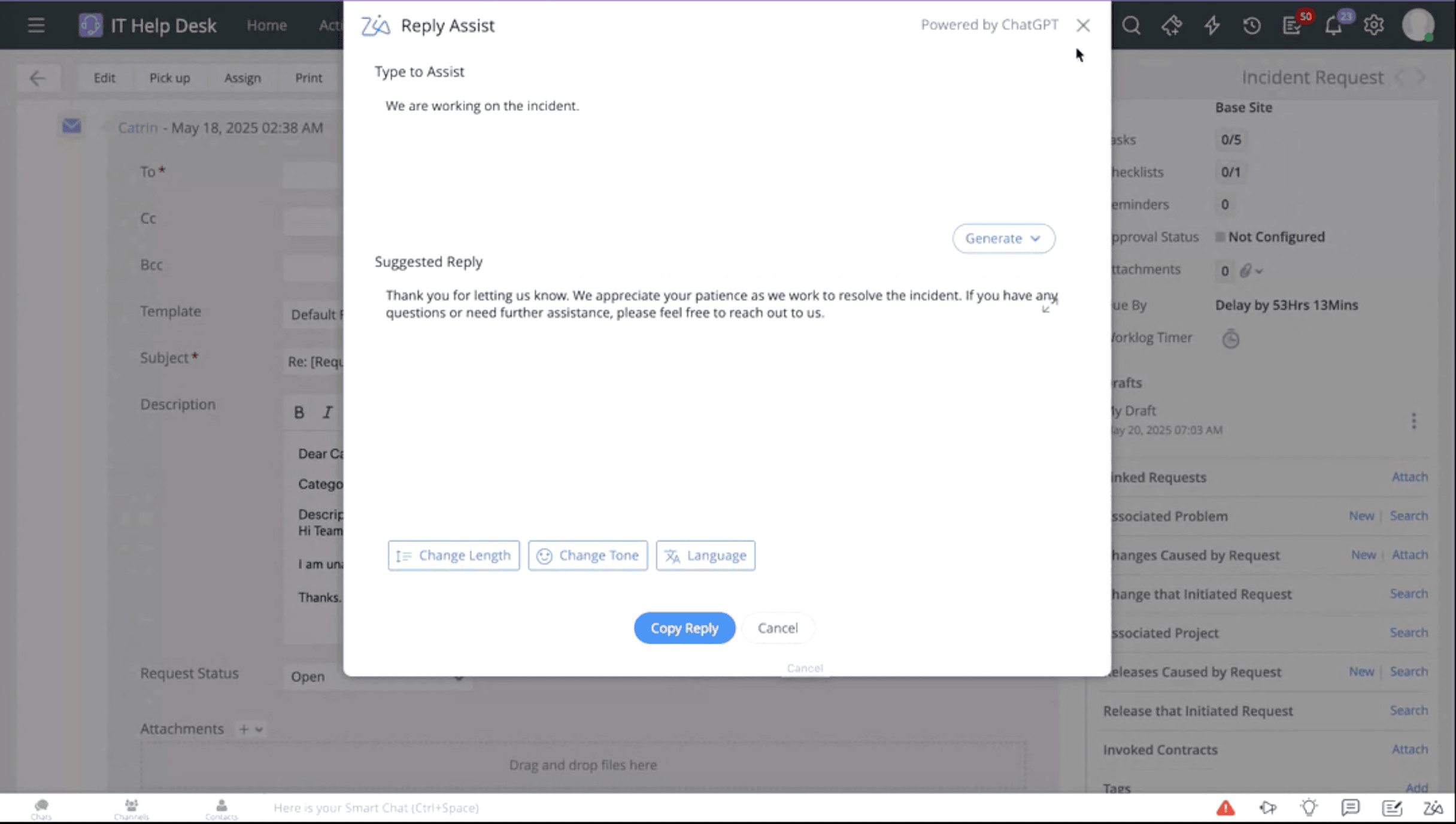
For personalized, contextual responses, technicians use Zia's Gen AI-powered Reply Assist to craft tailored replies with simple prompts. Internally, Text Assist helps document notes and descriptions more quickly within the ticket, improving team coordination.
6. Incident remediation and resolution
Previously, relying on external tools for incident remediation disrupted Zylker's flow of work. Juggling multiple tools led to fragmented context, increasing the risk of errors and oversights. This slowed resolution and undermined accuracy, causing unnecessary delays.
The integration advantage
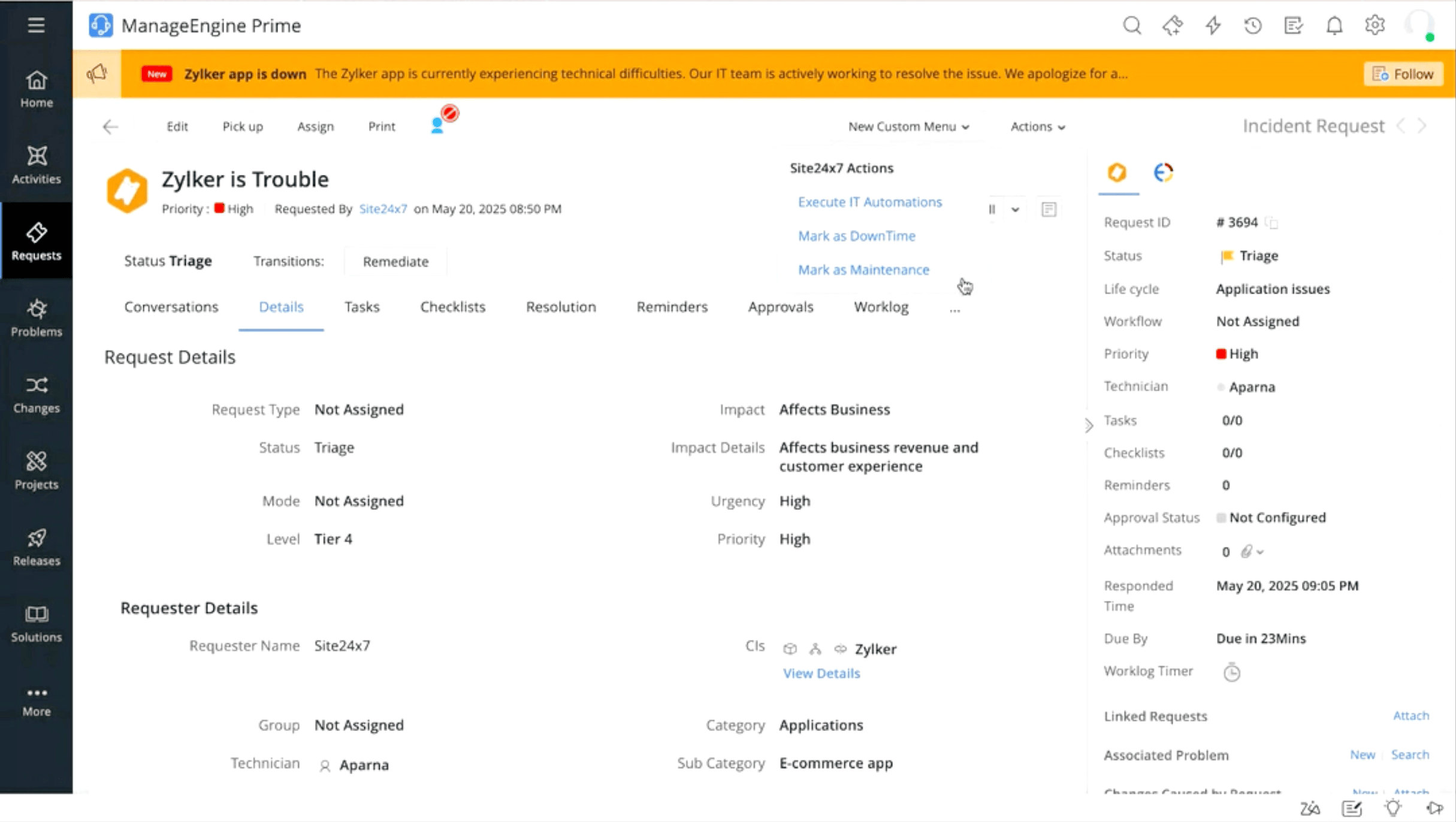
To accelerate incident remediation, Zylker now harnesses the Site24x7 extension for ServiceDesk Plus Cloud that enables technicians to trigger contextual remedial actions—like marking elements for maintenance or restarting database servers—directly from the ticket. The execution status also tracks within the ticket itself, preserving context and eliminating tab hopping. Closure rules then ensure that essential requisites are fulfilled, optimizing ticket closures.
7. Post incident review
To support future course corrections, Zylker maintains a central record of incident resolution efforts. Technicians used to manually piece together scattered notes, descriptions, conversations, to reconstruct what had transpired, often resulting in inconsistent or incomplete documentation. This weakened accountability and limited opportunities for long-term service improvement.
The ServiceDesk Plus advantage
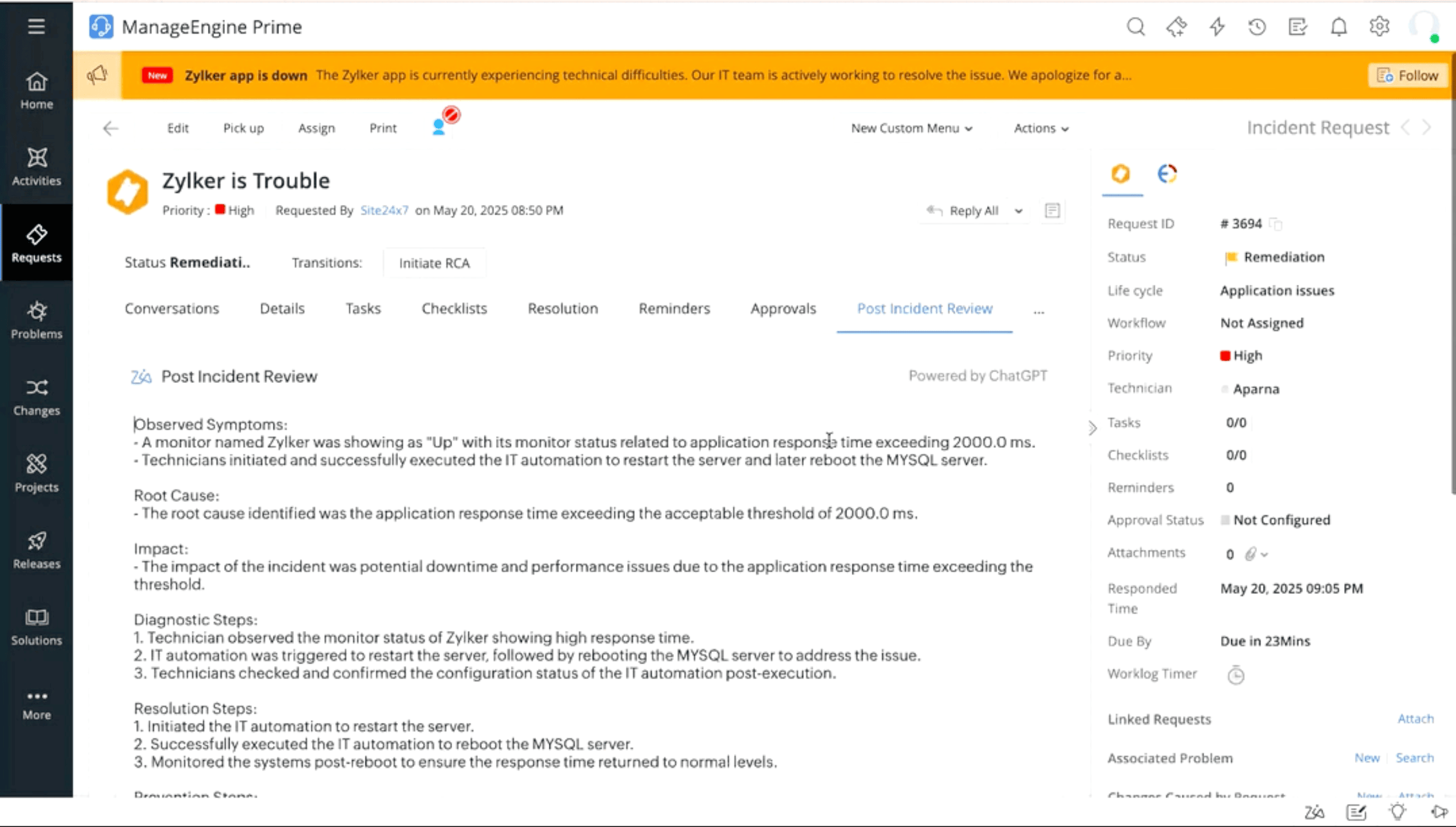
To streamline documentation and strengthen institutional memory, Zylker adopted the Zia Post-Incident Review extension in ServiceDesk Plus Cloud. Powered by Gen AI, Zia automatically analyzes the ticket workspace to summarize key details, timelines, root causes, remedial actions, and more—without manual effort. These insights, captured within the ticket itself, enable effortless knowledge sharing across teams and eliminate bureaucratic overhead.
8. Root cause analysis and permanent fix
Zylker often struggled with a cycle of repeat incidents as it addressed symptoms, not causes. The inability to nail the root cause eroded customer confidence and impacted profitability.
The ServiceDesk Plus advantage
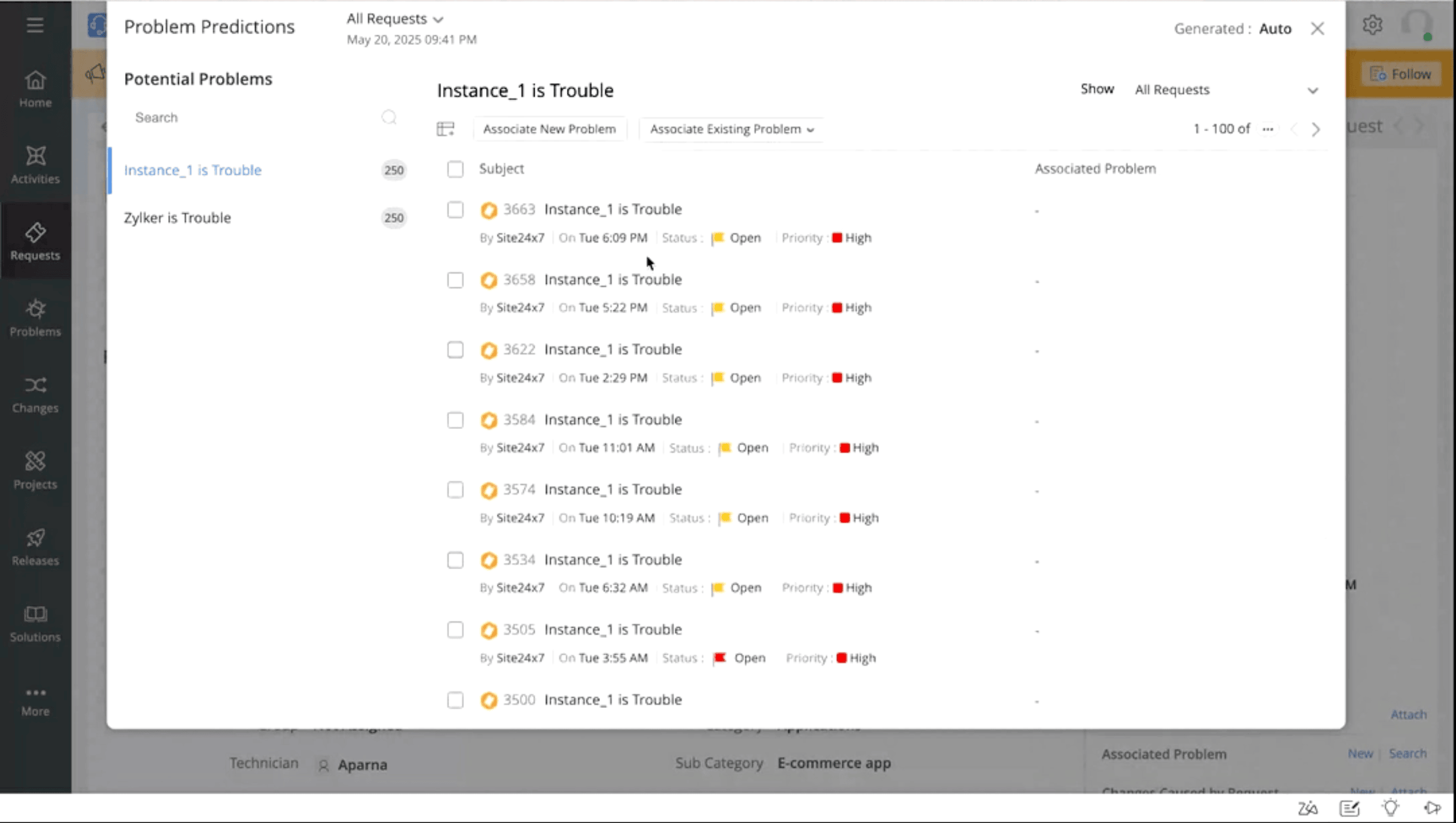
By clustering recurring application availability incidents, Zia now accurately predicts and anticipates potential problems in Zylker's service environment, which alerts the team early and enables centrally tracking of emerging problems.
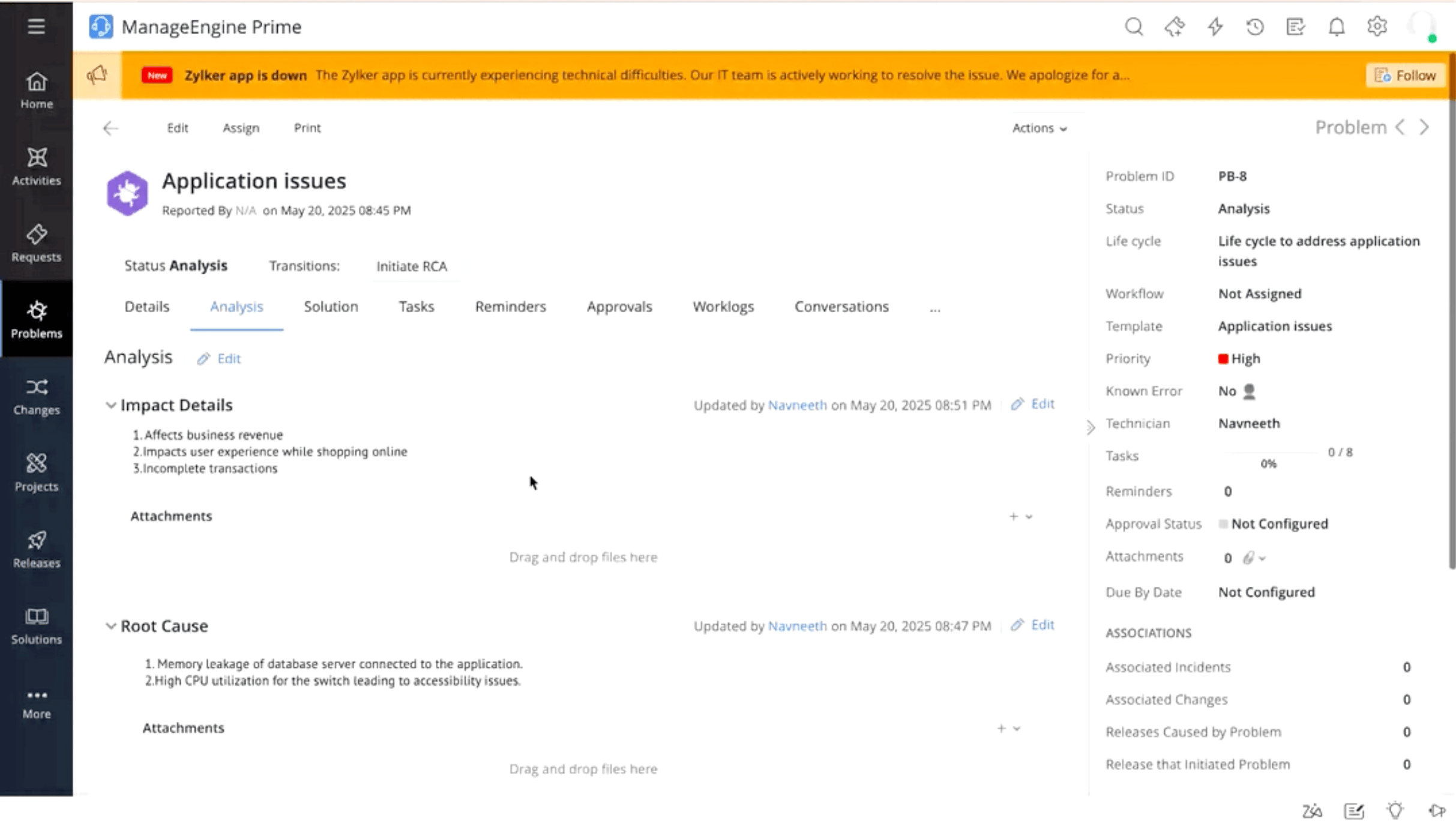
Integrated problem management serves as the single source of truth, helping Zylker systematically document symptoms, analyze impact, and uncover the root cause of the Cyber Monday incident. Leveraging the CMDB relationship maps in ServiceDesk Plus, Zylker pinpoints two key contributors:
- A memory leak in the applications' database server
- High CPU utilization on a network switch, disrupting application accessibility
To implement lasting fixes, Zylker initiated changes directly from the problem record—deploying a patch to resolve the leak and upgrading the switch firmware to stabilize performance.
Final thoughts

Facilitating five-nines availability isn't just about faster incident resolution—it's about transforming disruptions into drivers of long-term stability. By integrating ServiceDesk Plus, OpManager, and Site24x7, Zylker moved from fragmented firefighting to a unified, intelligent ecosystem where real-time visibility, seamless collaboration, and automated remediation turned downtime into a strategic advantage. This shift laid the foundation for sustained resilience, equipping Zylker to navigate future challenges with confidence and turn resilience into a lasting competitive edge.