USBs and other removable storage devices give employees a fast, offline way to move data. However, it is this very convenience that makes them dangerous. A single unmanaged drive can move sensitive files past every network-layer control an organization has in place or introduce malware into endpoints that no perimeter tool ever sees. This guide covers the top ten actionable best practices for removable storage security, explaining how to secure USB drives across an organization—from policy and device control to incident response and secure disposal.
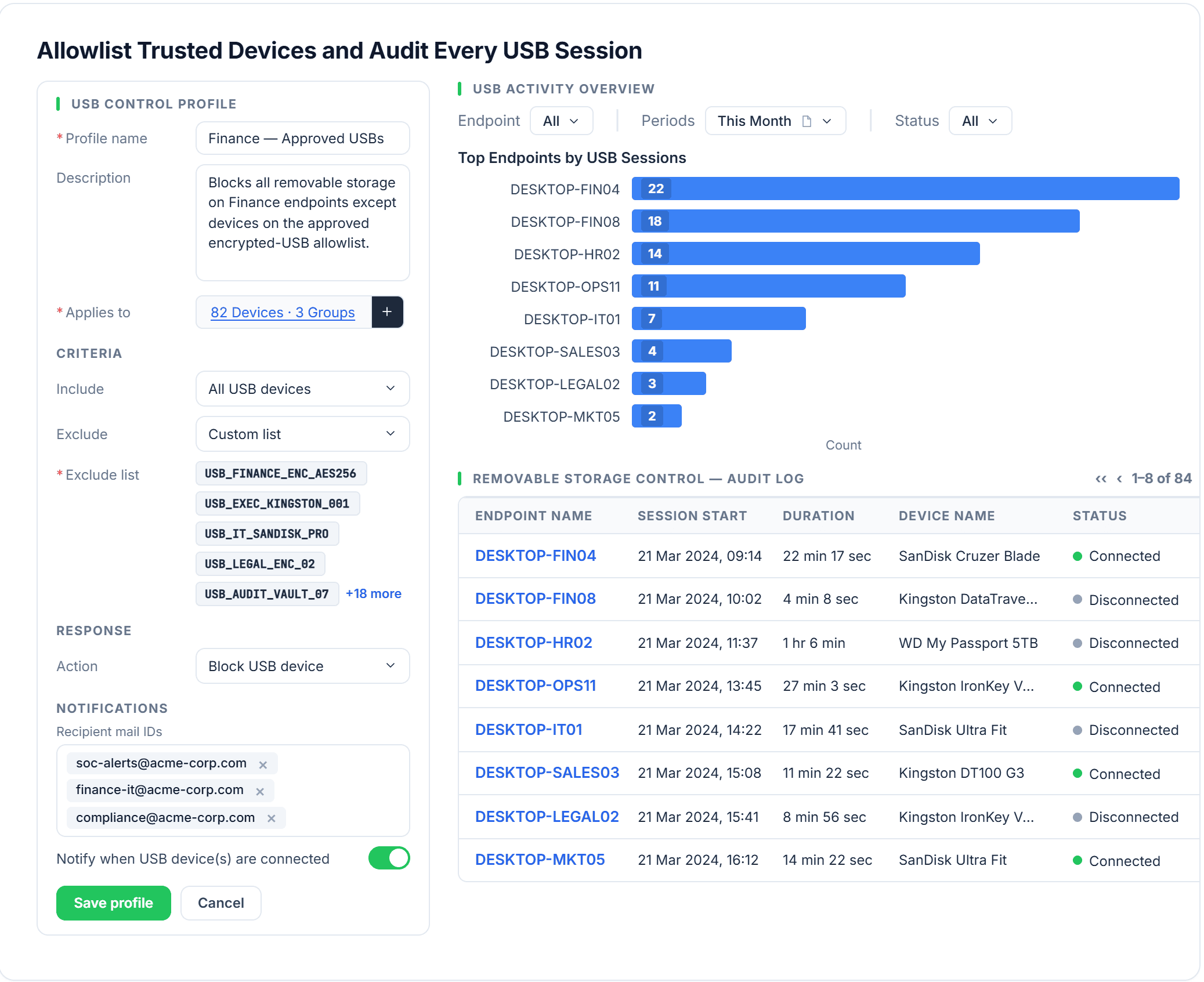
ManageEngine DataSecurity Plus provides security teams with precise control over how removable storage devices interact with endpoints. USB access control lets administrators define granular control policies for secure and efficient data transfers. When enforced, these policies are applied in real time and across the environment. Learn more about DataSecurity Plus' USB data theft protection solution.

Unmanaged USB drives pose two primary risks:
A blanket ban is operationally disruptive and often leads to workarounds that introduce greater risks, like employees using personal cloud storage or unapproved file transfer services. The more effective approach is a risk-based policy:
The goal is to reduce exposure without driving users toward hard-to-monitor visible alternatives.
Several major frameworks require organizations to control the use of removable media:
Blocking all USB storage devices is a blunt control that prevents both authorized and unauthorized use. Allowlisting permits only specific pre-approved devices—identified by hardware ID, serial number, or both—to connect and transfer data while blocking everything else. This gives organizations granular control. An IT-issued encrypted drive assigned to a specific user can be permitted on that user's machine, while every other drive is blocked. Allowlisting also enables a clear audit trail, tying every connection event to a known, registered device and a known user, making anomaly detection and incident investigation far more accurate.
The immediate response depends on whether endpoint controls are in place. If device control software is deployed, the connection should be blocked automatically and an alert should be generated. No manual intervention would be needed at the moment of connection; however, the security team should:
If device control software is not deployed, or if the USB connection is discovered after the fact:

